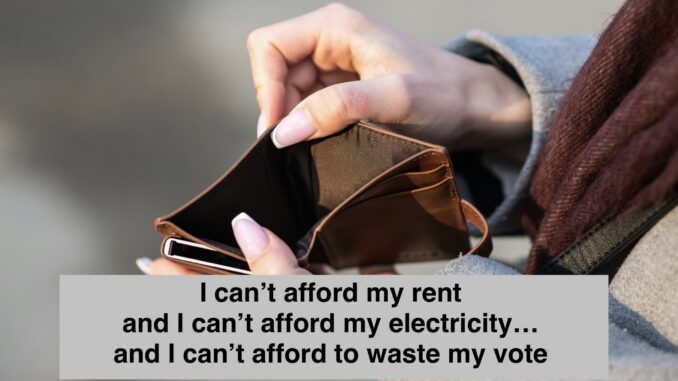
Politicians are right to be worried that economic insecurity can fuel radical politics. Labor should understand why some economically pressured voters are moving to parties it fears. There is something oddly comforting about this argument; it offers encouraging gestures and a general will that might redistribute the bad luck of job loss, making it easier for others to accept change.
It is an ethical problem, though, that governments are expected to take hardship seriously only when its political consequences are alarming, like finding the right beggar to give to. Which is the most deserving: the angriest, or the most politically dangerous?
Analysis of the outer suburbs can easily lose sight of individuals. It might find people just wanting to get by. Or it might find that a general will to win back outer-suburban voters, regional communities, or working-class people abandoning a major party may suit a politician’s rhetoric but matters less in practice.
I am not actually suggesting that we disqualify from the polls anyone whose concern is solely their own vote, but rather that we reject the idea that narrow political benefit should weigh more heavily in our pursuit of the larger ideal, the most comprehensive public interest.
But a politics that can encounter the public only when it smells electoral disaster already has a very limited notion of its constituents and, by extension, of what counts as a serious problem.
The much greater underlying problems of which these political difficulties are a symptom deserve political and ethical primacy over any hierarchy of political deservingness. Why should it matter if the citizen whose anger could be electorally dangerous is housed a few streets over from the citizen whose anger has yet to be unearthed, and who awaits the invitation to roll over into disaffection?
Polling released by Mental Health Australia on 8 September found that only 38% of surveyed One Nation voters said they could afford appropriate mental healthcare if they needed it.
How much worse served, then, were those equally needy people who happened to sleep through the entire campaign?
Some of this sounds like moral quibbling. And, of course, governments should already be helping people at every level of social distress and pain, regardless of political consequences. But even the political patron of the problem should find the abstract notion of helping disaffected voters difficult to digest when faced with the reality of doing the heavy lifting of government. A government ultimately exercises its power over everyone, not just those who bothered to vote for it, and its obligations to individual citizens go beyond a simple accounting of the fiscal benefits flowing to those whose votes it can count on. Surely, then, its obligation to address serious deprivation grows more insistent the less likely that deprivation is to show up in the opinion polls?
The people voting populist, progressive or reactionary may well include a population not being well served by the system. When voters struggle to access vital services, those are material problems before they are electoral ones. Underlying problems may include untreated illness, housing stress, insecure work, the cost of transport, and inadequate access to schools and services.
But voting behaviour is a very crude proxy for need. In most dimensions of human existence, we would be better off with less aggregate information and more granular information about what people actually need, rather than trying to judge need based on actions shaped by why they vote the way they do. Voting behaviour is an almost infinitely worse proxy for these things.
Suppose 60% of people needing more high-quality public housing remain disillusioned and insecure but continue voting for a major party, while 40% mysteriously vote One Nation. That might be politically interesting. It tells us very little about how much housing either group needs.
There are many ways to think about issues like infrastructure and healthcare access. For example, should we fix the primary healthcare system based on what we think people’s relative levels of access and security are? If so, who would we give priority to, the rich people who like to contemplate the relative merits of different levels of service, or the people who are so busy with their income and employment situation that they haven’t had time to catch up on the politics of a problem that ideally should have been on the national agenda before the last vote?
Political allegiance and voting behaviour are poor direct measures of disadvantage when we have so many better measures across areas like income and housing costs, which are better indicators of relative need than everyone’s best guess of how the next national election might turn out. Measures like unemployment rates, who is on which welfare payment and educational outcomes are much easier to observe directly than trying to diagnose them through how people vote. In contrast, the ABS’s area-based measures of socioeconomic advantage and disadvantage add still richer information. Health systems add waiting-list data and other measures of unmet need. At the same time, governments already collect information that can identify many areas struggling to provide even common public services, physical or social.
Folding voting share into a series of disadvantage measures adds very little. It may reflect constituents’ perceptions of higher deprivation and reduced access to essential services, which can already be measured more directly.
Such information should certainly be reported publicly. We increasingly understand the link between deprivation, reduced access to essential services and the hardships that result. That link should not be muddied by treating the electoral reaction as though it were the thing we are trying to measure.
In making the political case, we can just as straightforwardly claim that service provision should be directed towards those struggling most financially, most disadvantaged by skewed access to services and most clearly disconnected from the mainstream population.
The deeper point is that households living in poverty are too politically risky for us to ignore.
So long as they believe voting for us will change their circumstances for the better, the major-party argument goes, they will continue to do so. If they feel ignored and abandoned, the minor-party argument follows. History also gives us reason to worry that deepening economic insecurity and severe economic distress can be accompanied by increased support for extremist politics.
So material insecurity gets all the attention it has, in part, because of the additional argument that addressing it has political benefits.
Some direct measures of hardship would be far more useful to government than assessing the much more dangerous potential to harm the political patient. Any government really worried about that could start measuring deprivation and publishing the results, so that accountability puts pressure on political leaders to confront the nasty consequences of policy before alienation turns into something worse.
Publishing such measures and holding political leaders to account for how their spending allocations direct money in relation to those measures would produce better outcomes than waiting for the political sniffles.
These measures would also change the way we talk about things that will always influence political action in a democracy. Discontent rises and falls and develops over time, while populism is a difficult term because it has many different meanings.
What is often left unsaid is that governments can become particularly anxious when populations on the margins begin showing signs of political radicalism, and they have reason to be.
The danger lies in how they respond to that anxiety. US authorities have at times reacted to perceived radical threats with surveillance and disruption of political lives. A better response would be a good, hard look at the politics of the people in question and, more usefully, at what could improve their lives.
Governments often have the strongest political incentive to respond to problems they see as political. In some areas with poor health, the danger is that the problem may not attract enough political urgency if voters don’t pose a threat at the ballot box. Citizens should be able to expect governments to recognise and address hardship before it turns into political discontent.
Keep Independent Journalism Alive – Support The AIMN
Dear Reader,
Since 2013, The Australian Independent Media Network has been a fearless independent voice – holding power to account and delivering journalism that matters.
Running this site isn’t cheap. Rising costs mean we need your support now more than ever. Every donation, big or small, keeps our servers running, our writers working, and our stories free for everyone.
Donate here:
PayPal or credit card – just click on the Donate button below
Direct bank transfer: BSB: 062500; A/c no: 10495969

We’ve also set up a GoFundMe as a dedicated reserve fund for hosting and future improvements.

Thank you for standing with us. We couldn’t do this without you.
With gratitude,
The AIMN Team

Be the first to comment