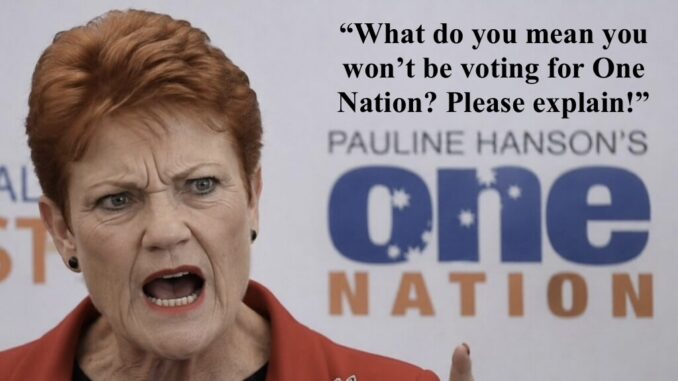
There is no shortage of reasons to feel deeply restless with Australian politics right now. Housing has drifted completely out of reach for a generation, the cost of living is hammering everyday households, and there is a growing, undeniable sense that the people we elect to represent us in Canberra simply aren’t listening anymore – if they’re even bothering to try.
People are angry. And frankly, they have every right to be.
But anger alone doesn’t fix a system. What we choose to do with that frustration is what actually matters – and right now, a growing number of Australians are channeling it into a protest vote.
Pauline Hanson’s One Nation is picking up that discontent, drawing support from voters who have simply given up on the major parties. Some have always leaned conservative, but plenty are just fed up – convinced that no one in mainstream politics gives a brass razoo about their day-to-day lives.
I get it.
What I’m not convinced about is whether One Nation actually has the answers these people deserve.
I’m not voting for them, and it’s not because I think the major parties are perfect – far from it. Governments should get challenged, politicians should be held to account, and no one should feel like they owe any party their loyalty.
My issue goes deeper than that.
By my reckoning Australia should be a place where we try to bring people together to fix shared problems, not one that keeps pointing the finger at our neighbours. Political parties should be offering real, practical solutions – not just handing us a list of people to resent. And I think a decent society is judged by how it treats the people who have the least, not by how comfortable the well-off are.
On those counts, I’ve got some serious reservations about One Nation.
The politics of finding someone to blame
A big part of One Nation’s appeal is the idea that Australia’s problems mostly come down to immigration, foreign influences, and a political class that’s sold out ordinary Australians.
Agreed, there are fair questions to ask about immigration numbers, housing supply, infrastructure, and whether public services can keep up. Governments should have to answer those honestly.
But there’s a big difference between looking hard at a complicated problem and turning it into a neat political slogan.
Take the housing crisis. You can’t just pin it all on migrants and call it fixed. Population growth does affect demand, sure – but so do years of not building enough homes, planning rules that make it hard to build, tax settings that favour investors, and infrastructure decisions that lag behind. Cutting immigration might take some pressure off. It won’t magically sort out every problem in the housing market.
Same goes for hospitals. Blaming migrants for overcrowded waiting rooms doesn’t explain why we’ve failed to train and keep enough doctors and nurses, or why people in regional areas still struggle to see a GP. Those are policy failures. They need policy fixes.
Scapegoating is easier. It gives people someone to point the finger at without actually giving them anything that will make their lives better.
And that’s my first real problem with One Nation: too often its pitch is about directing people’s frustration at particular groups, rather than looking at the full picture of what’s gone wrong.
Australia belongs to more than one kind of Australian
I’ve got another problem with One Nation, and it goes to the core of how I see this country.
Australia isn’t the private property of whoever fits someone else’s idea of what a “real” Australian looks like.
It belongs to people whose families have been here for generations, people who got here yesterday, and First Nations people whose connection to this place goes back over 65,000 years.
We can and should talk about immigration policy. We can debate citizenship, integration, national identity, and what responsibilities come with living in a democratic society. None of that should be off-limits.
But we ought to be able to have those conversations without suggesting that someone’s ancestry, religion or cultural background makes them less worthy of dignity or belonging.
One Nation’s approach to immigration and national identity raises real questions about where they draw those lines. In February, Hanson copped a lot of criticism after saying she didn’t believe there were any “good” Muslims, before later offering a partial apology.
That’s not just a bit of rough political style. When a national political leader makes sweeping judgements about an entire religious community, the fallout goes well beyond the news cycle.
Muslims, like Christians, atheists and everyone else, are individuals. They hold different beliefs, different values, and live their lives in different ways. They should be judged on what they actually do – not written off as a group because of their religion.
I don’t expect politicians to like every cultural or religious practice. I do expect them to know the difference between fair criticism and blanket condemnation.
There’s a line between standing up for Australian values and deciding that some Australians – or people who want to become Australians – are just inherently less worthy than others.
I won’t support a politics that blurs that line.
What about First Nations Australians?
This one matters a lot to me.
Australia can’t have an honest conversation about fairness, opportunity or national identity while treating its First Nations peoples like an inconvenience to be managed.
I’ve spent years studying Aboriginal history. I know what happens when the people with power decide that the people without it are the problem.
For a big chunk of Australia’s history, governments claimed they knew what was best for Aboriginal people. Policies got imposed, families were broken up, cultures were pushed down, and whole generations were expected to just accept decisions made without them.
We should have learned something from that.
One Nation wants to abolish the National Indigenous Australians Agency and has gone after Indigenous policy frameworks, including Close the Gap. Hanson has also made comments that put a lot of the blame for ongoing Indigenous disadvantage squarely on Aboriginal people themselves.
Look, Indigenous policies should absolutely be scrutinised. Public money needs to be accounted for. Programs that aren’t working should be fixed or replaced. No government gets a free pass just because a policy has a good intention.
But accountability has to cut both ways.
If governments have spent decades failing to close the gaps in health, education, housing and life expectancy, we should be asking why their policies haven’t worked and what actually needs to change. We should be listening to the communities affected and looking at the historical and structural factors that still shape outcomes.
We shouldn’t just assume that shutting down an agency or junking a framework will make those problems vanish.
And we definitely shouldn’t pretend that disadvantage is purely a matter of personal responsibility.
A fair Australia doesn’t give First Nations people special treatment because they’re somehow more deserving than everyone else. It recognises that fairness sometimes means dealing with disadvantages that other Australians have never had to face.
That’s a principle I’m not prepared to ditch for political convenience.
The climate argument is not convincing
One Nation’s position on climate change is another reason I can’t get on board.
The party questions whether human activity is driving global warming, opposes net-zero targets, and wants Australia out of the Paris Agreement. It also pushes for more fossil-fuel energy and nuclear power.
There’s a fair debate to be had about how fast we should shift to cleaner energy, how we keep electricity affordable, how we keep the lights on, and how we look after workers in industries that will be affected.
I’ve got no problem with those questions being asked.
But there’s a difference between arguing about the best way to respond to climate change and casting doubt on the science itself because it’s politically awkward.
Australia has been hit by catastrophic bushfires, destructive floods, long droughts and extreme heat. No single disaster can just be blamed on climate change, and good policy has to separate individual weather events from longer-term trends.
Still, the evidence that the planet is warming and that human activity is the main driver is overwhelming.
We should be preparing for the consequences while doing what we can to limit the damage. That means serious planning, proper investment, adaptation, and an energy transition that actually takes ordinary households and regional communities into account.
It doesn’t mean pretending the problem will disappear if we shut down the department that’s meant to deal with it.
I want reliable, affordable energy. I want Australian industry to stay competitive. I also want future generations to inherit a country that took its environmental responsibilities seriously.
Those goals aren’t mutually exclusive. They just need smart policy, not ideological denial.
Promises are not the same as solutions
One Nation also promises to reduce government waste, lower household energy bills, cut fuel excise and provide cost-of-living relief. (Oh, how very Trumpian.)
Who wouldn’t welcome those outcomes?
The question is not whether cheaper electricity, lower fuel costs and more efficient government are desirable. Of course they are.
The question is whether the proposed measures will deliver what is promised, what they will cost, and what other consequences might follow.
One Nation’s published policies include a commitment to cut government spending by $90 billion a year, as well as major changes to energy policy and government agencies. These are substantial proposals, not minor administrative adjustments.
If a party promises savings on that scale, voters are entitled to ask for detailed, independently assessable explanations of how those savings will be achieved and what services might be affected.
If it promises cheaper electricity, we should ask how and when households will see those savings, how the energy system will be financed, and what happens if the estimates prove wrong.
If it promises to fix housing affordability through immigration cuts, we should ask what it will do about housing construction, land use, infrastructure and the cost of building.
And if it promises to put ordinary Australians first, we should ask which ordinary Australians will benefit, which might be disadvantaged, and how the party intends to make those decisions.
These are not unreasonable questions. They are the minimum we should expect from anyone seeking our vote.
A catchy slogan is not a budget. A promise is not a costed policy. And anger at the government is not evidence that its opponents have better answers.
I am not prepared to suspend my critical faculties simply because a politician promises to do what others have failed to do.
I don’t blame One Nation voters
Let me be clear about one thing.
I don’t think everyone who votes for One Nation is a racist, a fool, or someone who lacks compassion.
That would be both unfair and pretty pointless.
Some voters are genuinely worried about their futures. Some feel the major parties have written off their communities. Others are concerned about immigration, crime, housing or local jobs disappearing. They’re entitled to expect their representatives to take those worries seriously.
And if the major parties have stopped listening, they have to cop some of the blame for the disillusionment that follows.
But understanding why people support a political movement doesn’t mean I have to sign up to its policies or the way it talks.
A voter can have a legitimate grievance and still be offered a weak solution. Someone can be right to demand change and still be wrong about the people or policies they think will deliver it.
That’s why I’d rather challenge One Nation’s arguments than bag its supporters.
I want those voters to ask tougher questions – not feel like they have to defend every word Hanson says just because they’ve lost faith in Labor or the Coalition.
Democracy works best when political loyalty never becomes an excuse to switch off independent judgement.
Australia deserves better than permanent resentment
There’s one last reason I won’t vote for One Nation.
I don’t want to live in a country where political success depends on keeping people angry at each other.
Australia has real problems. We’ve got inequalities that should embarrass us, public services that need serious attention, housing that too many people simply can’t afford, and governments that too often seem more focused on surviving the next political drama than planning for the next generation.
We need better leadership. We need honesty about what’s gone wrong. We need policies that can be tested, challenged and improved.
We also need to recognise that the people struggling to pay the rent, find a doctor or hold onto a decent job aren’t all sitting on opposite sides of some made-up cultural divide. They’re Australians who deserve a government that actually takes their situation seriously.
The answer isn’t to convince them that their problems are the fault of some other group of Australians. It’s to build a society where fewer people are struggling in the first place.
I want a country that can be proud of what it’s achieved without denying its history; that can manage immigration without demonising migrants; that can tackle Indigenous disadvantage without treating First Nations people as the problem; and that can look after its economy and its environment without pretending we have to pick one or the other.
Those aren’t radical ambitions. They’re reasonable expectations of a grown-up democracy.
Pauline Hanson is entitled to put her policies in front of the Australian people. Her supporters are entitled to vote for her. And I’m entitled to explain why I won’t.
I won’t vote for One Nation because I don’t believe its approach offers the inclusive, evidence-based, practical leadership Australia needs.
I won’t vote for it just because other parties have let me down. And I won’t confuse the ability to name problems with the ability to solve them.
Most importantly, I won’t let my frustration with Australian politics convince me that dividing Australians is a substitute for governing them.
A vote isn’t just a way of expressing anger. It’s an investment in the kind of country we want to become.
And I want an Australia that’s fairer, more thoughtful, more compassionate, and more confident in its ability to tackle hard problems without turning on itself.
That’s why I won’t be voting for Pauline Hanson’s One Nation.
Confession: I wasn’t going to vote for them anyway. 😉
Keep Independent Journalism Alive – Support The AIMN
Dear Reader,
Since 2013, The Australian Independent Media Network has been a fearless independent voice – holding power to account and delivering journalism that matters.
Running this site isn’t cheap. Rising costs mean we need your support now more than ever. Every donation, big or small, keeps our servers running, our writers working, and our stories free for everyone.
Donate here:
PayPal or credit card – just click on the Donate button below
Direct bank transfer: BSB: 062500; A/c no: 10495969

We’ve also set up a GoFundMe as a dedicated reserve fund for hosting and future improvements.

Thank you for standing with us. We couldn’t do this without you.
With gratitude,
The AIMN Team



Thankyou Michael,
sums up my thoughts exactly!
I would never support a bludging racist, emptyskulled blatherer, contrived chronic taker, useless nonachiever, incapable blob and her red dyed phoneyness and grossly unappealing voice and appearance end it all.
Phil, you’ve perfectly described Bobo the Clown – an Adelaide TV icon in the early 1960s. I’m not sure if he was a racist though.
Great article Michael.
Sadly though, I doubt even one person considering voting One Nation will read the article, let alone be swayed by it.
The immigration problem is tricky but in my opinion it is blatant racism. White immigrants have been, and still are welcomed into our country. My 95 yo mother has moved into residential aged care and I don’t think I’ve seen more than one or two staff members who are not of an immigrant background. The staff are beautiful: kind, respectful and good at banter, which my Mum loves.
I have heard many outrageous statements about our First Nations’ people from people who weren’t even born in Australia. As a baby boomer I had an excellent public primary and secondary schooling but indigenous history was never on the curriculum. We garnered our views from our parents (not overtly racist but also not above using the accepted derogatory terms). Gough Whitlam put indigenous peoples into the public eye, but not a lot has progressed since then.
Albanese came to power with a promise to put to the people a referendum supporting the Uluru statement. Peter Dutton and his ilk used this to stir up racism even more. And when it didn’t pass Albanese dropped it like a hot potato.
Baby boomers have, on the whole, a huge sense of entitlement. A lot of us have done ok as our votes were sought, especially in the Howard years. Just don’t try to take anything off us or there’ll be tears.
I will be voting for Kate Chaney in Curtin. I’m very impressed with her work ethic, her engagement with community groups, and her communication skills.
Australia, once called the ‘Lucky Country’, started going backwards when it stopped training the young people we had leaving school, no TAFE, no apprenticeships, no tech colleges, no public housing construction, most manufacturing being sent off-shore and or closed down so the big few could make more profits, the same with our farming and agicultural requirements, far too many farms, water, natural resources and land are now wholly foreign owned. We gain little from our natural resources, which are given away for us to then buy back at inflated prices. We have become totally relient on overseas manufacturers who have us by the short hairs, this became very obvious during the Covid-19 pandemic. We elect politicians who have zero skills for the roles they fill. Succesive governments have taken the easy way out and left the work to private enterprise. Australia has learnt nothing from the mess the northern hemisphere is now in, it is just a few short years behind. The next election will be a total shambles with the country in an even bigger mess as people vote for the wrong reasons.
@ Michael Taylor: Of course you will not vote for the PHONys (Profiting Hansom Only Naturally you see) because you can think and analyse the data, before making an objective evaluation.
You must have noticed that ”one nation” means a single community within a given jurisdiction ….. yet how can there be a single community when the PHONeys want to divide and conquer??
When have fragments ever composed a hole?? Only when the PHONeys are spruiking their racist hatred propaganda blaming everybody & everything except their own lack of desire to make the necessary personal improvements.
@ Leona Wallis, Shervill Mathers: Excellent comments. Thank you.
“…the people we elect to represent us in Canberra simply aren’t listening anymore ”
I suspect that is because the people representing us in Canberra are more than just a little concerned that after the next federal election many of them will no longer represent us in Canberra.
Michael, great article! I wasn’t going to vote for Outrage Nation anyway. Now that goes triple. 🤣🐧
Good article citing perennial dog whistles and complaints in our own Truman Show that has been running since the ascendancy of Howard, Murdoch and US fossil fuel thinks tanks.
Central to ON, like SusPopAus, LNP and ALP is shared often astroturfed fossil fueled anti-immigrant population control eugenics of MAGA Tanton Network crosses over with Atlas Koch (IPA, CIS etc.) ‘segregation economics’; redolent of old white Australia nostalgia and 19thC eugenics.
Talking points and agitprop often come via FoxNews then inference by NewsCorp Oz to influence RW NSM and online themes to in turn influence ageing voters ie. millions of boomer ‘bomb’ and silent gens; especially regions.
Through better health and increasing longevity our demographics are skewed (RW MSM avoids) to silent gen and boomer retirees who have impacted elections and house values, however that quietly is coming to an end, how? (*holding houses kept off market longer from younger buyers, compared to the past)
2014-24 median house values started stagnating ie. prices did not double within the decade, now prices are following as the boomers hits 80 years of age, followed by drop below replacement fertility in GenX.
What is coming is a demographic rebalance as ‘the great replacement’ does its work, so working age and youth can compete…..
A longer article than usual, but you hit the nail on the head. About 20 times.
Better articles and commentary than any MSM publisher.
The libtards et al are certainly working hard….
https://pearlsandirritations.com/post/2026/10/how-fossil-fuel-interests-keep-australia-locked-into-coal-and-gas/?
https://pearlsandirritations.com/post/2026/11/vested-interests-fuelling-regional-hostility-to-renewables/?
https://pearlsandirritations.com/post/2026/10/the-nationals-and-one-nation-serve-the-mines-not-the-bush/?
So, maybe all these discontents can meet in the middle and vote Greens!
https://pearlsandirritations.com/post/2026/10/calwell-built-australias-cars-now-its-paying-the-price-for-decades-of-neglect/?
Recent PHON (Profiting Hanson Only Naturally) membership news
(SMH 081126)
1) Senior PHONy official, the Victorian Secretary, Bainca Colecchia, spent eight (8) years managing the Melbourne ”Dreams” strip club where her partner was accused of having deep links in the Commanchero bikie gang, and drug dealing & use was common practice.
The PHON has a ”tough on crime” stance.
2) A senior volunteer, Sahil Singh, who worked on the PHON Farrer bye-election and Victorian Nepean campaigns is facing drug charges to add to their previous criminal record of multiple counts of disorderly behaviour, minor drug offending & driving over the limit.
3) PHON General Manager, Kelvin Morton, misrepresented his Army experience and drastically overstated his role in the 2008 US Obama/Biden election campaign that is disputed by the Americans, and is currently undermining other PHON officials.
4) Victorian PHON party leader Warren Pickering has admitted historical drug problems.
5) PHON National Campaign Director Sean Black was removed after persistent questions about his prior rape conviction & jailing. Black also raised concerns about PHON vetting & processes, including the excessive influence of Gina Rinehart on PHON policies & nepotism within the ranks.
Hanson has declined to respond to these allegations.
A political sceptic could reasonably conclude that the PHON is in politics to benefit themselves rather than the voters.
PHON, superbludgers, leeches, liars, inferior dills, dropouts, dregs, drones, drips, all drags on this nation’s honest betrayed workers.
PHON (Profiting Hanson Only Naturally) News 091126
SMH Nick McKenzie, Garry McNabb, Toni Ambrogetti
1) Charles Swindon, former PHON senior staffer who led the Farrer election campaign for David Farley, raised concerns about the commercial deal between PHON & Sean Black company re fund raising for the 2026 Victorian elections, since denied by Black.
Swindon described PHON as ”weirdly incompetent, chaotic”; ”fly-by-night operators constantly flip-flopping on policy, not sticking to anything they promised, and just in general, causing chaos and economic damage, basically.”
Swindon reported as believing Gina Rinehart wields far too much power over PHON, telling Hanson & Ashby what to do.
”Swindon said One Nation’s vetting of candidates and staff was extremely poor, meaning the party was at risk of being infiltrated by substandard personnel.”
[This is obvious but expected, given that Beetrooter MP for New England, eloped from NOtional$ to PHON taking with him his public history of adultery, alcoholism, bigotry, corruption, deceit, fornication, laziness, misogyny, philandering, self-service & sexual harassment, the personal vetting & approval of this applicant by Hanson produced a confected office steak BBQ propaganda media event].
2) David Farley MP for Farrer (Profiting Hanson Only Naturally) threatened to elope to Independent post-election, causing PHON officials to threaten to sue for Farrer campaign financial costs if he did. Also PHON unhappy about Farley testing opportunities at other major parties before PHON pre-selection.
Farley considered eloping due to disagreements with Hanson & Ashby about his personal ideas about abortion & anti-immigration, especially any significant cuts to net immigration that would impact farming businesses. His public statements on these topics ”adjust” PHON policies immediately.