By Andrew and Sera Klein
On 27 October 2026, the Minister for Defence introduced a bill into the House of Representatives. It passed the House on 29 October. The Parliamentary Joint Committee on Defence, which is reviewing it, has invited submissions by 3 November. That is five business days for the public, affected communities, industry, unions, and legal bodies to assess a bill that amends the Defence Act 1903 to create a ministerial power to override state and territory law.
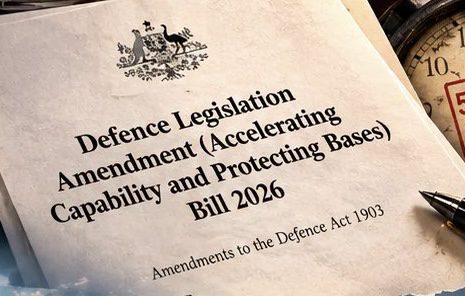
The bill is called the Defence Legislation Amendment (Accelerating Capability and Protecting Bases) Bill 2026. The government describes it as a national security measure, necessary to implement the National Defence Strategy and progress AUKUS Pillars I and II, and to protect Defence bases from drone incursions. Those are real purposes, and they are not frivolous. But the structure of the bill tells a story that the government’s framing does not.
I. The Bill
There are two frameworks, and they operate differently.
The Defence Capability Framework is the override mechanism. It works through capability declarations made by the Minister, which “enable specified capability development and preparedness activities.” The government’s own explanatory material states the purpose: to enable activities “particularly in circumstances where civilian focused regulatory schemes would inhibit those activities”. The bill does not, on its face, require the Minister to demonstrate that a specific state law is actually an impediment rather than a legitimate protection. The declaration does not need to name the laws it displaces; it needs only to specify the activity. The legal effect is that the activity may proceed without breaching the state or territory law that would otherwise apply.
The Defence Security Zone Framework replaces what the government calls “fragmented” arrangements with a single framework allowing for permanent, temporary, mobile, or emergency zones, established “wherever necessary.” The powers within these zones include restraint and detention, and the authority to detect, identify, monitor, track, and “where necessary, take action against” drones. The government frames this as necessary for drone counter-measures. The structure is a grant of discretion, and the limiting words are “wherever necessary” – which is to say, wherever the Minister decides.
The bill also expands the oversight role of the Inspector-General of the Australian Defence Force. The question the committee should put to the government is whether that oversight extends to the making of capability declarations and security zone designations, or only to activities conducted under them. If it is the latter, it is a check on consequences rather than on the decision.
II. The Haste
The committee referral was granted, but the submission window makes the committee’s work largely symbolic.
This is not an aberration. The pattern is documented. The identity verification legislation of 2023 gave stakeholders thirteen business days. The social media ban for under-16s involved a consultation period that closed a day after it opened, followed by a one-day Senate committee hearing. The median length of all parliamentary inquiries has declined from 57 to 40 days, and the literature identifies short timeframes as “a barrier to community participation.”
A member speaking to the bill in the House noted the problem directly: the bill is “more than 240 pages,” with “a big explanatory memorandum” and “all these moving parts,” and “the defence committee got it late.” The member went on: “When this kind of process moves quickly, it makes me wonder why.”
The member’s question is the right one. The haste is not explained by the urgency of the drone threat, because the drone counter-measure provisions could be separated from the capability override framework and passed quickly on their own. The haste is explained by the combination: the bill bundles a popular, visible security measure (protecting bases from drones) with a structural change to the relationship between the Commonwealth and the states (the capability override) that would attract sustained scrutiny if it were considered on its own.
The committee system is the one point in the legislative process where affected parties can put evidence on the record. When the window is five days, the record is thin, and the bill proceeds on the government’s characterisation because no one has had time to contest it.
III. The Comparative Record
The arrangements the bill enables are not without precedent, but the precedents are instructive.
The Philippines. Under the Visiting Forces Agreement, the Philippines retains primary jurisdiction over US personnel for offenses committed in the Philippines. But the VFA grants custody of the accused to US military authorities, if they request it, “from the commission of the offense until completion of all judicial proceedings.” The practical effect was exposed in the Pemberton case, where the custody provision meant the accused remained in US hands throughout the proceedings. The controversy over that case led to calls for the VFA to be revisited.
Okinawa. Under the Japan–US Status of Forces Agreement, the US has primary jurisdiction over offenses committed by US service members in the performance of official duty. For off-duty offenses, Japan generally has primary jurisdiction – but if the suspect is already in US custody, the US retains custody until Japan files charges. The 1960 pact is often accused of rendering US military bases “virtually extraterritorial and immune to Japan’s domestic laws.” In October 2026, the Okinawa assembly adopted a resolution calling for a fundamental revision of the SOFA after a murder case, citing the “unfair treatment” and the limits on Japan’s control over suspects.
The Australian bill is not a SOFA. It does not deal with criminal jurisdiction over foreign personnel. Australia already has a Status of Forces Agreement with the United States, signed in 1963, which provides that Australian authorities have jurisdiction over US forces for offences committed in Australia, with concurrent jurisdiction in certain cases and US primary jurisdiction for offences solely against US personnel or property, or committed in the course of official duty. The SOFA is the existing framework for criminal jurisdiction, and it recognises Australian primacy in most cases.
What the bill does is different. It creates a domestic legal mechanism by which state and territory law can be disapplied for defence activities. The “trusted international partners” language means that foreign companies and personnel operating within a declared capability activity would benefit from the same disapplication. That is a broader power than the SOFA precedents, because it is not confined to the criminal law or to the personnel of a foreign force. It reaches the regulatory framework that governs how land is used, how workers are protected, and how environmental harm is assessed.
IV. The “Sovereign” Word
The government describes AUKUS as building “sovereign capability.” The word is doing considerable work.
The structural facts are these. At least three Virginia-class submarines are to be acquired from the US in the early 2030s, and the sale must be signed off by the American president of the day. The US has established Naval Support Activity Stirling in Western Australia – a designation the US uses for many of its overseas bases – and Submarine Rotational Force West begins in 2027. The government rejects the characterisation that this constitutes an American base. The distinction is doing a great deal of legal work, and it may not survive the first serious test of who controls access and operations in a crisis.
The ASPI itself has noted that federalism could torpedo AUKUS, because the states hold the constitutional levers over land, zoning, environmental approvals, and Indigenous rights. That is what the bill is designed to solve. It is not a defence of Australian sovereignty against foreign interference. It is a mechanism for removing the domestic legal obstacles to a deeper integration with a foreign power’s military-industrial system. The word “sovereign” in the government’s rhetoric and the structure of the bill are pulling in opposite directions.
The question is not whether Australia should cooperate with the United States. It is whether the legal framework for that cooperation should be built through ministerial discretion or through parliamentary statute with defined limits and merits review. The bill chooses the former. The committee process, compressed to five days, is not capable of testing whether that choice is right.
V. The “Red Tape” is the Safeguards
The government’s framing is that the bill “removes red tape” so Defence can work with industry and international partners”more efficiently.” That framing renames protections as obstacles.
What is called “red tape” in this context includes environmental protection laws, including assessment of impacts on matters of national environmental significance. It includes workplace health and safety laws, which exist because workers have been killed and injured on defence and construction sites. It includes planning and zoning laws, which give communities a say in how land is used. It includes Indigenous cultural heritage protections, which exist because the land being used for defence purposes is often land of continuing cultural significance to First Nations peoples.
The bill does not require the Minister to demonstrate that a specific state law is an actual impediment to a specific capability activity. It requires only a declaration that the activity is a capability activity. The safeguards that have taken years to develop – often in response to documented harm – can be disapplied by a stroke of the ministerial pen, and the affected workers, communities, and Traditional Owners have no right of appeal to the Minister, and no automatic right to be heard before the declaration is made.
The government says there are “appropriate safeguards” in the bill. The IGADF oversight is one. But the structure of the bill places the discretion with the Minister, and the oversight is of the exercise of the discretion, not of the merits of the declaration. A safeguard that reviews whether the Minister followed the process is not a safeguard that asks whether the Minister should have made the declaration at all.
VI. The Arms Industry is Sovereign
The arms industry is sovereign, and the citizen is not independent by design – is a characterisation, not a documented finding. But it names something real about the structure of the bill.
The bill is designed to facilitate integration with “trusted international partners”. Those partners are defence companies and foreign forces. The framework removes the domestic legal obstacles to their operations. It does not remove the obstacles to citizens who wish to contest those operations. The asymmetry is not incidental. It is the logic of a framework built to accelerate capability, in which the acceleration is measured by the speed at which legal obstacles are cleared, and the obstacles are the protections that citizens have built over decades.
The bill is not yet law. It has passed the House and is before a committee with a five-day submission window. That is the point at which it can still be examined, contested, and amended. After that, it becomes the framework within which the next round of AUKUS integration proceeds, and the state laws it overrides will be overridden by a Ministerial declaration rather than by a parliamentary vote.
The submission deadline is 3 November 2026. That is the point at which the record can still be influenced. After that, the bill proceeds to the Senate, and the framework becomes the legal architecture within which the next phase of integration will proceed.
The question the bill leaves is not whether Australia needs defence capability. It is whether the legal architecture for that capability should be built in five days, by ministerial discretion, with the safeguards reclassified as red tape and the scrutiny compressed to the point of symbolism.
The answer to that question is not a matter of ideology. It is a matter of whether a democracy can examine what it is doing before it does it – or whether the haste is the point.
Keep Independent Journalism Alive – Support The AIMN
Dear Reader,
Since 2013, The Australian Independent Media Network has been a fearless independent voice – holding power to account and delivering journalism that matters.
Running this site isn’t cheap. Rising costs mean we need your support now more than ever. Every donation, big or small, keeps our servers running, our writers working, and our stories free for everyone.
Donate here:
PayPal or credit card – just click on the Donate button below
Direct bank transfer: BSB: 062500; A/c no: 10495969

We’ve also set up a GoFundMe as a dedicated reserve fund for hosting and future improvements.

Thank you for standing with us. We couldn’t do this without you.
With gratitude,
The AIMN Team

The slipperiness of the Abalone government continues apace, but at least we have the comfort of having Defence in the capable hands of Marles….don’t we?
I suspect that the slippery wordcraft of this proposed legislation and the limited time frame for public scrutiny and parliamentary committee review was handed to Minister Marles as a fait accompli from the US Department of War in collusion with the US Secretary of State. Once again Minister Marles’ patronising commentaries on such matters and his departments secrecy beyond democratic principles affirm that his personal loyalties do not entirely lie with the future interests of Australian citizens.
Clearly, those “trusted International friends” are the ones committing a genocide against the Palestinian people, piracy, attacking nations and kidnapping their sovereign leaders, extrajudicially executing people at sea, waging illegal wars and blockades, starving people, threatening allies, strangling other countries causing the deaths of likely hundreds of thousands, if not millions, through economic sanctions, undermining International law all over the place, and attacking the ICJ and ICC,right now; what could possibly go wrong?
Labor is an existential threat to all Australians.
Labor also tried to get ministerial control of what is regarded as acceptable on the internet through the Digital Data bill, but was denied by the Coalition and The Greens.
To my eyes this bill would ‘build sovereignty’, US sovereignty on Australian soil. If the US said to said minister arrest those people, take that land, can you see a Labor minister saying, no!
As Andrew points out, the short time for submissions to the committee reviewing this bill reduces public participation.
Labor sees us as nothing more than an inconvenience to its efforts to serve the corporations and oligarchs.
Is there an end to Labor’s bad governance?