By James Moore
“The most important thing about a person is always what they do next… Cynicism is just a coping mechanism, a way of pretending you’re too smart to be hurt. But it doesn’t build anything. Hope is a renewable option: If you have it until 5 o’clock and then it’s gone, you can choose to get it again at 5:01. It is a radical act to stay hopeful when everything tells you to give up.” (Barbara Kingsolver, author).
Every month a little piece of my Social Security check goes back to Washington as income tax. I paid into that fund my whole working life; it’s my money. The government takes a cut on the way out because Ronald Reagan signed a law in 1983 that made it so. I think about him every time the deposit hits.
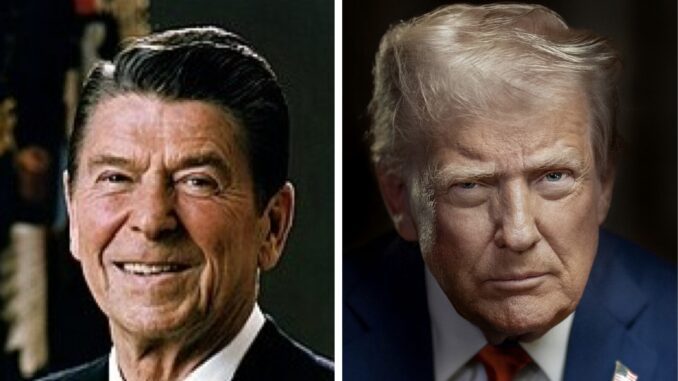
I think about him a lot lately; not as much as Trump invades my consciousness, though. But I find it appalling that most Americans under fifty have no memory of the man, only his myth. The myth is a sunny grandfather on horseback who won the Cold War and made us feel good again. The record is something else, considerably darker. Ronald Reagan is a man who taught a nation to hate its own government, who made the rich richer on the backs of everyone else, who winked at the law, and who opened the doors and windows for every con artist and bigot who came after him, including the current occupant of the peoples’ house.
Donald Trump did not come from nowhere. He is the last tenant in a building that Reagan started tearing apart in November 1980. We have been falling down the stairs ever since, one step at a time, and most people stopped counting the steps a long time ago. With an election five days off, I think it’s an important exercise to count them again.
The Government Is the Problem
Reagan told us who he was on his first day. Standing on the West Front of the Capitol in January 1981, he said government was not the solution to our problem, that government was the problem. He meant it, and spent eight years proving it by making government worse.
Seven months in, he fired more than 11,000 striking air traffic controllers and broke their union. Every boss in America got the message. He put James Watt in charge of the nation’s public lands, a man who seemed to regard a national forest as a lumber yard awaiting orders. I spent a day with Watt in 1981 as he examined an oil shale mine in Western Colorado and he seemed like a child on Christmas morning, eager and unable to restrain his urges to turn loose the strip miners and drillers across the sacred Western Slope of the Rockies.
No one was going to stand in his way after Reagan gave the Environmental Protection Agency to Anne Gorsuch Burford, who cut its budget, gutted its enforcement, and resigned in disgrace in 1983 after being held in contempt of Congress over the Superfund program. He pulled the solar panels off the White House roof. He promised to abolish the Department of Education and spent his years starving it.
Reagan liked to joke that the nine most terrifying words in the English language were “I’m from the government, and I’m here to help.” People laughed. But now they are beginning to cry in the hollowed-out county offices, the understaffed FEMA field teams, and the Social Security call centers where you wait on hold for an hour. The joke became a governing philosophy, though. If you tell people long enough that government cannot work, and then you make sure it does not work, they will believe you. They will also stop expecting anything from it, including honesty.
States’ Rights in Neshoba County
In August 1980, fresh off his nomination, Reagan went to the Neshoba County Fair in Mississippi. The fairgrounds sit a few miles from Philadelphia, where the Klan murdered James Chaney, Andrew Goodman and Michael Schwerner in 1964 for registering Black voters. (My father’s family were sharecroppers just north of there.) Reagan could have gone anywhere. But he went to that location with its history of racism and violence and told the crowd he believed in states’ rights. Every white Southerner in earshot knew exactly what the phrase had meant for a hundred years.
None of it was an accident. He had opposed the Civil Rights Act of 1964 and the Voting Rights Act of 1965. He campaigned for years on the story of a Chicago “welfare queen” in a Cadillac, a cartoon built to make white working people believe their taxes were funding Black idleness. In 1971, on a phone call with Richard Nixon that was finally released in 2019, he described African delegates to the United Nations as “monkeys.” As president he vetoed sanctions against apartheid South Africa, and Congress had to override him.
Lee Atwater, who worked on Reagan’s 1980 campaign and was an ally and mentor of Karl Rove from their College Republican days, explained the method in a 1981 interview. You could no longer say the ugly word out loud, he said, so you talked about forced busing and states’ rights and tax cuts, and the meaning got through anyway. Reagan perfected that code. Trump simply stopped bothering with it.
Trickle Down, Pour Up
When Reagan took office, the top federal income tax rate was 70 percent. His 1981 tax cut dropped it to 50. The 1986 tax law took it to 28. The people at the very top got the biggest raise in modern American history, and we were told the money would trickle down to the rest of us. Forty-five years later, the rest of us are still waiting on the trickle.
(Above: Ronnie puts his spin on his eight-year disaster. At least he understood the importance of immigration.)
The bill had to be paid somewhere. In 1983, with Social Security running short, Reagan signed amendments that, among other things, made a portion of benefits taxable for the first time. The income thresholds were never indexed to inflation, so every year more retirees cross them. A tax that was sold as a burden on the comfortable now lands on schoolteachers and machinists, and, yes, it lands on me and my family.
The national debt crossed $1 trillion in October 1981, the first time in our history. By the time Reagan left, it had nearly tripled. The party that lectured the country about kitchen-table budgets ran the biggest peacetime deficits the country had ever seen, because tax cuts for the rich mattered more than the arithmetic. George W. Bush ran the same play in 2001 and 2003 and was unbothered by passing a tax cut at the same time the country funded his needless war in Iraq. Trump ran it in 2017 and again in 2025. Every time, the wealthy collected, the debt climbed, and somebody showed up afterward to say we could no longer afford Medicaid and that we were compelled to look at cutting Social Security and Medicare for seniors..
The Law Is for Little People
Congress had passed the Boland Amendment to stop the United States from funding the Contra rebels in Nicaragua. Reagan’s people found a way around it. They secretly sold missiles to Iran; a country our own government listed as a sponsor of terrorism and funneled the profits to the Contras. Oliver North shredded documents in the Old Executive Office Building while investigators closed in.
Reagan went on television in March 1987 and said his heart and his best intentions told him he had not traded arms for hostages, but the facts and the evidence told him he had. It was a confession dressed as a sentiment. Fourteen people were charged. North and John Poindexter saw their convictions thrown out on appeal. In December 1992, George H.W. Bush pardoned six more, including former Defense Secretary Caspar Weinberger, on the advice of his attorney general, William Barr.
Remember that name? The lesson of Iran-Contra was simple. If you break the law in service of the president, the president’s party will protect you. Barr came back a generation later as Trump’s attorney general and applied the same lesson with more enthusiasm. A pardon became a promise, and a promise became a business model. Pardons are now for sale; not cheap, but if you have cash your crimes can be dismissed.
A Toaster with Pictures
For almost forty years, the fairness doctrine required broadcasters using the public airwaves to cover controversial issues and to give airtime to opposing views. The concept was, admittedly, imperfect and occasionally abused. But it also kept a floor under public argument. Reagan’s FCC chairman, Mark Fowler, famously dismissed television as a “toaster with pictures,” an appliance that needed no more oversight than any other. In 1987, Congress passed a bill to write the fairness doctrine into law. But Reagan vetoed it, and his FCC abolished the rule that August.
One year later, Rush Limbaugh went national. Within a few years, AM radio across the country belonged to him and his imitators, three hours a day of grievance and contempt, unanswered and unanswerable. Limbaugh taught millions of Americans that the press was lying, that liberals were traitors, and that facts were just another opinion. He was the warm-up act to the bad movie we are all acting in today.
Fox News arrived in 1996. Cable was never covered by the fairness doctrine, but Fox was birthed by the world Reagan had built. Its founding chief, Roger Ailes, had been a media adviser to Nixon, to Reagan, and to the first Bush. Rupert Murdoch had become an American citizen in 1985 so he could own U.S. television stations, and Reagan’s FCC cleared his way. For three decades the network has sold propaganda as news. In 2023 it paid $787.5 million to Dominion Voting Systems rather than defend in court the lies it aired about the 2020 election. That is what the market produced once the referee left the field. Free market capitalism without regulation tends to be very expensive.
The Heirs
Newt Gingrich took Reagan’s contempt for government and aimed it at the people in it. In 1990 his political action committee sent Republican candidates a memo listing words to use about Democrats, which included sick, pathetic, traitors, corrupt. Opponents became enemies. After the 1994 sweep, Gingrich shut down the federal government twice to get his way. Compromise turned into collaboration with the enemy, and Congress has never fully recovered.
Then came the second Bush. His administration sold the country a war in Iraq on claims about weapons of mass destruction that were false, and Congress went along. It handed over its war power in October 2002 and paid for the war for years through emergency spending bills, much of it kept outside the regular budget, while cutting taxes at the same time. A branch of government the founders put first in the Constitution had become a rubber stamp. When the weapons were never found, almost no one paid a price.
Meanwhile the statehouses turned into Animal Houses. Reagan’s federalism sent power down to the states, and corporate-written model bills followed it there. Legislatures that once argued over highways and school funding now spend their sessions on bathrooms, book bans, Jesus on the Jumbotron, and gerrymanders drawn by software. Texas leads the class, to our everlasting shame.
And then came Trump. Everything Reagan started, Trump finished in plain sight. Government as the enemy became a purge of the civil service. Coded racism became open racism. Tax cuts for the rich came twice. Contempt for the law became 34 felony convictions in New York, an attack on the Capitol, and a pardon power wielded like a party favor. Limbaugh and Fox gave him an audience trained for decades to believe nothing it did not want to hear. Reagan built the stage. Trump is the show that closes the theater.
The Bottom of the Stairs
Can there be any good news out of our present condition? We may finally be near the bottom. That’s something. The polls going into Tuesday show Democrats with a wide lead for Congress, and the president’s approval sits in a ditch. Waves are never guaranteed, and nobody should stay home on the strength of a poll. But the country appears ready to stop falling, even here in Texas the numbers offer optimism.
Stopping the fall is only the start. A Democratic Congress owes the country accountability, and that means subpoenas, hearings, and referrals for prosecution where the evidence leads. Every official who broke the law in office, every cabinet officer who sold access, every family member who turned the presidency into a crypto storefront, and most of all the man at the center of it, needs to answer under oath. Iran-Contra taught us what happens when pardons and political comfort erase consequences. We cannot learn that lesson a third time, and anyone who suggests the “country just needs to move on,” should be removed from influence.
The Republican Party has its own work to do, and it will be long. A party that spent forty-five years telling Americans their government was the enemy, and then gave that government to a con man, cannot ask for trust back after one bad election. It will have to rebuild from the ground, with leaders who believe in elections, in law, and in arithmetic. That will take a generation. It ought to. Credibility spent that recklessly does not come back on a press release.
My belief is that we are standing at the edge of the largest rebuilding of American government since Franklin Roosevelt and the order that followed the Second World War. Roosevelt took a broken country and made government the instrument of its people rather than its enemy. Harry Truman continued that work with congress. That is the job again. A fair tax code. A free press with real rules on the public airwaves. Schools and science funded like we understand the importance of knowledge to our future. Clean air and water protected by people who believe in them. Voting rights restored and defended. A Congress that remembers it is a branch of government.
Reagan began his long demolition in November 1980. We have a chance to begin something better in November 2026. Ronnie and his wrecking crew had their forty-five years. The next half century ought to truly belong to those of us who believe in our country and the will of the American people to fix what is broken.
It will be no small task.
This article was originally published on Texas to the world.

James Moore is the New York Times bestselling author of “Bush’s Brain: How Karl Rove Made George W. Bush Presidential,” three other books on Bush and former Texas Governor Rick Perry, as well as two novels, and a biography entitled, “Give Back the Light,” on a famed eye surgeon and inventor. Mr. Moore has been honored with an Emmy from the National Academy of Television Arts and Sciences for his documentary work and is a former TV news correspondent who has traveled extensively on every presidential campaign since 1976.
He has been a retained on-air political analyst for MSNBC and has appeared on Morning Edition on National Public Radio, NBC Nightly News, Last Word with Lawrence O’Donnell, CBS Evening News, CNN, Real Time with Bill Maher, and Hardball with Chris Matthews, among numerous other programs. Mr. Moore’s written political and media analyses have been published at CNN, Boston Globe, L.A. Times, Guardian of London, Sunday Independent of London, Salon, Financial Times of London, Huffington Post, and numerous other outlets. He also appeared as an expert on presidential politics in the highest-grossing documentary film of all time, Fahrenheit 911, (not related to the film’s producer Michael Moore).
His other honors include the Dartmouth College National Media Award for Economic Understanding, the Edward R. Murrow Award from the Radio Television News Directors’ Association, the Individual Broadcast Achievement Award from the Texas Headliners Foundation, and a Gold Medal for Script Writing from the Houston International Film Festival. He was frequently named best reporter in Texas by the AP, UPI, and the Houston Press Club. The film produced from his book “Bush’s Brain” premiered at The Cannes Film Festival prior to a successful 30-city theater run in the U.S.
Mr. Moore has reported on the major stories and historical events of our time, which have ranged from Iran-Contra to the Waco standoff, the Oklahoma City bombing, the border immigration crisis, and other headlining events. His journalism has put him in Cuba, Central America, Mexico, Australia, Canada, the UK, and most of Europe, interviewing figures as diverse as Fidel Castro and Willie Nelson. He has been writing about Texas politics, culture, and history since 1975, and continues with political opinion pieces for CNN and regularly at his Substack newsletter: “Texas to the World.”
Keep Independent Journalism Alive – Support The AIMN
Dear Reader,
Since 2013, The Australian Independent Media Network has been a fearless independent voice – holding power to account and delivering journalism that matters.
Running this site isn’t cheap. Rising costs mean we need your support now more than ever. Every donation, big or small, keeps our servers running, our writers working, and our stories free for everyone.
Donate here:
PayPal or credit card – just click on the Donate button below
Direct bank transfer: BSB: 062500; A/c no: 10495969

We’ve also set up a GoFundMe as a dedicated reserve fund for hosting and future improvements.

Thank you for standing with us. We couldn’t do this without you.
With gratitude,
The AIMN Team
Be the first to comment