
In January, 2016 I wrote an article on our old site titled Dear America, please don’t make Donald Trump your president.
I urged Americans to think carefully before handing the most powerful office in their country to a man whose campaign was built on fear, division and the promise that he alone could restore a nation that had supposedly lost its way.
I warned that people who initially laughed at Trump might eventually find themselves living under his authority.
I warned that dangerous ideas could become normalised, that the media could become desensitised, and that politicians could discover that there were votes to be harvested by encouraging people to fear their neighbours.
You could think of today’s article as Part 2 of my 2016 piece, with the focus shifting from Dear America to Dear Australia. The message remains much the same, but the audience has changed.
As our old website is no longer online, I’ve reproduced the original article below. You’re welcome to read it first, or skip straight to Dear Australia, please don’t be like America.
My suggestion, though, is to read them together. The first was written as a warning ten years ago; the second revisits that warning in the light of what has happened since.
Dear America, please don’t make Donald Trump your president
So Donald Trump wants to be president.
Well I would implore all Americans to think long and hard before casting a vote in his favour. Do you really, really want him in the White House?
I love America. One of the great things about America is that it embraces religious freedom. Take that away and not only will you diminish as the ‘land of the free’ but it just might not have the results that Trump hopes for. However, I’m not here to talk about that. There’s something else I want to warn you about.
I’ll begin with something a reader shared on one of our articles:
I remember the first couple of weeks of Trump’s campaigning.
There were those who said that it was funny. They insisted the buffoon was in it just for publicity, he’d be gone in a month. The man was so ridiculous that common sense would prevail and people would dismiss him.
Rather than burn out, Trump has dragged the Republican candidates to [a] dangerous group … he has normalised ideas that should be abhorrent … he is desensitising the mass media. His comments draw much less outrage than they should.
Letting Trump spew his relentless, loathsome rubbish has not caused people to turn away in disgust. Rather, it has placed him as a front runner to be the next US president.
As a nation [Australia] we took a laid-back attitude … And how did that turn out? Well, as usual, the politicians resorted to pandering to the lowest denominators … fear and ignorance.
“Those who can make you believe absurdities can make you commit atrocities.” – Voltaire
The underlying message there is that we in Australia know exactly how it turns out. We’ve had a glimpse of what life under a Trump-like disaster can be like.
And that’s how it was under our recently dethroned prime minister, Tony Abbott. In two short but destructive years Tony Abbott completely turned on its head the character and soul of our nation. In two frightening years under this manipulating dangerous man we saw the rise of patriot groups, supported by rogue politicians … encouraging racists to whip up fear and hatred with a passion never before seen in this country. And that, simply, is what changed us.
Dangerous, powerful men – supported by an obliging media – can easily change any nation. If they can change an easy-going, laid-back nation like Australia one can only shudder what they might do to a nation that has been on edge since the terrible events of 9/11.
You’ve been lucky not having a leader anything like Abbott: One that has made us frightened of shadows; of having us fear anyone with a long beard, a tanned skin, or a different religion. Of making us afraid that these people, at best, will take our jobs and security. At worst, slit our throats.
He turned us into a nation of nervous, frightened, angry vigilantes. Vigilantes who have set fire to homes belonging to people who speak Arabic; who threatened to kill people just because their skin was dark; who wanted people expelled from this country simply because they spoke a different language; who assaulted people in the streets because they wore a scarf around their head. No questions asked. Anyone who looked ‘different’ was a threat to our national security and had to be dealt with. Attacks on these people have become more daring, more devastating, and more frequent as each week passes.
It hasn’t helped us or ‘saved’ us one little bit, because to put it simply, the threat wasn’t there in the first place. If anything, payback might be on the horizon. Or worse still, blowback.
Tony Abbott was removed from office a few months ago but the seeds of hate he planted are now growing uncontrollably wild and unchecked.
It is as if overnight we were no longer a tolerant and welcoming nation. Fear-mongering prime ministers (or presidents) don’t succeed in such nations. Their political survival hinges on maintaining their political capital: fear. And then more fear.
Yes, there are troubles in the world which must be addressed, but are they being addressed by turning people against their neighbours, their work colleagues or people sharing the same bus? Are the troubles of the world being addressed when a young Muslim lady is bashed in a busy street in your city by stirred-up punks? Punks who, only a couple of years ago, would not have batted an eye lid at the same lady.
What good is it when the public discourse is one of hatred and violence? When talk around the local bar, the restaurant table, the coffee break at work or at family get-togethers is filled with nonsense at how people from other lands or other religions are obsessed with destroying us and our country. Yes, it’s nonsense, but people are frightened into believing it to be true.
Abbott frightened us and feasted on it. Trump will do the same to you.
And like Australia you have the same gutter-dwelling media who will keep boiling the pot of racism and bigotry for their own selfish needs.
Having said all that, I must say though that we’ve been lucky to date in that only kicks, punches and threats have been flowing. Blood has not been spilled. And that’s probably because of the one big difference we have with you. We don’t carry guns.
Dear Australia, please don’t be like America
Ten years later, the warning continues.
Perhaps people recognised the danger. Perhaps they thought I was exaggerating.
Donald Trump became president.
Then he became president again.
And here we are.
So, Australia, I have something to say to you.
Please don’t make the same mistake.
Actually, let me rephrase that. Please don’t convince yourselves that you are incapable of making the same mistake.
Because that is precisely how countries make mistakes. They convince themselves that the things happening elsewhere could never happen here.
We are Australians, after all. We are practical. We are irreverent. We take the mickey out of our politicians. We pride ourselves on a fair go, a healthy suspicion of authority and an ability to recognise a con when we see one.
At least, that is what we like to tell ourselves.
But national character is not a permanent insurance policy against political stupidity. It is something we must continually defend.
And history has a nasty habit of reminding us that no country is quite as exceptional as it imagines itself to be.
Remember how it starts?
When Trump first emerged as a serious contender for the American presidency, plenty of people treated him as a joke.
He was a television celebrity with an enormous ego, an instinct for self-promotion and a remarkable ability to say things that would once have ended a political career before the afternoon news bulletin.
Surely the American electorate would see through him.
Surely the Republican Party would stop him.
Surely the media would recognise that giving a man like this endless publicity was not necessarily a public service.
Surely, surely, surely.
There is a great deal of comfort in that word.
It allows us to avoid thinking too hard about what happens when a political movement taps into resentment, gives it a target and then offers itself as the only solution.
Trump understood something that many respectable politicians were reluctant to acknowledge: anger can be a powerful political currency, and there is a ready market for it.
You need only persuade people that their lives are becoming worse, that somebody else is responsible, and that you are the only person courageous enough to say so.
The explanation need not be accurate. The solution need not be practical. The promise need not be deliverable.
It only needs to feel satisfying.
And if the supposed enemies of the nation are foreigners, refugees, Muslims, immigrants, political opponents, journalists, academics or anybody else who can be conveniently blamed, so much the better.
The argument becomes wonderfully simple.
You are good. They are bad. Your problems are their fault. And I, naturally, am the person who can put everything right.
What could possibly go wrong?
Australia has been here before
We do not need to look across the Pacific to discover what happens when politicians turn fear into a political weapon.
We have our own history.
We have seen governments appeal to anxiety about immigration, national security and cultural change. We have seen refugees transformed into political props and asylum seekers discussed as though their humanity were an inconvenient detail.
We have seen the language of national protection used to justify policies that would once have provoked far greater public discomfort.
And we have seen how quickly a political argument about policy can become an argument about people.
During the Howard and Abbott years, the politics of border protection and national security helped entrench a language in which toughness became a virtue in itself, while compassion was too easily dismissed as weakness.
John Howard’s declaration that we would decide who came to this country and the circumstances in which they came became a defining political message. Tony Abbott, meanwhile, made the language of confrontation and political warfare a central feature of his leadership.
Their governments were different, their policies were different, and neither should simply be equated with Trump. But we would be foolish to ignore the lessons of those years.
Political rhetoric changes the boundaries of what a society considers acceptable.
A phrase repeated often enough becomes familiar. A prejudice repeated often enough becomes respectable in some circles. A group blamed often enough begins to look, to some people, like a legitimate target.
And once that happens, the politician who started the process can claim that he or she is merely responding to public opinion.
It is a remarkably convenient arrangement.
The politician lights the match, watches the fire spread, and then announces that somebody ought to do something about the smoke.
Enter the Australian imitators
We should be particularly wary of politicians who appear to have concluded that Trump’s success provides a blueprint for their own careers.
Australia is not America. Our parliamentary system is different, our gun laws are different, and our political culture has its own traditions and safeguards.
But political tactics travel remarkably well.
The language of grievance travels. The politics of resentment travels. The promise to restore a supposedly lost national greatness travels.
And so does the idea that a politician can gain support by convincing people that their country has been stolen from them by some combination of immigrants, minorities, progressive activists, bureaucrats and political elites.
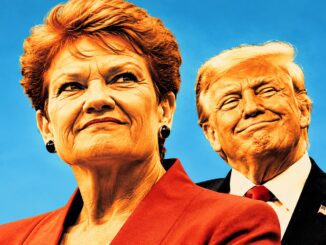
In Australia, Pauline Hanson and One Nation have built much of their political identity around opposition to immigration, multiculturalism and what they describe as threats to Australian values. The Liberal Party, meanwhile, faces a difficult question about how far it can move towards One Nation’s territory without sacrificing the broader electoral appeal that once made it a major party of government.
That is not to say the two parties are identical, or that every voter attracted to One Nation is motivated by racial prejudice. People vote for many reasons, including genuine frustration about the cost of living, housing, public services and a sense that established political parties have stopped listening.
Those frustrations deserve to be taken seriously.
But there is a difference between acknowledging a problem and blaming an entire group of people for it.
There is a difference between debating immigration levels and treating immigrants as though they were collectively responsible for every social and economic difficulty.
And there is a difference between defending Australian values and suggesting that those values belong exclusively to Australians of a particular ancestry, religion or skin colour.
The first is democratic debate.
The second is scapegoating.
The third is a warning sign.
We should know the difference.
The politics of the permanent enemy
One of the most dangerous features of Trump’s political method is the need for a continuing supply of enemies.
When one target loses its usefulness, another can be found.
Immigrants. Muslims. Journalists. Judges. Political opponents. Universities. Civil servants. Anyone who questions the leader’s judgement or refuses to applaud his latest pronouncement.
The details change, but the underlying message remains remarkably consistent: the country is in danger, the enemies are everywhere, and ordinary democratic institutions cannot be trusted to protect you.
Only the leader can do that.
It is a seductive argument, particularly when people are frightened or angry. It offers certainty in a complicated world and provides the emotional satisfaction of knowing exactly whom to blame.
But it carries a terrible price.
Democracy depends on the acceptance that political opponents are not traitors, that disagreement is not an act of sabotage, and that institutions must be allowed to constrain those who exercise power.
A leader who treats every critic as an enemy is not demonstrating strength. He is demonstrating an unwillingness to accept the limits that democracy places on their authority.
And a political movement that demands loyalty to a personality above loyalty to democratic principles is not making democracy stronger.
It is making democracy more vulnerable.
Australia should be especially careful here. We have inherited a Westminster system in which governments are supposed to answer to Parliament, the law and the electorate. We have independent courts, a professional public service, a free press and elections in which governments can be removed.
None of these institutions is perfect. All deserve scrutiny and, where necessary, reform.
But they are not obstacles to democracy merely because they sometimes frustrate a government.
They are part of what makes democracy work.
And what about the media?
In my original article, I warned Americans about the media’s role in normalising Trump.
That warning remains relevant.
There is a difference between reporting on a politician and becoming an unpaid publicity department for him.
There is a difference between scrutinising a provocative statement and broadcasting it repeatedly because outrage generates clicks, viewers and advertising revenue.
And there is a difference between holding a politician accountable and treating every public utterance as another episode in an endlessly entertaining reality show.
Trump understood the value of attention. His most outrageous statements often guaranteed another day of headlines, another round of television discussion and another opportunity to dominate the political conversation.
The fact that people were laughing at him did not necessarily mean they were diminishing his influence.
Sometimes they were helping him.
Australia has its own media landscape, with powerful commercial interests, ideological divisions and a continuing struggle for the attention of audiences. Our media are not uniform, and it would be unfair to suggest that every journalist or news organisation plays the same role.
But we should ask difficult questions about what happens when sensationalism is rewarded more consistently than explanation, when manufactured outrage crowds out serious discussion, and when the interests of media proprietors become entangled with political agendas.
If the public is continually encouraged to regard minorities as threats, political opponents as enemies and democratic institutions as conspiracies, it becomes increasingly difficult to have a rational conversation about the problems confronting the country.
And that suits certain politicians rather nicely.
An angry electorate is not necessarily an informed electorate.
A frightened electorate is not necessarily a safer electorate.
And a population that spends its time arguing about who deserves to be blamed may have very little energy left to ask who is actually responsible for fixing things.
Meanwhile, the real problems remain
Let us suppose that tomorrow every immigrant, refugee and asylum seeker whom a particular politician regards as undesirable simply disappeared.
Would housing suddenly become affordable?
Would rents fall overnight?
Would groceries become cheaper?
Would electricity bills shrink? Would our hospitals suddenly have enough staff, our aged-care facilities enough workers, and our public services all the resources they need?
Would the cost of living cease to be a problem?
Of course not.
Australia’s problems are complicated. Housing affordability involves supply, demand, planning, infrastructure, investment and government policy. Health services require funding, workers and effective administration. Economic insecurity cannot be explained by pointing at a single group of people.
Immigration levels are a legitimate subject for public debate. Governments must consider infrastructure, housing, labour-market needs and the capacity of public services to accommodate population growth.
But that is an argument for evidence, planning and competent government.
It is not an argument for turning people into scapegoats.
If politicians can persuade voters that immigrants are the cause of every difficulty, they can avoid answering awkward questions about their own policies and decisions.
It is much easier to promise that removing the supposed problem will restore prosperity than to explain the difficult, expensive and sometimes politically inconvenient work required to achieve it.
And it is considerably easier to hold a rally about national identity than to build enough affordable homes.
We should also remember who we are
There is something deeply ironic about politicians who speak endlessly about Australian values while encouraging Australians to abandon some of the qualities we have traditionally admired.
Fairness. Decency. A willingness to help someone who is doing it tough. A suspicion of people who think they are more important than everybody else.
We have never lived up to these ideals perfectly. Our history includes dispossession, racial exclusion and policies of which we should be ashamed. The White Australia policy was not an unfortunate misunderstanding; it was a deliberate expression of racial discrimination. First Nations Australians know better than most that our national story has never been as universally fair or welcoming as the mythology suggests.
But that is precisely why our ideals matter.
They give us something to work towards and a standard against which to judge our conduct.
We cannot claim to value fairness while denying it to people because of their ancestry.
We cannot claim to value freedom while demanding that others be silenced for expressing inconvenient opinions.
We cannot claim to be a confident nation if our politicians must continually invent new enemies to reassure us that we are under threat.
And we cannot claim that Australia is a land of opportunity if we are prepared to abandon people who arrive here seeking safety, dignity or a chance to build a better life.
Patriotism should not require us to despise somebody else.
If our love for Australia depends on finding another group of people to hate, perhaps we should reconsider what it is we actually love.
America is not a warning from a distant planet
There will be Australians who read this and dismiss it as another anti-Trump rant.
They may say that America is different, that its political system is uniquely dysfunctional, or that Australians are too sensible to follow the same path.
Some of those differences are real and important.
But the lesson of the past decade is not that Australia is destined to become America. It is that democratic societies can be changed by political leaders who understand how to exploit their fears and resentments.
We should not assume that our institutions will protect us automatically, that our traditions will save us, or that voters will always recognise when a line has been crossed.
Nor should we assume that the damage begins only when a particular politician becomes prime minister.
It can begin much earlier, when the language of public debate changes; when prejudice becomes an acceptable political tactic; when cruelty is marketed as courage; and when people who should know better decide that the immediate political advantage is worth the long-term cost.
Democracy is not usually destroyed in a single dramatic moment. Its safeguards can be weakened gradually, sometimes with the enthusiastic support of people who believe they are defending it.
That is why the early warning signs matter.
That is why we should pay attention before the damage becomes irreversible.
And that is why we should never confuse a politician’s popularity with the wisdom of their policies or the decency of their conduct.
A final word to Australia
Ten years ago, I asked America not to make Donald Trump its president.
America did not heed the warning.
I am not suggesting that every American who voted for Trump is a racist, that every supporter endorses every policy, or that every problem facing the United States can be attributed to one man. Elections are complicated, and voters have many motivations.
But political leaders must be judged by what they do with the power they are given. And voters must be prepared to reconsider their choices when the consequences become clear.
We have now had years to observe the consequences of Trump’s political style: the relentless division, the personalisation of power, the attacks on institutions, the treatment of opponents as enemies and the repeated appeal to grievance as a substitute for governing.
Australia does not have to reproduce that experience.
We can argue about immigration without dehumanising immigrants. We can debate national security without treating entire religious communities as suspects. We can demand accountability from governments without abandoning the institutions that make accountability possible.
We can elect conservative governments, progressive governments or governments somewhere in between without surrendering our commitment to democratic principles.
And we can insist that politicians address the real problems confronting Australians instead of offering us a procession of convenient enemies.
But we must be willing to recognise what is happening while there is still time to do something about it.
Because once hatred becomes ordinary, once cruelty becomes entertainment, and once the public begins to regard democratic restraints as unnecessary inconveniences, reversing the process becomes much harder.
So, Australia, please listen.
Do not assume that we are too clever to be manipulated.
Do not assume that our political system makes us immune to demagogues.
Do not assume that because we laugh at a politician today, we cannot find ourselves living under their influence tomorrow.
And do not allow anyone to persuade you that the road to a better Australia begins by making life worse for your neighbours.
We do not have to become America. We do not have to follow Trump. And we certainly do not have to learn every lesson the hard way.
We have a choice.
Let us make sure we make it while it is still ours to make.
Keep Independent Journalism Alive – Support The AIMN
Dear Reader,
Since 2013, The Australian Independent Media Network has been a fearless independent voice – holding power to account and delivering journalism that matters.
Running this site isn’t cheap. Rising costs mean we need your support now more than ever. Every donation, big or small, keeps our servers running, our writers working, and our stories free for everyone.
Donate here:
PayPal or credit card – just click on the Donate button below
Direct bank transfer: BSB: 062500; A/c no: 10495969

We’ve also set up a GoFundMe as a dedicated reserve fund for hosting and future improvements.

Thank you for standing with us. We couldn’t do this without you.
With gratitude,
The AIMN Team


Bravo!
I’ll add the following, Do not assume the political duopoly is the only way to vote.
I remarked to a friend that if Pauline guaranteed every adult a $5000 handout for electing her, she would probably make it to her cherished position of prime minister with barnaby Joyce as her deputy – what a nauseating prospect!.
My friend said it could never happen in Australia, for a start where would she get the money . Well, like Trump she would borrow it in the name of the Australian people and we would have to repay it as will the American people have to repay the estimated $1.2 trillion to $1.35 trillion he will have to borrow for his $US5000 bribe.
In Pauline’s case she would need to borrow around ninety two billion dollars (18,400,000 enrolled voters in Australia times $5000) which should be a doddle for One Nation.
But are we silly enough to fall for such a ploy – let’s see what happens in the US midterm elections, greed is a potent force.
Personally, I think we have the checks and balances in our constitutional and parliamentary system to avoid this level of corruption (and we don’t have a President which is a big plus) but so should there be in the US constitution and Congress but that doesn’t mean Trump won’t try it on as would the One Nation grifters.
I wish you had a wider readership, Roswell. I fear for the outcome of the next election.
Thank you, June.
I once did. After I published the original an American site contacted Michael Taylor to excitedly tell him that within 20 minutes of reposting the article it had been viewed 300,000 times. Yes, it gave me a big head.
I keep an eye on The AIMN’s stats, which over the last couple of years has seen a huge downturn. Before the downturn about 15,000 readers a day would come here via our Facebook page. But alas, Facebook is now suppressing posts with links in them as they don’t want people clicking on the link and exiting Facebook. They want people staying in Facebook and clicking on ads.
Oh dear Roswell, your well intentioned warning of the perils of the PHONeys (Profiteering Hanson Only Naturally you see) and the unthinking COALition toy boys of the billionaire’s club fortunately implies that only the Greens can secure Australia for the benefit of Australian voters. Thommo will be pleased.
The combined COALition policies regarding immigration are a farce because they fail to face the real cause of the problems ….. too many years of COALition maladministration and misgovernment since 1996.
The only way to insure that the outcome of the next feral elections in 2028 is work for the benefit of Australian voters: organise, discuss policies with everyone, make politics and political decisions the topic of mainstream conversation. Have an opinion favouring Australian voters and be prepared to defend, even expand upon it.
But most of all ….. never underestimate the ability of too many Australian voters to continue the voting preferences of their great-grandparents and against their own best interests. The time when all politicians represented Australian voters rather than foreign owned influencers infesting Parliament House has long passed.
That’s me NEC, I’m too easily pleased.
You know those questions in job interviews – “what’s your greatest weakness?” ‘I’m too easily pleased’; “why should you get this job?” I’m too easily pleased’.
Didn’t get any of those jobs – fuckin’ bastards, hope they get nationalized – well, it was the State police force, State fire-fighting service and for a State prosecutor position.
I didn’t do any better with the escort job interview in answering “what’s your greatest strength?” ‘I’m too easily pleased’. Can’t for the life of me see why that one didn’t go down too well with the interviewer.
And as for the mortician job, in answering “where do you see yourself in 10 years?”, ‘model RP3 in radiata pine with the wooden handles ‘ll do me fine, cause I’m too easily pleased’ wasn’t appreciated either.
What’s the world coming to NEC?
Terry:
” … it could never happen in Australia, for a start where would she get the money. Well, like Trump she would borrow it in the name of the Australian people … ”
Like Trump she would renege on the promise, because since when has either of them actually given anything to anyone that wasn’t forced out of them at metaphorical gunpoint?
“It is that democratic societies can be changed by political leaders who understand how to exploit their fears and resentments.”
Excellent comment Roswell and words that should be emblazoned across everyone’s forehead!
And so to the next question….
https://pearlsandirritations.com/post/2026/08/who-is-lobbying-the-australian-government-most-of-the-industry-is-hidden-from-view/?
Who’s salivating at the lips for their next useless fearmongering exercise?….
https://pearlsandirritations.com/post/2026/10/coalition-immigration-policy-unbalanced-unachievable-unworthy/?
I’ve said to before, and will say it again, if you want something to be afraid of, be afraid of the damage we have done to Mother Nature and her home, and the cumuppence that is arriving, thanks to the continuous weakness and stupidity of Albo….
https://pearlsandirritations.com/post/2026/10/australias-climate-policy-a-crime-against-humanity/?
https://pearlsandirritations.com/post/2026/10/environment-humanity-continues-to-foul-its-fragile-nest/?
What Robert Reich sees happening in TACO Trumpery’s America the Declining. (The Twin Evils; Unaffordability & Corruption 131026).
1) Trump’s war and the corruption underlying it
Trump’s war on Iran is causing Americans to spend almost 50 percent more on gas than before the war, on average. And the diesel fuel needed to transport almost everything else we buy now averages more than $6.00 a gallon, which is also being passed on to consumers.
These price increases due to Trump’s war tell only half the story. The other half is the political corruption at the root of the war — enriching Trump’s friends and family.
The war has been a huge windfall for Big Tech supplying the military — such as Palantir, a core artificial intelligence and data-integration partner for the U.S. Department of Defense, founded by Trump and JD Vance’s buddy Peter Thiel, and Elon Musk.
Musk’s SpaceX reportedly quintupled its connection fees for the Pentagon, from $5,000 per terminal to $25,000 per terminal for terminals integrated into U.S. “kamikaze” (LUCAS) drones deployed in the conflict.
2) Trump’s tariffs and the corruption beneath them
Trump’s tariffs offer another example of higher prices connected to corruption. The tariffs are import taxes that have increased annual household costs by an estimated $1,100, according to The Budget Lab at Yale.
Trump’s tariffs have enabled Trump to give out tariff waivers and carve-outs to industries and companies that do him favors.
After Tim Cook, Apple’s CEO, donated $1 million to Trump’s inauguration and promised major domestic investments, Apple got tariff exemptions for imported smartphones, computers, semiconductors, and flat panel displays, all of which saved Apple huge amounts of money.
After Elon Musk sank a quarter of a billion dollars into Trump’s 2024 campaign, Tesla got a tariff exemption for electronics.
3) Trump’s promotion of AI and the corruption underlying it
A third example linking higher prices to corruption is artificial intelligence. Together with the costs of Trump’s war in Iran, AI’s borrowing of over $500 billion so far this year has contributed to sky-high interest rates on mortgages, auto loans, and credit-card overdrafts. And AI data centers are raising electricity prices in areas where data centers are sucking up energy.
As with the war and the tariffs, Trump’s support for AI is tied to political payoffs. Tech companies and their executives donated over $300 million to support Trump’s 2024 reelection efforts and MAGA Inc, the political action committee aligned with Trump. (This doesn’t include Musk’s more than a quarter billion dollars in donations to Republicans.)
According to a CNBC analysis of FEC records, megadonor contributions from AI, crypto, and online gambling executives have overwhelmingly favored Republicans, with 14 of the 20 largest donor groups nearly exclusively backing GOP candidates or outside groups.
To see how Trump’s war, his tariffs, and his support for AI interact on prices, consider housing affordability, which is among voters’ top concerns.
While Trump’s war and encouragement of AI have contributed to the average 30-year fixed mortgage rate rising to over 7 percent, Trump’s tariffs have caused the prices of lumber and building materials to soar. The National Association of Home Builders estimates that tariffs on lumber and building materials have added $10,900 to the cost of constructing a new U.S. single-family home.
The price of copper, a key material for electrical wiring in residential and commercial construction, has risen 40 percent in the past year due to Trump’s tariffs and the demands of data centers — adding even more cost to building a typical home, which requires hundreds of pounds of copper.
4) Trump’s giant tax cut for the rich and the corruption it rests on
A final illustration of the close connection between rising prices and corruption is Trump’s tax cuts. Trump’s megadonors in the 2024 campaign demanded another big tax cut as a condition for their investments, which came in the form of Trump’s “Big Beautiful” (Big Ugly) bill.
But the tax cuts have come at the expense of healthcare for average Americans.
To pay for the tax cuts demanded by their largest donors, Trump and congressional Republicans have slashed Medicaid and failed to renew healthcare tax credits. As a result, millions of Americans are now forced to spend far more for health insurance coverage or do without it altogether.
5) The Democrats’ agenda if they retake control of Congress
If Democrats regain control of Congress, they will need to focus not only on alleviating high prices but also on eliminating the causes of those high prices. It will be impossible to do the former without attacking the latter.
In addition to ending Trump’s war and his arbitrary tariffs, they must reform campaign financing, and help reduce the influence of big money in politics. One method would be to match public financing with small-dollar donations.
They’ll also need to resurrect the systems of accountability Trump has dismantled —the independent civil service, independent inspectors general, the Office of Government Ethics, and the Federal Election Commission.
Under Trump and his Republican enablers, the richest Americans and biggest corporations have made out like bandits. Average working Americans are paying dearly for what the bandits have stolen. The grift and the graft must end.
The latest part of Trump’s war on USAnians is a little tweak to the postal and customs systems. It has been common for people on limited incomes to have their prescriptions filled by Canadian pharmacies and the drugs mailed to them. In most cases this was the only way these people could afford medications that kept them alive. As of 22nd Oct, that will not be possible any more, pricing large numbers of chronically ill and especially older people out of essential treatment.
He might as well send them all a note saying “Just die, already”.
NEC,
the Labor-USA-Israel illegal war against Iran is costing Australians too. What is Labor doing about its mates big oil and big gas?
“Oil companies are raking in billions in windfall profits from the Iran war as Australians suffer soaring petrol prices and the Labor government refuses to adequately tax the sector.
https://www.deepcutnews.com/p/ampol-profits-up-376-as-oil-sector
Multinational heavyweights ExxonMobil, Chevron, Shell and BP have all recorded sharp profit spikes by a combined $29.5bn (US$20.5bn) since the US and Israel illegally attacked Iran on 28 February, triggering a global energy crisis. Chevron, which reported a profit of US$14.5bn in the 15 months prior to the Iran war, hauled in US$12.1bn in the first quarter alone.”
Are Labor and the Republicans cut from the same cloth? Looks like it on graft involving the oil and gas companies.
The companies were making sensational profits before the Labor-USA-Israel war, they did nothing to earn the windfall, we should tax the entire windfall at 100%, how many government-owned supermarkets could be built with $30 billion/qtr. for as long as the war lasts? It’s already been two quarters, that’s $60 billion. Then there’s the subsidies Labor gives to the fossil fuel industry, another $8 billion/ half year.
What could Australia do with $68 billion/ half year? Labor, would (not) get two used Virginia class submarines – great work Marlesy.
The Greens say they’d expand publicly-owned renewable energy in their plan.
Robert Reich always provides a good read, NEC. I’ve been following him for as long as I can remember – then add another 5 years to that.
PS: It’s good to see you here.
@ Thommo: There you go again, having sensible ideas when all under the Canberra Bubble are busy contemplating their navels (not Scummo’s USUKA subs that are a mythical pipedream).
@ Carol Taylor: A wonderful surprise too rarely experienced.
To sum up the stupity of the yankey doodle dandy American voter. The yanks dont get free health care. While the US send billions to Israevil so the Israeli Jews get free health care, courtesy of the US voters.
Whats that song… “folks are dumb where I come from” Should be the US Anthem .
At any time out, someone will intone:
‘the major parties are the same so give One Nation, a go!’. She/They couldn’t do worse.
In America anyone hurting was hurting under biden and obama but trump’s bullshit and tv history spell hope.
The media complies with employees who are zealous in their compliance.