By Helen Reynolds
There is something about a koala that makes even the hardest of hearts soften a little.
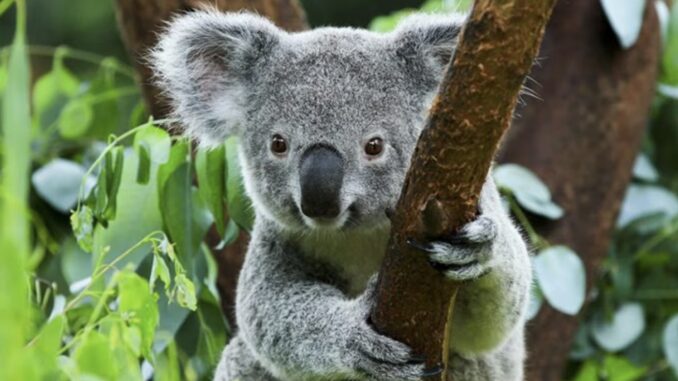
Perhaps it’s those enormous furry ears, that oversized nose, or the way it clings to a eucalyptus tree as though the rest of the world can go about its business without disturbing it. Perhaps it’s the sight of a tiny joey peeping out of its mother’s pouch, blissfully unaware of the dangers that await it.
Whatever it is, the koala has become one of Australia’s most recognisable symbols. We put it on souvenirs, postcards, tourist brochures and cuddly toys. We invite visitors from around the world to come and see our unique wildlife.
We are rather proud of the little fellow.
And yet, in parts of this country, the koala is endangered.
The animal that has come to represent so much of our natural heritage is struggling to survive in the very country that claims it as an icon.
How did we let that happen?
A home that keeps disappearing
Koalas have some fairly modest requirements. They need suitable eucalyptus trees, enough connected habitat to find food and mates, and somewhere safe to raise their young.
They don’t need a shopping centre. They don’t need a four-lane highway. They don’t need a sprawling housing estate with a landscaped entrance and a sign promising a better lifestyle.
But all those things need land. And when the land happens to contain the trees a koala depends upon, the consequences can be devastating.
Habitat loss and fragmentation are among the major threats to koalas. Land clearing for agriculture, mining and urban development has reduced or divided the places where populations live. Roads expose animals to traffic, while domestic dogs create another danger. Drought, extreme heat and bushfires place additional pressure on already vulnerable populations.
These are not imaginary dangers invented by environmental activists looking for something to complain about. They are documented threats recognised by Australia’s own environment department.
In February 2022, the Australian Government listed koala populations in Queensland, New South Wales and the Australian Capital Territory as endangered under national environmental law.
The decision followed evidence of serious population declines and continuing threats.
We didn’t suddenly discover that koalas were having a difficult time. We formally recognised the seriousness of a problem that had been developing for years.
And that raises an uncomfortable question: why did we allow so much damage to occur before the warning became impossible to ignore?
When progress comes at a price
Nobody is suggesting that Australians should stop building houses, growing food or developing the resources we need. Communities need jobs, families need homes, and regional towns need opportunities.
But surely we can acknowledge that development has consequences.
The real question is whether we have become too comfortable treating the natural environment as something that can be sacrificed whenever another use for the land promises a financial return.
A forest can be measured in hectares. A development can be measured in dollars. A new road can be measured in kilometres. But how do we measure the loss of a population of koalas that has lived in an area for generations? And who speaks for them when the decision is made?
The developer has representatives. The industry has lobbyists. Governments have economic forecasts and employment figures to consider.
The koala has none of those things.
It cannot appear before a planning committee and explain that the trees marked for removal are its food supply, shelter and means of survival. It cannot argue that a narrow strip of remaining bushland may be insufficient to sustain an isolated population.
It cannot ask why the needs of a living creature have been given less consideration than the proposed use of the land it inhabits.
We have to ask those questions on its behalf.
Promises are not the same as protection
Governments regularly announce environmental strategies, conservation funding and programs intended to protect threatened species. Some of this work is valuable, and conservation groups, researchers, wildlife carers, landholders and First Nations communities make enormous contributions to protecting koalas.
But a strategy on paper cannot substitute for effective protection on the ground.
The Australian Government’s own recovery planning identifies the need to protect and restore habitat, improve knowledge of koala populations and integrate conservation into land-use decisions.
That makes sense. Yet the challenge is turning those objectives into lasting results.
How much suitable habitat is being protected? How much is being lost? Are wildlife corridors being maintained? Are environmental rules being enforced? Are decisions about development taking the long-term survival of koalas seriously enough?
These are reasonable questions for citizens to ask, regardless of which party happens to occupy government.
Environmental responsibility should not be a partisan fashion, adopted when convenient and discarded when it becomes politically awkward.
Nor should it be reduced to the occasional announcement of money for rescuing injured animals after their homes have been destroyed.
Rescue workers perform extraordinary work. But rescuing a koala from a dangerous road is not a substitute for ensuring it has somewhere safe to live.
Treating an injured animal is essential. Preventing the injury in the first place is better.
And protecting a forest before it is bulldozed is rather more sensible than trying to recreate an established ecosystem afterwards.
The cost of looking the other way
There is another reason we should take this seriously.
The koala is not simply a cuddly attraction for tourists. It is a living part of Australia’s natural heritage, with a history stretching far beyond the arrival of European settlers.
Its fate also tells us something about our relationship with the country we inhabit.
We have inherited an extraordinary continent, with plants and animals found nowhere else on Earth. We cannot reasonably claim to value that inheritance while ignoring the pressures that are pushing some of its inhabitants towards extinction.
And we should remember that the threats rarely operate in isolation.
A population already struggling with disease may be less able to withstand habitat loss. A drought-stressed animal may have fewer options when extreme heat arrives. A road cutting through remaining habitat may separate animals that once moved between feeding and breeding areas.
The cumulative effect matters.
So does the question of what happens next.
The Australian Government’s National Koala Monitoring Program is improving estimates of koala populations. Its newer estimates suggest that the number of koalas may be higher than previously thought, but the government has cautioned that improved estimates do not, by themselves, demonstrate that populations are recovering.
That is an important distinction. We should welcome better information, but we must not confuse a better count with a problem solved.
There is a difference between discovering that more koalas exist than we thought and knowing that they have a secure future.
We need both accurate information and effective action.
What sort of country do we want to be?
I sometimes wonder what future generations will make of us.
They will look back at a time when we knew about climate change, understood the consequences of habitat destruction and had access to decades of scientific research.
They will know that we understood the dangers.
They may also ask why understanding the problem did not always lead to action on a scale sufficient to address it.
Perhaps they will admire the people who worked tirelessly to protect wildlife, restore damaged habitats and persuade governments to change course.
Or perhaps they will wonder why those people had to fight so hard to save something that should never have been treated as expendable.
We cannot preserve every tree or prevent every bushfire. Nor can we eliminate every threat to wildlife. Conservation is complicated, and different populations face different circumstances.
But we can make choices.
We can protect important habitat, restore damaged areas, maintain wildlife corridors, reduce avoidable deaths on roads, manage domestic animals responsibly and make sure development decisions properly account for environmental consequences.
We can also insist that governments measure success by more than the money allocated to a program or the number of announcements made about it.
The measure of success should include whether koala populations can survive and thrive in the wild.
That is not an unreasonable expectation. It is the minimum obligation we have to a species whose future is partly in our hands.
The little fellow deserves better
Imagine a koala sitting in the fork of a eucalyptus tree, its claws wrapped around the bark, its eyes half closed.
It has no idea what is happening in Parliament House. It doesn’t know about planning approvals, mining licences, economic forecasts or arguments over the cost of environmental protection.
It doesn’t understand why the forest around it might disappear.
It simply exists, as its ancestors did, depending on the trees and the habitat that sustain it.
And that is precisely why this matters.
The koala is not responsible for the decisions that have placed it at risk. It did not choose the economic priorities that determined whether its habitat would be protected. It did not decide that the land on which it lives would be more valuable for something else.
We made those decisions.
We must therefore accept responsibility for their consequences.
We can demand better decisions, stronger protection where it is needed, and genuine accountability for the promises governments make.
We can refuse to accept that the loss of irreplaceable habitat is simply the price of progress.
And we can remember that the natural world is not an obstacle standing between us and prosperity. It is part of the inheritance that makes this country worth living in.
The next time we see a koala clinging to a tree, perhaps we should look beyond the cute face and ask ourselves what sort of future we are leaving it.
Because the question is not merely whether we love koalas.
The question is whether we are prepared to do what is necessary to protect them.
The koala didn’t fail Australia. We have a responsibility to make sure Australia doesn’t fail the koala.
How did we let that happen?
More importantly, what are we going to do about it now?
Keep Independent Journalism Alive – Support The AIMN
Dear Reader,
Since 2013, The Australian Independent Media Network has been a fearless independent voice – holding power to account and delivering journalism that matters.
Running this site isn’t cheap. Rising costs mean we need your support now more than ever. Every donation, big or small, keeps our servers running, our writers working, and our stories free for everyone.
Donate here:
PayPal or credit card – just click on the Donate button below
Direct bank transfer: BSB: 062500; A/c no: 10495969

We’ve also set up a GoFundMe as a dedicated reserve fund for hosting and future improvements.

Thank you for standing with us. We couldn’t do this without you.
With gratitude,
The AIMN Team
Uhm …..At the risk of offending ”Koala Huggers”.
Preserving vast expanses of isolated mountainous country covered with natural forest containing food trees for koalas is the present strategy for koala preservation. However, where closer settlement and koalas coincide the consequences are not so happy.
Think Goonellabah Lismore NSW, where koalas roam the gardens at their peril, too frequently victims of attacks from passing dogs.
Think Portland Victoria, where the food trees around the lovely Caravan Park have been eaten bare by the exploding koala population. There is a need for koala re-location programmes here.
Think Kangaroo Island SA, where the problem of koala population was overcome, sadly & unfortunately, by seriously dangerous bush fires.
Think historically New England NSW, where before WWII there were many free-roaming koalas, that ended up in the cooking pots with the pelts making jumpers to protect human kids from the extreme winter cold.
What is required is management so that the decorative koalas survive but possibly have several addresses to protect the vegetation from over-exploitation.
re. “The koala is endangered. How did we let that happen?”
The answer is pretty straightforward. When the priorities favour one species, us, the humans, then all other species are likely to suffer. That this is the case is increasingly evident, per habitat destruction, global warming that impacts terrestial ecosystems as well as marine environments, human encroachment on remaining natural wilderness and more.
The selfishness apparent in much if not most of our interactions and engagements with the ‘world out there’ ensure that the outcomes favour us to the detriment of the ‘other.’
Years ago I witnessed land clearing in south-west Queensland. Two large bulldozers, 50 metres apart and linked by a massive chain, moved slowly through a natural forest. The chain flattened everything in its path. I tremble to estimate the thousands of species from micro to macro that were destroyed in a day’s work in those killing fields. Why was this happening? The landowner wanted to grow crops – cotton, or sunflower, or wheat. Did he care for the destruction of those thousands of native creatures and their habitat? Not one little bit.
That single experience has been repeated tens of thousands of times in this country, and continues to be repeated to this very day. The native animals, insects, birds and other creatures don’t stand a chance in the face of this government-endorsed mechanical onslaught against their lives and the habitat they rely on for their lives.
We are all, collectively, responsible for this disastrous state of affairs. The koalas may yet become extinct. Other iconic species as well. The days may yet come when we are reduced to looking at historical films of these animals & birds, prior to their extinction.