By Maria Millers
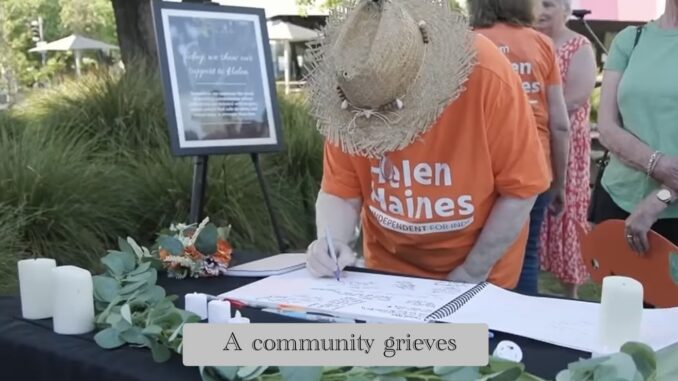
A sad and unsettling week since the brutal attack on Helen Haines, independent member for the federal seat of Indi, resulting in her sustaining horrendous injuries and the tragic loss of both legs. At the time of writing, she was listed as serious but stable. The attack on Haines is particularly confronting because she was always accessible to the people she served and this will undoubtedly impact on the way our representatives interact with their communities from now on.
The easy-going mingling at community events and private outings we have accepted and expected from our representatives may no longer be possible. Particularly, as the ABC reported that the Australian Federal Police in 2025-2026 received 1067 reports of threatening, harassing or offensive behaviour involving Federal politicians, nearly double the 555 reports recorded in 2021-22.
From Governor General Sam Mostyn to Prime Minister Anthony Albanese to prominent frontbenchers like Andrew Hastie they have all called for public debate to be ‘turned down.’ While aggression and anti-social behaviour should never be tolerated there is a strong case that what is needed is not avoidance of disagreement, but rather learning how to do so more respectfully and civilly.
The motive for the attack remains under investigation, so we should not assume that mental illness, political grievance or ideology explains the alleged attack. Nor should the front page of a major paper be emblazoned with foot high headlines implying that behind the attack the motive was HATE. Further comments from neighbours unnecessarily emphasised erratic behaviour, loud music, messy surroundings and overgrown gardens.
The alleged perpetrator, Brendan Nugent, was a highly qualified environmental scientist and activist who became increasingly isolated and frustrated with the system over environmental degradation and the lack of mental health support. Alienated from his family he lived alone on a property bought by his father and suffered long term mental health problems, as well as chronic pain from a neurological condition.
This being human is a guest house.
Every morning a new arrival.A joy, a depression, a meanness,
some momentary awareness comes
as an unexpected visitor.The dark thought, the shame, the malice,
meet them at the door laughing,
and invite them in.Be grateful for whoever comes,
because each has been sent
as a guide from beyond.(Excerpt from Jalaluddin Rumi The Guest House).
Fear and resentment still exist today towards somebody who has mental health problems. But most of those who experience mental illness are not violent and we should be careful to not stigmatise them by treating mental illness as an explanation for violence. At the same time, we need to ask why people experiencing serious psychological distress cannot access timely, sustained support, especially before a crisis develops. It appears there were limited resources for mental health in the district as across most areas.
Room for Everyone
We make room for broken bones,
for crutches, casts and healing scars.
Yet minds can hurt in ways unseen,
behind closed doors, behind routines.
Let kindness be the place we start.
There is no shame in a struggling heart.
(Anonymous).
This is the time to pose a profound question about the kind of society Australia has become, and the kind of society it still needs to become. A humane society must be able to do two things at once: hold individuals accountable for violence and examine whether its institutions have failed people who need help and support. We have always prided ourselves on being an easy-going society, but it’s time to have a deeper look at our own backyard and face the fact that we live with the flawed assumption that we are immune from the unrest and violence seen in other countries.
As many point out, we are living at an inflection point because systems built in the 20th century are not living up to sustaining the realities of the 21st century Hence all the unrest. As Antonio Gramci writing during a similar time of disruption said: The old world is dying and the new world struggles to be born; now is the time of monsters. The outcome of this period will depend partly on whether we treat disruption as something to resist at all costs, or as an opportunity to reconsider how we live together. Australia has developed sophisticated democratic institutions, a high standard of living and extensive public services. Yet increasingly the more vulnerable among us are often overlooked and sidelined.
The attack on Helen Haines has brought together things we often compartmentalize and discuss separately: mental health, political violence, growing inequality, youth crime and our reluctance to have difficult conversation such as Australia’s unfinished reckoning with its colonial past. There is an almost willful avoidance of healthy debate on these and other uncomfortable issues. We often teach children to be polite, but do we teach them how to disagree politely? We may encourage social harmony, but do we show people how to tolerate being challenged without feeling personally threatened?
In families difficult subjects may be avoided to preserve harmony. In public debates opponents can be portrayed as enemies rather than fellow citizens with different experiences and beliefs. Conversations usually retreat into safe areas around sport, football, cricket and the like give us a socially acceptable way to express passion, argue fiercely and disagree, while politics and other contentious subjects can feel as though they threaten friendships, family relationships or our sense of belonging. Today more than ever there is an urgent need to encourage difficult conversations and civil debate in every forum from homes to cafes and barbeques to public and national debates. The ability to disagree and argue and still remain friends is a skill that should be cultivated in schools through critical thinking and debates.
Our media could take more responsibility in promoting debate that is not just tied to vested interests. Mainstream media has deteriorated to the point where there are fewer voices and viewpoints heard. Social media fails by reinforcing strongly held prejudices and amplifying feelings of anger, grievance and despair. Just adding to and promoting alienation, extreme views and hostility towards those perceived to be responsible for their problems. We should also be asking why is it that we are so uncomfortable with difficult conversations? Avoiding asking uncomfortable questions may be because facing up to some aspects of our colonial past challenges our long-held view of our national identity and social cohesion
Coming to terms with the past requires more than commemorating achievements or expressing regret. It requires an honest examination of what happened, who benefited, who suffered, and how its consequences persist. Furthermore, there is an important distinction between a society that has evolved materially and one that has matured emotionally and ethically. The attack on Helen Haines can prompt us to ask what sort of society we are building, what we tolerate in our public discourse, and what we choose not to discuss. Do we care for people in psychological distress? Are mental health services accessible before a crisis, and is ongoing support available to people and families who need it? Can people disagree safely? Do our homes, schools and workplaces teach people how to listen, challenge assumptions, manage anger and repair relationships?
There is an interesting paradox here: we can argue passionately about who should captain the Australian cricket team yet feel deeply uncomfortable discussing how our country should treat its most vulnerable people or confront its history. A society does not become more socially cohesive by avoiding its differences. It becomes more cohesive by developing the confidence to face them together.
We live in a country with everything ready to make it into a great place to live. We only need the will and leadership. To borrow from Maggie Smith:
Life is short and the world
is at least half terrible, and for every kind
stranger, there is one who would break you,
though I keep this from my children. I am trying
to sell them the world. Any decent realtor,
walking you through a real shithole, chirps on
about good bones: This place could be beautiful,
right? You could make this place beautiful.
(Good Bones, Maggie Smith).
All of us can only wish and hope that Helen Haines will continue to improve and heal.
Hope is the thing with feathers –
That perches in the soul –
And sings the tune without the words –
And never stops – at all –
And sweetest – in the Gale – is heard –
And sore must be the storm –
That could abash the little Bird
That kept so many warm –
I’ve heard it in the chillest land –
And on the strangest Sea –
Yet – never – in Extremity,
It asked a crumb – of me.
The Woorilla Literary Event and Prize Awards will take place on Sunday November22 at 2pm at The Hub, Emerald
Free entry but please register woorilla.org.au
Keep Independent Journalism Alive – Support The AIMN
Dear Reader,
Since 2013, The Australian Independent Media Network has been a fearless independent voice – holding power to account and delivering journalism that matters.
Running this site isn’t cheap. Rising costs mean we need your support now more than ever. Every donation, big or small, keeps our servers running, our writers working, and our stories free for everyone.
Donate here:
PayPal or credit card – just click on the Donate button below
Direct bank transfer: BSB: 062500; A/c no: 10495969

We’ve also set up a GoFundMe as a dedicated reserve fund for hosting and future improvements.

Thank you for standing with us. We couldn’t do this without you.
With gratitude,
The AIMN Team
horrified that this has happened to such a wonderful human being and first class politician. Australia needs to fill every political position at every level with “Helen Haines”. However let’s not presume this is a political attack although all politicians seem to be making it THEIR issue. What if this turns out to be a personal grudge the perpetrator had against Helen ? Then what will be made of it ?