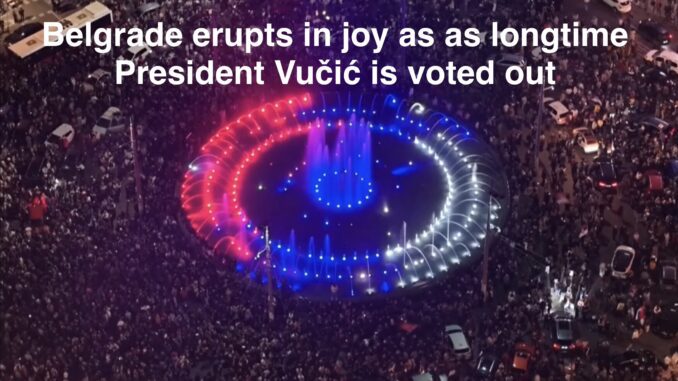
“This is not an ordinary election victory; this is an avalanche that has wiped out an authoritarian regime and entire political scene.” (Vladisavljević, University of Belgrade, BBC News, October 26, 2026).
When the flagging intelligentsia and jaded reformists retire to their offices of despair and forget that better days can come, let us give time to praise those of youth and youthful persuasion who, with faith and boldness, remain steadfast and stoic, committed and convinced. For them, the world is there to be changed, not gawped at or contemplated in regret and resignation. In India, the Cockroach Janata Party has shown that ministers will fall onto their swords when pressure is appropriately applied by an enraged, focused youth movement. In France, amidst the grunts and complaints about social media corruption, external influences and opportunistic troublemakers, students are making their charges against a culture of neglect, staff shortages and mouldering facilities.
The fashioned jewel in the crown of protest has turned out to be, much to the shaken surprise of sceptics and pundits, Serbia. As with other states whose machinery has become worn, its arteries hardened by authoritarian practices, clientelism and a lack of accountability, talk about change tended to stall at the ballot box. At the end of the count always seemed to loom the figure of Aleksandar Vučić, petrified into the bureaucratic apparatus like an obstinate gargoyle refusing to leave his perch. However disliked, his fractious opponents repeatedly failed to unseat him. His victories echoed the elections of other countries doomed to patterns of circular history. As the economist Branko Milanović chose to describe it, using V. S. Naipaul’s expression, Serbia, similarly to Argentina and Russia, would be the victim of such a circularity: “the same events with different personalities re-occur permanently, and seemingly forever.”
Something, however, rumbled in 2024 with the November 1 collapse of a concrete canopy at the newly renovated Novi Sad train station, located to the north of the country. It killed 16 people. Their deaths become cruel signifiers of entropy, decay and graft, linked to the procurement process and poor building standards. The odorous flies in the ointment proved to be Vučić and his Serbian Progressive Party (SNS). Opposition parties failed to jump at the opportunity to make hay and target the regime. It fell to students, initially from the Faculty of Dramatic Arts in Belgrade, to get busy. They, along with supportive academics, caught the oppressive eye of government authorities. A blockade of the faculty by way of retaliation was organised. A rash of university faculties and departments across the country followed suit. In time, an ecosystem of student participation flourished, characterised by secret meetings conducted by councils with no hierarchies to speak of, no political insignias or political flags. Rallies and blockades were organised. The decision to create neighbourhood assemblies entitled zborovi signalled a desire for the organisers to move beyond university environs. The “Student List-Students Win” movement, in time, would prove irrepressible.
The government response, which took the form of funded groups keen on harassing and pigeonholing the students as beneficiaries of foreign largesse, proved incessant. The pro-Vučić activists also set up their own encampment in Belgrade’s Pionirski Park derided as ćaciland by the protesters. (The origins of the term lie in the unlettered efforts of someone in Novi Sad who, in January 2025, attempted to graffiti ‘students, go to school’ only to misspell the word đaci, or students.) The signs were, however, clear: a movement, despite eschewing politics, had become a political threat to the Vučić government.
In the October 25 election, in which Vučić was hoping to win the post of prime minister, the Student List fielded candidates for all 250 parliamentary seats. They won an astonishing 52.65% of the vote, likely to translate into 135 to 140 seats. (The SNS have won 105.) Curiously enough, there were no students among them. If there was any notable head to speak of, it would have to be the cardiologist and Novi Sad academic Ilija Srdarnović. He had emollient words for the BBC: “We offer our citizens the core values of civilised society, which this previous regime has taken away from our citizens for the last time.”
After the jubilation and exercised tear ducts comes the reckoning. The elected candidates will have to learn, with some speed, the ropes of a rusty ship of state. “The movement realised early on that it could be successful only if it was entirely apolitical,” wrote Milanović. It is with interest and concern that he wonders whether an “amorphous mass that even lacks a visible leadership” can engage the traditional structures of government. “The decision not to move into the political and not to transform itself into a formal organization or a political party is both a blessing and a curse.” But for all that, the movement has ceased being amorphous, with its likely clutch of 140 representatives.
Vučić has, much to the relief of his opponents, grudgingly conceded defeat where a disruptive spell of stalling and bloodletting might have taken place. “I do not want unrest, I do not want killings, I do not want anything like that on the streets.” The question of how to deal with the matter of sundering corruption and addressing the absence of accountability, without rancour and vengefulness, looms. The Student List has, at least to date, embraced the principles of democracy, pluralism and justice that may stave off such urges.
Keep Independent Journalism Alive – Support The AIMN
Dear Reader,
Since 2013, The Australian Independent Media Network has been a fearless independent voice – holding power to account and delivering journalism that matters.
Running this site isn’t cheap. Rising costs mean we need your support now more than ever. Every donation, big or small, keeps our servers running, our writers working, and our stories free for everyone.
Donate here:
PayPal or credit card – just click on the Donate button below
Direct bank transfer: BSB: 062500; A/c no: 10495969

We’ve also set up a GoFundMe as a dedicated reserve fund for hosting and future improvements.

Thank you for standing with us. We couldn’t do this without you.
With gratitude,
The AIMN Team

Be the first to comment