With just days remaining before Americans head to the polls on November 3, the 2026 midterm elections are becoming increasingly interesting.
When we last examined the political landscape, the question was whether growing dissatisfaction with Donald Trump and his administration would translate into a meaningful shift in voting intentions.
There were signs of movement. Polling suggested Democrats were gaining ground, Republican-held congressional seats were becoming more competitive, and the Senate battlefield was expanding into states that Republicans would ordinarily expect to defend comfortably.
Now we have something rather more tangible: millions of Americans are already voting.
And the numbers deserve attention.
More than 43 million votes already cast
According to an Associated Press analysis published on October 31, more than 43 million Americans had already voted, either in person or by returning mail ballots.
That is almost 10 million more than at the equivalent point in the 2022 midterm elections.
The figures cover 47 states and Washington DC. In states reporting party affiliation, approximately 6.8 million registered Democrats and 5.2 million Republicans had cast their ballots.
That difference is interesting, but it requires some qualification. Party registration does not necessarily tell us how someone voted, and millions of early voters are not included in those party breakdowns.
Nevertheless, the overall increase in participation is significant.
The most interesting developments are occurring in several states where control of the Senate could be determined by relatively small changes in voter behaviour.
Texas, in particular, deserves watching.
Source:
- Associated Press reporting provides the latest figures.
Texas: Suddenly, everybody is watching
For decades, Texas has been regarded as one of the Republican Party’s most dependable strongholds.
Democrats have occasionally entertained the possibility of turning the state blue, only to watch those hopes disappear when the votes were counted.
This year, however, the Senate contest is attracting considerably more attention.
Republican Ken Paxton is facing Democrat James Talarico in a race that could have implications well beyond Texas.
Reuters reported on October 30 that most polls had Talarico narrowly ahead.
There are several interesting developments behind the contest.
First, early voting in Texas has increased substantially. More than 6.3 million Texans had voted by the Wednesday before the election, approximately 50 per cent more than at the equivalent point in 2022.
Second, Latino participation has increased considerably. According to data cited by Reuters, approximately 1.56 million Latino voters had already cast ballots, almost twice the number at the same point in the previous midterm election.
University of Texas polling also found Talarico leading Paxton among likely Latino voters by 54 to 41 per cent.
These figures do not guarantee anything, but they indicate that the electoral dynamics in Texas deserve considerably more attention than they might have received in previous cycles.
There are also questions surrounding Paxton’s appeal among women voters, particularly given the personal controversies reported during his campaign.
Republicans have considerable financial resources behind their campaign. Reuters reported that spending supporting Paxton had exceeded $300 million, compared with approximately $102 million for Talarico.
Money, however, cannot purchase a vote.
Source:
Texas is not the only state attracting attention
The early voting figures are also noteworthy elsewhere.
According to the Associated Press, early voting has increased compared with 2022 in several important Senate battlegrounds:
- South Carolina: up 83 per cent.
- Texas: up 50 per cent.
- Maine: up 44 per cent.
- Kansas: up 34 per cent.
- Michigan: up 32 per cent.
North Carolina has also experienced increased participation.
These are not necessarily indications of which party will benefit. Voting patterns differ between states, and Republicans have historically been more inclined in some places to vote on election day.
However, the numbers demonstrate that the election is generating considerable participation in states where control of Congress could be decided.
One particularly interesting feature is that some of these contests are occurring in states Donald Trump carried in 2024.
That makes the results worth watching, regardless of which party eventually prevails.
Source:
- Associated Press: Early voting jumps across Senate battlegrounds as millions more Americans vote ahead of Election Day
The House: A narrow majority under pressure
The House of Representatives remains an important part of the equation.
Republicans currently hold a narrow majority, and Democrats need a net gain of four seats to take control.
All 435 voting seats are being contested.
The significance of the House should not be underestimated.
If Democrats secure control, they would have the power to chair congressional committees, conduct investigations and exercise considerably greater scrutiny over the administration.
Republicans, meanwhile, would lose their ability to control the legislative agenda in the lower chamber.
For Trump, the difference could be substantial.
A president with both chambers of Congress under his party’s control has considerably more legislative freedom than one facing an opposition-controlled House.
But the Senate presents a different challenge.
Sources:
- ABC News: These House races could determine which party is in control in the next Congress
- The Constitution Centre: What constitutional powers do the Democrats get by winning the House?
The Senate: A more complicated calculation
Republicans currently hold a 53–47 majority in the Senate, counting the two independents who caucus with Democrats.
Democrats need a net gain of four seats to take control.
Several contests are attracting national attention, including those in Texas, Maine, Kansas, Ohio and North Carolina.
The difficulty for Democrats is that some of their targets are in traditionally Republican states.
A national swing towards one party does not automatically translate into victories in individual states.
That is why the Senate contest remains particularly difficult to assess.
The House and Senate could also produce different outcomes, leaving Washington with a divided Congress.
Source:
- The Washington Post: Many states deciding control of the Senate are seeing a big boost in early voting
The Trump factor
There is little doubt that Donald Trump remains central to this election.
The midterms are often treated as a referendum on the sitting president, and this election is no exception.
His approval ratings, economic policies, immigration enforcement, tariffs and the consequences of the war with Iran have all become part of the political debate.
Economic concerns are particularly important.
Voters may have supported a candidate two years ago because of promises about inflation, employment and household costs. They are now in a position to assess whether those promises have translated into improvements in their daily lives.
That is an uncomfortable calculation for any incumbent administration.
However, it would be a mistake to assume that dissatisfaction with Trump automatically translates into support for Democrats.
American politics remains deeply polarised, and Republican voters have their own reasons for supporting the administration.
The question is whether enough voters who previously supported Trump, or simply stayed away from the political process, have changed their minds.
An election is about more than winning seats
There is another issue worth keeping in view.
The integrity of the electoral process and the acceptance of legitimate results remain important questions in American politics.
The peaceful transfer of power is fundamental to democratic government. It should not depend on whether a particular candidate likes the outcome.
The counting and certification of votes must be allowed to proceed according to the law, without intimidation or political interference.
These principles matter regardless of which party wins.
So, what have we learned?
We now have considerably more information than we had two weeks ago.
Early voting is substantially higher than at the equivalent stage of the previous midterm election. Several traditionally Republican states are attracting unusually high levels of participation. Texas has become an especially interesting contest, and Democrats are competing in places where they have struggled for decades.
There is evidence of dissatisfaction with the administration, but there is also evidence that Republicans retain considerable organisational and financial resources.
None of this establishes the eventual result.
Nor should we confuse an increase in early voting with a guarantee of a particular outcome.
But something important is happening.
Americans are turning out in substantial numbers, and the political landscape is being tested in places that might once have seemed relatively predictable.
On November 3, the speculation will begin to give way to actual votes.
For Donald Trump, the midterms represent an opportunity to demonstrate that his political support remains sufficiently strong to sustain Republican control of Congress.
For Democrats, they represent an opportunity to regain a measure of congressional power and establish a different relationship between the White House and Capitol Hill.
For everyone else, they offer an opportunity to see whether the political dissatisfaction identified in polling has translated into something more consequential.
We have spent the past two articles examining whether the political ground is shifting.
Now, with millions of votes already cast, we are getting closer to finding out just how far it has moved.
November 3 is approaching. And this time, the numbers are beginning to speak.
And what happens if Trump doesn’t like the result?
There is another question hanging over these midterms, and it is one that Americans should not have to ask in a functioning democracy.
What happens if Republicans perform poorly?
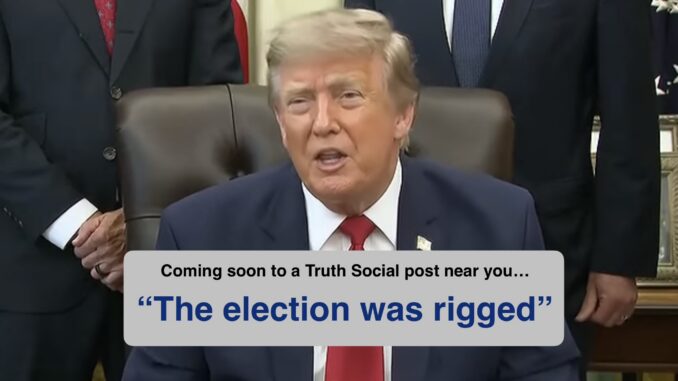
Donald Trump has repeatedly promoted allegations that American elections are rigged, despite the absence of evidence supporting his claims about the 2020 presidential election.
There are growing concerns that a disappointing result for Republicans could be followed by another attempt to discredit the electoral process.
But the concerns extend beyond the president’s familiar rhetoric.
Reuters recently published an investigation examining nine possible ways the Trump administration could interfere with the midterms. Its investigation involved interviews with more than 50 election officials, lawyers and voting experts.
Among the issues examined were federal attempts to influence state election administration, restrictions on mail voting and the possible use of federal law enforcement.
The concerns are not entirely hypothetical.
On October 31, a federal judge ordered the Justice Department to stop threatening state and local election officials with prosecution over their refusal to comply with certain federal demands concerning alleged non-citizen voters.
The ruling restricted the administration’s ability to demand that officials remove registered voters, withhold ballots or segregate votes on the basis of its allegations.
Meanwhile, current and former national security officials have been advising state governments about preparing for possible federal interference.
There are also concerns about the possibility of federal agents or military personnel appearing at polling locations. Such deployments would raise serious legal questions and could intimidate voters.
To be fair, the administration has said its election-monitoring personnel will observe rather than interfere with voting, and the Justice Department has stated that FBI and ICE personnel will not serve as poll monitors.
We should distinguish between what has actually happened, what has been threatened and what remains a possibility.
Nevertheless, the broader issue cannot be ignored.
American elections are administered primarily by individual states, not by the president. The president does not have the constitutional authority simply to take control of the electoral process because he dislikes the political circumstances.
And there is an even more fundamental principle.
A president cannot decide that an election is legitimate only when his preferred candidates win.
If Republicans perform poorly, the appropriate response is to examine the results through established legal procedures, accept the certified outcome and allow the democratic process to continue.
The alternative is a country in which every election becomes a contest not merely over who receives the most votes, but over whether the losing side will accept that the votes count.
That is a dangerous precedent for any democracy.
Previous reports:
America’s Midterms: The House, the Senate and the Early Signs of a Political Shift, October 14, 2026.
America’s Midterms: The political ground is shifting, but how far?, October 19, 2026.
Keep Independent Journalism Alive – Support The AIMN
Dear Reader,
Since 2013, The Australian Independent Media Network has been a fearless independent voice – holding power to account and delivering journalism that matters.
Running this site isn’t cheap. Rising costs mean we need your support now more than ever. Every donation, big or small, keeps our servers running, our writers working, and our stories free for everyone.
Donate here:
PayPal or credit card – just click on the Donate button below
Direct bank transfer: BSB: 062500; A/c no: 10495969

We’ve also set up a GoFundMe as a dedicated reserve fund for hosting and future improvements.

Thank you for standing with us. We couldn’t do this without you.
With gratitude,
The AIMN Team

And then there is the hip-pocket factor.
Trump has promised a $5000 payout to every citizen of voting age, contingent on Republicans retaining control of both the House of Representatives and the Senate in the upcoming November midterms.
As Jack Lang observed some years ago, “Always back the horse named self-interest, son. It’ll be the only one trying.”
Trump has also said that the only caveat to receiving the money is that it cannot be spent overseas and must be spent entirely within the United States. That could be an interesting requirement to enforce: most suppliers to Amazon are offshore.
Something Trump has not been so clear on is where the money (some $1.2 Trillion) will come from but it is safe to say that it will be by borrowings which will have to be repaid by a future generation of Americans.