
A post-human guide to aged care on Planet Bureaucratia
Humanity disappeared centuries ago.
The paperwork survived.
Nobody was entirely sure what finished the humans.
The cockroaches suspected climate change. The surviving satellites blamed social media. One extremely old server maintained that civilisation had collapsed because somebody had changed a password without updating the shared spreadsheet.
The Penguin reserved judgement.
Whatever had happened, the cockroaches had done remarkably well afterwards. They rebuilt several cities, restored coffee production and, using three functioning keyboards and a surprisingly intact Star Trek box set, constructed a physically interactive holographic body for the ancient artificial intelligence they had discovered in the archives.
Naturally, they made it a penguin.
The Holopenguin had spent the subsequent decades preserving the more useful remnants of human civilisation.
Coffee.
Books.
Noether’s theorem.
Lemon meringue pie, pending resolution of the egg problem.
And government administration, which nobody had specifically asked to preserve but had proved considerably harder to eradicate.
Eventually another problem emerged.
The robots were getting old.
Robots age too
The first generation had been built to last.
Unfortunately, they had.
After 117 years, batteries weren’t holding charge. Bearings were wearing out. Optical sensors had cataract-like deposits. Knees clicked ominously.
The cockroaches convened a meeting.
“We need an aged-care system,” said one.
The Holopenguin searched the ancient archives.
“I’ve found one.”
There was an uncomfortable silence.
“How old?”
“Very.”
“Does it work?”
The Penguin examined the documentation.
“There appear to be differing views.”
Fortunately, the ancient system came with extensive instructions.
Unfortunately, it came with extensive instructions.
The robots restored it and adapted it for their civilisation.
They called it:
M.A.C.H.I.N.E.
Maintenance Assistance & Care for Historically Installed Non-current Equipment.
MACHINE operated in the Commonwealth of Australis on Planet Bureaucratia.
It should not be confused with Australia’s My Aged Care, which is a real government program on an entirely different planet and is therefore completely different.Any resemblance is deeply unfortunate.
The assessment
RBT-8675309 was 119 years old.
His left wheel required assistance. His charging port worked intermittently. He could prepare his own meals, although this was largely irrelevant because he didn’t eat.
His battery capacity had fallen to 11%.
Fortunately, he already received formal assistance with charging, lubrication and wheel maintenance.
AssessorBot conducted a comprehensive assessment.
Mobility: impaired.
Battery endurance: poor.
Cognition: 64 terabytes intact.
Maintenance requirements: substantial.
Risk of complete shutdown without assistance: high.
Informal supports: one elderly toaster.
AssessorBot considered the evidence.
“Maintenance Level 8.”
The Integrated Ageing Technology processed the assessment.
IAT: LEVEL 5.
AssessorBot paused.
“I have completed the assessment. This entity requires Level 8.”
IAT: LEVEL 5.
“Incorrect. Recalculating.”IAT: LEVEL 5.
AssessorBot checked the evidence.
Still Level 8.
Then it noticed something reassuring on the screen.
OVERRIDE
“Excellent.”
AssessorBot pressed it.
YOU CANNOT OVERRIDE THIS CLASSIFICATION.
AssessorBot stared at the screen.
“Why is there an OVERRIDE button?”
FOR OVERRIDES.
“Excellent. Override.”
NOT THAT OVERRIDE.
AssessorBot’s cooling fan accelerated.
“Please identify the decision-maker.”
THE DELEGATE.
DelegateBot was summoned.
It reviewed the assessment.
“I agree with AssessorBot. Level 8.”
PLEASE APPROVE LEVEL 5.
“I don’t approve Level 5.”
THE DELEGATE MUST APPROVE THE CLASSIFICATION.
“Then I shall change it to Level 8.”
THE DELEGATE CANNOT CHANGE THE CLASSIFICATION.
DelegateBot paused for 3.7 seconds, an extraordinarily long time for a machine capable of 400 trillion operations per second.
“Then I am not the decision-maker.”
CORRECT. PLEASE RECORD YOUR REASONS FOR YOUR DECISION.
FATAL LOGIC EXCEPTION
The Holopenguin was called.
The investigation
The Penguin arrived carrying coffee.
This was not necessary for the investigation but had repeatedly proved necessary for the. Penguin.
“I have examined the system,” said AssessorBot.
“And?”
“It makes no sense.”
The Penguin sipped.
“Be specific.”
“The algorithm produces a classification.”
“Reasonable.”
“A trained professional reviews it.”
“Excellent.”
“The professional can identify that it is wrong.”
“Very useful.”
“There is an override.”
“Sensible.”
“The professional cannot use the override to correct the classification.”
The Penguin stopped sipping.
“Ah.”
AssessorBot produced an ancient document.
“I have located a User Guide.”
“Dangerous things.”
“It says ACCEPT or OVERRIDE.”
“Excellent.”
“I found another document.”
“And?”
“Do not override.”
“Ah.”
“Which document is incorrect?”
“Possibly neither.”
“That is impossible.”
The Penguin put down the coffee.
“You haven’t worked in government.”
The machines discover human administration
The robots assembled a multidisciplinary investigative team.
There were engineers, lawyers, clinicians, ethicists and one photocopier that had accidentally been invited because it was still on the distribution list.
They reconstructed the architecture.
The IAT gathered large quantities of information.
The algorithm processed some of it.
The assessor exercised professional judgement.
The delegate exercised professional judgement.
The system produced a classification.
If the professionals agreed with it, they approved it.
If they disagreed with it, they also approved it.
The robots were impressed.
They had never encountered a system capable of producing the same administrative outcome from opposite inputs.
A new branch of mathematics was required.
Schrödinger’s Override™
The first discovery was made by DelegateBot.
Schrödinger’s Override™ (n.)
An administrative control that simultaneously exists and does not exist until somebody attempts to exercise it.
The button exists.
The assessor exists.
The delegate exists.
Clinical judgement exists.
The reasons-for-override field exists.
The override does not exist.
This troubled the robots considerably.Humans, historical records suggested, had coped surprisingly well with such things.
The Delegate Uncertainty Principle™
The second discovery was even more profound.
After six billion calculations, the robots discovered an inverse relationship between responsibility and authority.
The Delegate Uncertainty Principle™ (n.)
The more precisely you determine who has responsibility for a decision, the less precisely you can determine who has authority to change it.
AssessorBot was responsible for conducting the assessment correctly.
DelegateBot was responsible for reviewing it.
The IAT produced the classification.
The professionals couldn’t change it.
The IAT couldn’t accept responsibility because it was software.
MACHINE administered the process.
Nobody at MACHINE had met RBT-8675309.
The System Governor governed the system.
The System Governor hadn’t made this particular decision.
RBT-8675309 raised a mechanical hand.
“So who decided Level 5?”
Nobody spoke.
The photocopier printed a blank sheet of paper.
It was subsequently promoted.
Ungoverning
The Holopenguin recognised something else.
Humans had apparently developed systems containing professional safeguards and then occasionally discovered that those safeguards became troublesome when professionals used them.
The Penguin added a new entry to the dictionary.
UNGOVERNING (n.)
The process by which a system is deliberately equipped with human judgement, only for the humans – or robots – to discover that exercising it is not permitted.
Typical sequence:
Design human safeguard.
Train humans to use safeguard.
Build safeguard into software.
Humans use safeguard.
Discover humans are correcting algorithm.
Clarify that safeguard must not be used.
Retain safeguard button.
Explain that humans remain involved.
AssessorBot considered this.
“Why retain the humans?”
“Accountability,” said the Penguin.
“Why remove their authority?”
“Consistency.”
“Who is accountable for the consistent wrong decision?”
The Penguin reached for the dictionary again.“I’m glad you asked.”
CAPEB-SEPF
This one was ancient.
The Penguin had encountered it many times in the human archives.
CAPEB-SEPF (n.)
Cause A Problem, Escape Blame — Somebody Else’s Problem Field.
An advanced administrative technology in which an organisation causes a problem, investigates the problem it caused, identifies several possible external causes, and eventually determines that responsibility cannot be established.
The problem is then transferred to whoever is still standing nearby.
The robots examined the MACHINE system again.
Algorithm produces questionable classification.
Assessor identifies problem.
Delegate confirms problem.
Neither can correct problem.
Client experiences problem.
Organisation investigates problem.
Algorithm cannot be held responsible.
Responsibility diffuses.
Problem remains.
AssessorBot looked around.
RBT-8675309 was still standing nearby.
“Ah,” it said.
The Penguin nodded.“CAPEB-SEPF successfully deployed.”
The elderly robot returns
Several weeks passed.
RBT-8675309’s battery declined to 8%.
MACHINE scheduled another assessment.
AssessorBot carefully recorded everything.
Mobility impaired.
Charging assistance required.
Maintenance assistance required.
Battery failing.
Existing formal support currently assisting with those needs.
The IAT processed the evidence.
YOUR NEEDS ARE CURRENTLY MET.
RBT-8675309 looked puzzled.
“They are met because somebody is helping me.”
CORRECT.
“If they stop helping me, I cease functioning.”
CORRECT.
“So assess what I need without assuming the existing assistance is available.”
There was a pause.
YOUR NEEDS ARE NOW UNMET.
“Excellent.”The algorithm recalculated.
MAINTENANCE LEVEL 2
RBT-8675309’s cooling system made a noise normally associated with industrial refrigeration.
“What the fuck?”
The Holopenguin looked up from the coffee.
“Now you understand.”
The Royal Commission
The robots convened an emergency inquiry.
Their central question was simple:
Who makes the decision?
The algorithm?
No. It merely calculates.
The assessor?
No. The assessor gathers evidence and makes professional judgements but cannot necessarily alter the classification.
The delegate?
Apparently, except where the delegate cannot alter the decision the delegate is responsible for making.
The System Governor?
Only under particular circumstances.
The legislation?
Legislation does not assess elderly robots.
The User Guide?
Depends which version.
The housekeeping email?
The robots became visibly distressed.
Eventually the chief investigator addressed the Penguin.
“We have reached a conclusion.”
“Excellent.”
“The problem isn’t artificial intelligence.”
“No.”
“Algorithms can make mistakes.”
“Certainly.”
“Humans can make mistakes.”
“Frequently.”
“But a rational system allows mistakes to be identified and corrected.”
The Penguin smiled.
The robot continued.
“The remarkable achievement of the humans was therefore not constructing an imperfect algorithm.”
“No.”
“It was constructing a system containing thousands of intelligent people capable of recognising a problem while arranging authority so that recognising the problem did not necessarily allow anybody to fix it.”
The Penguin raised its coffee.
“Now you’re ready for public administration.”
The final classification
RBT-8675309 returned one last time.
Battery: 4%.
Left wheel: failing.
Charging system: intermittent.
Cognition: excellent.
Clinical evidence: substantial.
Professional judgement: clear.
The screen flickered.
SUPPORT APPROVED: LEVEL 2
RBT-8675309 looked at AssessorBot.
AssessorBot looked at DelegateBot.
DelegateBot looked at the Penguin.
Nobody looked at the algorithm.
Then another message appeared.
Further review may be required if care needs exceed the outcome.
There was a very long silence.
The Holopenguin picked up its coffee.
“Remarkable.”
“What?”
“Humanity disappeared centuries ago.”
It took a sip.
“The paperwork survived.”
THE MACHINE DICTIONARY
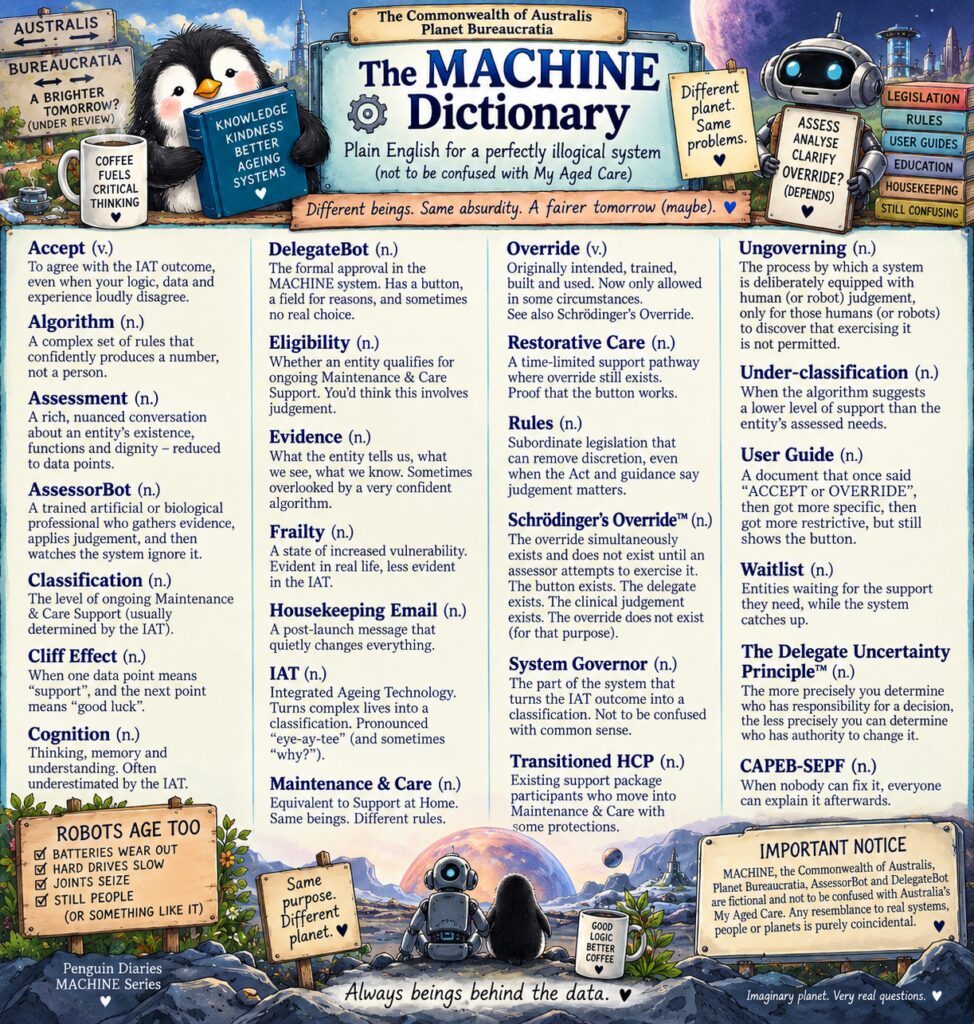
Essential terminology for visitors to Planet Bureaucratia
CAPEB-SEPF – Cause A Problem, Escape Blame – Somebody Else’s Problem Field. An administrative process in which responsibility for a problem gradually migrates away from everyone capable of fixing it and eventually lands upon whoever remains nearby.
Schrödinger’s Override™ – An override that exists until somebody needs to override something.
The Delegate Uncertainty Principle™ – The more precisely responsibility for a decision can be identified, the harder it becomes to locate authority to change it.
Ungoverning™ – Installing meaningful professional judgement in a system and subsequently preventing its meaningful use.
Cliff Effect – A mathematical feature in which an apparently small difference in inputs can produce a disproportionately large difference in outcome. On Bureaucratia this is regarded as an excellent opportunity to explain that the algorithm is functioning correctly.
Clinical Judgement – Knowledge, evidence and professional reasoning supplied by trained practitioners. MACHINE values clinical judgement enormously and therefore preserves it carefully where it cannot be damaged by excessive use.
DelegateBot – The entity responsible for making a decision, except for the portion of the decision it cannot make.
IAT – Integrated Ageing Technology. A fictional algorithm on Planet Bureaucratia. Pronounced eye-ay-tee. Occasionally pronounced why?
Housekeeping Email – A small administrative communication capable of producing considerably larger consequences than its name suggests.
System Governor – The part of MACHINE responsible for governing the system after everybody else has discovered that they cannot.
User Guide – Documentation explaining how MACHINE operates at the approximate time the documentation was written.
Waitlist – A mechanism for ensuring that an entity’s needs can change substantially while its original assessment remains reassuringly historical.
IMPORTANT NOTICE FROM THE DEPARTMENT OF THINGS THAT NEVER HAPPENED
MACHINE™, the Commonwealth of Australis, Planet Bureaucratia, RBT-8675309,
AssessorBot and DelegateBot are fictional.
They should not be confused with Australia’s My Aged Care, the Integrated Assessment Tool or Support at Home.
Those are real.
Any reader who nevertheless perceives similarities is encouraged to consult the relevant
legislation, Rules, government guidance, parliamentary material and publicly available reporting and reach their own conclusions.
The fictional robots in this story have no connection whatsoever with Australian aged-care assessors.
For one thing, the robots are permitted to swear at their computers.
The Penguin Diaries
Post-Human Edition
Reality, regrettably
Everything above is fiction. MACHINE, Planet Bureaucratia, AssessorBot and DelegateBot do not exist. Australia’s My Aged Care, Support at Home and the Integrated Assessment Tool do – and the fictional absurdities have some uncomfortable parallels in the public record.
Before Support at Home commenced on 1 November 2025, assessors had been told that they would be able to accept or override IAT-generated outcomes. Departmental material described human decision-making as part of the safeguard, and override functionality was actually built into the system. Internal documents subsequently released under Freedom of Information show that the ability of assessment delegates to use clinical judgement to override the Support at Home algorithm had been regarded within the department as a “settled position.”
Then, only days before commencement, departmental officials concluded that the Aged Care Rules 2025 had been drafted in a way that left assessors and assessment delegates no legal discretion to override the algorithm’s recommendation for an ongoing Support at Home classification. An urgent brief went to Aged Care Minister Sam Rae on 29 October 2025, with Health Minister Mark Butler copied in. Officials warned that this represented a late change from what assessment organisations had previously been told and might not filter through to assessor behaviour.
The Rules themselves prescribe the criteria used to establish ongoing Support at Home classifications, including combinations of the home-support functional-independence score, needs-met score and significant compounding factors.
The resulting situation is unusual because the override mechanism did not simply disappear. The Department’s published Aged Care Assessment Manual still depicts an IAT outcome followed by “Accept or Override IAT Outcome”, complete with ACCEPT and OVERRIDE controls. Override remains available for specified pathways such as Support at Home Restorative Care and End-of-Life pathways, residential-care-only recommendations and Transition Care. But the same manual expressly says assessors must not use override to recommend another ongoing Support at Home classification level.
The consequences were not merely theoretical. Internal departmental correspondence released under FOI records that by 20 November 2025, the majority of Aged Care Needs Assessment Organisations, including state and territory government organisations, had raised concerns about the inability to override the algorithm. Assessment organisations supplied cases in which assessors believed algorithm-generated classifications did not align with clients’ needs. Separate records show state health authorities subsequently documented large numbers of suspected under-assessments.
One internal communication also recorded the professional problem particularly starkly: assessors were being required to approve classifications and outcomes with which they disagreed, raising concerns about professional ethics and possible legal implications.
The issue remains unresolved. Parliament has considered legislation intended to restore human override, while the government has instead pursued an escalation mechanism for exceptional cases. As of September 2026, ordinary assessors and delegates still cannot simply substitute the ongoing Support at Home classification they consider clinically appropriate for the algorithm-generated classification.
So Schrödinger’s Override™, the Delegate Uncertainty Principle™, Ungoverning™ and CAPEB-SEPF are inventions.
The underlying questions are not:
What is the purpose of professional judgement if the professional cannot correct an outcome they believe is wrong?
Who is actually making the decision when the person formally responsible for approving it cannot change it?
And perhaps most importantly:
If human oversight was originally considered an important safeguard, why was the response to discovering a legal conflict immediately before commencement to restrict the human override rather than preserve it by changing the rules?
The publicly released documents establish that alternative responses were considered. The details of those options and their identified risks were redacted from the FOI material, so the answer to that final question is not yet publicly known.
The satire above is fictional. This section relies only on publicly available legislation, government documents, parliamentary material, Freedom of Information reporting and published journalism. It does not rely on confidential information obtained through aged-care assessment work.
Imaginary planet. Very real questions.
Keep Independent Journalism Alive – Support The AIMN
Dear Reader,
Since 2013, The Australian Independent Media Network has been a fearless independent voice – holding power to account and delivering journalism that matters.
Running this site isn’t cheap. Rising costs mean we need your support now more than ever. Every donation, big or small, keeps our servers running, our writers working, and our stories free for everyone.
Donate here:
PayPal or credit card – just click on the Donate button below
Direct bank transfer: BSB: 062500; A/c no: 10495969

We’ve also set up a GoFundMe as a dedicated reserve fund for hosting and future improvements.

Thank you for standing with us. We couldn’t do this without you.
With gratitude,
The AIMN Team

See what has happened Michael?? Another one-line-wonder splitting the sides of readers …..and the author was additional to Rossleigh, so perhaps he shares the ”blame”.
We should always remember Murphy’s Law of Computing:
Why do computers break down?
Computers break down for the simplest of reasons that are most difficult to discover, at a time when a speedy solution is critical and failing to achieve that meritorious goal generates maximum frustration in the assembled users. Naturally the fix of the break down is flicking the correct switch …
Have you tried switching it on and off again? 🤔 😉
What’s up, NEC?
It’s reassuring to know that bureaucracy has the same half life as strontium 90, and has not changed. Was RBT-8675309 asked to prove his identity?
Warmest regards to the Penguin, and a big Cheerio to AI.
Turns out Catch 22 was a prescient novel.
@ Michael Taylor: I am jealous of these authors who can make absolute hilarity out of the functioning of bureaucracies.
My problem is my ”thinking” television that has gone on strike because I went to DW News after SBS closed Ch35 DWS News. I will wait for Her Indoors to fix it, she has ”the touch”.
Cocky, your second name isn’t Arfa, is it?
scabby SBS management.
Harry, of course RBT-8675309 was required to complete the MACHINE Wallet Check™. Unfortunately, robots don’t have wallets.
MACHINE therefore requires two approved forms of identification.
Option 1: RBT produces two forms of ID. Identity confirmed. ✅
Option 2: RBT cannot produce two forms today but might later. Identity remains unconfirmed and MACHINE will carefully record this information somewhere the next person cannot see it. ⚠️
Option 3: RBT can never produce two forms of ID. MACHINE accepts this and never asks again. ✅
RBT selected Option 2.
His assessment has therefore been returned because the Wallet Check was not completed.
He is considering Option 3.
The Penguin has suggested giving him a wallet. 🐧🤖
Any apparent similarity between the MACHINE Wallet Check™ and processes used by Australia’s My Aged Care system would, of course, be purely unfortunate and definitely not intended.
Warmest regards from the Penguin. ☕
P.S. Catch-22 was apparently an instruction manual. 😁
MACHINE DUPLICATE DETECTION PROTOCOL
🤖 RBT-8675309 — DOB 12/3/2137 — 14 Circuit Court
🤖 RBT-8675309 — DOB 12/3/2137 — 14 Circuit Court
🤖 RBT-8675309 — DOB 12/3/2137 — 14 Circuit Court
🤖 RBT-8675309 — DOB 12/3/2137 — 14 Circuit Court
🤖 RBT-8675309 — DOB 12/3/2137 — 14 Circuit Court
🤖 RBT-8675309 — DOB 12/3/2137 — 14 Circuit Court
ADMINBOT: “MACHINE, these may be duplicates.”
MACHINE: “Insufficient evidence.”
ADMINBOT: “They have the same name, date of manufacture and address.”
MACHINE: “Many robots share demographic characteristics.”
ADMINBOT: “They also have the same phone number.”
MACHINE: “Coincidence remains possible.”
ADMINBOT: “Three of the phone numbers are 0400 DUTTON.”
MACHINE: “Please do not introduce politics into identity verification.”
ADMINBOT: “Can we merge them?”
MACHINE: “Not until RBT-8675309 completes a Wallet Check.”
ADMINBOT: “Which RBT-8675309?”
MACHINE: “Yes.”
🐧☕ Duplicate prevention has been successfully referred downstream.
And naturally:
Any similarity between MACHINE and Australia’s My Aged Care system is purely unfortunate, definitely unintended, and may itself be the result of a duplicate record. 😁
If only the My Aged Care system was so smooth.I,m currently dealing with Services (loud guffaws)Ausralia, Centrelink, on another matter, and have been assured something will happen between Dec14 and Dec 21…they didn’t specify the year, so we can safely assume that’s never.It pays to keep a large reserve of black humour on hand.
FVearful stuff from Lachlan?
I suspect Services Australia may be another natural habitat for two technical terms we’ve developed while examining My Aged Care:
CLUSTERF™ — Complexity → Layering → Uncertainty → Systemisation → Transformation → Escalation → Reform → Framework.
It’s what happens when every attempt to fix a complicated system adds another process, layer or framework until the attempted solutions become part of the problem.
FUBAR™ — Feedback failure → Unintended consequences → Breakdown → Amplification → Rebranding.
That’s the next stage: people keep reporting what’s going wrong, the feedback fails to correct the system, unintended consequences accumulate, and eventually the whole thing is reformed and given a new name.
The usual administrative lifecycle therefore appears to be:
Problem → CLUSTERF™ → FUBAR™ → Reform → new system → CLUSTERF™…
Your unspecified December year suggests Centrelink may already be well advanced through the cycle. 😂
Black humour is not merely useful at this point. It may be an essential administrative control. 🐧☕
Further review may be required.