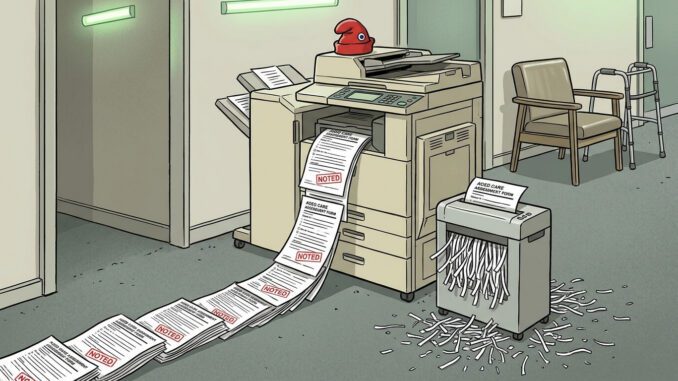
“Basically a copy and paste.”
Those are the words of a top mandarin who sat through the government’s confidential briefing on its new NDIS budget tool. Not a Greens senator. Not an advocate with a placard. A public servant. Rick Morton got them on the record, and broke the story, in The Saturday Paper on 31 October.
The catastrophic error being assiduously copied is the Integrated Assessment Tool, the algorithm that has decided since November 2025 how much help an older Australian gets to stay in their own home. Or not.
Commonwealth Ombudsman Iain Anderson published his verdict on it on 26 October. It reads like a coroner’s preliminary.
The machine’s decisions, he found, cannot be overridden by a human, “even if they are clinically inappropriate.” The emphasis is his.
Assessors were told otherwise. So was the public. Up to the eve of the new Act, the department kept assuring both that a person could step in. The law it had written gave nobody that power.
The department, Anderson found, “did not, and may still not, understand key components of the legal framework it created”. It was not even sure what law it had been asked to write.
The secretary, Blair Comley, puts it down to “the misunderstanding within the department.” A misunderstanding, in this case, with the force of law.
The assessors did win one concession. During the trials, the ombudsman notes, they told the department that writing their own notes was “very important.” So they got a box for notes. The algorithm never opens it. Whatever goes in “is not considered by the algorithm.”
Picture the nurse at your kitchen table. She writes that you can’t get up from the chair without two goes at it. She writes that the pill organiser is a week out of order. Every word goes into the box.
The box goes nowhere.
Copy.
One case sits in the report like a stone. An older woman could not do without a nurse or carer calling in to give her vital medication. The machine filed her under medium priority. She ended up in hospital and very nearly died, so slow was the response to her need.
Paste.
Now the NDIS. From 1 April 2027, a bit of commedia dell’arte worthy of Dario Fo, the “Reasonable and Necessary Budget Method”, starts setting disability budgets. Once it has spoken, nobody on the public payroll will be able to change its answer either.
Not even the tribunal. Michael West Media reports that the Administrative Review Tribunal changed 73 percent of the NDIS decisions it finalised in 2024-25. Under the new Act it can only send you back to the same machine for another go.
Nobody gets a word in. Your own doctors and therapists, your family, friends, the people who actually know you, the ones keeping you alive, can write what they like. The formula is built to ditch their reports at the door. And beware. Your nearest and dearest; a supportive family could cost you dearly. Officials who have seen the draft rules told Morton they mandate “discounting” wherever the rules detect “24/7 family care.”
If your family is home, the machine books them as staff. Unpaid. Unrostered. Never off sick.
The questionnaire that feeds the formula is called I-CAN. Sam Arnold, an academic in Western Sydney University’s psychology school, helped develop it. Writing with the campaigner George Taleporos, Arnold now says he is “concerned” by the “apparent diminution” of clinical judgement. A GP’s letter can go unread.
When a “client’s” needs are tangled, or shift from week to week, they argue, a clinician’s report is “not a luxury.” It is “a safeguard.”
The man who helped build the instrument is warning you about the xerox machine it has been bolted to.
Copy. Paste.
The official charge sheet reads consistency and transparency. Nobody would be singled out, the department’s salesman assured the states. Every budget would be “worked out in the same way.”
A Victorian official interrupted. “Why don’t you just say this is about saving money?”
Nobody said it. Nobody needed to. The budget papers say it for them.
The NDIS package is meant to claw back $37.8 billion in four years, and something like $170 billion inside a decade. By the Grattan Institute’s count, that one package supplies about 60 percent of all the savings and reprioritisations in the May budget.
Aged care has been pulling its weight too. Talk about taut, trim and terrific.
In 2025-26 the government spent $1.4 billion less on aged care than it had budgeted. The Final Budget Outcome blames “provider capacity constraints”, which is Treasury for not enough carers. The deficit came in $6 billion better than forecast. Finance Minister Katy Gallagher felt she should spell it out to the press: “This really relates to a few programs spending less, so in aged care, PBS, across the childcare system.”
In the same year, 6,436 people died waiting for the home care the government had assessed them as needing. That is up 34 percent on the year before. The two figures are not strictly comparable: Support at Home replaced the old home care packages in November 2025.
The caveat is true. It does not make the number smaller.
The deficit improved. So it goes.
When home care fails, the bill turns up in a state hospital bed. South Australia spent $123.7 million last year caring for older patients stranded in hospital waiting for aged care: $1,318 a day each, against about $320 a day for an aged care bed. Queensland has taken to the airwaves and the papers to tell Canberra so. The NDIS plan plays the same game on a different ledger: the states are expected to rebuild the disability services they wound down when the scheme arrived.
Then there is the consultation. It is a pea and thimble act.
Canberra invited people with disability to say how the budget rules ought to work. But the rules were already written. In early October Leo Hardiman, a former senior lawyer at the Australian Government Solicitor and now with consultancy SPA Australia, took the states through them.
SPA is being paid $948,000 for his legal work.
Seven days later, the window for public comment shut. The public never saw a word of the draft. You were invited to guess which thimble hid the pea. The pea was in Canberra’s pocket all along.
The department’s answer is that the NDIS Amendment Act 2026 lets computers handle only “limited administrative functions, such as payments and claims or how a participant’s plan is organised.”
Watch the hands. A person’s budget is how their plan is organised. Calling the machine that sets it an administrative function is bare-faced equivocation. By the same logic a guillotine is a hat adjustment.
Both machines answer to one minister, Mark Butler, and one department. Butler holds the two portfolios the way a liquidator holds both sets of books. Tight in the scrum. Roy and HG would call it the squirrel grip.
In May, a po-faced Butler told The Australian’s The Front podcast that the lessons of Robodebt were “front of mind.” The government would be careful, he said, to make sure “that humans are always in the loop in making important decisions.”
In the aged care loop, the ombudsman found, “a human decision-maker does not decide” who qualifies or how urgent their need is. The machine does. The human is in the loop. The loop is closed.
The ombudsman also found the aged care tool fails Recommendations 17.1 and 17.2 of the Robodebt Royal Commission, the ones on transparency in automated decisions. Labor called that royal commission.
Parliament tried to fix the aged care machine. In July the Senate passed Anne Ruston’s bill to restore human override, with only Labor voting against. Labor’s majority killed it in the House. In August the Senate called for the tool to be scrapped altogether.
The ombudsman’s first recommendation was a law letting assessors put their own judgement in place of the machine’s. The department’s reply form offers three boxes: Accepted (in principle), Not accepted, Noted. It ticked Noted.
What Parliament got instead, on 15 October, with Coalition votes, was the government’s “escalation pathway”. From January 2027, hard cases go back up to the department whose machine got them wrong. The pathway comes with a sunset clause: it covers decisions made only until the end of 2027. For the NDIS, nothing at all.
I know a man who has met this machine. He is 78, lives in Western Victoria and stands high in his community. I have known him all my life.
He appealed his assessment. Forty-five days later, an email arrived. It was signed by no one, only by a Review of Decisions Section. It promised to write again with the outcome. Then it explained what happens if it doesn’t. If no decision reaches him within ninety days, the reviewer “is taken to affirm” the original decision. It did not mention the Administrative Review Tribunal, the one door the law leaves open.
Silence is the decision. Nobody has to sign it. A reviewer who reviews nothing is taken to agree. It is the system in its purest form: a refusal with no author.
At the side-show of Senate estimates, a public servant can take you on notice and put you on hold, forever. Taken on notice. Taken to affirm. It is the orchestrated hold music of an ever more autocratic and remote mandarin prefecture in a Phrygian cap.
A state official put it to Morton plainly. “They can’t say they weren’t warned.”
They were warned by the ombudsman. They were warned by the Senate, twice. They were warned by the states in their own briefing, and by the academic whose questionnaire they bought. They were warned by 6,436 empty chairs.
Copy. Paste.
Call it what it is. This was never copy and paste.
It was cut.
The department promises a “root cause analysis.” It need not look far. Its secretary has already written down the finding.
“The Government decided in 2024.”
This column stands on Rick Morton’s reporting, “Exclusive: Confidential briefing reveals NDIS copy and paste,” in The Saturday Paper of 31 October 2026. He broke the story. “Basically a copy and paste” are the words of the official he interviewed, and every quotation from the October briefing comes from his reporting, used here with full attribution for comment and satire. The ombudsman’s findings are from the ombudsman’s own report, Katy Gallagher’s words from the Treasury transcript. Further reporting from Michael West Media and The Weekly SOURCE is linked in the text. The jokes, and the anger, are mine. Read Morton in full. Better still, subscribe.
Keep Independent Journalism Alive – Support The AIMN
Dear Reader,
Since 2013, The Australian Independent Media Network has been a fearless independent voice – holding power to account and delivering journalism that matters.
Running this site isn’t cheap. Rising costs mean we need your support now more than ever. Every donation, big or small, keeps our servers running, our writers working, and our stories free for everyone.
Donate here:
PayPal or credit card – just click on the Donate button below
Direct bank transfer: BSB: 062500; A/c no: 10495969

We’ve also set up a GoFundMe as a dedicated reserve fund for hosting and future improvements.

Thank you for standing with us. We couldn’t do this without you.
With gratitude,
The AIMN Team

Governments may change, but those who have built kingdoms for themselves in government departments, mostly stay the same. Those who are smart enough not to get embroiled in politics but wield power from the shadows.
While I don’t doubt the contents of the article, this was happening years before Labor got into power. Aged care assessments done by contractors who prefilled docs and refused to rectify errors. Aged care nominally granted, but with no way of accessing the assistance.
In my family, a year after the death of an aged loved one, a breezy phone call from a privatised ngo to check how things are and if there is any further help needed.
Things need to change, and pressure is needed at a political level to weed out the deeply embedded incompetence and callous attitudes within those charged with delivering services.
Well FFS at least give us the option to knock ourselves off!
Yep ….. Sadly the government is more intent upon saving the USA (Undemocratic Sewer of Apartheid) from the enemies it is creating for itself and for the benefit of the US NE Military Industrial Complex armaments manufacturers, while gifting Australian sovereignty as tribute to the most self-serving exceptionalist nation than in providing infrastructure & services to Australian voters.
Both political duopoly parties have done it religiously since the Dismissal of the Whitlam ALP government in 1975, turning instead to building the best interests of foreign owned multinational corporations at every cost to Australian voters as our nation is transformed into a third world export economy of European & American entities.
The extent of this ”treasonous” activity goes deep into legislation to guarantee that profits flow overseas with little , preferably no, cost to the foreign entities.
However, as noted above, it is the professional self-serving government desk jockeys, some earning more than the PM, who benefit most from within their empires paid for by the taxpayers to serve those same taxpayers. Rather, like Beetrooter, these overpaid, usually underwhelming bureaucrats live the life of Riley at public expense.
Now anybody for a ”political donation”??
“In May, a po-faced Butler told The Australian’s The Front podcast that the lessons of Robodebt were “front of mind.” The government would be careful, he said, to make sure “that humans are always in the loop in making important decisions.”
How that bloke can look anybody in the face is a Supernatural phenomenon, that also includes the entire cabinet who have authorized this.
Robodebt on steroids with heartless, soulless people and the mess that they have crated in addition to this with AUKUS is obviously bordering on the brink of bankruptcy, morally, ethically and financially.
Maybe they feel ‘safe’ at such distance to the polity, however that’s a mistake, as what comes around goes around.
Then there’s this list of political controversies federally in this country….
https://en.wikipedia.org/wiki/List_of_political_controversies_in_Australia#Federal_controversies
heather, thanks for this. You’ve put your finger on it. “Humans in the loop” sounds like a safeguard and works like an alibi. In the new assessment system the human is in the loop the way a passenger is in the loop on a runaway tram. The assessor types in the answers. The algorithm hands down the verdict. The assessor can’t overrule it.
That’s the lesson of Robodebt learned backwards. The Royal Commission called that scheme crude and cruel. The government’s answer is to build a politer version and point it at people in their eighties.
You’re right about the distance, too. Cabinet ministers don’t wait months for a home care package. Nobody scores their mums and dads with a spreadsheet. That kind of insulation breeds a moral deafness, and you can hear it every time Butler opens his mouth.
AUKUS goes in the same ledger. Up to $368 billion for submarines we may never see, while the old are told the cupboard is bare.
But you’re right that the bill comes due. Pensioners vote. So do their kids, and their kids’ kids. Keep writing in, Heather.
NEC Spot on, and you’ve got the timeline right. 1975 was the day Canberra learned who it really answers to, and neither side of the duopoly has forgotten it since. Pine Gap stays open, AUKUS gets signed, and the gas goes out the door with barely a royalty to show for it. Somewhere in Arizona a shareholder sleeps well.
The one bit I’d push back on is the desk jockeys. Some of them do very nicely, no argument there. But the real money isn’t in the public service. It’s in the people who’ve been hollowing it out. Every time a department gets cut, the work doesn’t disappear. It goes to the Big Four, at three times the price, and comes back as a slide deck. PwC handed confidential tax policy to its own clients and still got government work. The bureaucrat on a fat salary is the small fish. The consultant billing $2,000 a day to tell the minister what he wants to hear is the shark.
As for Beetrooter, the life of Riley is never short of a sponsor.
A political donation? Only if it comes with a seat at the table, mate. That’s the going rate.
Lorraine, You’re right, and thank you. This didn’t start with Labor. The Coalition left behind a waiting list for home care packages that ran into six figures, and the Royal Commission called its interim report, simply, Neglect. Labor inherited the rot. What it’s done is automate it.
I’m sorry about your loved one. That phone call, a year late and full of cheer, says more than any report. It’s what happens when care becomes a contract. The NGO ticks a box marked “follow-up”, the department ticks a box marked “outsourced”, and nobody anywhere is answerable for the fact that the person they were meant to help is already gone.
That’s where I’d add something to your point about the people in the shadows. Some of them are callous, no doubt. But the bigger problem is a system built so that nobody has to own a failure. The contractor blames the form. The form blames the algorithm. The minister says humans are in the loop. Accountability gets passed around like a hot potato until it falls on the floor.
You’re dead right about pressure. It has to be political, and it has to be loud. Stories like yours are how it starts.
David, that is just one of the distressing issues that occurred both before and after my loved one passed. I suspect that, being generous, some people are busy or distracted and really don’t care to think about the vulnerable people their actions affect.
Then there are those who actively don’t care because they believe the vulnerable are somehow undeserving. Its often people like this who rise to the position where they are assuring the political leaders that all is fine.
Pressure has to be loud and political. People need to be held accountable for their actions.
Heather, a neighbor who worked at Centrelink during the height of Robodebt told me how some colleagues cried, objected, fell into deep despair, and quit because senior people demanded they applied fake debts. There were Centrelink staff who took their own lives because they were pressured to do the unthinkable.
The office bullies of all ranks, the ones who appeared to take some joy in imposing Robodebt, need to be held accountable for their actions.