By Chen Ziqi
The opening of the Pinglu Canal in southern China on September 16 is more than the launch of a new waterway. By creating a shorter route from southwest China to the sea, the canal could change how goods move between China and ASEAN countries and create new opportunities for trade and cooperation.
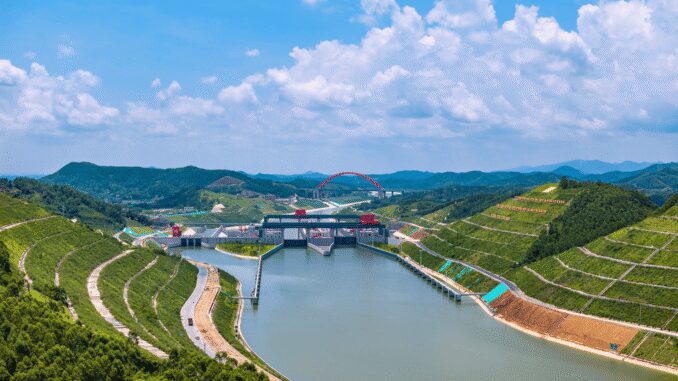
The 134.2-kilometer canal links the Xijiang River shipping network with the Beibu Gulf, running through Guangxi Zhuang Autonomous Region toward the sea toward Qinzhou Port. Designed for vessels of up to 5,000 tonnes, it provides a more direct southward route from southwest China to the South China Sea.
Previously, cargo moving from southwest China to the coast often had to follow a longer route eastward through Guangdong before reaching the sea. The Pinglu Canal effectively cuts across this detour, shortening the inland shipping distance by more than 560 kilometers. Authorities estimate that the new route can reduce logistics costs by 18% to 30% and save more than $700 million in transportation costs each year.
For businesses and ASEAN economies, however, the significance of the Pinglu Canal may go beyond savings on individual shipments.
Speaking to China Central Television, China’s national television broadcaster, ambassadors from several ASEAN countries highlighted its regional significance. Cambodian Ambassador to China Soeung Rathchavy said the canal could facilitate the movement of agricultural products between Cambodia and China, allowing Cambodian goods to enter and leave China more easily.
Lao Ambassador to China Somphone Sichaleune said the canal could help landlocked Laos overcome the challenge of limited access to the sea and open up new development opportunities.
From a shorter route to a wider supply chain
The canal’s significance lies partly in where it connects. Guangxi sits close to Vietnam and is already part of the New International Land-Sea Trade Corridor, which links inland China with ASEAN markets and other international destinations.
The new route could make it more economical to move not only finished goods but also raw materials and intermediate products across the region.
For example, agricultural products, rubber, semi-finished products and other commodities from ASEAN nations could be transported to southwest China for processing or manufacturing, while machinery and manufactured goods could move in the opposite direction.
This could gradually turn transportation infrastructure into part of a broader production network, in which different stages of manufacturing are distributed across China and ASEAN according to their respective strengths.
One example can already be seen in Nanning, Guangxi.
In May last year, the China-Cambodia Rubber Production Base began operations in Nanning’s Comprehensive Bonded Zone.
Backed by Cambodian and Thai partners, the project includes a rubber mixing production line with an annual capacity of 24,000 tonnes, as well as research and warehousing facilities. The project was expected to generate industrial output of about $149.8 million in 2026.
The project shows how a commodity that once mainly moved across borders as a raw material can become part of a wider production chain, with raw materials, processing, technical expertise and markets spread across different countries.
As the Pinglu Canal shortens the inland shipping distance between southwest China and the coast, it could make such cross-border production networks more efficient and give companies greater flexibility in deciding where to source, process, store and distribute goods.
The potential impact could extend beyond individual factories to supporting industries such as logistics, warehousing and further processing.
Growing trade, growing connectivity
The scale of China – ASEAN trade helps explain why improving physical connectivity between the two sides matters.
China has been ASEAN’s largest trading partner for 17 consecutive years. Data from China’s General Administration of Customs shows that, in the first eight months of this year, two-way trade between China and ASEAN reached $887 billion, accounting for about 17% of China’s total foreign trade.
Speaking at a reception in Beijing on September 15 marking the fifth anniversary of the ASEAN – China Comprehensive Strategic Partnership, ASEAN Secretary-General Kao Kim Hourn said the partnership is delivering real benefits to more than 2 billion people, spanning regional peace, stability and prosperity, trade and investment, connectivity, digital transformation, agriculture, education, tourism and sustainable development.
The Pinglu Canal adds a new physical link to these expanding economic ties, alongside rail and road networks, ports, trade corridors, cross-border industrial projects and digital connectivity that are increasingly linking China and ASEAN economies.
Linking trade, infrastructure and the green transition
The canal is also opening at a time when China – ASEAN economic cooperation is expanding beyond traditional trade in goods.
The China – ASEAN Free Trade Area (CAFTA) 3.0 Upgrade Protocol, signed in October last year, adds new areas of cooperation, including the digital economy, green economy and supply-chain connectivity.
This provides a wider framework for trade and investment in emerging industries, including those related to the green transition.
The Pinglu Canal could complement that framework by providing physical infrastructure to move some of the products and materials involved in this transition.
Electric vehicles and batteries are a case in point. As production and trade in new-energy products expand across China and ASEAN, efficient and cost-effective transport links will become increasingly important for shipping batteries, components and finished vehicles between production bases and markets.
The canal could provide another waterway option for such cargo, particularly between southwest China and the Beibu Gulf, while potentially reducing the carbon intensity of freight transport compared with road haulage.
The canal itself is also being positioned as a platform for greener transport. In August, Chinese battery maker CATL signed a strategic cooperation agreement with the Pinglu Canal Group covering zero-carbon energy systems for the canal.
The plan includes electric vessels, battery leasing, renewable energy, energy storage and smart energy-management systems.
The real test of the Pinglu Canal will not be how many ships pass through it, but what changes because they can.
The canal may have been built to shorten the route to the sea. Its bigger significance could be adding new momentum to the broader China – ASEAN partnership by making trade and economic cooperation easier and more connected.
Chen Ziqi is a reporter with CGTN Radio
Keep Independent Journalism Alive – Support The AIMN
Dear Reader,
Since 2013, The Australian Independent Media Network has been a fearless independent voice – holding power to account and delivering journalism that matters.
Running this site isn’t cheap. Rising costs mean we need your support now more than ever. Every donation, big or small, keeps our servers running, our writers working, and our stories free for everyone.
Donate here:
PayPal or credit card – just click on the Donate button below
Direct bank transfer: BSB: 062500; A/c no: 10495969

We’ve also set up a GoFundMe as a dedicated reserve fund for hosting and future improvements.

Thank you for standing with us. We couldn’t do this without you.
With gratitude,
The AIMN Team
“China has been ASEAN’s largest trading partner for 17 consecutive years. Data from China’s General Administration of Customs shows that, in the first eight months of this year, two-way trade between China and ASEAN reached $887 billion, accounting for about 17% of China’s total foreign trade.”
Uhm …. that 17$ converts to OVER FIVE TRILLION DOLLARS ($5,000,000,000,000) PER YEAR!!
Look ….. PRC China can build an extensive new canal system using civil engineering rather than the demolition by bombardment method preferred by POTUS Butcher Bibi and PPOTUS (Pederast Protector of the Undemocratic Sewer) TACO. How long has it been since there was a major civil engineering project in America??
A political sceptic could reasonably conclude that we are seeing the TRUMP regime destroying America from within by ignoring the necessary principles of democracy. How long passes before ”the fall of the Washington Wall” is a matter for speculation.
Meanwhile, there is still a government keen on improving the well being of their people which is prepared to plan, implement & execute the necessary projects to make it all happen. The usa has lost the plot and the lead and the respect of the world during these TACO Trumpery regimes.
Thank you for an excellent ”happy” article.
And that is the main difference between current China and USAnia – carrots from China, nothing but sticks from Trumpistan.
Yes indeed Cocky, another great article.
“Meanwhile, there is still a government keen on improving the well being of their people which is prepared to plan, implement & execute the necessary projects to make it all happen.”
Exactly.
Since the Russian Revolution we’ve heard continuously — “Socialism bad.”
Well, that one has finally worn thin.
Candidates for election in the US are now openly identifying as socialists, something that was inconceivable just a few years ago.
I wonder how long it will be before ALP candidates declare their socialist convictions?
Or is the ALP no longer seen as a suitable vehicle for a genuine government for the people?