Continued from What Went Wrong? (Part 5)
Part 6: Have We Moved Forward?
There was a time when I genuinely believed we were moving forward.
I remember the election of Barack Obama in 2008 and the feeling that, after the years of George W. Bush, America might finally be turning a corner. I remember Kevin Rudd’s victory in Australia in 2007 and feeling something similar. After more than a decade of John Howard’s Coalition government, there was a sense that perhaps Australia was ready for something different.
I wasn’t alone in feeling that way.
For a while, it seemed possible that politics might become less about fear and division and more about what governments could actually do for the people they governed.
Almost twenty years later, I’m not so sure.
When I look at Australian politics today, one person in particular keeps coming back into the story.
Pauline Hanson.
Hanson has been in Australian politics for a very long time. She first entered the national consciousness in the 1990s, when her political message centred heavily on immigration, multiculturalism and what she saw as the preferential treatment of Indigenous Australians. Her political career has gone through extraordinary highs and lows, but she has repeatedly managed to return to the political conversation.
And that raises an uncomfortable question.
How much of Pauline Hanson’s political influence has been created by Pauline Hanson herself – and how much has been created by the attention we have given her?
Because politics has changed enormously since Hanson first appeared.
The traditional media no longer controls the political conversation in the way it once did. Television, newspapers and radio compete with Facebook, X, TikTok, YouTube, podcasts and thousands of online commentators. Politicians can now speak directly to millions of people without having to pass through a journalist or editor.
But the old media still matters.
In fact, sometimes it matters precisely because politicians understand how it works.
Attention is power.
Say something provocative and the cameras arrive. Attack the media and the media reports the attack. Make a controversial statement and suddenly the controversy becomes the story.
That doesn’t mean the media should ignore Pauline Hanson. Political figures should be scrutinised, particularly when they make claims that deserve examination. A functioning democracy requires journalism that questions politicians rather than simply repeating what they say.
But there is a difference between scrutiny and amplification.
And that distinction has become increasingly difficult to make.
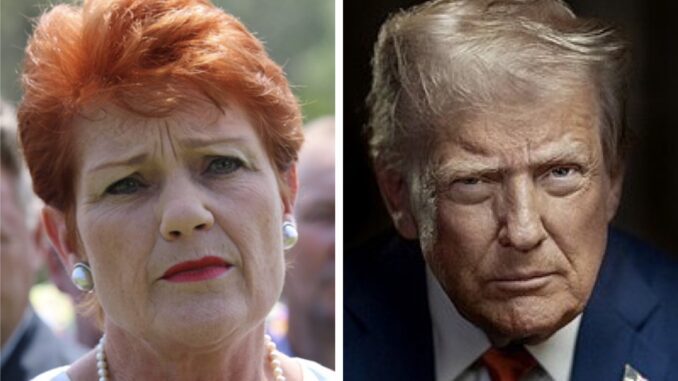
In June this year, Hanson’s appearance at the National Press Club demonstrated just how far she has travelled from the political margins of the 1990s. Her speech received national attention as she attacked multiculturalism, climate policy and the media, while adopting some of the confrontational political style that has become familiar in the age of Donald Trump.
That is significant.
Not because Pauline Hanson suddenly became a different politician, but because the political environment around her has changed.
Donald Trump did not create Pauline Hanson. One Nation existed long before Trump entered the White House. Hanson had already built a political movement around immigration, nationalism and opposition to what she regarded as political correctness.
But Trump demonstrated something that politicians everywhere could see.
A politician could attack the media, attack political institutions, present himself as the voice of ordinary people against an establishment, and turn controversy itself into political currency.
He demonstrated that outrage could become a political strategy rather than simply a consequence of politics.
And whether deliberately or not, that changed the environment in which people like Hanson operate.
It is important, however, not to make the mistake of assuming that everyone who votes for One Nation is a racist or an extremist.
People vote for political parties for many different reasons.
Some may be concerned about immigration. Some may be angry about the cost of living. Some may believe governments have lost control of Australia’s borders. Some may feel that the major parties no longer listen to them. Others may simply agree with particular One Nation policies.
Those concerns do not automatically make someone far right.
Nor does disagreeing with immigration policy, multiculturalism or government policy make someone a racist.
The danger begins somewhere else.
It begins when political frustration is turned into hostility towards entire groups of people. It begins when minorities become convenient targets for problems they did not create. It begins when political disagreement becomes hatred, when misinformation replaces evidence and when political violence becomes something that can be excused because the other side supposedly deserved it.
That is where the politics of fear becomes powerful.
Fear offers simple explanations for complicated problems.
- Housing is expensive? Blame immigrants.
- Wages aren’t keeping up with prices? Blame foreigners.
- Government isn’t working properly? Blame elites.
- Society is changing? Blame multiculturalism.
- The media doesn’t agree with you? Blame journalists.
It is a remarkably effective political formula because it gives people something very human: someone to blame.
But there is another question we need to ask: Why are so many people receptive to it?
Pauline Hanson didn’t invent the frustrations that exist in modern Australia. Neither did Donald Trump invent the frustrations that existed in America.
Politicians can exploit grievances, but grievances have to exist before they can be exploited.
That brings us back to the question running through this entire series.
What went wrong?
Perhaps it wasn’t one government.
Perhaps it wasn’t one political party.
Perhaps it wasn’t even one politician.
Perhaps what went wrong was that, over time, we became less confident that our political institutions could solve the problems confronting ordinary people. When people lose faith in government, they don’t necessarily become apolitical. Sometimes they look for someone who promises to tear the system apart.
That is where politicians like Hanson can find political space. And it is where Trump found his.
The media has a role in this as well.
Journalists have a responsibility to report what politicians say. But the media also has to recognise that attention can have consequences. A politician who understands that controversy generates coverage can deliberately create controversy because the coverage itself becomes part of the political strategy.
The irony is almost impossible to miss.
A politician can complain that the mainstream media is biased against them while simultaneously benefiting enormously from the attention that same media provides.
And the media can complain about the politician’s behaviour while providing them with another hour of television, another headline and another opportunity to reach an audience.
Everybody gets something from the arrangement, except perhaps the quality of the political conversation.
That is one of the great changes since 2007.
Politics has become faster, louder and more permanent and there is no longer much opportunity for an argument to disappear.
Every statement can become a headline. Every headline can become a social media post. Every social media post can become another argument. And before one controversy has finished, another has already arrived. In that environment, outrage is valuable. Quiet competence isn’t nearly as interesting. And perhaps that helps explain why someone like Pauline Hanson can remain politically relevant decades after first entering national politics.
But there is another reason we should pay attention to her rise: She tells us something about ourselves.
It is easy to look at Hanson and ask what is wrong with her politics. A harder question is to ask why her politics continue to find an audience. And perhaps the answer is uncomfortable.
People don’t need to believe everything a politician says to believe that politician is speaking for them. Sometimes they simply need to believe that somebody is listening.
That takes us all the way back to where this series began.
In 2007, I believed Australia was moving towards something better.
In 2008, Obama’s election gave me a similar feeling about America.
I believed that perhaps we had learned something from the mistakes of the past. That governments could be compassionate without being weak, that nations could cooperate rather than constantly confront one another, and that politics could be about improving the lives of ordinary people.
Almost twenty years later, we have travelled a very long way from that moment.
We have seen governments come and go. We have seen institutions weakened and rebuilt. We have watched social media transform political communication. We have watched populism move from the margins into the mainstream. We have seen Donald Trump become President of the United States twice.
And here in Australia, Pauline Hanson is once again commanding enormous political attention.
So perhaps the question I began asking six articles ago has a different meaning now.
What went wrong?
Maybe nothing went wrong in one dramatic moment.
Maybe it happened gradually.
A little less trust here.
A little more cynicism there.
A little more fear.
A little more anger.
A little less faith that government could actually make things better.
And perhaps, eventually, we reached the point where the politics of fear became more powerful than the politics of hope.
I don’t know whether Australia has moved forward or backwards since 2007.
Perhaps history will eventually make that judgement for us. But I do know that we have moved a long way from the Australia I thought we were becoming.
And that leaves me with one final question: Have we moved forward, or have we simply moved somewhere else?
Perhaps the answer depends on what we believe progress actually means.
If progress means economic growth, technological change and bigger houses, then perhaps we have moved forward.
If progress means treating people with greater dignity, trusting evidence, respecting institutions, listening to people who disagree with us and refusing to make minorities the scapegoats for problems they did not create, then the answer may be more complicated.
And perhaps that is the uncomfortable conclusion to this whole story.
Democracy doesn’t guarantee that history moves forward.
It only gives us the opportunity to decide which direction we want to take.
The choice is never finally between Pauline Hanson and someone else.
It is between fear and hope. Between division and cooperation. Between a politics that tells us who to blame and a politics that asks what we can actually do.
And if we have learned anything since 2007, perhaps it is that hope cannot simply be assumed.
It has to be defended.
It has to be earned.
And above all, it has to be renewed.
Because governments don’t belong to politicians, and they don’t belong to corporations. They don’t belong to media empires and they don’t belong to the loudest voice in the room.
They belong to the people.
Perhaps that was what I believed back in 2007.
And perhaps, after everything that has happened since, it is still worth believing.
Keep Independent Journalism Alive – Support The AIMN
Dear Reader,
Since 2013, The Australian Independent Media Network has been a fearless independent voice – holding power to account and delivering journalism that matters.
Running this site isn’t cheap. Rising costs mean we need your support now more than ever. Every donation, big or small, keeps our servers running, our writers working, and our stories free for everyone.
Donate here:
PayPal or credit card – just click on the Donate button below
Direct bank transfer: BSB: 062500; A/c no: 10495969

We’ve also set up a GoFundMe as a dedicated reserve fund for hosting and future improvements.

Thank you for standing with us. We couldn’t do this without you.
With gratitude,
The AIMN Team

Everyone is too politically disengaged now. Too busy doing life. Need to take more notice of whats happening.
Rereading Nancy MacLean’s Democracy in Chains and Jane Mayer’s Dark Money, around 2009-10 the emergence of Obama and Democrat’s flat footedness, had Koch Network emerging…raising millions at secretive events to fight the centre.
Behind multiple astroturfs, PACs, vicious campaigns and the faux grass roots Tea Party to attack Obama, Democrats and the centre to gridlock US democracy for fossil fuel oligarchs and ‘segregation economics’.
In parallel with their now Project2025 partners the anti-immigrant MAGA Tanton Network whose people informed Tucker Carlson et al at Fox News which created the Trump ‘Frankenstein’; while nudging RW MSM further right and clubbing up with social media to radicalise ageing regional audiences.
There is a use by date, hence the urgency on immigration and the great replacement of white Christian nationalist voters with more educated, centrist and diverse younger gens……
All three networks have a strong presence in Australia desperate at the moment to platfrom ON on immigration, population, anti-clean energy, anti-superannuation etc..
Acting as a nasty narrative delivery system, so the RW MSM and LNP can claim plausible deniability, till they take cover from ON before any election campaign?
It is very sad to realise that ignorant imbeciles are currently running the Democratic system, we all grew up with.
Did we ever expect Hellenic Democracy to achieve more than Tribal Agreements?
Educated and intelligent individuals can all see that Civilisation is under threat. Do any of us with a background in International Law; feel we have an optimistic future in the next year?
Is there anyone out there willing to battle the corporate hegemony of our Corrupted Democratic, Civilised future?!
If you’re not with TRUMP; then you’re with the Evil Anti-Christ, and God Forgive you”
If you’re not with Trump, you probably realise that its all a scam!
WAKE UP TO ALL OF YOU; YOU ARE READY TO FACE THE TRUTH!!!
SORRY, you pathetic investors in our destroyed system of DEMOCRACY. There is no future in our Democratic System: Other than the hope of a continued Democratic System!
Interesting posting from Andrew Smith also.
Democracy is constantly changing and not for the better. Add to this, the fact that Tweedle Dee and Tweedle Dum became complacent, but the electorate still voted for them!! Figure that!!!
@ Andrew Smith: The recent update of how the whingers are winning. However, the cause in Australia dates back to our English heritage of forelock tugging that created the dreaded ”Great Australian Cultural Cringe”.
When sportspersons become world champions the Australian public notices, roars approval and goes back to sleep.
The first ”rebellion” at Castle Hill (1804) was put down by the military hanging the mutineers on site. The Eureka Stockade Rebellion (1851) was also put down by English troops, but sparked the demand for self-government.
So the 20th century Australian cultural cringe was seeded in the economic & military successes of Victorian England, and sycophantic politicians, notably led by Robert Menzies, an unapologetic Monarchist who, while in London fighting WWII, denied Australian troops returning from the Middle East until replaced by John Curtin (ALP).
Naturally, everything English was considered the best available. The English banking system stripped our Australian financial sovereignty to create the 1929 Depression Squeeze (Remember Neimeyer??) when we had built to Indian Pacific Railroad entirely with Australian banking practices ….. effectively for free!!
The cringe continued deep into the 20th century, every Australian innovation, especially in government departments, was ”gifted” to foreign interest to make huge profits for their shareholders, rather than Australian citizens. Think the same strategy with sales of natural gas to Japan on long term contracts while Australians but their own gas on spot markets high prices.
The so-called ”Cabbage Tree ”kids, known by their hats made from Cabbage Palm fronds, would have none of this cringe rubbish. They were the smarts on the street, surviving without government assistance and proud of their achievements.
When we are proud of our achievements then the cringe philosophy is excluded. Somebody should inform our politicians that kissing the backside of foreign politicians is NOT the optimal way forward.
Maybe there’s hope yet, that a genuine party of the people will emerge here in Australia.
There is a decisive shift away from centre-left and centre-right parties taking place in Europe.
BERLIN, Sept 20 (Reuters) – The far-left Left Party’s victory in the Berlin state election on Sunday was overshadowed by the continuing advance of the far-right in eastern Germany but it marked another defeat for Chancellor Friedrich Merz’s ruling coalition.
A significant influence in the move away from the centre in Europe is the clamour from the centre for a suicidal war against Russia.
Ordinary folk, for some reason beyond the grasp of the centrists, would prefer to have no war.
Will it take an imminent war for us to wake up to the need for serious change?
It’s worth noting the influence of the mainstream media in how these events are portrayed.
The Left Party in Germany is referred to as far-left or communist, while the AfD, a conservative party, is referred to as far-right.
The centrists with their lap-dog media are more afraid of losing office than they are of a war that will result in total ruin of the country.
Liberal democracy has completely lost the plot.
Short answer Michael, we went backwards.
Since the Reagan ‘trickle-down’, the capture-capitalism of neo-liberalism / neo-conservatism, 9/11 & America’s reaction; ‘War on terror’ (a guile all of its own), the subprime crisis & the GFC, governance became increasingly chicken shit, and everyone was taught to have fear – amongst the crumble it seemed inevitable.
Then came Trump and the pandemic. Both (in league with Israel & others) created a pandemic of fear. The olde guard of the ‘west’ dwelt in purse-lipped histrionics premised on history’s fuck-ups.
The ‘west’ is stuck in it, stalled, cringing, threatening & lashing out.
So much for liberal democracy.
Perhaps China will help them see the light?
Now Pawlein is selling favours for a mere $50,000 for anybody so inclined.
”One Nation received nearly $50,000 from one of Australia’s biggest labour-hire firms after the party performed an eleventh-hour reversal and supported legislation that gutted several legal challenges in which the company, WorkPac, was potentially exposed to $100 million in liabilities.
”The previously unreported contribution from WorkPac raises questions about the motivations behind One Nation’s decision to reverse its position. A One Nation source also alleged WorkPac made contributions before and after the March 2021 vote, casting doubt on the party’s disclosures.
”Australian Electoral Commission disclosures show Pauline Hanson’s party received $48,000 from WorkPac across four transactions during the 2021-22 financial year. It represented just under 10 per cent of the party’s disclosed receipts for that period. They are the only contributions the company has made to One Nation.
”WorkPac, Australia’s largest privately owned recruitment and staffing business, also gave $57,000 to the Liberal Party across the 2020-21 and 2021-22 financial years.”
From SMH (041026) (paywall)
https://www.smh.com.au/politics/nsw/a-100m-liability-a-50k-donation-and-one-nation-s-sudden-change-of-mind-20261004-p611y9.html
Gina’s current useful tool will do anything for money, it used to be called the world’s oldest profession.She’s a soulmate for that morality vacuum, the arsehole Trump.In fact she’s got quite a few mates of similar ilk.Funny how most of them are filthy rich,makes her talk of concern for the strugglers stand out for the utter bullshit it is.