Continued from What Went Wrong? (Part 2)
Part 3 – The Reset Button
By the time Donald Trump left the White House in January 2021, Americans were exhausted. Exhausted by the anger, exhausted by the division, and exhausted by the constant assault on institutions, expertise and international cooperation.
And perhaps most of all, exhausted by the feeling that politics had become a battle rather than a means of governing.
Then something happened that gave me a little hope again: the political pendulum began to move.
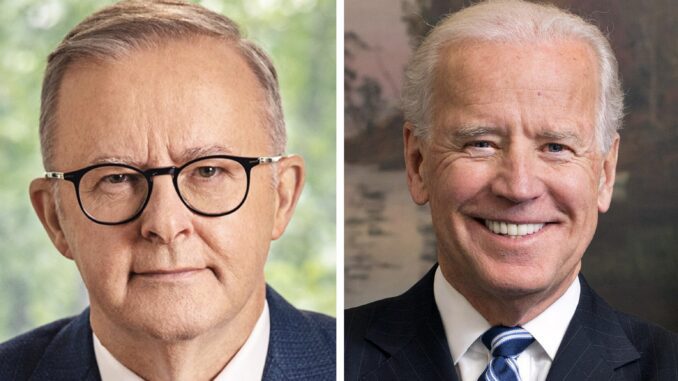
In the United States, Joe Biden defeated Donald Trump in the 2020 presidential election.
In Australia, Anthony Albanese led Labor to victory over Scott Morrison in 2022.
For a moment, it felt as though someone had found the reset button.
Perhaps we hadn’t lost our way after all. Perhaps democracy still had the capacity to correct itself. And perhaps voters had looked at what they had experienced and decided:
Enough.
Biden and the attempt to rebuild
Joe Biden’s presidency was never going to be as dramatic as Trump’s.
And perhaps that was precisely the point.
After four years in which almost every day seemed to produce another political crisis, Biden presented himself as something rather different.
- He spoke about restoring normality.
- He spoke about rebuilding alliances.
- He spoke about listening to scientists.
- He spoke about repairing institutions.
And then his administration began doing something that governments are supposed to do.
It governed.
The Bipartisan Infrastructure Law committed hundreds of billions of dollars to rebuilding America’s physical infrastructure – roads, bridges, public transport, clean water and broadband.
After decades of talking about America’s ageing infrastructure, the federal government was actually putting money into rebuilding it.
The Inflation Reduction Act went further.
It represented one of the largest investments in climate and clean-energy policy in American history, supporting renewable energy, electric vehicles and domestic clean-energy manufacturing.
But there was another part of the legislation that particularly interested me.
Health care.
For years, Americans had watched pharmaceutical companies make enormous profits while ordinary people struggled to afford medicines. The Biden administration introduced a $35 monthly cap on insulin for many Medicare beneficiaries. It also gave Medicare the ability to negotiate prices for certain prescription medicines.
For a country in which the cost of medicines can be a serious financial burden, that was significant. It wasn’t revolutionary. It wasn’t socialism.
It was government doing something rather basic: using its power to make life a little easier for ordinary people.
There were other changes.
The Respect for Marriage Act provided federal protections for same-sex and interracial marriages.
There was renewed investment in science and renewed emphasis on climate policy. And, perhaps most importantly after the previous four years, there was a renewed commitment to America’s alliances and international institutions.
The Biden administration wasn’t perfect. No administration is. But compared with what had come before, it felt like someone had switched the lights back on.
Perhaps America had found its way back.
And then there was Australia
Two years after Biden’s victory, Australians went to the polls. Scott Morrison’s Coalition Government was defeated, and Anthony Albanese became Prime Minister.
Once again, there was that feeling. Perhaps the reset button had been pressed here too, and there were reasons for optimism.
The Albanese Government inherited an Australia dealing with the consequences of COVID, rising inflation, pressure on household budgets and a decade of political instability.
Yet it began making changes.
The government produced back-to-back budget surpluses – something Australia had not experienced for 15 years.
The first, in 2022–23, was about $22 billion. The following year also produced a surplus.
That was hardly what many people had expected from a Labor government.
There was strong employment growth, with more than a million additional jobs created during the government’s first term.
Labor also changed the controversial Stage 3 tax cuts it had inherited, making the package more generous to lower- and middle-income earners rather than simply implementing the Coalition’s original design.
Again, the argument was that government should provide greater assistance to those who needed it most.
Then there was the cost of living.
The maximum price of a PBS prescription was reduced to $25.
There were energy bill rebates.
There was additional assistance for households under financial pressure.
The government supported increases in the minimum wage and improvements in the pay and conditions of aged-care workers.
These weren’t abstract economic indicators. They affected real people.
And then there was climate change.
After almost a decade in which Australian climate policy seemed to lurch from one position to another, the Albanese Government legislated a 43 per cent reduction in emissions by 2030 and net zero emissions by 2050.
It strengthened the Safeguard Mechanism for major industrial emitters and began establishing the foundations for a national environmental protection agency.
Again, whether one believes those measures went far enough is another question.
But at least there was a policy direction.
And there was education.
The government restructured HECS and HELP debt indexation, reducing the impact of accumulated indexation on student debt.
It expanded Fee-Free TAFE and subsequently legislated for 100,000 free TAFE places a year to become a permanent feature of the system.
There was also something rather important happening beneath all these individual policies.
The language of government had changed.
After years of arguments about what government should tear down, there was once again more emphasis on what government could build.
- Infrastructure.
Training.
Clean energy.
Health care.
Public services.
Industry.
Jobs.
It sounded familiar.
It sounded like government had remembered what it was supposed to do.
Perhaps we were right to hope
Looking back, I think this was the period when I allowed myself to become hopeful again.
Maybe the pendulum really had swung back.
Maybe the experience of Trump, Morrison and the years before them had taught voters something.
Maybe we had finally realised that government wasn’t supposed to be a spectator while powerful corporations and wealthy individuals determined the direction of society.
Maybe government could once again be an instrument through which ordinary people could improve their lives.
Perhaps the lesson had finally been learned.
But there was something I hadn’t yet fully appreciated.
Winning an election doesn’t reset a country. It resets a government.
- The problems remain.
- The inequalities remain.
- The vested interests remain.
- The corporations remain.
- The media organisations remain.
- The political pressures remain.
- And the expectations of voters remain.
Biden inherited a deeply divided America.
Albanese inherited an Australia facing rising living costs, housing pressures, an increasingly insecure international environment and the accumulated consequences of years of policy drift.
Both governments made genuine attempts to address those problems and both achieved things worth acknowledging. But neither could simply press a button and return their country to the world we thought we had lost.
And perhaps that is why this part of the story feels so timid.
Because there was no dramatic moment when everything went wrong.
There was no single scandal that explained it.
There was no obvious villain.
Instead, something more subtle began to happen.
The governments we had elected to repair the damage were themselves becoming constrained by the same political, economic and institutional forces that had produced the damage in the first place.
The reset button had been pressed, but perhaps the machine was more complicated than we thought.
And that brings us to where we are now.
Because Donald Trump didn’t disappear.
He returned.
And in Australia, Labor won again – but the questions about whether it was governing boldly enough, effectively enough and, most importantly, for whom, did not disappear either.
The hope was still there. But it was becoming harder to sustain.
And so we arrive at the present.
Not with the certainty that everything went wrong.
Not with the certainty that everything went right.
But with a much more uncomfortable question:
After everything we have experienced, have our governments actually learned anything?
Continued tomorrow…
Keep Independent Journalism Alive – Support The AIMN
Dear Reader,
Since 2013, The Australian Independent Media Network has been a fearless independent voice – holding power to account and delivering journalism that matters.
Running this site isn’t cheap. Rising costs mean we need your support now more than ever. Every donation, big or small, keeps our servers running, our writers working, and our stories free for everyone.
Donate here:
PayPal or credit card – just click on the Donate button below
Direct bank transfer: BSB: 062500; A/c no: 10495969

We’ve also set up a GoFundMe as a dedicated reserve fund for hosting and future improvements.

Thank you for standing with us. We couldn’t do this without you.
With gratitude,
The AIMN Team

By the end of the current Trump administration there may well be very little left to salvage, his war on Iran is likely to bring most democracies to their knees with spiralling oil costs and availability His constant bleat “Iran can never have a nuclear weapon” looks more futile every day, with the way he is handling this they are MORE likely than before to dig in and make sure they get one !!!
Voters need to take a long hard look at themselves…..throwing future gens under a bus via collective narcissism and pensioner populism….
In the US so many potential Democrat voters, can’t be arsed voting, then complain about GOP policies; so much about beliefs, money, themselves and orders.
Oz it’s middle aged+ skip rump that skews electorates, especially regions, being catered to by RW MSM & white Christian nationalism, also platformng Hanson to promote anti-immigrant and anti-clean energy talking points.
The US, Oz and UK do not have a centrist media ecosystem, but RW MSM & ecosystem promoting white Christian nationalism and segregation economics; fossil fueled Tanton and Atlas Koch Networks; so transparent and easy…..
Michael Taylor has produced a tonic for us doubters who feel the ALP have strayed too much from “Labor” principles and I welcome it muchly.
I will look forward to the instalment and welcome this balancing article.
Andrew Smith reminds me of what the government had to deal with both with Biden’s foreign policies and even worse ones from the Donald.
Hope beats eternal in the heart of this 83 year old.
Paul, I intend to be brutal.
Michael ….. you need to consider the BRICS achievements as an alternative to US money-grubbing imperialist domination.
It makes more sense to spend national revenues on building infrastructure & providing services for the population than being ripped oof by American armaments manufacturers and self-serving Australian politicians.
https://johnmenadue.com/post/2026/09/brics-builds-alternatives-as-washington-turns-up-the-pressure/
There was no obvious villain
Oh, I think there is.
The media organisations remain
One in particular, and there is our chief villian: Murdoch. There are others doing the same work, and plenty of other billionaires who support him, but he is the frontrunner in pushing the neofeudalistic dystopia we are heading into.
leefe, spoiler alert: that’s in Part 5.
Uhm ….. John Menadue on Pearls & Irritations (160926) says it all:
”The ALP no longer represents the people who vote for it. It is controlled by an unrepresentative coterie of factional controllers and officials. Internal politics is conducted almost entirely within an elite class.
This has produced a timid, managerial poll-driven approach to politics. Raising money and the compromises that go with it, including gambling interests, have supplanted party membership. By refusing to take the community seriously, and by hiding from public discussion, Labor has disenfranchised its natural constituency.”
Then there is the reduction of media mastheads swept into the Murdochracy Media Manipulation Monopoly as small publishers went broke as the Internet strengthened.
”Another feature of the alienation is the mass closure of media in outer suburban and rural Australia. Between January 2019 and March 2024, 161 Australian news outlets closed. This followed a decline of more than 200 regional and community newspapers over the preceding decade. By 2024, 29 Australian local government areas lacked a single local news outlet in either print or digital form.”
Then there is Uncle Rupie’s distaste for the Labor party since Whitlam rejected his desire to become Australia’s Ambassador to Washington after The Australian masthead was the only media supporting Labor at the 1972 Whitlam election win.
”Australia also has one of the highest media concentrations in the world. With this concentration and the decline in media outlets it is not surprising that people feel alienated.”
https://johnmenadue.com/post/2026/09/one-nation-and-the-trust-crisis-part-one-why-alienated-voters-are-turning-away/
Sorry, Michael; didn’t mean to spike your guns. Carry on.
Quite the opposite, leefe. I hadn’t fully worked out where to take the series, and you gave me an idea.
Sorry, got the threads mixed up.
I wanted to offer tribute to NEC for the excerpt from Pearls and Irritations.