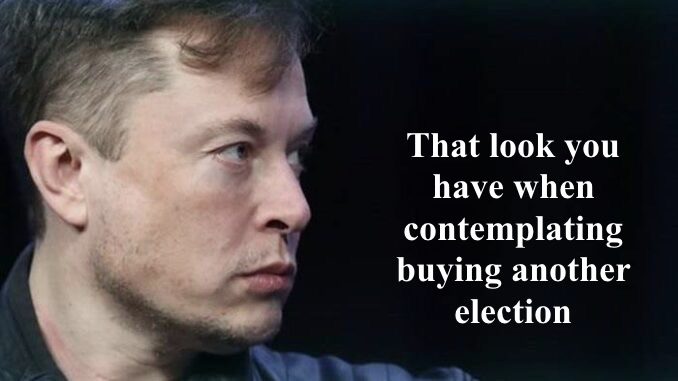
There are many things Elon Musk has demonstrated an extraordinary talent for.
Building electric cars, launching rockets, buying Twitter and turning it into X, annoying approximately half the population of Earth and convincing the other half that he is going to colonise Mars are among them.
He has also demonstrated an extraordinary talent for spending money on American politics.
And now he is doing it again.
Musk has authorised his America PAC to spend between US$100 million and US$120 million helping Republican candidates in November’s US midterm elections. The operation is expected to target at least eight states, concentrating on voter turnout through door-knocking, digital advertising and direct mail.
And on Wednesday, the first instalment arrived.
America PAC reported spending more than US$800,000 in August, primarily on Republican candidates in competitive Senate and House races in Texas and Maine.
That is presumably the political equivalent of Musk putting a toe in the water before throwing the entire swimming pool into it.
The man who said he was going to start a third party
There is, however, a delicious little complication.
Musk and Donald Trump did not exactly part company as lifelong political soulmates.
After serving as one of Trump’s most prominent supporters and becoming a central figure in the administration’s Department of Government Efficiency experiment, Musk had a spectacular falling-out with the president.
Musk became furious about Trump’s spending legislation and subsequently floated the idea of creating a new political party.
For a brief period, it appeared that the world’s richest man might become the world’s richest political dissident.
Apparently, that didn’t last.
Musk is now back in the Republican camp, preparing to pour another enormous sum of money into the party’s midterm campaign.
The bromance may have suffered a temporary outage, but someone apparently rebooted the server.
And Musk has form
This isn’t Musk discovering American politics for the first time.
During the 2024 presidential election, he spent hundreds of millions of dollars supporting Trump and other Republican candidates.
The final figures put his spending at roughly US$288 million, making him the largest individual political donor of that election cycle. Much of the money went through America PAC, the organisation he created and largely funded.
That is an extraordinary amount of money.
It is also worth pausing for a moment to consider what US$288 million actually means.
It is not simply a large cheque.
It is the annual income of a small country.
It is enough money to make most people wonder whether they should finally replace that saucepan with the broken handle.
Musk spent it trying to influence who would occupy the White House.
And it worked.
Trump returned to the presidency.
Trump returned to the presidency, and the world’s richest political investor appears convinced his previous bet paid handsome dividends.
The midterms aren’t a presidential election.
There is no Trump name at the top of the ticket.
Turnout is generally lower, which makes organised voter mobilisation particularly important.
And Republicans are facing a rather awkward political environment.
Trump’s approval ratings, economic concerns and dissatisfaction with his administration are creating vulnerabilities for Republican candidates, while Democrats are increasingly targeting seats that previously would have been considered safely Republican.
Republicans also have an enormous amount of money available.
Trump’s MAGA Inc.super PAC reportedly has more than US$400 million sitting in its coffers, although Republican lawmakers are increasingly frustrated that comparatively little of it has been deployed in the crucial battleground races.
So Musk is arriving at a rather interesting moment.
The Republican Party has money.
Trump has money.
Musk has money.
What they don’t necessarily have is the one thing money can’t guarantee: voters who actually want to vote for them.
Can a billionaire buy an election?
This is where the Musk story becomes much more interesting than another episode of Elon Musk Does Something Elon Muskish.
America’s political system permits extraordinarily wealthy individuals and organisations to spend enormous sums attempting to influence elections.
And Musk is now one of the most powerful examples of that phenomenon.
The argument isn’t necessarily that Musk can simply purchase a Republican victory.
He can’t.
Money cannot manufacture enthusiasm where none exists. It cannot force a voter to like a candidate. It cannot guarantee that an advertisement will persuade anyone.
But money can buy something enormously valuable in an election: reach.
It can buy advertisements.
It can buy staff.
It can buy data.
It can buy mail campaigns.
It can buy armies of people knocking on doors.
It can buy sophisticated efforts to identify sympathetic voters and persuade them to actually turn up on election day.
That is precisely what Musk’s America PAC intends to do.
And that raises a rather uncomfortable question.
If an ordinary American has one vote, while one billionaire can spend US$100 million attempting to influence millions of other voters, are they really participating in the same democracy?
Technically, yes.
Practically, that’s a rather more complicated question.
The irony of the world’s richest man fighting for the little guy
Musk has frequently presented himself as an opponent of establishment politics.
Yet there is something almost wonderfully American about a billionaire attempting to disrupt the political establishment by spending an enormous fortune supporting one of the country’s two established political parties.
It is rather like protesting against the country club by buying the country club.
And there is another irony.
Musk’s political involvement has often been presented as an attempt to give ordinary Americans a greater voice.
But the mechanism through which he is doing it is his extraordinary personal wealth.
The average American voter doesn’t have US$100 million to deploy between breakfast and lunch. (Losers!)
Most don’t even have US$100 million lying around between Christmas and Christmas.
They have one vote.
Musk has one vote too.
He just has a rather larger megaphone.
And a ludicrous sense of entitlement.
Money doesn’t always buy victory
There is also a useful corrective to the idea that Musk can simply throw money at a political race and expect it to obey him.
His political investments have not always produced the desired result.
Money helps. It can be enormously influential.
But elections remain stubbornly unpredictable things.
Voters occasionally have the irritating habit of making up their own minds.
Which means Musk’s midterm gamble could ultimately become something rather more interesting than a demonstration of billionaire power.
It could become a test of it.
Because if Musk spends US$100 million, US$120 million or potentially even more and Republicans retain control of Congress, his supporters will undoubtedly point to the money as part of the winning formula.
But what happens if he spends a fortune and Democrats take control?
Then we will have an answer to a rather important question:
How much influence can one billionaire actually buy?
Perhaps Musk should remember something
There is nothing inherently wrong with wealthy people participating in politics.
They have every right to express their opinions, support candidates and contribute within the law.
The problem begins when political influence becomes so closely associated with personal wealth that democracy starts looking less like one person, one vote and more like one person, one vote plus several hundred million dollars.
Musk’s latest political investment therefore deserves more scrutiny than simply asking whether he is supporting Trump again.
The more important question is what it says about American democracy.
A man who can spend hundreds of millions of dollars trying to influence an election isn’t merely another political donor.
He is an institution unto himself.
And now he is placing another US$100 million-plus bet on the Republican Party.
Perhaps that is the real midterm question.
Not whether Elon Musk can buy Congress.
But whether American democracy has reached the point where we have to ask how much Congress costs.
Keep Independent Journalism Alive – Support The AIMN
Dear Reader,
Since 2013, The Australian Independent Media Network has been a fearless independent voice – holding power to account and delivering journalism that matters.
Running this site isn’t cheap. Rising costs mean we need your support now more than ever. Every donation, big or small, keeps our servers running, our writers working, and our stories free for everyone.
Donate here:
PayPal or credit card – just click on the Donate button below
Direct bank transfer: BSB: 062500; A/c no: 10495969

We’ve also set up a GoFundMe as a dedicated reserve fund for hosting and future improvements.

Thank you for standing with us. We couldn’t do this without you.
With gratitude,
The AIMN Team

Interesting comments which can also be directed to billionairs investing in Australian politics, that Gina woman comes to mind
Don’t ignore the Zionist influence in USAS and Australian politics.
@ Mediocrates: Agreed. Both the US State & Defence Departments are well staffed with ZION@ZI sympathisers wrapping their true allegiance to the Israeli ZION@ZI Knesset in a Stars & Stripes flag.
Has anybody tested the ”Buy a Vote” strategy yet??
What TACO Trumpery is up against- Robert Reich analysis.
https://youtu.be/WAmMLP3kvZg?si=UHVMPr7D7uKAcEFV (2:55 minutes)
”Perhaps that is the real midterm question.
Not whether Elon Musk can buy Congress.
But whether American democracy has reached the point where we have to ask how much Congress costs.”
Well there is the precedent of IT&T buying President Nixon for $1,000,000 donation to the Republicans, given as twenty (20) donations from each of fifty (50) zombie companies thus circumventing the electoral laws.
@ NEC and all… maybe read this article and pause for thought….
https://link.latimes.com/view/69a9c73932cb8112ec0833e2s8zyd.1wc0/75f75ab3
The equivalent of getting into a car with a blind driver, who may not be that well trained!