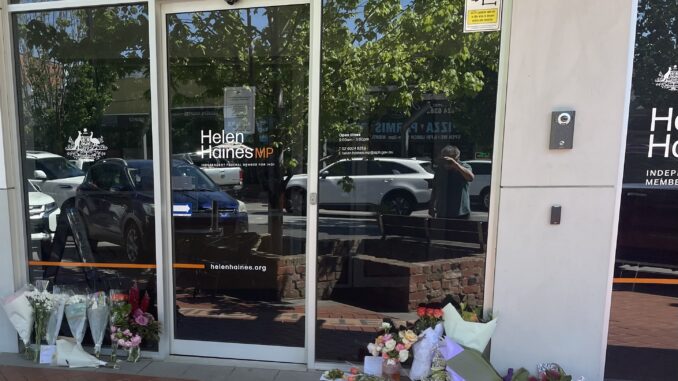
It is not a good time to be a politician. Prices are rising with extortionate speed. Foolish wars continue being waged. The banksters are in clover. Corporate oligarchies are humming along. The thieves in artificial intelligence are gloating about an end of civilisation they are happy to exploit for commercial reasons. But even in these situations there are certain figures who have distinguished themselves with quiet tenacity. They should be bottled and perfumed for posterity.
Helen Haines, the federal Member for the rural Victorian seat of Indi, baffled psephologists with her electoral victory in 2019, becoming the first independent to succeed another in the country’s history. The previous member, Cathy McGowan, had pioneered a form of grassroots political engagement that stressed the importance of representation and service over the hulking monster of party politics and vulgar self-interest.
Haines has shown herself to be a most unusual Australian politician. Untied to the direction and directives of a party machine, unclouded by tribal judgments and collectivist buffoonery, she has, along with various other independents in the Parliament, returned politics to a mature Athenian state: a representative for her constituents. Her platforms have been principled and studied, foremost among them the creation of the National Anti-Corruption Commission that was intended to, in her words, “restore the trust that so many Australians have lost.” (Sadly, the body has yet to achieve its intended goals.) Were it not for representatives like her, there would be little reason to have an isolated parliament functioning in the arid, distant alienation of Canberra.
On October 19, Haines found herself the subject of an attempted assassination in the town of Wangaratta. This was most unusual: Australians usually prefer slaughtering their parliamentarians at the ballot box. A 43-year-old man, Brendan Nugent, allegedly used his Toyota LandCruiser as a potential murder weapon, ramming into the MP as she was retrieving items from the boot of her car. He did so twice. He also sported a knife in his car, which he mercifully never got to use – the local barber had managed to restrain him. At this writing, Haines remains in a critical condition, having lost one leg. She may lose the other. Nugent has been charged with dangerous driving causing serious injury, intentionally causing serious injury and the specific Commonwealth offence of causing harm to a Commonwealth public official. The counter terrorism unit has also been activated and the domestic intelligence service, ASIO, is being consulted.
Explanations are now forming various clots in the infosphere. Particularly irritatingly, they are mirrors of their proponents, each attempting to jostle to the front as the primary explanation. Without waiting for any detailed assessment of the motives of the attacker, we already have a log of theories. The gender agenda suggests that Haines was attacked because she was a woman, a victim of manospheric mania. “It is too early to know if Haines’ gender was a factor in the attack on her,” cautions Jacqueline Maley in the Sydney Morning Herald, only to say that “we are alive to the possibility because we know women politicians cop a degree of sexualised, highly personal abuse unique to their sex.”
The public discourse narrative suggests that Australian politicians and public figures are themselves responsible for evocations of violence, a normalising tendency inspired by the United States. The security narrative offers the view that politicians in the country have been at increasing risk of attack. Politicians have been mailed bullets. The workplaces of politicians have been vandalised. A Jewish MP’s office was firebombed. Australian Home Affairs Minister Tony Burke points to 951 incidents of harassment and threatening behaviour “against high office holders from July 2024 to June 2025.” The internet narrative turns the blame to a technological premise that has become a government favourite: the medium as the message, and a nasty one at that. As Australian Prime Minister Anthony Albanese put it, there had been “too much shouting, not enough discourse, not enough polite conversation and disagreement.” Last, not least and possibly the most plausible is the mental state of the assailant’s mind. According to a report by the ABC, “A neighbour of Brendan Nugent said those who lived nearby had frequently called authorities over concerns over his mental health.”
Then come suggestions as to what is to be done. Albanese analogises about the temperature of debate, suggesting that it be turned down. (Politics Down Under is rarely more than tepid at the best of times, riddled with such dulling potions as interest rates, inflation and mortgages.) Keen on stock banalities, the PM opined that one could “have a disagreement at the footy [football], people at a Grand Final cheering for Freo [Fremantle] or cheering for the [Brisbane] Lions, and when the game’s over, having a beer together and engaging in talking about the game. That’s who we are as Australians, and that’s an important part of our character.”
Safety is also a smouldering topic of interest. Australia’s politicians are some of the most accessible representatives among their peers in liberal democracies, even if they represent one of the most secretive and opaque of political systems. (There is a true irony there.) This is likely to change. What will matter more will be how the current institutions and system of power deals with the economy of grievance. At the moment, it is a burgeoning one. It’s all good to see a local member turn up to commemorative events, make themselves available for the local dog and flower show and ensure photo opportunities at the opening of a municipal building. Better still would be the sense that the member in question is not a drone, impotent and, in the end, seemingly useless to address the tide of events. Curiously enough, a parliament filled with the likes of Haines and her crossbench colleagues would be a start. Out with the machine types and clod apparatchiks; in with the sentient, sensitive human, at long last.
Keep Independent Journalism Alive – Support The AIMN
Dear Reader,
Since 2013, The Australian Independent Media Network has been a fearless independent voice – holding power to account and delivering journalism that matters.
Running this site isn’t cheap. Rising costs mean we need your support now more than ever. Every donation, big or small, keeps our servers running, our writers working, and our stories free for everyone.
Donate here:
PayPal or credit card – just click on the Donate button below
Direct bank transfer: BSB: 062500; A/c no: 10495969

We’ve also set up a GoFundMe as a dedicated reserve fund for hosting and future improvements.

Thank you for standing with us. We couldn’t do this without you.
With gratitude,
The AIMN Team

I am tempted to opine that, as our rulers suppress peaceful protests which should be the right in democratic societies, something like this was bound to happen sooner or later. What I do not understand is that this was aimed at a politician standing for her community, not a party apparatchik.
Two points from Hotspringer — both beauties.
I ask you to join with me and wish Dr Helen Haines PhD MP for Indi, a rapid recovery and return to bonny health so that she may continue her exemplary work representing the voters of Indi and all Australian voters.
IMHO the standout politicians under the Canberra Bubble are both Independents; Dr Helen Haines PhD and David Pocock. Australian voters need more politicians like these two fine persons.
Dr. Haines has had her right leg amputated as well.
He husband Phil has asked anyone who would like to support Dr. Haines to make a donation to the Save The Children Fund.
She was due to talk at a Legacy function about the charity.
What makes me very angry is that Nugent might go to gaol for a whole 10 years (less for good behaviour?). Helen Haines, however, is looking at health and medical issues for the rest of her life. Doesn’t seem very fair does it?
GL:
I think Nugent is going to wind up in a psychiatric facility for a very long time. I don’t usually have any time for the mental health claim with most male violence against women, but it appears to be valid in this case.
@GL; OK, I am not a clinical or forensic psychologist or psychiatrist however it seems to me that the accused was sufficiently sentient to drive his vehicle to where he knew he would encounter his intended victim and was sufficiently sentient to realise that his deliberate action would result in extreme injury and distress according to his intention. Thus, I hope, the courts will meter punishment that will ensure he will never be able threaten another living organism again, however long his following life may be.
Trying to be objective in a most difficult emotional matter ….. The public record reports that the alleged perpetrator had/has a mental health problem, yet also reports he had failed to take his medical treatment(s) as required.
Surely this amounts to a case of deliberate personal negligence because the likely outcome is that a psychotic event, of unknown scale and unknown target, will occur.
It is the same argument that when a person ingests any substance, either proscribed or commonly known to change personal behaviour, and later under the influence of that substance causes physical harm to a person(s) or property damage, then that person should, be held liable for total restitution for any & all injuries and property damage.