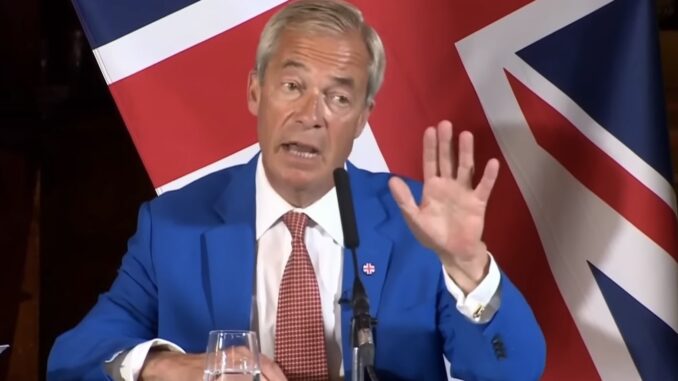
Much has been written recently about Nigel Farage and the Brexit referendum, but while the headlines have focused on the familiar arguments, some rather important questions remain unanswered.
Who paid for the campaign? Where did the money come from? And why was European taxpayers’ money reportedly being used to support a campaign dedicated to taking Britain out of the European Union?
These are not questions of political allegiance, but of transparency and accountability. Ten years after the referendum, it is worth looking beyond the familiar Brexit debate and following the money.
There is a certain irony in the story of Nigel Farage’s campaign to take Britain out of the European Union.
For years, Farage denounced the EU as wasteful, undemocratic and an institution that took British taxpayers’ money while giving too little in return. Yet documents obtained by the Financial Times have revealed that approximately €1.8 million from a European Parliament-funded political group was spent on activities supporting his anti-EU campaigning in 2015 and 2016.
That money reportedly helped pay for campaign meetings, venues, banners, live-stream production and security.
The revelation does not, by itself, establish that Farage broke the law. Nor does it prove that the Brexit referendum result was improperly obtained. But it raises important questions about the financing of one of the most consequential political campaigns in modern British history.
And it presents a rather awkward question for the man who built his political reputation attacking Brussels: how did European taxpayers’ money end up helping to promote a campaign against the European Union?
The money behind the message
The Financial Times reported in June 2026 that documents relating to the former Europe of Freedom and Direct Democracy group in the European Parliament showed around €1.8 million had been spent on Farage’s Say No to EU tour and other expenses associated with the referendum campaign.
The group included Farage and other Eurosceptic politicians. Its funding came from the European Parliament’s budget, which is supported by European taxpayers.
The reported expenditure included the hire of venues for campaign meetings, banners, live-stream production and security arrangements. Some of the campaign materials carried UK Independence Party branding, and events featured prominent UKIP figures.
The expenditure therefore raises questions beyond the simple fact that a European political group supported Eurosceptic activity.
European Parliament political groups are permitted to fund certain activities relating to European issues, including some referendum-related activity. However, their funding rules prohibit the use of that money to finance national electoral campaigns or national political parties.
The question is whether particular payments supported permissible political activity or crossed the line into expenditure that the rules prohibited.
That distinction matters. Political campaigning can involve several organisations, overlapping responsibilities and different categories of expenditure. Establishing whether the rules were breached requires examination of the payments, their recipients, their purposes and the relevant dates.
It is not enough simply to point to the irony.
Fortunately, the documents reported by the Financial Times provide a basis for asking more specific questions.
The timing question
One of the most important details in the reporting concerns the timing of the expenditure.
Britain’s official referendum campaign period began on 15 April 2016. During the regulated period, organisations campaigning in the referendum were subject to spending restrictions and rules governing which organisations could participate and how much they could spend.
The Financial Times reported that most of the expenditure identified in the documents related to dates before the official campaign period. However, it also identified approximately €42,000 in expenses that might have been used during the regulated period.
Those expenses included costs associated with the Say No to EU website and a trailer hired until the end of 2016.
Why does this matter?
Because expenditure before a regulated period and expenditure during it may be treated differently under electoral law. The dates on an invoice, the period during which a service was provided, and the purpose for which it was used can all be relevant.
If expenditure fell within the regulated period, the question would be whether the organisation involved was permitted to incur it and whether the spending complied with the applicable limits and reporting requirements.
The reported figures warrant scrutiny, but they should not be confused with a judicial finding or a determination by the relevant authorities that an offence occurred.
That is precisely why a proper investigation matters.
The European Parliament’s own rules
There is another issue, separate from the British referendum spending rules.
European Parliament political groups receive public funding to carry out parliamentary and political activities. That funding is subject to rules governing its permitted use.
A European Parliament spokesperson told the Financial Times that the funds could not be used to finance national electoral campaigns or national political parties.
The newspaper reported that some of the itemised expenditure included campaign meetings, posters and leaflets associated with UKIP and its anti-EU campaign.
Transparency International EU called for an investigation into the revelations, while other political figures argued that the expenditure warranted further examination.
The question is whether the money was used for activities permitted under the funding rules or whether some expenditure improperly supported national political campaigning.
Again, the distinction is important. A political group may legitimately campaign on European policy questions, but that does not mean it can use public funding without restriction to support a national party’s electoral activities.
The applicable rules exist for a reason. Public money must be used for authorised purposes, and the organisations spending it must be able to account for what they have done.
What does Nigel Farage say?
Farage’s spokesperson rejected suggestions of potential breaches of funding rules, describing them as “baseless and contrived.”
That response should be included in any fair account of the controversy.
It is also important to acknowledge that the Electoral Commission previously investigated a separate issue involving donations associated with UKIP and European political allies. Following that investigation, the Commission concluded that UKIP had not received impermissible donations in 2015 and 2016.
That earlier conclusion cannot simply be ignored. Equally, it should not automatically be treated as resolving every question raised by the more recent reporting, which concerns particular expenditure and the application of different funding rules.
The relevant authorities would need to examine the specific transactions and determine whether any rules were breached.
Until then, the appropriate language is that the reporting raises questions requiring examination, not that it establishes criminal wrongdoing.
Why the public should care
Some AIMN readers might reasonably ask why anyone should care about the financial arrangements behind a referendum that took place a decade ago.
The answer is that political funding is not merely an administrative matter.
Money enables political organisations to hire venues, produce campaign material, reach voters and maintain a public profile. The source of that money, the conditions attached to it and the rules governing its use can affect the transparency and fairness of a political contest.
Voters should be able to understand who is funding political campaigns and whether the relevant laws have been followed.
That principle applies regardless of which side of an argument receives the money.
It applies to pro-European campaigns and Eurosceptic campaigns, to left-wing parties and right-wing parties, and to politicians who advocate policies we support as well as those we oppose.
The point is not that a campaign becomes illegitimate simply because it receives public funding from a political institution. Nor is the use of European Parliament money automatically unlawful merely because the recipient opposes European integration.
The question is whether the money was spent within the rules.
If the rules were followed, the evidence should establish that. If they were not, the public deserves to know what happened and what consequences follow.
A lesson that extends beyond Brexit
Britain’s referendum was a defining political event. Its consequences continue to shape the country’s economy, international relationships and domestic politics.
The arguments over whether Brexit was a mistake are unlikely to disappear. But those arguments should not obscure a separate issue: the integrity of the process through which political decisions are made.
The Financial Times investigation has brought renewed attention to the financing of Farage’s anti-EU campaign. It has also highlighted the complexity of regulating political money when several organisations operate across national and European institutions.
That complexity is not an excuse for a lack of accountability. It is a reason for clear rules, transparent records and effective oversight.
And it is a reminder that politicians who demand accountability from others must be prepared to accept the same scrutiny themselves.
The man who spent years criticising the European Union for how it used taxpayers’ money now finds his own campaign financing under examination because of reported expenditure from an EU-funded political group.
That is an irony worth examining. Whether any rules were breached is a question for the evidence and the relevant authorities.
Democracy depends not only on who wins the argument, but on whether the rules governing the argument are followed. Voters deserve to know who paid for the campaign, what their money funded, and whether those responsible complied with the law.
Ten years after Brexit, those questions remain worth asking.
Also by Michael Taylor:
Would Pauline Hanson turn Australia into an Outsider?
Keep Independent Journalism Alive – Support The AIMN
Dear Reader,
Since 2013, The Australian Independent Media Network has been a fearless independent voice – holding power to account and delivering journalism that matters.
Running this site isn’t cheap. Rising costs mean we need your support now more than ever. Every donation, big or small, keeps our servers running, our writers working, and our stories free for everyone.
Donate here:
PayPal or credit card – just click on the Donate button below
Direct bank transfer: BSB: 062500; A/c no: 10495969

We’ve also set up a GoFundMe as a dedicated reserve fund for hosting and future improvements.

Thank you for standing with us. We couldn’t do this without you.
With gratitude,
The AIMN Team

Be the first to comment