By Leonie Saunders
There are two overarching fictions, the ‘Hidden Hand’ and Ceteris Paribus, both rooted in the bedrock of liberal economics that disrupt my equilibrium more than I can say. Because writing acts as a catharsis allowing me to externalise my angst, I will push on with this essay. I hope those who read it will reflect upon my observations.
The Hidden Hand, Ceteris Paribus: The Architecture of Power
Competition, Neoliberalism and the Politics of Economic Abstraction
Presumably, most people have heard the metaphor popularly known as Adam Smith’s ‘hidden hand of competition’. Before I go further, and not that it really matters in the scheme of things. Nevertheless, in the interest of accuracy and to ward off the pedants. The metaphor Adam Smith used in his manuscript, The Wealth of Nations published in 1776 was not the ‘hidden hand’. It was the “Invisible Hand” Smith used to describe how the spontaneity of competition in free market economies operate.
Smith’s thesis remains one of the most enduring legitimising devices in capitalist economic thought. It continues to sustain the belief that individual self-interest, mediated through market competition, can generate socially beneficial outcomes without deliberate collective direction.
The other fiction that causes me grief is ‘ceteris paribus’. If you have never heard this term before, rest assured you are not alone. The first time I heard the phrase was while studying political science and sociology as a mature age student. In my wisdom – or perhaps madness – I decided to undertake a semester in microeconomics. The first time I heard the lecturer (and a banker to boot) use the Latin term ceteris paribus, meaning ‘all other things being equal’, I was struck dumb.
Ceteris paribus describes the overarching assumption that the economic relationship between variables can be isolated, so long as all other influences are held constant. While it plays a central role in economic modeling and theoretical analysis, I argue its practical application is deeply flawed.
Clearly, the idea that all other influences can be held constant is absolutely preposterous. It is impossible to isolate variables completely in an environment where numerous factors continuously interact and influence outcomes. The mere fact that ceteris paribus, all things being equal, is the starting point for economists when modeling market behaviours, tells me why the majority of economists get it wrong; it is not science.
In practice, employing the notion of all things being equal as zero, as a starting point, is quite obviously out of whack with reality. The real world is complex, dynamic, and interdependent; variables rarely remain constant. By relying heavily on the concept, economists risk producing models that are detached from lived reality and overlook the messy, interconnected nature of market economies. In essence, this assumption may seem credible on paper, but it often distorts understanding when applied to real-world conditions.
While the methodological principle of ceteris paribus is a limited analytical device, it is a concept that is not inherently illegitimate. The problem arises when assumptions are mistaken as explanations. In the context of capitalist political economics, ceteris paribus used in modelling facilitates the removal of history, power and institutional structures from the conditions under examination. The assumptions in Adam Smith’s ‘hidden hand’ metaphor articulates the idea that competition operates formally between equal actors within a neutral marketplace. Add ceteris paribus to the mix, as yet another concept that conveniently overlooks how unequal social relations determine the capacity of individuals to compete. In some economic circles these inconvenient truths are treated as external to economic analysis.
Marx’s critique of capitalism is important in my contention that the hidden hand of free market competition is an illusion. On the surface, labour markets appear to be based on equality: workers freely agree to sell their labour, while employers freely agree to pay for it. But beneath this apparent equality lies a fundamental imbalance of power. Employers own the businesses, land and productive resources, while most workers own little beyond their capacity to work.
The worker may appear ‘free’ to choose whether to accept a job, but that freedom is constrained by the need to earn a living. Without access to productive property or sufficient wealth, selling labour is often not a genuine choice but an economic necessity. What appears to be a fair and voluntary exchange therefore conceals a deeper relationship of dependence and power. For Marx, this is one of capitalism’s central contradictions: the market presents the exchange as equal, while the social conditions surrounding that exchange are profoundly unequal.
The capitalist market is founded upon the formal equality of exchange, yet this equality conceals a materially unequal relationship between those who own the means of production and those who must sell their labour in order to survive. The labour contract appears voluntary because both parties enter into it as juridically free individuals. However, the worker’s ‘freedom’ is conditional. The apparent neutrality of exchange therefore obscures a deeper structure of economic compulsion.
The mythology of competition similarly obscures the historical conditions of accumulation. Capital does not emerge within an empty marketplace populated by equal individuals. It is inherited through historically specific processes of enclosure, dispossession, colonial expansion and the appropriation of land, labour and resources. What Marx described as ‘primitive accumulation.’was not simply a transitional episode preceding capitalism but a process whose underlying logics continue to shape contemporary patterns of ownership and inequality.
Karl Polanyi further destabilised the mythology of the self-regulating market by demonstrating that markets are neither natural nor autonomous institutions. The attempt to construct a self-regulating market requires extensive political intervention. Land, labour and money must be treated as commodities despite not being produced for sale in the ordinary sense. The supposedly ‘free’ market is therefore dependent upon a substantial legal and institutional architecture.
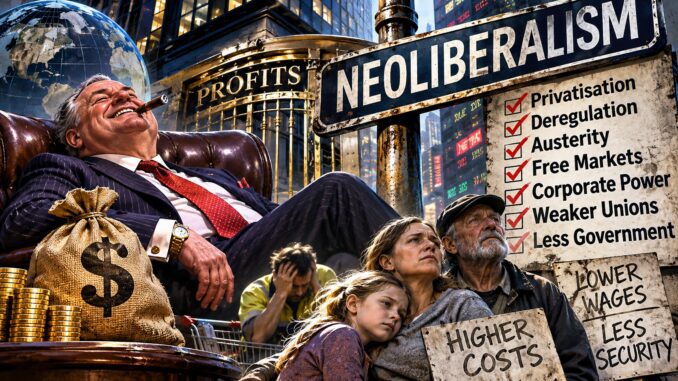
Neoliberalism intensifies this contradiction. Contrary to its rhetoric of deregulation and limited government, neoliberalism does not simply withdraw the state from economic life. As David Harvey argues, it reorganises state power in ways that facilitate capital accumulation, market expansion and the protection of private property. Privatisation, deregulation and austerity are political projects rather than spontaneous economic developments. The state does not disappear; it changes its function.
This transformation also resonates with George Monbiot’s analysis of neoliberal governmentality. Neoliberalism extends the logic of competition beyond the market and into the social sphere. Individuals are increasingly constituted as entrepreneurial subjects responsible for managing their own risks, productivity and economic value. Structural inequality is thereby individualised. Failure becomes a deficiency of personal competitiveness rather than a consequence of unequal social conditions.
Ceteris paribus assumes particular ideological significance within this intellectual environment. By bracketing out the historical and institutional conditions under which competition occurs, economic analysis risks reproducing the fiction that outcomes emerge from individual choices alone. Colonial histories become background conditions rather than constitutive structures. Class relations become secondary variables. Ecological destruction becomes an externality. Corporate concentration becomes a market imperfection rather than a predictable consequence of concentrated accumulation, allowing the creation of corporate monopolies.
The language of abstraction thus performs a political function. It transforms historically produced inequalities into apparently natural outcomes:
- wealth becomes evidence of merit,
- poverty becomes evidence of insufficient effort,
- corporate power becomes efficiency, and
- ecological destruction becomes a cost that can be calculated rather than a material limit upon economic activity.
With that said, the ‘hidden hand’ stands not as an explanation of market processes but as a metaphor for the concealment of power.
The market is not an autonomous realm operating independently of politics. It is constituted through law, property relations, state institutions and historically inherited systems of power. Competition does not occur on a level playing field because the field itself has been constructed through unequal processes of accumulation and dispossession.
From my perspective – and that of the rising masses of democratic socialist – the hand is not hidden. It is visible in the laws that protect private property, in the institutions that discipline labour, in the state interventions that socialise corporate losses, and in the global economic structures that continue to facilitate the extraction of wealth from formerly colonised societies. It is visible in the transformation of collective resources into private assets and in the systematic subordination of ecological survival to economic growth.
The ideological achievement of neoliberalism has been to present these political arrangements as the natural consequences of competition.
A critical political economy must therefore reject the comforting fiction that markets operate independently of power. The central question is not whether markets are regulated, but who regulates them, in whose interests, and under what historical conditions.
Until economics restores history, power, colonialism and ecology to the centre of its analysis, the language of competition and equilibrium will continue to function less as a description of reality than as an ideological defence of the economic order it seeks to explain.
If humanity is to have any hope of navigating the challenges ahead, we must confront and dismantle the ideological stranglehold of neoliberalism, replacing its market-driven priorities with a broader commitment to economic justice, social equality and cultural transformation. This demands more than incremental reform; it requires a fundamental rethinking of how we organise our economies, distribute wealth and exercise political power. In the present political climate, democratic socialism offers the most credible framework for advancing that transformation.
Also by Leonie: The Human Paradox: Blind Faith, Institutional Authority and the Failure to Evolve
Keep Independent Journalism Alive – Support The AIMN
Dear Reader,
Since 2013, The Australian Independent Media Network has been a fearless independent voice – holding power to account and delivering journalism that matters.
Running this site isn’t cheap. Rising costs mean we need your support now more than ever. Every donation, big or small, keeps our servers running, our writers working, and our stories free for everyone.
Donate here:
PayPal or credit card – just click on the Donate button below
Direct bank transfer: BSB: 062500; A/c no: 10495969

We’ve also set up a GoFundMe as a dedicated reserve fund for hosting and future improvements.

Thank you for standing with us. We couldn’t do this without you.
With gratitude,
The AIMN Team
Another great article by Leonie Saunders.
Brilliantly put together, but the last line demands conditions.
“In the present political climate, democratic socialism offers the most credible framework for advancing that transformation.”
In an ideal world democratic socialism should be the preferred option by any person with a shred of decency, but the world is not ideal.
History tells us that the achievement of a democratic socialist government must be followed by a ruthless elimination of threats to the new order.
The liberal order has endless resources of wealth and willing servants.
Unless those forces are regulated into irrelevance, they will resurface to remove the social gains, and to prevent the socialist ideal from gaining influence again.
If that sounds unnecessarily aggressive, consider the recent case of Venezuela.
The people of Venezuela have consistently voted for and supported a party devoted to socialist ideals. They made great progress, reducing poverty, raising literacy rates, all the good things we expect of a socialist system.
Some industries were nationalised in the national interest, but the business sector was largely left alone.
Even right-wing news media survived the transition.
But the liberal elites were not satisfied.
After several failed attempts to dislodge the socialist government, the liberals assisted the US in the kidnap and deportation of the President, and control of natural resources by the US.
So in our ideal social democracy, we can still have a private business sector, but it must be ruthlessly controlled to confine its activities to business only, to the exclusion of all other interests.
Excellent vital reading, and thinking on it, from the Trump types down, we have so many overpaid oafs who do not know the job, nor know that they do not know. Business operates for profit and is run by types with peronal narrow ambitions. A society suffers from too many self fixated vain oppressors, and rights for all get ignored. And so, industrial and corporate commercialised societies miss the reason why some affluence for all is good. Our scale of values now is not whole life and must be re-arranged. Better social purpose, more fair go, is needed and quickly.
These two incisive essays by Leonie Saunders lead naturally to questions that beg to be answered.
What will be the determining catalyst(s) that will usher in the necessary changes at socioeconomic levels such that, as in the mid-term rout of the GOP in America, one can say, in concert with general agreement and no room for disagreement, that the damaging era of neoliberal dominance in marketplace behaviour is no longer, that it has been replaced with a more humane and appropriate structure that places the welfare of people at the core and that severely limits the capacity of individuals and corporations to benefit via the exploitation of others along with mandating social and ecologically responsible behaviours?
Given Leonie’s correct assessment of the failure of character that typifies much of human behaviour – aggression, wars, selfishness and accumulation, enrichment to the exclusion of others, blind adherence to moribund policies and dogmas and belief systems that benefit no-one & etc. – from where are the Nietzschean Übermensch going to arise to lead the way into this new phase of the human experience, given we are all, collectively, living under the conditions of materialistic overburden, the greater mass of us experiencing life as a burdensome existence of hand to mouth, with limited exposure to examples of what is possible, better, worthy of aspiring towards?
And further to the challenges facing humanity, we’re now embedded in an era of rapid changes at the ecological level; global warming and its manifold consequences, too much and too little of too many indicators – melting ice everywhere, rising seas that are also acidifying, desertification, deforestation, extinction rates through the roof, and dare I suggest, overpopulation and cities that struggle to accomodate these increases. No-one, it seems, has any practical strategies for dealing with these challenges, no magic wands, no authoritative think tanks that command universal respect and agreement – witness the ongoing failure of the COP process to rein in the incipient rise in global warming… it seems as if it’s lame ducks, all the way down, and it’s unsurprising that many may find it all too depressing and too difficult.
Most Australians are neoliberal, but relatively benign being focused on personal income, cost of living, house prices, super, a bit materialistic and a need to big things up….
However, the macro level neoliberalism is more malignant as it masks Koch Bros.’ muse behind Hayek’s bastards, ‘segregation economist’ James Buchanan.
However, like neoliberalism, Marxism or ecological construct LTG limits to growth, there is no empirical support, just models based on ideas or philosophy without data analysis in support.
I’ll stick to Keynes and tinkering….
One would not be so tough on Smith as he did support education, health etc. to many he didn’t promote unbridled freedom, that’s how neoliberals willfully (mis)interpreted his work for tnier freedom…..
However, the earlier malign influence has left its mark, Calvin a dour protestant preacher type ‘economist’……
Andrew:
“Most Australians are neoliberal … ”
I would argue that many – and possibly most – Aussies, regardless of socioeconomic status, are “neoliberal for thee, but not for me”. They can be big on the rhetoric, but when it bites them, which it assuredly will at some stage, they do not like it.
An excellent article, that clearly identifies the four ”principles of abstraction” practiced in New England communities to justify the communal apathy and justify political decisions so obviously contrary to their own best interests.
The local cause is the political power of the landowner to provide work; ”keep the boss happy, get the job” thinking of necessity that extends by osmosis into every day political life. This is an example of the work market being manipulated/regulated by the money people ….. for their own benefit(s).