Adelaide University Media Release
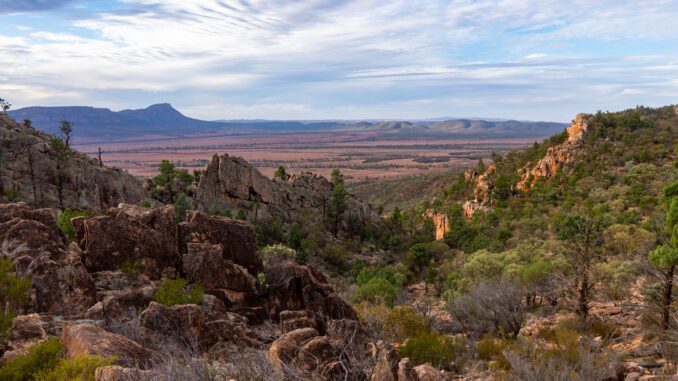
Geologists have uncovered new evidence that dramatic sea level changes carved giant underwater canyons in South Australia’s Flinders Ranges hundreds of millions of years ago, helping to create conditions that preserved some of the earliest complex life on Earth.
The findings, led by Adelaide University, shed new light on the environmental changes that accompanied the rise of the mysterious Ediacaran biota.
Published in the journal Earth and Planetary Science Letters, the study examined rock formations across the Flinders Ranges, renowned for its exceptionally diverse collection of fossils from the late Ediacaran Period (approximately 635 to 538.8 million years ago).
These fossils preserve evidence of soft-bodied organisms that lived before the explosion of animal diversity seen later in Earth’s history.
Despite their scientific importance, researchers have long debated how the landscape beneath these fossil-bearing rocks formed and what role changing sea levels played in their development.
Lead author, geologist Dr Karol Faehnrich and colleagues from Adelaide University, the South Australian Museum, the University of California and Pomona College, mapped geological features across the Flinders Ranges, including Nilpena Ediacara National Park, to reconstruct the ancient landscape and investigate how sediments accumulated over time.
They found evidence of vast, southeast-oriented canyons reaching depths of up to 280 metres and widths of more than six kilometres.
The team believes these features were largely formed by underwater erosion, beginning when sea levels fell significantly. Some may also have developed through erosion above sea level before becoming submerged.
The research suggests that, as sea levels subsequently rose, seawater flooded the landscape and sediments gradually filled the canyons. This process helped create the geological conditions in which the Ediacara Member – a specific geological layer of Rawnsley Quartzite – was deposited, preserving its extraordinary collection of ancient life.
Dr Faehnrich said the findings provide a clearer picture of how the landscape changed before and during the formation of one of the world’s most significant fossil deposits.
“More than half a billion years ago, the landscape of what is now South Australia looked very different,” said Dr Faehnrich.
“We found evidence that huge underwater canyons cut across the continental shelf before being rapidly flooded as sea levels rose again. This flooding created the conditions that allowed one of the world’s richest Ediacaran fossils to be preserved.”
The study also highlights the scale of the environmental changes that shaped the Flinders Ranges during the late Ediacaran Period.
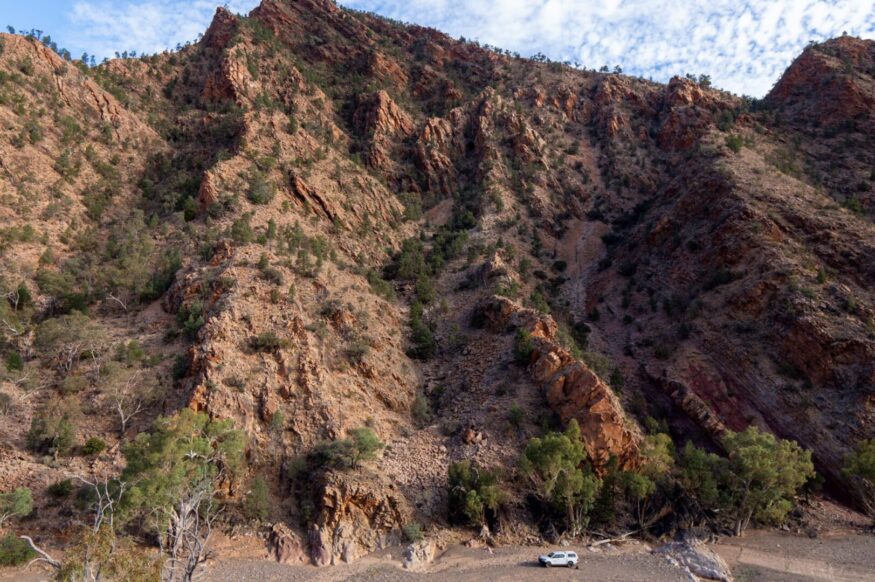
Exposures of the Rawnsley Quartzite at Brachina Gorge in the Flinders Ranges that the researchers used to reconstruct dramatic sea-level fluctuations in the late Ediacaran
The researchers found that the canyons varied considerably across the region, becoming wider and generally deeper towards the southeast. Their shape and the types of sediment filling them point to powerful underwater flows capable of transporting large amounts of material.
By comparing these features with modern submarine canyons, the team concluded that underwater erosion offers a more convincing explanation than a purely river-driven process, which would require an exceptionally large fall in sea level or substantial uplift of the land.
“The evidence points to a combination of changing sea levels and local geological processes shaping the ancient basin,” said co-author Associate Professor Diego Garcia-Bellido from Adelaide University’s School of Biological Sciences.
“This extraordinary evolution paved the way for the preservation of fossil-rich horizons. Many Ediacaran fossils are preserved as delicate impressions of soft-bodied organisms.
“Those kinds of fossils only survive when environmental conditions are just right. Our work shows that the rise in sea levels played an important role in creating a window of exceptional preservation,” he said.
‘Submarine canyons and sea-level fluctuations in the late Ediacaran: evidence from the Ediacara Member, South Australia’ is published in Earth and Planetary Science Letters. DOI: 10.1016/j.epsl.2026.120285.
Keep Independent Journalism Alive – Support The AIMN
Dear Reader,
Since 2013, The Australian Independent Media Network has been a fearless independent voice – holding power to account and delivering journalism that matters.
Running this site isn’t cheap. Rising costs mean we need your support now more than ever. Every donation, big or small, keeps our servers running, our writers working, and our stories free for everyone.
Donate here:
PayPal or credit card – just click on the Donate button below
Direct bank transfer: BSB: 062500; A/c no: 10495969

We’ve also set up a GoFundMe as a dedicated reserve fund for hosting and future improvements.

Thank you for standing with us. We couldn’t do this without you.
With gratitude,
The AIMN Team
Everyone should put the Flinders Ranges on their bucket list as a must-visit before they expire; visit the gorges – Parachilna, Edeowie, Brachina, Chambers – and climb Mt Chambers for amazing views across to Lake Frome – a salt lake, see Wilpena Pound, as well as the wildlife – Yellow-footed Rock Wallabies & Wallaroos, also the rock carvings on the walls of the gorges from the indigenous inhabitants eons ago.
Take the Aerogard – it’s the outback and the flies are legendary, good walking boots, a good camera, and prepare to be delighted and amazed.
My most magical experience over a number of visits was going to a location north of Blinman where the driver pulled up in a sort of non-descript spot; we got out, climbed over a fence, walked a short distance to what became evident as a ‘hole in the ground,’ clambered down this hole and into an underground extended cavern with a stream flowing through. The torches showed that the cavern extended forever, and in the stream we saw small freshwater fish, perhaps around 10-20 cm in length, possibly blind given they lived in a pitch-black environment. Pretty special, indeed!
The mob I identify with – the Adnyamathanha – are the traditional owners of these lands. Looking at the stunning photos you might not be surprised to learn that Adnyamathanha has two meanings:
NEC:
… and Wilkawillina, and all the way through Vulkhathunha (Gammon Ranges) up to and through Arkaroola. Mavellous country. I’m hoping to finish the Heysen next winter and do some more exploration in Vulkhathunha; only nibbled around the edges there so far.