By Denis Hay
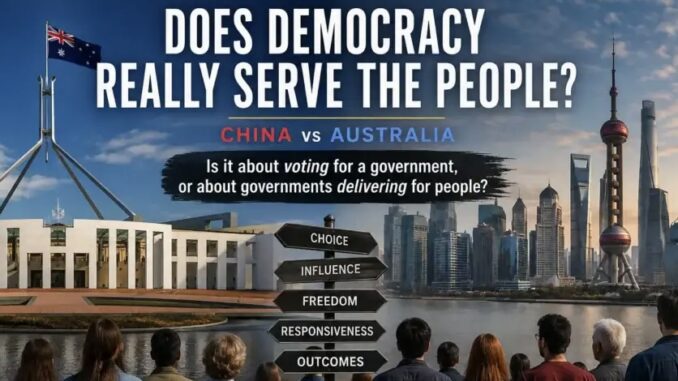
Australian political reform could give citizens more influence between elections. Is our democracy really delivering for the people?
Introduction: What Does Democracy Actually Deliver?
Australia proudly describes itself as a democracy. Every few years we vote for our representatives and decide which major party will form government.
But there is a question we rarely ask:
How much influence do ordinary Australians actually have once the election is over?
We are told that citizens can influence government through elections, petitions, protests, submissions, lobbying and contacting MPs. Yet having the right to influence government is not the same as actually changing government policy.
This raises an uncomfortable question: Is democracy simply about choosing who governs, or should it also mean that government listens to citizens and delivers for them?
China provides a fascinating comparison because it operates under an entirely different political model.
Australia: The Power to Vote
Australia’s House of Representatives is elected for a maximum three-year term, using preferential voting. The party or coalition commanding a majority forms government.
This gives Australians an important democratic right: we can remove a government at an election.
But what happens between elections?
This raises a fundamental question: does Australia’s democratic system really serve the people?
Citizens can protest, sign petitions, make submissions and contact politicians. Yet governments are not required to accept those demands.
Political influence is also unequal. Australia’s parliamentary research has recognised concerns that political donations can create opportunities for undue influence, while research into federal lobbying has identified weaknesses in transparency and accountability.
So we have political participation – but does that participation translate into political power?
Labor or LNP: Does Changing Governments Change the System?
This is perhaps the most important question.
Australians can vote Labor out and elect the LNP, or vote the LNP out and elect Labor. The policies of the two parties are certainly not identical, and governments make genuine differences in areas such as industrial relations, welfare, climate policy and public spending.
But do these differences fundamentally change Australia’s economic and political direction?
There is substantial academic literature examining Labor’s relationship with neoliberalism. Research has argued that Labor governments have operated within, and sometimes helped develop, the neoliberal economic framework.
More recent research suggests that today’s Labor government has made tangible policy changes while still accommodating significant elements of the existing market-based framework.
This leads to a provocative possibility:
Perhaps Australians can change the government without being able to substantially change the system.
The parties may argue fiercely about individual policies while accepting many of the same underlying economic assumptions.
If that is true, elections can become a choice about who manages the system, rather than allowing citizens to choose fundamentally what kind of system they want.
China: A Completely Different Model
China cannot be described as a multiparty electoral democracy like Australia.
The Chinese Communist Party (CCP) leads the political system, and opposition parties do not compete for national government in the Australian sense. China’s Constitution explicitly establishes CCP leadership while also providing for people’s congresses and political consultation.
However, it would also be misleading to claim that Chinese citizens simply have no elections or political participation.
China has elections for people’s congresses at different levels. County and township-level deputies are directly elected, while higher-level congresses are elected indirectly. The Chinese system also incorporates political consultation through bodies such as the Chinese People’s Political Consultative Conference.
It is a different conception of political participation – not Australia’s competitive party model.
Does China Deliver for Its Citizens?
This is where the comparison becomes particularly interesting.
Whatever criticisms we make of China’s political system, it is difficult to deny the scale of its economic and social transformation.
The World Bank reports that China eliminated extreme poverty by 2020 and that access to health, education and other services improved significantly over the preceding decades.
China has also invested enormously in infrastructure, housing, transport, education and industrial development.
That doesn’t mean everything in China is successful. China faces serious problems, including inequality, an ageing population, environmental pressures and economic imbalances.
But it does challenge the simplistic Western assumption that a one-party political system necessarily means a government that does not serve its population.
Do Chinese Citizens Support Their Government?
There is evidence worth taking seriously.
A major Harvard Kennedy School study conducted eight surveys between 2003 and 2016, involving more than 31,000 Chinese citizens in urban and rural areas.
In the final 2016 survey, 95.5% of respondents reported being either relatively or highly satisfied with the central government in Beijing.
Earlier reporting on the same research cited 93.1%, depending on how satisfaction was calculated. The important point is not the difference between those figures but the consistently high level of reported satisfaction.
The researchers also found that satisfaction with China’s central government was considerably higher than satisfaction with lower levels of government.
This research is not proof that every Chinese citizen supports the CCP. Nor does it eliminate legitimate concerns about political freedoms, censorship or dissent.
But it does demonstrate something Western commentary often overlooks:
Many Chinese citizens have reported being highly satisfied with their government.
What About Political Freedom?
This is where comparisons must remain honest.
Australia provides genuine political competition, a free electoral choice between parties and much greater space for organised opposition.
China does not provide those same political freedoms.
But political freedom is only one dimension of government.
Another is government responsiveness.
A citizen may have the freedom to vote against a government but still feel that the government ignores them for three years.
Another citizen may have less influence over who leads the country but feel that their government is delivering improvements in their community and their standard of living.
Neither experience should automatically be dismissed.
Why Australian Political Reform Matters
Australia has valuable democratic institutions that should be protected. But we could learn from the idea that government legitimacy should depend not only on winning elections but also on delivering for citizens. We could create stronger mechanisms for citizens to influence policy between elections.
These reforms are also essential to addressing Australia’s major social justice issues, including housing insecurity, inequality, healthcare and insecure employment.
Australia has valuable democratic institutions that should be protected.
But we could learn from the idea that government legitimacy should depend not only on winning elections but also on delivering for citizens.
We could create stronger mechanisms for citizens to influence policy between elections.
We could strengthen lobbying transparency, limit the influence of political money and make governments more accountable for their promises.
Most importantly, we need to break the assumption that Australians must choose between only two major political alternatives.
Breaking the Two-Party System
Australia already has an example of how change can occur.
The Senate uses proportional representation, allowing smaller parties and independents to win representation.
We should build on that principle.
Possible reforms include:
- stronger proportional representation;
- reducing the influence of political donations;
- greater transparency around lobbying;
- stronger independent representation;
- citizens’ assemblies on major national issues;
- greater use of referendums where appropriate;
- stronger local democratic participation;
- electoral reforms that make it easier for new political movements to compete.
The objective should not be to replace Labor and the LNP with another permanent political establishment.
It should be to create a system where no political party can take voters for granted.
Imagine if politicians knew that citizens had genuine alternatives – not merely the choice of replacing one major party with the other.
That could change political behaviour dramatically.
Democracy Should Be About People
Perhaps the most important lesson from comparing Australia and China is that we should stop treating political systems as simple black-and-white categories.
Australia has electoral freedoms that China does not.
China has achieved levels of long-term policy continuity and social and economic transformation that Australia has struggled to match.
The question should therefore not be:
“Which country is democratic?”
A better question is:
“Which political arrangements give ordinary people the greatest ability to shape their future and ensure that government actually works for them?”
Australia has an opportunity to rethink democracy without abandoning democracy.
We could retain the right to vote while giving citizens far greater influence between elections.
And we could demand something more fundamental from our politicians:
Don’t simply ask for our vote. Listen to us – and govern for us.
What do you think?
Is voting every three years enough to make Australia genuinely democratic if governments can largely ignore citizens between elections?
Or should democracy mean much more than simply choosing which major party governs?
If you found this article insightful, explore more about political reform and Australia’s monetary sovereignty on Social Justice Australia.
Share this article with your community to help drive the conversation toward a more just and equal society.
If you value independent voices for social justice and democratic reform, please consider making a small donation to help keep Social Justice Australia going.
Click on our “Reader Feedback” menu. Let us know how this article has inspired you. Submit your testimonial and help shape the conversation today!
This article was originally published on Social Justice Australia
Keep Independent Journalism Alive – Support The AIMN
Dear Reader,
Since 2013, The Australian Independent Media Network has been a fearless independent voice – holding power to account and delivering journalism that matters.
Running this site isn’t cheap. Rising costs mean we need your support now more than ever. Every donation, big or small, keeps our servers running, our writers working, and our stories free for everyone.
Donate here:
PayPal or credit card – just click on the Donate button below
Direct bank transfer: BSB: 062500; A/c no: 10495969

We’ve also set up a GoFundMe as a dedicated reserve fund for hosting and future improvements.

Thank you for standing with us. We couldn’t do this without you.
With gratitude,
The AIMN Team

Denis, love your article on the Chinese political system, and needles to say many fail to comprehend or understand Asian countries at all.
I’m not saying they are perfect, no one is, it has a complex and contradictory history like is nemesis.
Maybe it’s time for us all to learn more thru Asian studies rather than just munching our way thru their cuisine?
However we approach this subject of change, other perspectives always help sharpen our views….
https://pearlsandirritations.com/post/2026/09/the-pieces-i-cant-shake-message-from-the-editor/?
Happy adventuring.
Did you know that, in its original format, the Australian Constitution made no reference to political parties.
That changed by referendum in 1977 after Joh Bjelke Petersen declined to follow convention and appointed a coalition leaning man, Albert Field, to fill a senate vacancy after the death of Bert Milliner a Labor senator.
Field was expelled from the ALP immediately upon accepting the position and sat as an Independent. His controversial appointment altered the balance of power in the senate, depriving the Labor government of a crucial seat and directly contributing to the Coalition’s ability to block supply, which ultimately led to the 1975 Australian constitutional crisis and the dismissal of Prime Minister Gough Whitlam.
So we amended section 15 of The Constitution to ensure that casual vacancies in the Senate are filled, by respective state governments, with a nominee who follows the same political leanings as the senator being replaced.
My only changes to our constitutional arrangements would be to ensure that in the Lower House, any politician who defects from the party that he/she was elected to serve (e.g. Barnaby Joyce) is immediately subjected to a bi-election and any such party defection in the senate be treated as a senate casual vacancy and the respective state government nominates a replacement immediately to avoid some of the senate clowns hanging around for up to six years.
That’s all!
Thanks Denis Hay. China also takes the biggest share of our exports but on advice from the National Security Committee and intel services both mainstream parties place restrictions on Chinese investment and associate membership of BRICS with its links to the New Development Bank (https://www.ndb.int/).
Great article Denis, plenty of food for thought about out political alignment with the USA against our own best interests selling huge amounts of iron ore to PRC China that has been leading the innovations world for over a decade.
“We are told that citizens can influence government through elections, petitions, protests, submissions, lobbying and contacting MPs. Yet having the right to influence government is not the same as actually changing government policy.”
This generalisation fails in too many regional electorates where decades of grooming by the unelected hacks in air-conditioned city offices have conned the voters into believing that fourth rate self-serving pre-selected tools of the hacks are in the voter’s best interests. This applies especially in the NOtional$ where local government is used indirectly to fund pre-election party advertising in rural media controlled by NOtional$ supporters.
Consequently, the push in northern NSW for the renovation and re-opening the Great North Railway (GNR) north of Armidale to Jennings/Wallangarra that was closed about 1988 by the first wave neo-liberal Greiner COALition misgovernment, so that those government funds could be transferred to further subsidise the metro passenger rail network.
This removed subsidised public transport from 216km of voters resulting in long term economic & social decline of the affected towns.
Recently a local Committee formed, collected signatures for a NSW Parliamentary Petition (over 10,000 signatures) that was debated in Parliament ….. nothing positive resulted.
Meanwhile the ARC Mayor stubbornly continues using ratepayer funds to buy a professional business case for ripping up the rails to build an on-formation bike path to nothing. This along with his ”genius” proposal to supplement town water supply (after gifting the local export large tomato farm with town water use) demonstrates his very good ability for having very bad ideas.
It works this way ….. the Mayor of Armidale Regional Council (ARC), aspiring to NOtional$ pre-selection now that Beetrooter has been ”retired” by the party and run off to join the PHONeys. The ARC Mayor has family connections deep into the NOtional$ who are owed about 50 years of return political favours. We wait to see if the pre-selection is a foregone conclusion.
Now the NOtional$ are deeply embedded in the heavy interstate transport industry that depends upon closing as many railway lines as possible. So taken together, the interests of the voters are being ignored in favour of interests of individuals and corporate ”political donors” that buy policy decisions favourable to their objectives.
Given that the current LABOR government is AGAIN waving the red herring High Speed Rail (HSR) link between Melbourne & Brisbane, perhaps Australia should be talking to PRC China engineers where over 20 years of experience is carrying thousands of passengers each year.
Maybe the HSR would be a better government investment for Australian voters that the $368 BILLION USUKA sub debacle that drone warfare during the past five (5) years has already demonstrated is redundant military technology.
Then as the BRICS+ international financial transactions system grows in competition with the US banks SWIFT system, it may be another benefit for Australian voters for our country to change systems and allow the US banks to receive less income.
@ Terry Mills: Great suggestion. My analysis of your suggestion for the recent Beetrooter move is that the yokels are so rusted on to believing that ”the reds are under the beds” (since 1956??) and King Charles II is the current English monarch, so it seems likely that he would have been returned as a PHONey in the HoR.
Thanks Heather. I agree that we have much to learn from Asian countries if we are prepared to look beyond the usual Western assumptions. Understanding different political and economic systems doesn’t mean accepting everything about them—it means being willing to examine what works and why.
As you say, different perspectives can sharpen our own thinking. That’s really what I was trying to encourage with the article.
Happy adventuring to you too!
Thanks Terry. That’s a fascinating piece of Australian constitutional history, and your point about politicians changing parties after being elected raises an important question about who they are actually accountable to—their party or the voters who elected them.
I particularly like your suggestion that a defection in the House of Representatives should trigger a by-election. It would put the decision back where it belongs: with the voters.
Thanks for adding this important perspective to the discussion.
Thanks Denis. The contradiction you highlight is certainly worth discussing: China is enormously important to Australia’s economy, yet our strategic and political relationship with China is increasingly shaped by our alliance with the United States.
I think Australia needs a much more independent foreign policy—one based on Australia’s own economic and national interests rather than automatically following either side.
Our dollar sovereignty also gives Australia more policy independence than is often recognised, so I believe we should be thinking much more carefully about how that independence can be used in Australia’s interests.
Thanks for such a detailed response. Your example of the Great Northern Railway is a powerful illustration of the point I was making: citizens can organise, petition, collect thousands of signatures and even get an issue debated in Parliament, yet still struggle to achieve meaningful change.
That raises an important question about whether our democratic institutions provide citizens with enough power between elections.
I also agree that Australia needs to think more independently about infrastructure, foreign policy and defence spending. Whether China is the answer to all these challenges is another question, but we should certainly be prepared to examine what other countries have achieved rather than dismissing them because they don’t follow our political model.
Thanks again for contributing so much to the discussion.
Another ”shot yourself in both feet” example of how a political party bent over for a major political donor.
https://kangaroocourtofaustralia.com/2026/09/03/how-labor-spoon-fed-one-nation-the-state-seat-of-secret-harbour-in-wa/
Does the Albanese LABOR government care about workers any more??
https://johnmenadue.com/post/2026/09/albanese-governs-with-insiders-and-leaves-voters-outside-the-room/
My ideas of what would be good for our children, Australia and the world are closely aligned with the Greens (the ABC’s Vote Compass repeatedly finds that most Labor supporters values also align with the Greens party.) I’m in favour of community Independents.
Either way though, if it turns out that some other party is elected then you face 3 years in the wilderness. A system that involves Australians throughout the electoral term would end ‘being in the wilderness’.
One such system that interests me is the Swiss direct democracy model. As time goes by it would seem that it has been largely successful, but not necessarily perfect.
Speaking of petitions, Labor is about to spend $1.9 billion to build a gas hub for the foreign gas companies that donate to them, and in doing so destroy the environment of Darwin Harbour and Middle Arm.
The Larrakia people, want to protect those waters. They are petitioning Labor Federal members to stop the funding of this hub, redirect the money to more worthwhile projects, and hold the gas companies to account for damage done to the harbour and Middle arm.