Afghanistan and Pakistan: Beyond the Border
Continued from Part 1
By Wahidullah Noorzai
5. Tactical Success and the Failure to Turn it into Sustainable Security
In security operations, military action can reduce a threat, reopen a route, restrict the presence of an armed group, or disrupt its operational capacity for a period of time. These are real achievements and should not be dismissed. But they must not be confused with the end of the threat.
In the field, the conclusion of an operation does not necessarily mean the completion of the mission.
The distinction between tactical results and strategic outcomes begins here. A tactical result concerns what is achieved during an operation. A strategic outcome concerns the changes that remain afterwards in the security environment, social relationships, state capacity, and the behaviour of relevant actors.
If an armed network is weakened in one area but its human resources, social connections, financial channels, and ability to reorganise remain intact, a reduction in military capability does not necessarily mean that the threat has ended.
Similarly, if a state clears an area of an armed group’s visible presence but fails to establish effective administration, justice, services, and public confidence, the resulting power vacuum may again become an arena of competition among different actors.
In my experience with road security, reopening a route is only one part of the task. Once it has been reopened, the conditions for safe movement, response to disruption, coordination between units, and continuity of order must also be established. Without these conditions, the route may remain vulnerable to renewed insecurity.
The same logic applies to border environments. Reducing the presence of an armed group becomes a step towards sustainable security only when its capacity to reorganise and the conditions that reproduce insecurity are also reduced.
For this reason, security policy should not be evaluated solely through the number of operations conducted, people killed or arrested, or areas declared cleared. The more important questions concern what has changed after the operation. Has the state’s freedom of action increased? Has public safety improved? Can local structures maintain order? Has the armed group lost the ability to rebuild its network?
If operational costs continue to rise while the capacity to reproduce insecurity remains, the state enters a cycle in which it must commit increasing resources to preserve short-term achievements.
This is the gap between operational effect and strategic outcome. It must be taken seriously in any assessment of security policy.
6. The Delegation of Armed Power and the Problem of Institutional Control
States facing prolonged insecurity sometimes rely on auxiliary forces, local structures, or cooperating armed actors to expand their operational reach. Under specific conditions, this can form part of a security arrangement. Its consequences, however, depend on the legal framework, command structure, oversight, and accountability governing those forces.
There is a fundamental difference between an officially constituted auxiliary force operating within a chain of command and oversight, and an armed group operating outside that structure.
The problem emerges when a state delegates coercive responsibilities to local actors but cannot exercise effective control over their resources, command, behaviour, operational boundaries, and accountability.
Under such circumstances, an increase in operational capacity may occur alongside a decline in institutional control.
To explain this situation, I use the concept of the Delegation–Control Gap. In this article, the term is an analytical instrument for examining the relationship between the delegation of armed responsibilities and the state’s actual capacity to control the actors to whom those responsibilities have been delegated. It is not presented as an established academic theory.
The gap can emerge through several stages. A state delegates some security responsibilities to local actors in order to expand access or reduce operational costs. In the short term, its presence and operational capacity increase. However, if command, oversight, resources, discipline, and accountability are not clearly established, local actors may gradually acquire greater practical autonomy.
The state may then require additional resources, negotiations, and oversight mechanisms to control the very actors whose capabilities it helped strengthen.
At that point, what initially appeared to be an operational solution becomes an institutional challenge.
This mechanism should not be applied indiscriminately to all Pakistani security structures without specific evidence. Each case requires examination of command autonomy, financial resources, organisational allegiance, operational authority, legal oversight, and the ability to enforce accountability.
It is also necessary to distinguish between the Pakistani Army, intelligence institutions, the Frontier Corps, formally constituted auxiliary forces, local armed groups, and non-state militant organisations. These structures do not have identical legal status, command arrangements, or responsibilities.
The underlying principle, however, is clear: a state possesses effective control over armed power when it can command, regulate, supervise, and, when necessary, restrict or terminate its use.
Possessing armed personnel is not, by itself, evidence of institutional strength. The ability to control those forces and hold them accountable is part of the state’s actual power.
7. Pakistan, the West, and Strategic Dependence Combined with Bargaining
Pakistan’s geographical position has been important in the calculations of external powers since the country’s creation. Rivalry with India, the Cold War, and Pakistan’s position in South Asia provided the conditions for a close relationship between Islamabad and Washington.
In 1954, Pakistan and the United States signed a Mutual Defense Assistance Agreement. Pakistan joined the Manila Pact and SEATO in the same year, and the Baghdad Pact, later known as CENTO, in 1955. Historical reports by the US Congressional Research Service on Pakistan–US relations examine the history and changing character of this cooperation.
The relationship was never an alliance without disagreements. During the Indo-Pakistani wars of 1965 and 1971, US military assistance to the parties involved was suspended. Disagreements over Pakistan’s nuclear programme also led to the suspension of US assistance in 1979 under non-proliferation restrictions.
The Soviet invasion of Afghanistan in December 1979 changed the calculations of both countries. Pakistan once again became an important security and intelligence partner of Washington. During the 1980s, cooperation among the United States, Pakistan, and Saudi Arabia in supporting the Afghan resistance against the Soviet Union strengthened Pakistan’s position in Western regional policy.
After the Soviet withdrawal from Afghanistan, the immediate importance of this cooperation declined. The Pressler Amendment, enacted in 1985, required annual certification that Pakistan did not possess a nuclear explosive device. When certification was not made in 1990, a significant portion of US assistance was suspended.
The attacks of 11 September 2001 changed the relationship once again. Pakistan became one of the principal partners of the United States in the war on terrorism. Security cooperation, military and economic assistance, and Pakistan’s geographical role in operations related to Afghanistan increased its importance in Washington’s foreign policy.
Nevertheless, the relationship after 2001 was also marked by tensions. Disagreements over militant activity, the US operation in Abbottabad in 2011, the NATO attack at Salala, and periodic suspensions or restrictions on security assistance demonstrated that the two sides did not share identical assessments of regional threats and priorities.
Pakistan’s relationship with the West, therefore, cannot be described simply as one-way dependence or as a stable alliance. It has combined strategic dependence, security cooperation, bargaining, and efforts to balance relationships among external powers.
Pakistan has used its geographical position and military capabilities to obtain external support while seeking to preserve room for manoeuvre in its relationships with China, the United States, and other powers.
However, external support does not automatically create independent institutional capacity. The central question is how effectively external resources and cooperation are absorbed into accountable institutions, coherent policy, and capable state structures. Without this transformation, a country may become caught in a cycle of dependence, bargaining, and adjustment to the changing priorities of external powers.
This issue is also connected to Pakistan’s internal power structure. The role of the military in national politics and security, relations with external powers, and the position of civilian governments have all operated within a complex political environment.
The political developments involving Imran Khan and Nawaz Sharif illustrate part of this environment, although they must be examined through documented events rather than assumptions about hidden arrangements.
Nawaz Sharif was disqualified from office in July 2017 and faced corruption convictions in 2018. Imran Khan was removed from the premiership through a parliamentary vote of no confidence on 10 April 2022. Khan was arrested in May 2023 and subsequently imprisoned in August 2023. Nawaz Sharif returned to Pakistan on 21 October 2023 after approximately four years in London. On 11 November 2026, Reuters reported that Imran Khan remained in Adiala Jail after receiving medical treatment at a hospital in Islamabad. Reuters also reported that all but one of his convictions had been suspended or overturned, with appeals pending; Khan denies wrongdoing and describes the cases as politically motivated, while the government rejects that claim.
This sequence should be understood as a change in the political and legal positions of two political figures and their respective political movements. It does not, by itself, prove a secret agreement or a direct arrangement between domestic and external actors.
The strategic significance of these developments lies in the relationship between political stability, the civilian–military balance, the credibility of political institutions, and the state’s ability to make decisions. A country facing border insecurity, regional competition, and economic challenges requires institutional coordination. The wider the gap between political and security institutions becomes, the more difficult it is to convert national resources into a coherent strategy.
8. From Field Realities to Strategic Outcomes: Assessing Control, Power, and Consequences
When we examine strategic questions from the field, events can no longer be treated as isolated developments. The relationship between decisions, operations, actors’ behaviour, and the consequences that follow becomes central.
The situation between Afghanistan and Pakistan reveals five interconnected issues.
First, influence without control does not produce sustainable power. A state may affect regional actors, maintain relationships with armed networks, or benefit from their capabilities at a particular moment. But if it cannot regulate their behaviour, resources, command structures, and operational boundaries, influence does not become sustainable control.
Second, the delegation of armed power without oversight and accountability exposes institutional capacity to erosion. Increasing the number of forces or expanding operational access becomes an increase in state power only when the chain of command, legal oversight, discipline, and accountability remain intact.
Third, military success without addressing the factors that reproduce insecurity remains a limited achievement. Reducing the capability of an armed group does not establish sustainable security if the conditions that allow recruitment, resource mobilisation, network reconstruction, and renewed violence remain unchanged.
Fourth, geography and society define the actual limits of state power. Formal borders, administrative structures, and military deployment are important instruments of sovereignty. Effective control, however, depends on understanding the environment, maintaining relationships with communities, managing routes, and regulating relationships among different actors.
Fifth, external competition cannot replace domestic institutional capacity. Cooperation with major powers, military assistance, and the use of geographical position can create resources and opportunities. These resources become sustainable power only when they are absorbed into accountable institutions and effective state structures.
These five issues are not separate. Weak control over the environment can create space for militant networks. Relationships with armed actors can generate consequences beyond the original calculations. Delegating responsibilities without oversight can weaken institutional control. Military operations without changes in local conditions may produce only temporary effects.
Current evidence as of 14 November 2026
The developments reported in November 2026 reinforce the need to distinguish operational claims from independently verified outcomes. On 13 November, the Associated Press reported that Pakistan’s military said security forces had killed 74 militants in operations over the preceding ten days in areas including Khyber Pakhtunkhwa and Balochistan. The figure is an official military claim reported by the press; it should not be treated as independently verified casualty data. The same report notes that Kabul denies allegations of Afghan support for the armed groups.
On 11 November, the Associated Press reported that an attack on police vehicles in Kohat killed at least ten police officers and that officials reported eighteen attackers killed during the ensuing exchange. The TTP later claimed responsibility, according to the report.
These reported events demonstrate the continuing domestic security burden on Pakistan, but they do not, by themselves, establish the full extent or direction of cross-border command relationships.
UNHCR’s 6 November 2026 update described continued insecurity along the Afghanistan–Pakistan border, displacement in eastern Afghan provinces, constraints on humanitarian access, and sporadic cross-border fire and military activity. The United Nations Secretary-General’s report of 9 September 2026 likewise recorded continued cross-border hostilities, civilian casualties, displacement, and damage to critical infrastructure. Taken together, these sources support the article’s central concern: the relevant measure is not the number of operations or declarations, but whether security decisions produce durable civilian protection, institutional control, and a reduction in recurring instability.
The cross-border clashes of 2025 and 2026 demonstrate that these issues are not merely historical questions. According to the United Nations Assistance Mission in Afghanistan (UNAMA), in its update of 6 March 2026, the mission verified 185 civilian casualties in Afghanistan between the evening of 26 February and 5 March: 56 people killed and 129 injured. These figures refer to the specified period and verified casualties inside Afghanistan. They should not be presented as a total for all fighting or casualties on both sides of the border.
The significance of this evidence in the present analysis extends beyond recording human losses. It demonstrates that the consequences of security decisions do not remain within the institutions of the states involved. They reach communities, affect the security of border regions, shape relations between the two countries, and influence the capacity to manage future crises.
From this perspective, power is not simply the ability to produce an effect. The ability to preserve that effect, regulate its consequences, and control the conditions that follow an action is also part of power.
The security of Afghanistan and Pakistan should therefore be assessed through questions that go beyond military numbers and political declarations. Have military and political instruments produced sustainable control? Do institutions have the capacity to maintain order? Has public safety improved after operations? Have security policies reduced the capacity to reproduce violence?
This is where field experience connects with strategic analysis.
Conclusion: The Issue Is Not Only the Border; It Is the Ability to Turn Power into Sustainable Order
In the field, the outcome of an action cannot be judged only by the moment an operation ends. What remains afterwards shows whether the action has produced a lasting change or merely a temporary result.
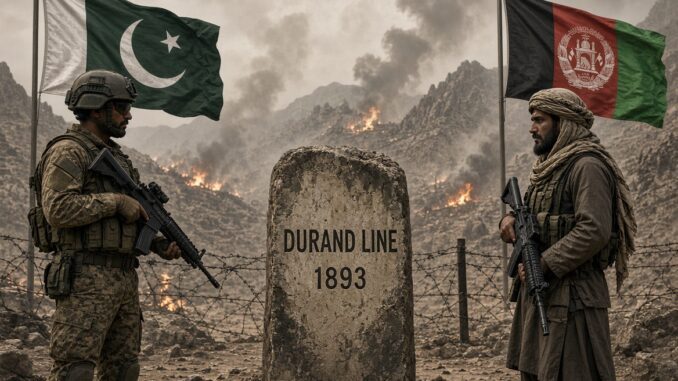
Relations between Afghanistan and Pakistan must be examined through the same standard. They are not the product of a simple border dispute. The history of British colonial expansion, the Durand legacy, cross-border social structures, militant networks, regional competition, and several decades of security policy have all contributed to the present situation.
The Durand Line is part of a historical legacy of territorial division and frontier management. Militant networks have also developed within environments where social and ideological connections extend beyond formal state borders. Pakistan has used its geographical and security position at different times to expand regional influence and strengthen external relationships. Yet recent experience demonstrates that influence over regional actors and developments does not amount to complete control over their consequences.
Afghanistan, in turn, faces the difficult task of translating political authority into institutional capacity, territorial control, accountability, and sustainable security. Neither country can resolve its security problems in a lasting way through military pressure, border policy, or reliance on armed actors alone.
What field experience has made clear to me is that presence must become control, control must produce order, and order must lead to a sustainable outcome. When this relationship is not established, an operation may succeed while the wider security environment remains vulnerable.
A state must know whom it sends into the field, whom it commands, whom it holds accountable, and how it will maintain security after an operation ends. It must also understand the consequences of each security decision for society, institutions, regional relationships, and its future freedom of action.
A border can be drawn on a map. Forces can be deployed. An operation can be launched. An armed actor can even be weakened for a period of time. But sustainable order emerges only when the state can connect geography, society, institutions, and instruments of power within a structure that is controllable and accountable.
Power that cannot control the consequences of its own actions does not necessarily become security.
Selected References
The sources below support the historical, institutional, political, and current-affairs context discussed in the article. For contested claims, consult the source text and retain attribution to the actor making the claim.
1.Daniel Balland, “Boundaries III. Boundaries of Afghanistan,” Encyclopaedia Iranica. Historical account of the 1893 agreement and the 1894–1896 demarcation process.
2.Bijan Omrani, “The Durand Line: History and Problems of the Afghan-Pakistan Border,” Asian Affairs, 40(2), 2009, pp. 177–195.
3.International Crisis Group, “Pakistan: Responding to the Militant Surge on the Afghan Border,” 27 February 2026.
4.Combating Terrorism Center at West Point, “The Tehrik-i-Taliban Pakistan After the Taliban’s Afghanistan Takeover.”
5.United Nations Assistance Mission in Afghanistan (UNAMA), “Update on Civilian Casualties in Afghanistan,” 6 March, 2026. Verified civilian casualties inside Afghanistan from late 26 February to 5 March 2026.
6.Congressional Research Service, “Pakistan-U.S. Relations,” historical background on bilateral security cooperation.
7.Congressional Research Service, “Pakistan: U.S. Foreign Assistance.” Background on the Pressler Amendment and restrictions on assistance.
8.European Union Agency for Asylum, “Country of Origin Information Report: Afghanistan – Country Focus,” February 2026, section 2.2.3.
9.Council on Foreign Relations, “Conflict Between Afghanistan and Pakistan,” updated 7 October 2026. Background and chronology; allegations are attributed to the relevant actors.
10.Associated Press, “Pakistan’s self-exiled former Prime Minister Nawaz Sharif returns home ahead of a parliamentary vote,” 21 October 2023.
11.Reuters, “Former Pakistan PM Imran Khan back in jail after medical treatment, sources say,” 11 November 2026.
12.Supreme Court of Pakistan, Constitutional Petition No. 37 of 2017, judgment dated 21 February 2018.
13.Historical Background, Sindh Archives, Government of Sindh. Historical record concerning the annexation of Sindh in 1843.
14.“Accumulation by Attachment: Colonial Benevolence and the Rule of Capital in Nineteenth-Century Panjab,” Past & Present, Oxford Academic. Historical analysis of the 1849 annexation of Punjab.
15.Regulation III of 1901: The Frontier Crimes Regulation, 18 September 1901. Digitised transcription and scan.
16.United Nations Security Council, Report S/2023/370, 2023. Reporting on terrorist groups in Afghanistan and assessments concerning the Afghan Taliban–TTP relationship.
17.Elisa Giunchi, “The Origins of the Dispute over the Durand Line,” Internationales Asienforum, 44(1–2), 2013, pp. 25–46.
18.United Nations Secretary-General, “The situation in Afghanistan and its implications for international peace and security,” A/81/363–S/2026/724, 9 September 2026.
19.UNHCR, “Pakistan-Afghanistan – Returns Emergency Response #57,” 6 November 2026. Update on border insecurity, displacement, and humanitarian access.
20.Associated Press, “Militants ambush police in Pakistan, sparking gunbattle that kills 10 officers and 18 militants,” 11 November 2026.
21.Associated Press, “Pakistan’s army says it killed 74 militants in raids on their hideouts,” 13 November 2026. Casualty figures are attributed to Pakistan’s military.
 Wahidullah Noorzai is a former senior officer of the Afghan National Police, with professional experience in the Afghan National Civil Order Police (ANCOP). His work focuses on security and military affairs, geopolitics, and the political economy of insecurity, particularly in Afghanistan and its wider regional environment. His analytical approach combines firsthand professional experience with independent research to examine how geography, local realities, political decisions, and relationships of power shape security and strategic outcomes. Wahidullah is also the founder of NIDA (Noorzai International Doctrine Academy), an initiative dedicated to field-informed strategic thinking and analysis.
Keep Independent Journalism Alive – Support The AIMN
Dear Reader,
Since 2013, The Australian Independent Media Network has been a fearless independent voice – holding power to account and delivering journalism that matters.
Running this site isn’t cheap. Rising costs mean we need your support now more than ever. Every donation, big or small, keeps our servers running, our writers working, and our stories free for everyone.
Donate here:
PayPal or credit card – just click on the Donate button below
Direct bank transfer: BSB: 062500; A/c no: 10495969

We’ve also set up a GoFundMe as a dedicated reserve fund for hosting and future improvements.

Thank you for standing with us. We couldn’t do this without you.
With gratitude,
The AIMN Team
A stand-out from this article is the importance of geography in global politics.
I’ve done a bit of cherry-picking.
“Pakistan’s geographical position has been important in the calculations of external powers since the country’s creation…”
“Pakistan has used its geographical position and military capabilities to obtain external support…”
“…geography and society define the actual limits of state power.”
“…sustainable order emerges only when the state can connect geography, society, institutions, and instruments of power…”
For centuries, the geographical location of vulnerable states resulted in them becoming pawns in The Great Game, as the Brits called it.
And despite some like Pakistan trying to use their location to their own advantage, the influence of the great powers is still immense.
The numbers of foreign NGOs (that are actually political influencers) in strategically valuable outposts, is staggering.
The Great Game continues apace.
History shows (e.g., Iran) that the power of these foreign influences is so great that only revolution can remove their power to bribe and corrupt.
And it’s only Iran’s development of missile technology that has enabled it to resist the forces of counter-revolution that operated from without and within.
There are lessons for Australia in this.
Our geography is our greatest defence.
All we need now is the missile technology.
Just to give an idea of the extent of foreign NGO influence in geo-politics, there are 797 international and foreign affairs organizations in Georgia.
As of April 2023, the number of registered NGOs in Kazakhstan was a mind-blowing 23,335.
It really is amazing how much Western countries want to help you when you have a border with Russia.
My apologies for being off topic…
In the mid 1970s a friend and I were sitting at a table in an Adelaide nightclub, seating was scarce, but we had two spare seats. A couple of blokes asked if they could join us. We jumped at the chance, as we recognised the elder of the two. And an absolute gentleman he was.
We talked for hours. He was Zaheer Abbas, the Pakistani cricketer.
His younger friend didn’t impress us. He’s what we call “big-headed”. The next day the young bloke took five wickets against Australia. He was (my then lookalike) Imran Khan.
Michael, it sounds like you’ve been waiting years to tell that story!
🙂
But you are forgiven for being off-topic — it’s a great story.
In regard to the influence of foreign NGOs, this from Yemen.
A recurring and glaring pattern of covert military supply under humanitarian pretexts has once again been exposed. A massive cache of weapons bearing the logo of the United States Agency for International Development (USAID) was originally uncovered by Yemeni forces during liberation operations in Al-Bayda governorate in mid-2020.
Today, on November 15, 2026, the exact same USAID logo reappears on weapon crates seized from Saudi-backed mercenary mobilizations in Al-Madaribah and Ras Al-Ara.
This undeniable continuity lays bare how external agencies and humanitarian facades are co-opted to funnel arms, fueling proxy conflicts and exposing the profound hypocrisy of interventionist policies.
Indeed, the USA has become adept at seeking to conceal its ways and means of influence and active interference (on the ground) in foreign politics. By way of contemporary example, in Iran:
During the eruption of violent civil uprising in Tehran January 2026 which followed on from US-Israeli operation Midnight Hammer (bunker-buster bombing) in June 2025, USA provided 200 starlink sat-phones to activists. A report from Greyzone on covert operations of the US “National Endowment for Democracy” (NED). This was no doubt in addition to Israel’s Mossad information.
A reading of NED’s Damon Wilson (President and CEO) testimony at the Hearing Before the Subcommittee on National Security, Department of State, & Related Programs, House Committee on Appropriations February 24, 2026 provides an insight into how the USA goes about its ‘foreign affairs’ business.
It is notable that whilst (so called) diplomatic negotiations were underway between US and Iran, Trump unilaterally ordered the US-Israel operation Epic Fury against Iran on 28 February 2026, just two days after the abovementioned Congressional hearing.
It seems, no state can rely upon ‘good intentions’ and diplomatic straightforwardness in any formal diplomatic exchanges with the USA, whilst it operates in the shadows via the likes of NED, and then NED’s use of proxy organizations whose origins are in ‘other’ states, so as to disguise the source of its ‘insurgencies’.
It is now globally, a seriously unstable geo-strategic environment, generated mainly out of USA actions, principally since 9/11.
In such circumstances, it is no wonder, in Oz, the Albo govt, is VERY cautious, and likely terrified of Trumpian vengeance, and presses for what ordinarily may seem to be excessive secrecy.
Thank you all for your thoughtful contributions and for extending the discussion beyond the immediate Afghanistan–Pakistan context.
The comments raise an important broader question: how do geography, external influence, and strategic dependency shape the ability of states to maintain independent decision-making?
I would add one distinction to this discussion: the presence of foreign organisations, external assistance, or strategic partnerships does not automatically establish political control or foreign interference. These relationships need to be examined through evidence, institutional arrangements, accountability, and their actual effects on national decision-making.
Geography can create strategic opportunities, but it can also expose states to external pressure and competing interests. The decisive question is how effectively national institutions can manage these pressures while preserving strategic autonomy.
As the article argues, influence is not the same as control, operational capacity is not the same as sustainable security, and the possession of strategic resources does not automatically translate into institutional strength.
I appreciate everyone’s engagement. These exchanges demonstrate why strategic questions should be examined through historical experience, field realities, and careful analysis rather than through assumptions alone.