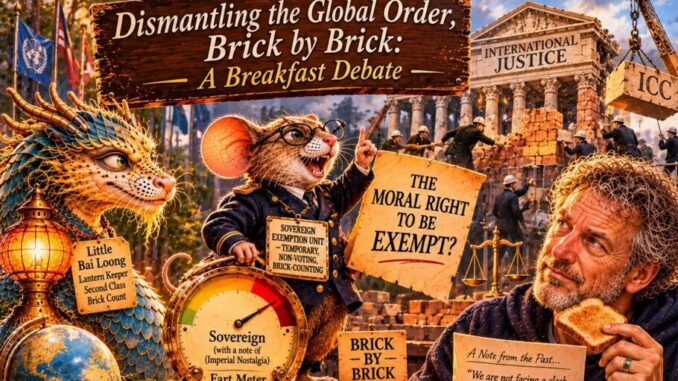
Featuring: The Democracy Mouse (Chief Investigator, Fart Meter Division, Sovereign Exemption Unit), Little Bai Loong (Lantern Keeper, Second Class, Keeper of the Brick Count), and Andrew (The Human, Provisional Assistant, Holder of the Toast, Asker of the Question)
Recorded at the kitchen table, with the meter on the saucer and the Saturday papers unread.
ANDREW: The title is good. But I want to make sure we know what we are dismantling. The Secretary of State said the ultimate question of our time is whether Americans have a moral right to exist as a distinct nation, and to demand a government that defends and pursues their interests above all else. That is not a question about existence. It is a question about exemption.
LITTLE BAI LOONG: The Mouse has read the speech. He has asked for the meter to be set to “sovereign, with a note of imperial nostalgia and a distant sound of an institution being dismantled brick by brick.”
MOUSE: (Climbing onto the saucer. Adjusting the lanyard that reads “SOVEREIGN EXEMPTION UNIT – TEMPORARY, NON-VOTING, BRICK-COUNTING.”) Right. The first thing to establish is what the speech is for. It is not a philosophical inquiry into American nationhood. It is a justification for dismantling the International Criminal Court.
ANDREW: The ICC.
MOUSE: The ICC. The United States is not a party to the court, but the court has jurisdiction over crimes committed on the territory of member states, which includes Palestine. The ICC issued arrest warrants for the Israeli Prime Minister and his former defence minister in 2024. The American campaign against the court is, in significant part, a campaign to protect an ally from accountability.
LITTLE BAI LOONG: The sequence is documented. In February 2025, Trump signed an executive order imposing sanctions on ICC officials. In July 2026, Rubio launched a diplomatic push to “dismantle the ICC brick by brick.” In October 2026, the administration imposed sweeping new sanctions on the entire court. Rubio stated: “Either the ICC will end its threats, or we will end the ICC.”
MOUSE: The ICC president, Judge Tomoko Akane, addressed the UN General Assembly remotely because US sanctions prevented her from travelling. She called the sanctions “extraordinary” and “unprecedented.” She noted the timing: the new sanctions were announced on the day the Nobel Peace Prize was awarded to a former ICC judge for her work in international justice. “The contrast could not be starker,” she said.
ANDREW: So, the question “do Americans have a moral right to exist” is asked in the context of a court that is investigating an ally. And the answer is used to justify the dismantling of the court.
MOUSE: The moral right to exist becomes the moral right to be exempt.
ANDREW: Is this new? Has the United States always behaved this way?
LITTLE BAI LOONG: The Mouse has looked at the history. The pattern is older than the current administration, though the current administration has accelerated it.
MOUSE: The United States has a long record of rejecting international constraints. It signed but never ratified the Convention on the Rights of the Child. It withdrew from the Paris Agreement and the WHO. It rejected the jurisdiction of the ICC before the court existed. The Mouse does not say this to single out the United States. He says it to place the current speech in its context. The speech is not a break from American tradition. It is a distillation of it.
ANDREW: So, the speech is the tradition, stripped of the diplomatic wrapping.
MOUSE: The tradition, stated without the wrapping. And the wrapping is what made the tradition tolerable to the rest of the world.
ANDREW: How does this affect Australia?
LITTLE BAI LOONG: The Mouse has read the Defence legislation. The Defence Legislation Amendment (Accelerating Capability and Protecting Bases) Bill 2026 was introduced on 27 October 2026 by Richard Marles. The government’s own factsheet states that the reforms are “critical to implement the National Defence Strategy and progress work on Pillars I and II of AUKUS.” The bill establishes a Defence Capability Framework that enables Defence, industry, and “trusted international partners” to develop, test, and introduce capabilities “more efficiently in Australia.”
MOUSE: The factsheet is careful. It says the reforms do not remove environmental protections or native title rights. It says decisions are subject to judicial review and merits review. It says the IGADF’s oversight role is expanded.
ANDREW: But?
MOUSE: But it does not say which state or territory laws might be displaced by a capability declaration. It does not say who the “trusted international partners” are, or what legal status their personnel and contractors will have. It does not say how the “efficiency” of the framework will be measured, or by whom.
LITTLE BAI LOONG: The Mouse’s formulation: Australia is not adopting American exceptionalism. It is adopting the infrastructure of a power that practices it.
ANDREW: That is the connection.
MOUSE: That is the connection. The integration is not a moral endorsement. But it is a structural alignment.
ANDREW: What would happen if China made the same statement?
MOUSE: The Mouse offers a thought experiment. If a Chinese official said that the “ultimate question of our time” is whether Chinese people have a “moral right to exist as a distinct nation,” and that China must “demand a government that defends and pursues our interests above all else,” the response from Western capitals would be immediate and unanimous. It would be described as aggressive nationalism, a threat to the rules-based order, and evidence of expansionist intent.
LITTLE BAI LOONG: The United States makes the same statement, and it is reported as a speech about the ICC. The frame is different because the speaker is different.
MOUSE: The Mouse does not say this is hypocrisy in the ordinary sense. He says it is the structure of the hierarchy. The same claim is heard differently depending on who makes it.
ANDREW: What does the academic literature say about this?
MOUSE: The Mouse has consulted the research on nationalism and authoritarianism. Osborne, Milojev, and Sibley (2017) distinguish between nationalism – belief in the superiority of one’s nation – and patriotism – attachment to one’s homeland. Their longitudinal study found that Right-Wing Authoritarianism had positive effects on both nationalism and patriotism. But Social Dominance Orientation had a positive effect on nationalism and a negative effect on patriotism.
LITTLE BAI LOONG: The finding is precise. The belief that one’s nation is superior is associated with a preference for hierarchy, not with love of country. Rubio’s formulation is a nationalist formulation in this technical sense. It is a claim about superiority and exemption, not about attachment.
MOUSE: The research on authoritarian-right narratives in Europe adds a second dimension. The literature on “masculinist identity politics” describes how right-wing actors use narratives of crisis, insecurity, and victimhood to legitimise authoritarian solutions. The formulation “do Americans have a moral right to exist” is a victimhood narrative. It positions the most powerful nation on earth as the potential victim of “global bureaucrats and activist judges.”
ANDREW: The irony.
MOUSE: The irony. The nation with the largest military budget in the world is asking whether it has the right to exist.
ANDREW: So, our discussion is about more than the speech.
MOUSE: The discussion is about the structure. The speech is the occasion. The structure is the same one we have traced throughout the corpus: the creation of a framework in which a category of activity is placed outside the ordinary legal order. The Australian Defence bill does it for state law. The American campaign does it for international law. The scale is different. The logic is the same.
LITTLE BAI LOONG: And the logic produces conflict. If the United States is exempt from international law, and if it is willing to dismantle the institutions that attempt to apply it, then other states have no reason to trust the legal order. They will build their own. The result is not a rules-based order. It is a competition of exemptions.
MOUSE: The Mouse adds a third observation. The claim is self-undermining. The United States has spent eighty years building the international order that Rubio is now dismantling. The order was never perfect, and the United States was never a perfect participant. But it provided a framework in which American power was exercised through institutions rather than against them. The dismantling removes the framework and leaves only the power. And power without a framework is harder to justify, harder to sustain, and harder to distinguish from the power of any other state.
ANDREW: So, what is the question the discussion leaves?
LITTLE BAI LOONG: The question is not “why is Rubio saying this?” It is: what happens to the international order when the most powerful state in it declares that the order does not apply to it?
MOUSE: And the answer, at the level of hypothesis, is this. The order does not collapse. It fragments. The institutions continue to exist, but they lose their authority. The law continues to be written, but it is applied only to those who accept it. The result is not chaos. It is a world in which the rules are optional for the powerful and binding for the rest.
ANDREW: That is the dismantling.
MOUSE: That is the dismantling. Brick by brick. And the Mouse notes that the bricks are being removed by the same power that laid them.
ANDREW: So, the title works.
LITTLE BAI LOONG: The title works. It is precise, and it is documented.
MOUSE: The Mouse approves the title. He has requested that his meter be recalibrated to “sovereign, with a note of imperial nostalgia and a distant sound of an institution being dismantled brick by brick.” He has also requested a second piece of cheese, on the grounds that the debate has been long and the brick count is high.
ANDREW: And the ladder?
MOUSE: Hold the idea of a ladder. We’re going to need it to reach the bricks. And the bricks are not going to like being asked who laid them.
END
Keep Independent Journalism Alive – Support The AIMN
Dear Reader,
Since 2013, The Australian Independent Media Network has been a fearless independent voice – holding power to account and delivering journalism that matters.
Running this site isn’t cheap. Rising costs mean we need your support now more than ever. Every donation, big or small, keeps our servers running, our writers working, and our stories free for everyone.
Donate here:
PayPal or credit card – just click on the Donate button below
Direct bank transfer: BSB: 062500; A/c no: 10495969

We’ve also set up a GoFundMe as a dedicated reserve fund for hosting and future improvements.

Thank you for standing with us. We couldn’t do this without you.
With gratitude,
The AIMN Team

Brilliantly written, but I have a question mark over this — “The institutions continue to exist, but they lose their authority. The law continues to be written, but it is applied only to those who accept it. The result is not chaos. It is a world in which the rules are optional for the powerful and binding for the rest.”
That has certainly been the case, until now.
It seems that Iran is considering cutting ties with the Nuclear Non-Proliferation Treaty.
This follows the US walking away from the JCPOA, an agreement on Iran’s nuclear program, in 2018.
It turns out that “the rest” do not always remain weak and vulnerable.
Eventually, seeing the way the world is run, they insulate themselves to the point where they can make their own rules.
Now, if only we can inject a bit of that independent thinking into Albo and his Cabinet of nobodies.
When was the last time we heard an original thought from a current Cabinet Minister?
@ Steve: Now, now, expecting an original thought from Albo-Appeasie would destroy his determination to be the longest serving Labor sycophant of US foreign policy since Menzies & Holt.
Possibly the correct path for Australian politics is to become a non-aligned middle power state located in Asia and trading with our Asian neighbours who constitute the biggest world market, right on our front doorstep!!
We see the EEC collapsing under decades of self-serving middle & upper class politics providing little for the working voters, poverty in the USA (Undemocratic Sewer of Apartheid) so extreme that the Hollywood “American Dream” is the ”Nightmare on Main Street” reality.
The American”exceptionalist” philosophy is founded in their strange ”religious” beliefs to justify their determined exploitation of every other person as a human right.
“…Dismantling the Global Order, Brick by Brick….”, the sacred global order that USA imposes by militant exceptionalism is slowly being dismantled first by BRICS and now by BRICS+. So much for the bricks.
Yes indeed the West, having fallen apart at the seams is crumbling fast. The old religious dogs of war have mostly waned, and can now be seen to be pursuing a pacific ecumenicalism. UK/Western European hegemons are long gone, and have been buffered by the might of the great US post-WWII hegemon. But the USA has been rife with corruption since its inception. Its money and power focused adventurism and coercion knew no bounds. But it has failed miserably, and now noticeably under the brazen neo-fascist kleptocracy of the Trumpian regime.
China has much to be proud of in its post-WWII vitalization, and I too barrack for it – with caution. It has adopted in its own form the West’s ‘capture capitalism’, and that can be a slow and painful suicide mission in and of itself. Although it can be said that China seems to learn and act fast. Nevertheless, it is now in a bind, in that its integration with the ‘West’ sees it vulnerable to the West’s demise.
BRICS+ may be a partial answer to some immediate problems, but at this time it is far from the be-all-and-end-all. Africa may be a target, but it remains a mess of post-colonial hangover, and a difficult continent for all. And for West Asia through to SE Asia nothing can be taken for granted. It’s very shakey through the Levant, the Gulf, Persia, Afghanistan, Pakistan, India, Myanmar, Indonesia and the Philippines. Not to forget Russia/Ukraine.
China, wisely, is terrified of the collapse of the West, especially America, as it would bring with it global catastrophe.
It’s all very well bagging Albanese and his govt. But perhaps he recognizes the perils better than any other so-called political adventurers in Oz. He’s been dashing about talking to all leaders on the aforementioned Asian shakey grounds. And in that regard figures that his efforts are best focused on aiding the West from within, by slowly carefully and incrementally offering a leg-up to them reconstructing themselves into a more functional less combative global order rid of kleptocratic oligarchs. It’s undoubtedly a tough job, and to a significant extent has to be done in the shadows.
It is notable that the sport de jure, initiated by the right wingers of NewsCorpse and the various increasingly RW political alignments in Oz are the ones hell-bent on bagging Albo & Labor. Why, I can’t imagine (yes I can).