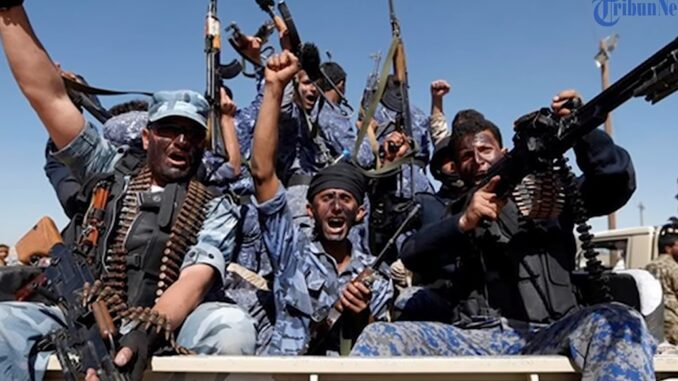
Yemen, land of so much suffering, is becoming ever more distempered. The official government, its status assured only because of such sponsors as the Kingdom of Saudi Arabia, is teetering. The appetite on the part of Riyadh to keep up the fight against the seemingly imperishable Iranian-backed Houthis is diminishing. What is interesting on this score is that interest in Washington for a military response has barely registered. In September, when Saudi Crown Prince Mohammed bin Salman urged US President Donald Trump to authorise strikes on Houthi positions, he was rebuffed.
Despite a counterattack in October intended to seize west coast territory taken by the Houthis in September, the Yemeni government announced on November 15 that it was withdrawing from the environs of the Bab el-Mandeb Strait, another indispensable global shipping route that became even more prominent with the closure of the Strait of Hormuz by Iran in its battle with the United States and Israel. The Bab el-Mandeb Strait, linking Europe to Asia via the Red Sea and Suez Canal, remains important as a shipping passage. According to a satellite estimate by IMF PortWatch, as of November 11, it had 26 transits a day, a figure 33.8% down from the same week in 2025.
The statement from the Southern Armed Forces barely concealed the desperation. “In light of the latest developments on the fronts, the military build-ups, and the threats targeting the capital Aden and neighbouring governorates and given the responsibilities and field and security priorities this phase imposes, the Southern Armed Forces announce that they are carrying out a repositioning of their forces from Dhubab Airport and the Bal al-Mandab area in western Taiz Governorate.”
On November 16, an aggressive advance by the Houthis along the southern coastline into Khor Omairh was reported, placing them within a hundred kilometres west of Aden, which has served as the government’s bastion of power since the 2014 capture of Sanaa by the rebels. This also placed them within 25 kilometres of government lines at Qawah. A report noted by Dawn claimed that the Houthis had made even more impressive progress, advancing to an area about 60 kilometres from Aden, situated around the highlands island of the coastal plain bordering Taiz and the southern governorate of Lahj.
Taiz itself, encircled by the Houthis in October, continues to be besieged, with Colonel Majid Abdullah al-Nuzaili, spokesperson for the Yemeni Armed Forces, proffering an image of stoic resistance in the face of precipitous decline. The position of the Southern Forces on breaking the siege, he claimed, “represents a patriotic stance at a highly sensitive stage, considering the protection of the capital Aden and the breaking of the siege of Taiz to be a national and moral responsibility to stop the threat of violations by the terrorist Houthi militia.” Al-Nuzaili is certainly one to keep up appearances, having announced the launch of 906 operations on November 15 that left 201 Houthis dead and wounded, followed by 661 operations the next day that inflicted 173 Houthi casualties.
Houthi progress has not been stalled by some 5,183 Saudi airstrikes allegedly launched against rebel positions since July. If anything, the resolve of the militia is proving formidably steely. Saudi territory has also been harried by missiles and drone strikes, becoming so common as to be daily fact since November 7. The increased frequency of such assaults took place after air strikes by the Saudi-led Coalition to Restore Legitimacy in Yemen on a Taiz Market on November 6 and Bani Hushaysh in Sanaa on November 7. Thirty died in the Taiz Market strike; forty in Bani Hushaysh. Houthi drone strikes have since taken place against oil facilities at Yanbu, Khamis Mushait Air Base and an Aramco facility in Riyadh. Cruise missiles were directed at King Khalid International Airport. On November 16, two Houthi-launched drones were intercepted and destroyed in the Makkah and Riyadh regions. A third was destroyed over the Riyadh region the next day.
The over decade old conflict between the respective claimants to Yemen’s control and sovereignty continues to cause death, injuries and displacement to civilians in a country hideously impoverished and facing a humanitarian crisis of staggering proportion. An OCHA (United Nations Office for the Coordination of Humanitarian Affairs) report covering August 1 to November 10 this year found that 329,117 people (54,846 households) had suffered displacement.
In a bureaucratic spasm, cosmetic changes have been made on the Saudi side of the conflict. When morale needs to be restored, it becomes fitting to, if not execute a general then relieve him of command. Lieutenant General Fahd bin Hamad Al-Salman accordingly suffered an ignominious relief of command for failing to hold the front, with a royal decree naming him “adviser for military affairs to the minister of defence.” Saudi Arabia’s Chief of General Staff General Fayyad bin Hamed bin Ruqad al-Ruwaili is the hurried replacement.
The sense of an ending among the Coalition forces, however, is hard to stem. The motley assembly, including the Southern Transitional Council (STC) leader Aidarous al-Zubaidi, detect the rank smell of incompetence and lack of direction from Riyadh. To muddy matters, Al-Zubaidi is backed by the United Arab Emirates, and remains in Abu Dhabi, his return to southern Yemen barred by Riyadh. (This is less a coalition of allies than an assembly of warring, disagreeable chieftains.) Amr al-Bidh, a spokesperson for al-Zubaidi, insists that “STC forces retain a credible capability on the ground. But we need practical and political support from the region to counter the Houthis and create the basis for a negotiated settlement, one in which the pathway towards southern independence is fully recognised.” That credibility is being sorely tested, with the terms of any settlement being increasingly set by the military gains of the Houthis. As this development unfolds, they are being egged on by Tehran as it continues to mock an outmanoeuvred and outplayed Trump administration, one that did so much to encourage a widening conflict in the Middle East.
Keep Independent Journalism Alive – Support The AIMN
Dear Reader,
Since 2013, The Australian Independent Media Network has been a fearless independent voice – holding power to account and delivering journalism that matters.
Running this site isn’t cheap. Rising costs mean we need your support now more than ever. Every donation, big or small, keeps our servers running, our writers working, and our stories free for everyone.
Donate here:
PayPal or credit card – just click on the Donate button below
Direct bank transfer: BSB: 062500; A/c no: 10495969

We’ve also set up a GoFundMe as a dedicated reserve fund for hosting and future improvements.

Thank you for standing with us. We couldn’t do this without you.
With gratitude,
The AIMN Team

The complete evaporation and permanent demise of Saudi Arabia might be a wonderful thing to imagine, depending on your culture, outlook, mood, indoctrination, perversion, superstition, corruption and current view. No “good” seems to emanate from this outpond of Trump sewage currently.
No matter to whom our what Australia is “aligned”, this is a conflict we must keep out of.