By Henry Johnston
As the postmodern version of the Yalta Conference looms in Shenzhen China, it is worth looking at the history of Ukraine’s historically poisonous relationship with Russia. Given that I began this essay with a reference to Yalta, I’ll look back at the malignant figure who sat between Roosevelt and Churchill and helped shape Ukraine’s misery. His name was Joseph Stalin.
In February 1945, Roosevelt, Churchill and Stalin met in Yalta in Crimea to shape post-war Europe. The conference took place while the Soviet Union occupied much of Eastern Europe. Its decisions helped establish a political order in which smaller nations, particularly those falling within the Soviet sphere, had little practical freedom to determine their own destinies. The promises of national self-determination made at Yalta were ultimately overwhelmed by Soviet power.
A decade before Yalta, Stalin engineered the famine of 1932–33. Known as the Holodomor, it remains one of the darkest episodes in Ukrainian history. This Ukrainian word means death by starvation, or murder by hunger. Australia formally recognises the Holodomor as genocide. Approximately four million people died. Forced collectivisation, confiscation of grain and food, punitive measures against villages and restrictions on movement, turned famine into an instrument of political repression.
Ukraine did not escape the subsequent catastrophe of the Second World War. Soviet Ukraine became one of the principal theaters of the German invasion and some of the bloodiest fighting on the Eastern Front.
This history matters because Vladimir Putin’s invasion cannot be understood merely as a territorial dispute. His so-called Special Military Operation is rooted in his refusal to accept Ukraine as a sovereign nation. Putin has repeatedly questioned the legitimacy of Ukrainian statehood and portrayed the country’s independence as a historical aberration. For Ukrainians, this is not an abstract argument about borders. It is a threat to their national existence.
The human cost of Putin’s invasion is staggering. Estimates published by the Washington-based Centre for Strategic and International Studies puts Russian battlefield fatalities at between 400,000 and 450,000, with total Russian casualties, including wounded and missing, around 1.4 million. These are estimates and not independently established totals, but they demonstrate the extraordinary price Putin has forced Russia to pay. Ukraine’s losses have also been immense. Behind every statistical estimate are families, communities and a generation whose lives have been permanently altered.
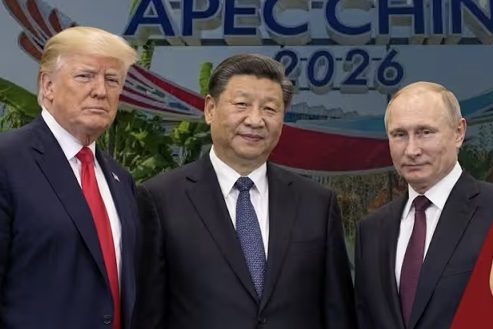
Against this background, the proposed meeting between Donald Trump, Vladimir Putin and Xi Jinping in Shenzhen on 19 November raises a profoundly troubling question: will Ukraine’s future be discussed by three powerful men without Ukraine having a seat at the table?
The circumstances in Shenzhen are different from Yalta, but the danger is recognisable. Putin wants an outcome that validates his invasion and secures the territorial and political gains Russia has made. Trump may see a negotiated settlement as a diplomatic achievement, a way to demonstrate his capacity to end a war. Xi, meanwhile, has an opportunity to present China as a global powerbroker and to strengthen its bonds with Moscow while managing its complicated relationship with Washington.
These objectives do not coincide. But they share one potential consequence: Ukraine could become an object of negotiation rather than an equal participant in determining its own future.
For Ukraine, the danger is that a ceasefire could become a disguised capitulation. A settlement that leaves Russia in possession of occupied territory, without credible security guarantees for Ukraine, would reward aggression.
There is also the question of Ukraine’s relationship with Europe. The European Union and NATO countries provide military, financial and humanitarian support on a substantial scale. They have a direct interest in the outcome because the security of Ukraine is inseparable from the security of the European continent. Any agreement reached over their heads would risk undermining European unity and confidence in the American security guarantee.
I doubt Donald Trump understands that a settlement imposed on Ukraine would not end the conflict. A peace agreement that Ukrainians regard as illegitimate, would be politically fragile and potentially impossible to enforce.
The historical irony is profound. Ukraine endured Stalin’s famine, fought on an immense scale against Nazism, and then spent decades within a Soviet system dominated by Moscow. After independence in 1991, Ukrainians sought to build a democratic state with the freedom to determine its own alliances and institutions. Putin’s invasion represents an attempt to reverse this historical achievement.
Australia, too, has a particular responsibility in this matter, founded on a tradition of moral independence and support for the rights of smaller nations. At the birth of the United Nations, Australia’s Minister for External Affairs, Dr H. V. Evatt, argued forcefully at the San Francisco Conference in 1945 that smaller and middle-ranking nations must have a meaningful voice in the new international order. He later presided over the General Assembly at the Palais de Chaillot in Paris in 1948, insisting that international relations should be governed by justice and morality rather than physical power. That principle was not confined to diplomatic chambers. Following the Chernobyl nuclear disaster in 1986, Australian families and community organisations opened their homes to over 1,300 children from the affected regions of Ukraine and Belarus, bringing them here for the simple experience of childhood beyond the shadow of contamination.
These were acts of practical compassion, but they also expressed something larger: an understanding that Ukrainians were not strangers whose suffering could be ignored. As Anthony Albanese attends the APEC summit in Shenzhen, Australia should remember this inheritance. Australia must clarify that Ukraine is a sovereign nation, not a bargaining chip for powerful men, and that a lasting peace must respect the right of Ukrainians to determine their own future.
If the sideline meeting in Shenzhen produces a genuine path to peace, it will be welcome. But peace cannot mean rewarding an invasion, legitimising territorial conquest or denying Ukrainians the right to determine their future. Without Ukraine’s consent and credible guarantees of its security, a new Yalta will not bring peace to Europe. It will merely lay the foundations for another conflict, possibly fought with nuclear weapons.
The strongest argument here is not simply that Shenzhen resembles Yalta. It is that a peace negotiated without Ukraine could reproduce the very denial of Ukrainian sovereignty that has driven the conflict.
Further reading: Anne Applebaum, Red Famine: Stalin’s War on Ukraine
Henry Johnston is the author of We Who Decide, on sale here.
Keep Independent Journalism Alive – Support The AIMN
Dear Reader,
Since 2013, The Australian Independent Media Network has been a fearless independent voice – holding power to account and delivering journalism that matters.
Running this site isn’t cheap. Rising costs mean we need your support now more than ever. Every donation, big or small, keeps our servers running, our writers working, and our stories free for everyone.
Donate here:
PayPal or credit card – just click on the Donate button below
Direct bank transfer: BSB: 062500; A/c no: 10495969

We’ve also set up a GoFundMe as a dedicated reserve fund for hosting and future improvements.

Thank you for standing with us. We couldn’t do this without you.
With gratitude,
The AIMN Team
The first Yalta didn’t have Hitler participating; this time, poo tin and his bumchum theRump will dominate.
If Henry Johnston wishes to be accepted as a serious author, he should take a lead from Wahidullah Noorzai, whose recent articles here are great examples of scholarly neutrality.
What we see here is not neutrality — it’s propaganda.
This article is so full of holes that I assumed while reading, that Henry had been led astray by Timothy Snyder, but all is revealed at the end where we see that his inspiration is the equally questionable Anne Applebaum.
A comprehensive criticism of Applebaum’s Red Famine, the book recommended by Henry and upon which this article is based, can be found here: https://www.historynewsnetwork.org/article/review-of-anne-applebaums-red-famine-stalins-war-o
And so we see Applebaum’s errors repeated here.
One almost trivial example — according to Henry, holodomor means “death by starvation, or murder by hunger.”
That is incorrect.
Historian Mark Tauger writes — According to multiple dictionaries, “mor” in Ukrainian means “plague, pestilence.” The verb form of this word, “moriti,” can mean extermination, for example of rats or flies, and it can also mean “to starve” or “to exhaust.” But as it is written, “Holodomor” means something like “famine-plague” or “severe famine” rather than “extermination by famine.”
Henry states — “After independence in 1991, Ukrainians sought to build a democratic state with the freedom to determine its own alliances and institutions.”
Here we go again.
Plucky little Ukraine, battling against the odds to establish a model democracy.
The outlet American Conservative begs to differ.
In response to the false allegation that Russia was kidnapping Ukrainian children it wrote — It is common in Ukraine for single mothers or impoverished families to send their children to orphanages hoping one day to reclaim them when their circumstances improve. This makes it difficult for Russian authorities who want to place war orphans in new homes; they don’t know which ones still have parents in Ukraine who might want them back.
The second thing is that child trafficking in Ukraine is a real problem. The U.S. State Department, the European Union, and UNICEF have all named Ukraine as a hotspot for “institution-related trafficking.” Children in orphanages have been sold to American parents by unscrupulous adoption agents or taken away on false pretenses by criminal gangs, who then use the children in any one of their various money-making enterprises. For a fictional treatment of this issue, based on real stories, see the 2014 novel Orphanage 41 by Canadian investigative journalist Victor Malarek, an expert in human trafficking and author of the non-fiction expose The Natashas: Inside the New Global Sex Trade.
In other words, there are good reasons why Russian authorities will not release a child simply because someone in Ukraine claims to be his rightful guardian. The desire to reunite children with their relatives must be balanced against the need to protect children from bad actors. Those concerned with the welfare of these children should put their effort into meeting the criteria the Russian authorities have set for reunification in order to bring them home as soon as possible—and leave charges of “genocide” out of it.
https://www.theamericanconservative.com/is-russia-kidnapping-ukrainian-children/
Henry followed that little fantasy with another — “Putin’s invasion represents an attempt to reverse this historical achievement.”
Australian historian Renfrey Clarke tells the true story of that “historical achievement”.
In researching this book I found a 1992 Deutsche Bank study arguing that of all the countries into which the U.S.S.R. had just been divided, it was Ukraine that had the best prospects for success. To most Western observers at the time, that would have seemed indisputable.
Ukraine had been one of the most industrially developed parts of the Soviet Union. It was among the key centres of Soviet metallurgy, of the space industry and of aircraft production. (Courtesy of investment by Moscow.) It had some of the world’s richest farmland and its population was well-educated even by Western European standards.
Add in privatisation and the free market, the assumption went, and within a few years Ukraine would be an economic powerhouse, its population enjoying first-world levels of prosperity.
Fast-forward to 2021, the last year before Russia’s “Special Military Operation,” and the picture in Ukraine was fundamentally different. The country had been drastically de-developed, with large, advanced industries (aerospace, car manufacturing, shipbuilding) essentially shut down.
World Bank figures show that in constant dollars, Ukraine’s 2021 Gross Domestic Product was down from the 1990 level by 38 percent. If we use the most charitable measure, per capita GDP at Purchasing Price Parity, the decline was still 21 percent. That last figure compares with a corresponding increase for the world as a whole of 75 percent.
To make some specific international comparisons, in 2021 the per capita GDP of Ukraine was roughly equal to the figures for Paraguay, Guatemala and Indonesia.
What went wrong? Western analysts have tended to focus on the effects of holdovers from the Soviet era, and in more recent times, on the impacts of Russian policies and actions. My book takes these factors up, but it’s obvious to me that much deeper issues are involved.
In my view, the ultimate reasons for Ukraine’s catastrophe lie in the capitalist system itself, and especially, in the economic roles and functions that the “centre” of the developed capitalist world imposes on the system’s less-developed periphery.
So Ukraine was mis-managed from the time it distanced itself from Moscow. By the time of the invasion it was already an economic disaster.
But there was another factor that destroys Henry’s cosy picture of a model democracy.
State corruption in Ukraine has been reported by journalist Seymour Hersh, who writes that the CIA assesses that Ukrainian officials, including Zelenskyy, have embezzled $400 million from money the U.S. sent Ukraine to buy diesel fuel for its war effort, and that Ukrainian government ministries literally compete with each other to sell weapons paid for by U.S. taxpayers to private arms dealers in Poland, the Czech Republic and around the world.
But I know you want more, and fair enough, because a good rule of thumb in an era of unprecedented global propaganda, is to question everything.
A press release from the European Court of Auditors, Luxembourg, 23 September 2021, adds some weight to the claims by Hersh.
The report heading reads — EU support for reforms in Ukraine ineffective in fighting grand corruption.
It continues;
“Grand corruption and state capture are still widespread in Ukraine despite EU action, according to a special report published by the European Court of Auditors (ECA). The EU has been trying to address corruption in Ukraine as a cross-cutting priority; it has channelled funds and efforts through a variety of sectors, from the competition environment to the judiciary and civil society. But the support and measures put in place have not delivered the expected results, the auditors say…Grand corruption and state capture are endemic in Ukraine; as well as hindering competition and growth, they also harm the democratic process.”
Well, well.
Grand corruption and state capture are endemic in Ukraine.
That tells us all we need to know.
But the killer point to be made lies here — Henry states — “The European Union and NATO countries provide military, financial and humanitarian support on a substantial scale.”
He somehow overlooked the most important aspect to that.
The EU and NATO assisted Kiev in its war crimes against its own people.
After the 2014 coup, when the people of the Donbas lost their language rights, their protests led to the Minsk Accords.
The Accords were signed by France and Germany, but they failed to make Ukraine abide by the agreements.
Ukraine, Germany, France, and the Donbas republics had agreed as per the Accords, on autonomy within Ukraine for the Donbas.
All that was left was for the details of the autonomy to be finalised.
But Ukraine began military action against the Donbas, with the help of NATO.
Ukraine’s claim that this was an anti-terrorist action has been dismissed by the ICJ.
None of this is ever mentioned by critics of Russia.
Russia’s intervention to stop Ukraine killing its own citizens, is never mentioned.
Firstly, Steve, your jumbled attack on Applebaum masquerading as analysis is basically running protection for Putin’s Russia and Anglo right?
This meeting is for the benefit of Putin, while apparently Xi is ambivalent, but going through motions of supporting its partner Russia, or vassal state….
The far right and faux anti-imperialist tankie sh*theads of the left talking points and narratives vs Ukraine, NATO and ultimate target the EU align with Le Pen, AfD, Farage, Atlas Koch – MAGA Tanton, FoxNews etc., and the Green’s policies?
Exemplifies a serious problem in Australian media and politics of misinformation, lack of analysis and key literacies to conduct analysis; we end up with geopolitical eugenics…..
From Andrew Smith — “Firstly, Steve, your jumbled attack on Applebaum masquerading as analysis is basically running protection for Putin’s Russia and Anglo right?”
Gee, it would be really good if Andrew Smith was to quote something I said, and refute it.
I won’t hold my breath waiting.