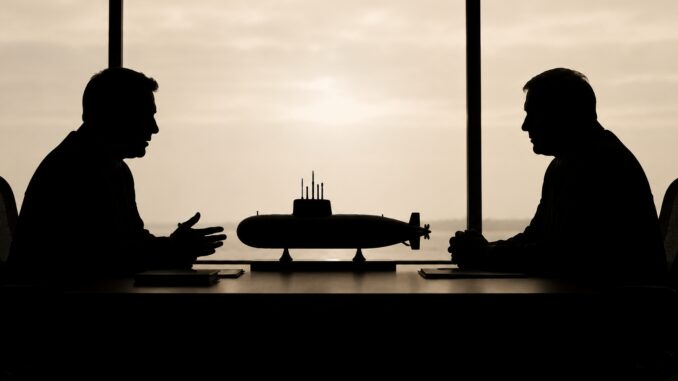
With love, respect and apologies to Bryan Dawe, and to the memory of John Clarke (1948–2017), whose weekly interviews taught a generation of Australians to listen for the gap between what is said and what is meant. The Minister below is no one and everyone. The dollar figures are real.
The set is two chairs and a desk. We join Bryan Dawe and John Clarke mid-interview.
DAWE: Minister, under the original plan Australia was to receive three submarines. Two second-hand, one new.
CLARKE: The number remains three, Bryan.
DAWE: The new one has gone.
CLARKE: The program has been refined.
DAWE: In what way?
CLARKE: By removing the element of novelty.
DAWE: So all three are now second-hand.
CLARKE: All three are seasoned, Bryan. They’ve been down, they’ve come up, they’ve been down again. They are no longer in the process of becoming submarines.
DAWE: Experienced in what?
CLARKE: Underwater matters.
DAWE: How old are they?
CLARKE: They are within a known range.
DAWE: Which is?
CLARKE: A range we’re comfortable with.
DAWE: The design life is thirty-three years.
CLARKE: Which means the early uncertainties have been addressed elsewhere. We arrive at the settled portion of the submarine’s life. The middle. The dependable middle. The part that has already revealed its character.
DAWE: At considerable expense.
CLARKE: It is a substantial investment in certainty.
DAWE: For three used submarines.
CLARKE: For three submarines with a history. An identity. And a story. Provenance adds value.
DAWE: Only in the antique market. When do they arrive?
CLARKE: The first in 2032.
DAWE: And until then?
CLARKE: We move along the optimal pathway.
DAWE: What is that?
CLARKE: It is set out in the MOU.
DAWE: The memorandum of understanding.
CLARKE: Of Australia’s special relationship with its great and powerful friend.
DAWE: DAWE: And the friend is committed?
CLARKE: The friend is reviewing its commitment.
DAWE: Reviewing.
CLARKE: As friends do, Bryan. Periodically. To be sure they still mean it.
DAWE: What does it involve?
CLARKE: Integration. Rotation. Uplift. A steady deepening of familiarity. A broadening of interchange. A kind of proximity without possession. Presence without custody. Access without ownership.
DAWE: In practical terms.
CLARKE: We have a substantial workforce uplift forward-deployed.
DAWE: Two hundred of them. In Hawaii. On American submarines.
CLARKE: Operating within the framework of the MOU.
DAWE: Our submarines.
CLARKE: Submarines operating within the framework of the MOU.
DAWE: We’ve sent Australian workers to maintain the United States Navy.
CLARKE: To enhance availability.
DAWE: Of their submarines.
CLARKE: Of the collective capability.
DAWE: While we wait for ours.
CLARKE: While we progress.
DAWE: We’re paying for submarines we don’t yet have and supplying labour to the country selling them.
CLARKE: We’re participating in a shared endeavour.
DAWE: At a cost of hundreds of billions of dollars.
CLARKE: Over time, Bryan. It is not a sum so much as a duration. It extends. It accumulates. It accompanies us.
DAWE: We send them a fair bit of our sunburnt country’s iron ore and coal. And a fair bit of wine.
CLARKE: We do, Bryan. (Pauses.) My word, we do.
DAWE: And what do we get in return?
CLARKE: Just about everything, Bryan. Do try to keep your periscope up.
DAWE: Are we any safer?
CLARKE: We are more assured.
DAWE: Of what?
CLARKE: Of our position.
DAWE: Relative to whom?
CLARKE: The environment.
DAWE: Which includes?
CLARKE: The unspeakable foe.
DAWE: A country you won’t name.
CLARKE: A country with which we have a mature, comprehensive and stable trading relationship.
DAWE: Our largest trading partner.
CLARKE: Among the larger ones.
DAWE: So we’re defending ourselves against a country we rely on economically.
CLARKE: We are balancing the relationship. There is the economic aspect, the strategic aspect, and the anticipatory aspect. And in between, a certain level of mistrust, sinophobia and deep-seated unease, all of which must be responsibly maintained.
DAWE: Maintained.
CLARKE: At an appropriate level.
DAWE: And the submarines arrive when?
CLARKE: The first in 2032. The Australian-built vessels in the 2040s.
DAWE: Until then?
CLARKE: We have access to the MOU.
DAWE: Where is that?
CLARKE: It is held jointly.
DAWE: In Australia.
CLARKE: In America.
DAWE: Thank you for your time.
Also by David Tyler
A Cathedral of Grievance: How Murdoch Built The Monster He Can No Longer Control
Australia’s Social Media Ban: A Billion-Dollar Theatre of the Absurd
Keep Independent Journalism Alive – Support The AIMN
Dear Reader,
Since 2013, The Australian Independent Media Network has been a fearless voice for truth, giving public interest journalists a platform to hold power to account. From expert analysis on national and global events to uncovering issues that matter to you, we’re here because of your support.
Running an independent site isn’t cheap, and rising costs mean we need you now more than ever. Your donation – big or small – keeps our servers humming, our writers digging, and our stories free for all.
Join our community of truth-seekers. Please consider donating now via:
PayPal or credit card – just click on the Donate button below
Direct bank transfer: BSB: 062500; A/c no: 10495969

We’ve also set up a GoFundMe as a dedicated reserve fund to help secure the future of our site. Your support will go directly toward covering essential costs like web hosting renewals and helping us bring new features to life. Every contribution, no matter the size, helps us keep improving and growing.

Thank you for standing with us – we truly couldn’t do this without you.
With gratitude, The AIMN Team

Each time I read these, I hear the voice of John Clarke.
There can be no greater compliment.
I have heard these submarines referred to as used, second hand,surplus to requirements, pre-loved and as klunkers defined as a vehicle in poor condition, typically old, noisy, or unreliable, often still roadworthy but prone to mechanical issues like rust or sputtering engines. Perhaps the kindest description is operational.
@ Steve: Agreed!!
The sooner the Scummo USUKA sub project is jettisoned the better it will be.
Little Johnnie Howard lumbered Australia with the inadequate Joint Strike Fighter, JSX, described by Australian aeronautical persons as over-described capabilities and under-performing abilities.
Why is Australia building a nuclear sub base in WA AT AUSTRALIAN COST for the US Navy to dominate the Indian Ocean??
Why is Australia buying USAUKA subs that are second-hand, have less missile capacity than the originally ”ordered” new sub, when obviously from the US wars in Gaza, the Occupied West Bank, Lebanon and Iran have clearly demonstrated that subs currently in the water are now redundant?
Verily I say unto you that since the 1996 Little Johnnie Howard COALition misgovernment, Australia has been slid into a third world economy by the succession of elected politicians unwilling to consider Australia developing their own natural resources and manufacturing industries, rather, preferring to become a third world export economy importing high cost products thus financially benefiting foreign manufacturers.
That’s brilliant David; well done.
I tried copying and pasting it to The Guardian with a citation, but at this stage the moderator has refused to post it.
I assumed you wouldn’t mind, as I did also mention Urban Wrongski, but let me know if you’re opposed to that being done.
Update: they did post it, just took a while checking it (or having a good chuckle over it. ‘hey, hey come and look at this’ probably.)
Apart from the gratuitous or otiose, “g”in Wronski, an affliction Urban is quietly confident he can ignore, you have done well. Typo aside. Unlike writing about himself in the third person, an affectation that is a deadset worry.
Get the message out, Thommo. That’s the thing. And well done on getting it published. Kind regards, David
I looked at the image at the top of the article and the following popped into mind:
“That’s a nice model of a submarine,” says Chicken Marles while nervously glancing at the sky outside from the corner of his eyes.
“Model?” replies Hegseth. “That’s no model, that’s the first of your three submarines. Now pay up $120 billion or we take it back.”