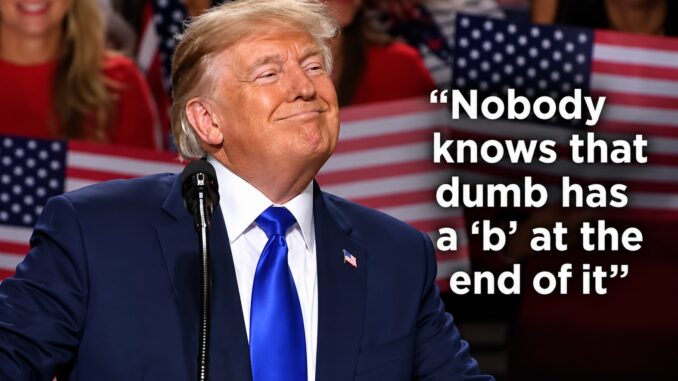
After centuries of linguistic confusion, one man has finally accomplished what generations of scholars apparently could not.
There are moments in human history when the world changes forever.
The discovery of fire. The invention of the wheel. The development of penicillin. The discovery of DNA.
And now, in an achievement that may well eclipse them all, Donald J. Trump has brought humanity one step closer to understanding the English language.
He has discovered the letter B.
More specifically, he has drawn the world’s attention to the existence of the letter B in the word dumb.
Until recently, this humble consonant had been performing its duties in relative obscurity, sitting quietly at the end of a perfectly ordinary word. Generations of schoolchildren had learnt to spell it. Teachers had written it on blackboards. Dictionaries had documented it.
Yet somehow, its existence had not received the international recognition it deserved.
Then came Donald Trump.
And suddenly, the world would never look at a dictionary in quite the same way again.
A discovery of historic proportions
The President’s revelation emerged while he was explaining his ingenious rebranding of the Democratic Party as the “Dumocrats”.
His reasoning was straightforward. Remove the E from Democrats, replace it with a U, and you have Dumocrats. Because, according to the President, their policies are dumb.
There was, however, a complication.
The word dumb contains a B.
Trump drew attention to this overlooked feature of the English language, observing that many people apparently did not know it was there.
One can only imagine the excitement in linguistic circles.
Somewhere in Oxford, a professor may have dropped his teacup.
At Cambridge, a doctoral student may have abandoned a dissertation on Middle English to investigate this extraordinary development.
At Harvard, an entire department may have convened an emergency seminar.
For centuries, the letter B had occupied the same position in the word dumb, making no attempt to conceal itself. Yet it had apparently escaped the notice of a considerable portion of humanity.
Or at least, that was the impression left by the presidential announcement.
It was a moment that called for more than a passing mention on the evening news.
It called for a Nobel Prize.
The Nobel Committee takes note
The Nobel Prizes have traditionally recognised achievements in physics, chemistry, medicine, literature, peace and economics.
But perhaps the time has come to consider a new category.
The Nobel Prize for Orthography.
After all, if the Nobel Committee can recognise advances in scientific understanding, why should it not acknowledge an individual who has brought renewed attention to a consonant that millions of people have been spelling correctly for generations?
The proposal practically writes itself.
The committee could establish a new international discipline dedicated to the discovery of letters that have been hiding in plain sight.
There would be an annual ceremony in Oslo. Academics would assemble in formal dress. Distinguished linguists would deliver solemn addresses. A gold medal would be presented to the recipient.
And the citation might read:
For his outstanding contribution to the public understanding of the letter B, and for drawing international attention to its presence in a word whose spelling has remained remarkably stable for centuries.
It would be an unprecedented honour.
Although, given the circumstances, one might reasonably wonder whether the committee should consult a dictionary before finalising the inscription.
The academic establishment is shaken
Naturally, such a discovery would have profound implications for universities around the world.
What, after all, have our linguists been doing?
For centuries, they have compiled dictionaries, studied phonetics, examined the evolution of language and taught students the fundamentals of spelling.
Yet here was a President explaining that people did not know there was a B in dumb.
Had the academic establishment become complacent?
Had generations of researchers overlooked a fundamental truth?
Or had the letter B simply been waiting for the right man to come along?
One can imagine the frantic activity in university libraries.
Students would be dispatched to inspect every copy of the Oxford English Dictionary. Research assistants would check the spelling of thumb, comb, lamb and climb. International conferences would be organised to establish whether these words contained any further surprises.
A distinguished professor might rise to address the assembled scholars.
“Ladies and gentlemen, I regret to inform you that the B in thumb is also silent.”
There would be gasps.
A delegate from the back row would demand to know whether the same applied to comb.
The professor would nod gravely.
The world of linguistics would never be the same again.
An emergency meeting of the United Nations
It would be irresponsible to ignore the international implications of the discovery.
The United Nations should convene an emergency session to consider the geopolitical consequences of this newly highlighted linguistic phenomenon.
Delegates would arrive from every corner of the globe, armed with dictionaries and increasingly anxious expressions.
The United States representative would explain the President’s findings.
The British delegation would request clarification.
The French would insist that the English language had always been a peculiar business.
Australia would offer to send a schoolteacher.
After several hours of discussion, the assembly might establish a Commission on Previously Unremarkable Consonants.
Its mandate would be to investigate letters whose contributions to the written language had gone insufficiently appreciated.
The commission would begin with B.
It would then move to K in knee, G in gnome, and P in psychology.
Should the investigation prove successful, the United Nations might issue a declaration recognising the right of every letter to be acknowledged for its contribution to civilisation.
The proposal would be referred to a subcommittee.
The subcommittee would commission a report.
The report would be translated into six languages.
And the B would continue sitting at the end of dumb, wondering what all the fuss was about.
A new frontier in scientific research
The implications extend beyond linguistics.
If the existence of the B in dumb has escaped widespread recognition, what other fundamental truths might humanity have overlooked?
Scientists would need to investigate.
Could there be letters in other words that people have failed to appreciate? Could the English language contain further mysteries concealed in plain sight?
Researchers might begin with the humble word island, where the S has been quietly minding its own business.
Then there is receipt, where the P has made an extraordinary career out of being written but not pronounced.
The possibilities are endless.
Perhaps a new branch of science could emerge: presidential orthography.
Its central principle would be simple. Any letter that has existed for centuries without receiving sufficient public attention would be eligible for rediscovery.
Funding applications would pour in.
Universities would compete for grants.
A distinguished research institute might propose a ten-year study into the social and economic consequences of the silent B.
The final report could run to 800 pages.
Its principal conclusion would be that the letter had been there all along.
Keep Independent Journalism Alive – Support The AIMN
Dear Reader,
Since 2013, The Australian Independent Media Network has been a fearless independent voice – holding power to account and delivering journalism that matters.
Running this site isn’t cheap. Rising costs mean we need your support now more than ever. Every donation, big or small, keeps our servers running, our writers working, and our stories free for everyone.
Donate here:
PayPal or credit card – just click on the Donate button below
Direct bank transfer: BSB: 062500; A/c no: 10495969

We’ve also set up a GoFundMe as a dedicated reserve fund for hosting and future improvements.

Thank you for standing with us. We couldn’t do this without you.
With gratitude,
The AIMN Team

Very clever – thanks!
Here are a couple for him too:
Bastard
Bozo
Bully
Browbeater
Bandit
Bad
Brutal
Bogart
I asked an AI Bot if Trump was a Russian asset. After much grinding of cogs it responded but seems to be equivocal :
Official investigations have not established that Donald Trump is a Russian asset or that he conspires with the Russian government, though the question remains a subject of intense political debate, investigative journalism, and intelligence scrutiny.
In intelligence terminology, an “asset” can range from a conscious, controlled agent to an unwitting “useful idiot” whose actions are leveraged to benefit a foreign power.
‘an unwitting useful idiot’ sounds about right.
@ Roswell: Such excitement so early in the morning!! My heart is pumping as I contemplate this wonderfully adventurous innovation from the PPOTUS (Pedophile Protector of the Undemocratic Sewer).
Another obscure linguistic phenomenon that recently came to light in my ”Concise Oxford Dictionary” (1976 ed) was the suffix ”-ery”, a rarely used inclusion in politics.
When applied to TACO this word ”Trump” becomes ”trumpery” having the meaning: 1. n, Worthless finery, rubbish, nonsense; 2. a, Showy but worthless, delusive, shallow.
Seems to describe the present PPOTUS pretty accurately. Ahhh ….. the joys of the English language!!
the first language l spoke was Fijian . lt was not written until missionaries wished to translate the Bible into it . so 2 who had lived long in another Pacific nation developed a suitable spelling for it . Every letter can only be sounded 1 way , no 2 letters can make the same sound , so it is totally phonetic and no silent letters sit idle on the page .lt has meant that redundant letters such as ‘c’ are put to better use – in this case making the ‘ th’ sound .