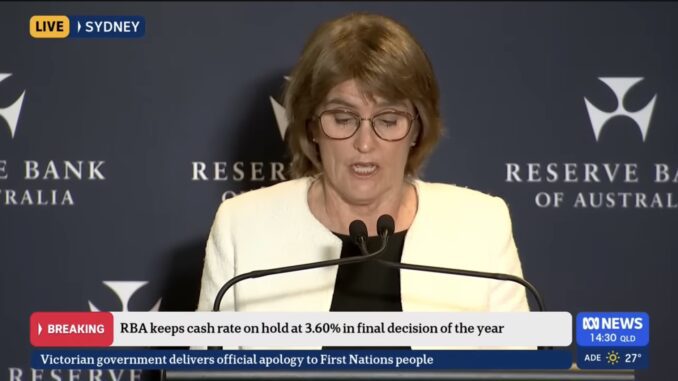
The Reserve Bank of Australia would like you to know that everything is fine. Or at least “a little tight”.
Also, you can fix it all by punishing nurses. Fifty thousand full-time jobs vanished in November, but RBA High Priestess, Michele Bullock, peering bravely into the entrails of a freshly slaughtered worker, by video link from Martin Place, assures us there are still “continuing signs of tightness in the labour market.”
Somewhere out there, apparently, workers are refusing to be poor enough.
Business surveys report that firms are “struggling to find workers”. This is “econobabble” for we would like staff, but only if they accept wages from 2009 and gratitude instead of penalty rates. Naturally, the RBA’s response is unchanged: keep interest rates high until Australians forget what disposable income feels like and stop harbouring dangerous ideas about food security.
Don’t you just love those business surveys, though? All halcyon objectivity, benevolence and altruism.
- Full-time work collapsing? A statistical quirk.
- Participation falling? Seasonal noise.
- Underemployment rising? Character building.
What really terrifies the RBA is the spectre of wage growth. It haunts their boardroom like Banquo’s ghost, rattling chains of enterprise agreements and whispering, “cost-of-living adjustment.”
Economics as a Branch of Medieval Theology
At the heart of the RBA’s thinking, (thinking being regarded with suspicion), is NAIRU, the Non-Accelerating Inflation Rate of Unemployment. This is not so much an economic concept as a theological belief: there exists a sacred level of unemployment below which workers become insolent.
No one can see NAIRU. No one can measure it. But like the Holy Trinity, it must be obeyed.
NAIRU functions in modern economics much as the Nicene Creed did in medieval theology: endlessly invoked, rarely examined, and infinitely adaptable. When unemployment is high, NAIRU is said to be high. When unemployment is low, NAIRU quietly moves lower. When inflation rises, NAIRU was apparently breached. When inflation does not rise, NAIRU is merely “uncertain” or “temporarily obscured”.
It explains everything after the fact and predicts nothing in advance. No thinking necessary.
Like a creed, it allows central bankers, Treasury officials, and orthodox economists to speak a common language without agreeing on substance. It provides legitimacy and a moral order vibe. Question it, and you are not just wrong, you are heretical.
Above all, NAIRU absolves decision makers of responsibility. Unemployment is not imposed, it is revealed. Wage restraint is not enforced, it is necessary.
If unemployment falls too low, the story goes, workers will start demanding higher wages. Inflation will rise. Society will collapse. So unemployment must be carefully maintained, like a bonsai tree of human misery, ruthlessly clipped whenever it grows too lush.
This is why the RBA does not fight unemployment. It curates it.
Richard Denniss, the party-pooper at The Australia Institute, has been pointing out an inconvenient fact: wages did not drive recent inflation. Profits did. Repeatedly. Obnoxiously. Across every dataset that isn’t laminated and framed in the RBA foyer.
From 2019 to 2022, unit profit costs surged by more than 35 percent. Unit labour costs barely twitched. Corporate profits hit record highs. But to hear the RBA tell it, inflation was clearly caused by Danielle the nurse splurging on electricity. Binge-watching ABC repeats of Hard Quiz and Antiques Roadshow.
- Her wage rose by $102.
- Her bills rose by $8,700.
Case closed. Lock her up.
Corporate Profiteering: Now You See It, Now You Don’t
The Allan Fels’ price-gouging inquiry laid it out in terms so blunt even Josh Frydenberg could understand them. Coles. Woolworths. Qantas. The banks. Energy companies.
All cashing in while households ration heating and skip meals.
And yet the RBA remains heroically silent.
When did you last hear the Governor call a press conference to tell supermarkets to stop gouging? When did she wag a finger at the banks for profiteering off mortgage holders? When did the Reserve Bank express concern that concentrated corporate power might be relevant?
Never. Because in the RBA’s economic fairyland, competition is fierce, markets are pure, if not sacred, and if Woolworths overcharged, Coles would undercut them out of civic virtue.
This would be touching if it weren’t so reality-defying, dippy-delirious yet destructive.
Australia’s economy is not competitive. It is concentrated, cartelised, and lawyered-up. We do not have markets. We have toll booths. But the RBA insists on treating inflation as if it emerged spontaneously from workers buying too many packets of Tim-Tams, tea-bags and hoarding toilet paper.
The Interest Rate: A Blunt Instrument for a Subtle Problem
Interest rate rises are sold as neutral, technocratic tools. In reality, they are a sledgehammer swung at households. Or, alternatively, where a household could be if there weren’t a housing crisis.
- Mortgage holders pay more.
- Renters pay more.
- Small businesses pay more.
Corporations? They pass the costs on. Or don’t. Because they don’t have to.
William Mitchell, Professor of Economics and Director of the Centre of Full Employment and Equity (CofFEE) at NSW’s University of Newcastle, has shown how rate rises are themselves inflationary. Higher rates push up rents. Rents are in the CPI. Inflation rises. The RBA raises rates again. It is a feedback loop so elegant it could be mistaken for policy.
Energy prices surge, not because of scarcity, but because privatised utilities are legally obliged to gouge. The Australian Energy Regulator approves price hikes approaching 25 percent while global coal prices fall. Inflation rises. Rates rise. Shareholders smile.
This is not economics. It is a machine for redistributing wealth upwards with self-righteous deniability.
Things the RBA Could Do (So Naturally It Won’t)
There are other options:
- Windfall profits taxes.
- Price regulation in essential sectors.
- Public investment in housing.
- Breaking up monopolies.
- Actually taxing multinationals.
All of these would reduce inflation without immiserating, impoverishing or punishing households. All of them involve confronting corporate power. All of them are therefore unthinkable.
Michele Bullock once concedes that “maybe there was some profiteering-driven inflation.” This was treated not as a reason to change policy, but as justification for doubling down on it.
As Crikey’s Bernard Keane puts it: corporations keep the profits, households get the punishment.
RBA 2.0: New Chairs, Same Dogma
The RBA review promised reform. What it delivered was new governance, shinier processes, new stationery and the same ideological engine humming beneath the well-polished bonnet.
Full employment remains legally mandated. Inflation targeting remains religiously enforced. Corporate power remains invisible.
The Reserve Bank Act never mentions a 2–3 percent inflation target. It does mention prosperity and welfare. Those words now function as decorative flourishes, like Latin on a law school crest.
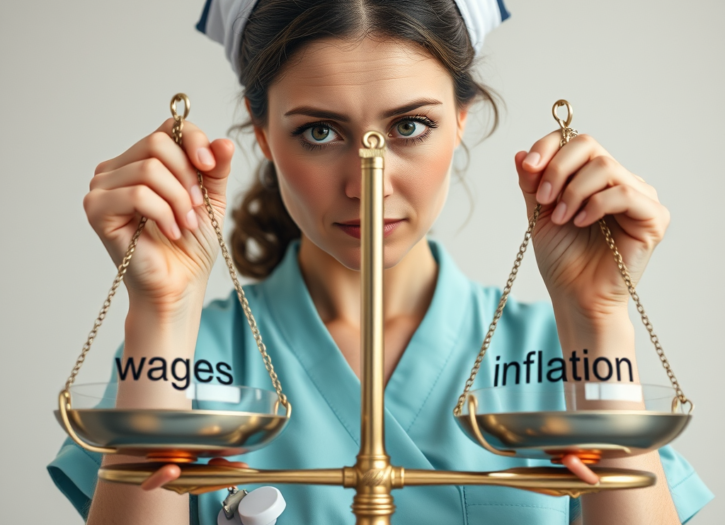
So What Is the RBA Actually For?
If your response to corporate price-gouging is to crush demand by crushing households, you are not managing the economy. You are enforcing class discipline.
The RBA will defeat inflation eventually. Not by challenging profiteers. Not by fixing broken markets. But by breaking you: making you poor enough to stop buying the overpriced goods and services you are being so enthusiastically flogged.
Mission accomplished.
- Inflation will fall.
- Jobs will be lost.
- Households will suffer.
- Profits will endure.
And the Reserve Bank will declare victory from its marble executive suite sanctuary, secure in the knowledge that orthodoxy has been upheld and nothing truly dangerous has been questioned.
Independence, after all, is a wonderful thing. Especially when you’re independent of everyone except those at the top of the income ladder.
Coda: As Paul Keating might have said, if he were not a Neoliberal himself, but as a tribute to an era when a working family could expect the articulate and impassioned advocate they deserved.
Inflation will fall. It always does when households have been sufficiently broken, when mortgages have done their work, when fear has killed confidence and restraint has been mistaken for virtue. But let no one pretend this is mastery, or that exhaustion masquerading as policy deserves applause.
Because if your response to corporate power is unemployment, if your answer to price-gouging is to immiserate working people, then you are not governing an economy at all; you are preserving a hierarchy. You are defending margins, underwriting monopolies, and disciplining labour, all while congratulating yourselves on your independence from politics.
But independence from democracy is not neutrality. It is choice. And this institution has chosen, again and again, to shield those with power while imposing “discipline” on those without it.
History is unkind to central banks that confuse punishment for prudence and austerity for authority. And when the history is written, no amount of marble foyers or sanctimonious press conferences will disguise the fact that inflation was beaten not by intelligence, but by inflicting pain on those least responsible – while those who caused it walked away richer, and entirely unrebuked.
So let us be clear about what this was, what it did, and who it served.
Pain without reform. Discipline without fairness. Victory without honour.
This article was originally published on URBAN WRONSKI WRITES
Keep Independent Journalism Alive – Support The AIMN
Dear Reader,
Since 2013, The Australian Independent Media Network has been a fearless voice for truth, giving public interest journalists a platform to hold power to account. From expert analysis on national and global events to uncovering issues that matter to you, we’re here because of your support.
Running an independent site isn’t cheap, and rising costs mean we need you now more than ever. Your donation – big or small – keeps our servers humming, our writers digging, and our stories free for all.
Join our community of truth-seekers. Donate via PayPal or credit card via the button below, or bank transfer [BSB: 062500; A/c no: 10495969] and help us keep shining a light.
With gratitude, The AIMN Team


Thanks David.
I agree 100%, distinctly remember Phillip Lowe constantly talking in terms of a wages-prices spiral when everyone outside the RBA acknowledged that inflation was driven by broken supply chains limiting the availability of materials and parts, etc., and a spike in gas prices due to the Ukraine war, and shortly after corporate profiteering.
The problem with the supply chain was due to the Covid pandemic and was always going to sort itself within a year or two, as happened. The gas price too was always going to come down as the USA steadily filled up the shortfall.
Instead of addressing inflation at its sources, Labor’s Jim Chalmers handballed the problem over to the RBA fully aware that it would be people with a mortgage who would bear the pain, and the banks laughing all the way to the…well…bank.
Australia was awash with gas, not only could the government have called it an emergency, rewritten the contracts and kept enough gas in Australia at a low price as to significantly lower inflation, but we now know that Santos has been pillaging East Coast uncontracted gas and exporting it. If that was available then, Labor isn’t telling as with everything else, that gas could have been used to keep prices from rising as much. Instead, Chris Bowen played the small town lawyer going up against the big city law firms in a behind closed doors meeting with the energy generators and retailers, the result being a high price (lower than the peak, but higher than before the war) for gas was locked in, at a time when even the world spot market price was rapidly readjusting back lower. Who won out of that? the gas companies, not us.
Did Chalmers do anything about the profiteering? no he played a game of my hands are tied; saying the RBA has only interest rates it can use, and it is independent and I’m not interfering. But he never mentioned the government could have used windfall profits or price caps to control the profiteering. Who benefitted? the likes of Coles and Woolworths, not us.
The higher the inflation, the higher our interest rates went up. Who benefitted out of that? the big four banks, not us.
Labor let the people bear the pain while it protected windfall profits for corporations. It wouldn’t have been able to stop inflation rising, but it could have reduced how much it went up, and it could have kept the LMITO to relieve stress on our most vulnerable, but no Labor chose to let the poorest suffer for two years.
The Coalition would have been even worse than Labor. But still, Labor is going to throw the people under the bus every time this happens.
Labor and/or the Coalition have been pissing down our backs and telling us its raining for well-nigh 50 years; if we keep returning a duopoly government we will keep getting bad governance.
Michelle Bullock, incompetent and delusional at best and sounds more like an IVR menu while waiting on hold.
She’s no oracle of Delphi and ought to hand in her resignation, and as for whatever transpired between Chalmers and the supposed adjustments of the RBA, that was also pure fiction.
Some things the duopoly have in common:Neoliberalism,self interest and cowardice, deceit and hypocrisy.We’d be better off with a benign dictatorship.
And, hey hey, Gonggongche,seconded.
This problem is not confined to Australia.
All the developed economies are struggling in one way or another because no-one is prepared to admit that the assumptions on which liberal (free market) economics is based are false.
As the rich get richer and the rest struggle, ratbags from the Right appear with the promise to have all the answers.
And people fall for it because they see no other choice.
At present, One Nation is getting support from disaffected Liberal voters.
When disaffected Labor voters start to move in that direction we will be on the verge of a chaotic form of fascism.
Chaotic, because Hanson has never been able to control the freaks who see One Nation as a playground of opportunity. These freaks all have their own private agenda, so chaos will reign.
There’s no sign that the Reserve Bank or the Libs/Labs intend to change course, so things will get worse.
The great worship of money has intensified, corporate, tax concession, speculation, investment rigging, new tech., fakery with bitcoin, Trump driven greed, intense egofixated acquisition, fascist lobbying and cronyism.., I’ve faced headwinds, hostility, marginalisation, and it intensifies. Citizen voters, Joe Average is near finished. Hanson and Joyce types here, Farage, etc., remain cartoon castoffs, no remedy. Meanwhile, oppression, coercion, war, injustice, inadequacy prevail.
Well said David.
“What really terrifies the RBA is the spectre of wage growth.”
But only wage growth for the plebs, you know those people who actually do the work and it doesn’t stop those at the RBA from getting their annual increases. The governor of the RBA now has a remuneration package of $1,195,275, almost twice as much as the Prime Minister and higher than the governor of the US Federal Reserve.
“Labor and/or the Coalition have been pissing down our backs and telling us its raining for well-nigh 50 years; if we keep returning a duopoly government we will keep getting bad governance.”
Truer words have never been spoken!
The RBA is there to protect business, not the people.