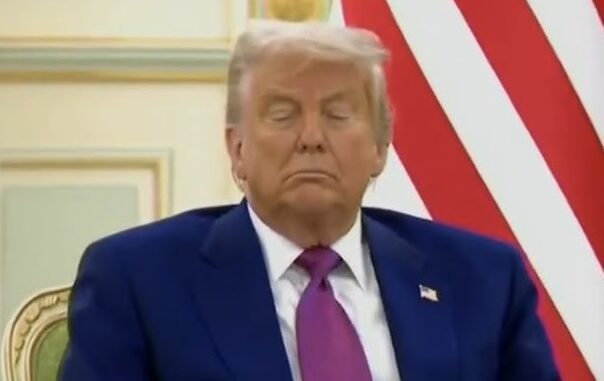
Trump’s cognitive decline, marked by notable memory lapses, impulsive and often erratic remarks, and a troubling pattern of inconsistent statements, ignites profound worries regarding his mental fitness for leadership. These signs not only raise eyebrows but also cast doubt on his ability to make sound decisions in critical moment.
It frustrates me endlessly when I’m engaged in conversation and suddenly draw a blank on a specific fact, name, or event that, only a few years ago, was etched clearly in my mind. Yet, as I approach the grand milestone of 85, such lapses are hardly surprising. Given the myriad of ailments I’ve battled over the years, I find myself astounded by the clarity and sharpness of my thoughts.
Yet, in those moments when my friends enthusiastically proclaim that I possess a swiftness that outpaces the current American President, a wave of elation sweeps over me. Their assurances ignite a spark of joy, filling me with a sense of exhilarating confidence. Just kidding.
For one thing, the President was recently angered after the media criticised him for aging in office, following a recent Cabinet meeting at the White House during which he had a little nap.
However, this is far from the most alarming facet of his decline. The incessant barrage of Trump’s venomous insults and unpredictable tirades poses a significant threat to national security, underscoring the pressing need for decisive action.
During a recent encounter with Nancy Cordes, the CBS White House correspondent, the air crackled with tension as he aired his frustrations candidly. With an intensity in his gaze, he questioned, “Are you genuinely that oblivious to the situation?” His words hung in the air, laced with a mix of disbelief and a desire for understanding – a moment ripe with potential for constructive dialogue and mutual learning.
The exchange didn’t end with words; as they delved into the perspectives of New York Times correspondent Katie Rogers, he expressed his thoughts in a tone dripping with condescension, labelling her approach as “not up to par.” This remark reveals a profound issue in the dynamics of opinion and the friction between the media and those it covers, paving the way for a meaningful dialogue about the principles of journalistic integrity.
In an intense exchange with Bloomberg’s Catherine Lucey, he leaned forward, his voice cut through the air like a razor, “Can we hold it down for a moment?” The urgency of the situation was palpable, capturing the moment’s weight. Although his tone held a trace of sharpness, it served as a poignant reminder of the essential role communication plays, particularly when the stakes are high and emotions run deep.
When addressing Democratic lawmakers who encouraged military personnel to reconsider specific commands, he expressed outrage, indicating his strong feelings about the matter. This passion certainly reflects how seriously he takes the role and responsibilities that come with leadership in times of uncertainty.
Additionally, his comments regarding Somali immigrants seeking sanctuary in the U.S. raised eyebrows. While his remarks were harsh, they signal a critical discussion of compassion and the complex issues surrounding immigration – topics that deserve thoughtful, humane consideration.
Looking at Karoline Leavitt’s comments about the President’s openness and frankness, I understand where she’s coming from. However, the conversation has moved beyond straightforward honesty. What we hear now sometimes challenges our collective understanding of reason and compassion, especially given the significant role he occupies. There is a palpable sense of turmoil, and the rhetoric can be discomforting. Promoting respectful dialogue is essential for a more unified and constructive national discourse.
This unsettling decline isn’t merely a byproduct of aging; it appears to be a sign of severe cognitive impairment that warrants immediate attention and action.
I can speak to this with some authority; I am a few years older than the foul-mouthed President of the United States, and as I said at the start, while my own mental faculties may not shine as brightly as they once did, I still choose my words with care, opting not to unleash whatever thought flickers through my mind.
It’s true that when you’re pushing 80, brain inhibitors start shutting down. You begin to let go. Even in my daily uttering or writing, I find myself using language I’d never have used when I was younger, like the word “sh*t”. Age seems to give us certain liberties. Trump appears to have taken a double dose of angry pills. Those big bitter ones.
As I approach my 85th, I am apt to tell friends it’s about time they paid their fair share of the restaurant bill. I recall my father telling his mechanic he was dangerously incompetent and should be fired. He told me I needed to dress better and polish my shoes.
He lost some of his inhibitions, but at least his observations were accurate.
Older people lose certain inhibitions because they don’t care as much about their reputations as younger people do. In a way, that’s rational. Older people no longer depend on their reputations for the next job, next date, or new friend. If a young person says whatever comes into their head, they have much more to lose, reputation-wise.
Trump’s recent outbursts reveal a more profound shift beyond the usual loss of restraint that often accompanies aging. He appears to have shed any remaining filters, exhibiting a striking spontaneity. This impulsivity hints at a man who is not just losing his inhibitions but may also be becoming increasingly unpredictable in his actions and remarks.
The prospect is concerning for anyone grappling with the complexities of aging. Yet, a president of the United States who speaks his mind without a censor poses an unparalleled risk. Imagine a moment when tensions rise between him and China; in a fit of rage, he picks up the phone and, with unrestrained fury, hurls insults at Xi Jinping. What if, in that volatile heat of the moment, he decides to unleash the unthinkable and gives the green light for a nuclear strike? The thought is both chilling and profoundly alarming.
The moment has arrived for the media to shine a spotlight on this pressing issue. It’s time for America to confront the harsh truths that have long been ignored. America must rally and implore Congress to take bold, meaningful action before the sands of time run out. Among these urgent measures, invoking Section 4 of the 25th Amendment stands as a critical step that cannot be overlooked.
What encapsulates Donald Trump more vividly than anything else is the bizarre creation of a peace prize by a football organisation (FIFA), an honour he accepted with an almost desperate gratitude that underscored his sense of insignificance. Even Fox News hinted at the notion that Trump harboured a lingering envy toward former President Barack Obama, who had been bestowed the illustrious Nobel Peace Prize – a recognition Trump believed he deserved just as much, if not more.
My thought for the Day
American exceptionalism carries a significant burden of accountability.
Keep Independent Journalism Alive – Support The AIMN
Dear Reader,
Since 2013, The Australian Independent Media Network has been a fearless voice for truth, giving public interest journalists a platform to hold power to account. From expert analysis on national and global events to uncovering issues that matter to you, we’re here because of your support.
Running an independent site isn’t cheap, and rising costs mean we need you now more than ever. Your donation – big or small – keeps our servers humming, our writers digging, and our stories free for all.
Join our community of truth-seekers. Donate via PayPal or credit card via the button below, or bank transfer [BSB: 062500; A/c no: 10495969] and help us keep shining a light.
With gratitude, The AIMN Team


Oh ffs. I tried to comment using appropriate sites but it felt like I had to offer my first born for sacrifice. Far too many hoops to jump through.
For what it’s worth, in my humble, nobody, opinion; the US has been on a downward spiral for at least three decades. The absolute love of money, the hatred towards any poc, the entitlement, the inability to reflect on any of its actions or behaviours demonstrates that the USA has well and truly lost its moral compass. And I don’t say this with any sense of pleasure.
Australia has looked, in the past, toward the US as a “protector”. But those days are gone.
The USA only wants to look after itself. And only the rich
An eloquent perspective John, however all that aside what we are all dealing with is pure evil personified in Trump! And that’s when he had cognitive capacity.
What keeps the show going are the oligarchs, pure and simple, they want to carve up the country for personal gain.
I took the time to look up a definition of fascism as various commentators around the world are pointing to Trump as fashioning a fascist state in the once great
US of A:
Fascism generally includes authoritarianism, nationalism, suppression of dissent, and centralization of power.
If the (MAGA) cap fits, wear it!
Trump, who is on course to be the oldest president in U.S. history, has repeatedly made gaffes while boasting about conflicts he claims to have ended in his second term. This includes frequently saying he ended a war between Azerbaijan and Albania, when he actually means the conflict between Azerbaijan and Armenia which, in fact, he didn’t resolve at all.
“We saved millions and millions of lives with all of them. Azer…baijan. If you look at, if you look at, errr—” Trump told the crowd of CEOs while failing to recall Armenia. “Just take a look at that one,” he added after giving up on trying to identify the country.
Memory lapses are one thing but just making things up is totally delusional. You have no cause for concern, John.
I have been reminded by family members that my views on Trump, frequently published online, are more than sufficient to have me barred from entering the US under the new fascist regime. That being the case, I wear it like a badge of honour or indeed a fictional chocolate peace medal awarded by FIFA.
Someone once told me that as you age you do forget things. If you can remember that you’ve forgotten something you are doing okay – if you can’t remember that you’ve forgotten something you have a problem. On that basis the writer seems to be okay – we have no information to determine is Trump is too.
I rather like this line from “The Albino’s Secret” by Michael Moorcock and Mark Hodder. It made me think straight away of The Donald and the state of the US:
“One madman makes many madmen, and many madmen make national madness.”
I left my car unlocked by the side of the road yesterday, while on a bushwalk that took far longer than planned. I can fairly blame that on the difficulty of adapting to remote locking with the new car (first one I’ve had that does it). Leaving the keys sitting on the bonnet for the nine hours I was out, however, was down to something else entirely.
And yet my mental acuity is still galaxies beyond Der Pumpkinfuhrer.
Good effort leefe
Finally the flight-logs have been released and will assist Trump in remembering the number of flights he took on the Epstein’s jet.
So far Trump has adopted the Sergeant Schultz response : I know NOTHING!!
The old man reflected on past romance, saying, “I’ll never forget…what’s her name again.” Perhaps the grey cells turn brown.