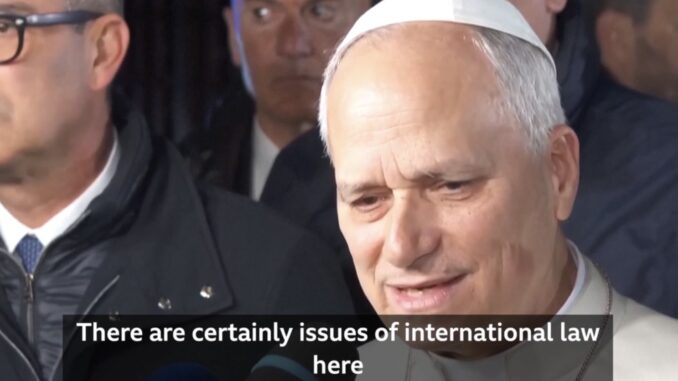
Depending on which historical sources you care to consult, the Pope has been a figure of obloquy, ridicule and abomination. This mediator between the terrestrial and the divine was always set for the battering. Martin Luther’s violent Protestant split from the body of the Catholic Church was merely one aspect of attacking the occupants of that office. Acrimonious disputes between the secular arm of the State and Church power have also figured. In the 11th century, Pope Gregory VII famously battled the Holy Roman Emperor King Henry IV in the Investiture Controversy over who had the power to appoint bishops.
Pope Leo XIV, for his part, has become increasingly perturbed by President Donald Trump’s metamorphosis from an alleged eschewer of war to that of a spluttering warlord. His remarks in January criticising US military action against Venezuela saw the Vatican’s ambassador called to an unpleasant meeting at the Pentagon. In April, the pontiff responded to Trump’s annihilatory statements concerning Iranian civilisation by calling it “truly unacceptable.” He exhorted believers to “Contact the authorities – political leaders, congressmen – to ask them, tell them to work for peace and to reject war always.”
Without naming US Defense Secretary Pete Hegseth, whose deranged notes of prayer for the war on Iran have not gone unnoticed, Leo declared that Jesus “does not listen to the prayers of those who wage war.” In his April 11 prayer vigil for peace, Leo warned against the “delusion of omnipotence that is becoming increasingly unpredictable and aggressive,” describing death as an enslaver of “those who have turned their backs on the living God, turning themselves and their power into a mute, blind, and deaf idol.”
Such views were bound to draw a snarky, snappy response from Trump, who called the pontiff “WEAK on Crime, and terrible for Foreign Policy.” Given the institutional history of the Catholic Church, one would have thought this qualification on crime came with the office, be it the making of testy alliances with sanguinary tyrants or shielding predatory and lubricious priests. And to make matters that much sillier, the president also posted an AI-generated image, since removed, depicting himself as Jesus, subsequently claiming he was merely being an administering doctor.
The Truth Social statement also rambled on about liking the Pope’s brother Louis “much better than I like him, because Louis is all MAGA.” With the usual neglectful approach to the evidence, Leo was taken to task for wishing Iran to have a nuclear weapon, reproached for taking issue with the attack on Venezuela, despite the country “sending massive amounts of Drugs to the United States” along with “murderers, drug dealers, and killers.” Trump had been doing what he had been elected “IN A LANDSLIDE” to do: keep crime figures low and create “the Greatest Stock Market in History.” With narcissistic flourish heavy with megalomania, the president also had a unique reading of Leo’s election to be the Vicar of Christ. He was there only “because he was an American, and they thought that would be the best way to deal with President Donald J. Trump. If I wasn’t in the White House, Leo wouldn’t be in the Vatican.”
The recent rages expressed by Trump may seem peculiar and out of keeping with US-Vatican relations, till one realises that formal diplomatic ties were only established in 1984. The Catholic bloc, while far from negligible in US politics, has been historically regarded with wariness by the Protestant establishment. The founding editor of the Journal of Global Catholicism, Mathew Schmalz, sees it this way: “Obviously Catholics in America are an important political constituency and regardless of whether they’re Republican or Democrat, presidents have been careful not to alienate them.” Trump’s openly hostile remarks directed at the pontiff, however, was distinctly “new political territory.”
That territory was already charted with Trump’s successful tilt at the White House in 2016. Trump’s intemperate behaviour towards the Vatican was already simmering even as a presidential candidate, notably on the issue of immigration. He made little secret about his dissatisfaction at the decision by Pope Francis to celebrate Mass in Ciudad Juarez near the US-Mexican border, claiming that it enlisted him as a political pawn of the Mexican state. The pontiff had failed to appreciate “the danger of the open border we have with Mexico.”
The response from Francis, delivered on his papal plane, was suitably calm and dismissive: “Thank God that he said I am political because Aristotle defines the human person as animal politicus (political animal). At least I am human!” This preceded a well administered verbal shot aimed at Trump’s promise of building an impervious wall to stop illegal immigration. “A person who thinks only about building walls, wherever they may be, and not building bridges is not Christian.” This was most certainly “not in the Gospel.” That said, he was willing to “give the benefit of the doubt” to Trump as to whether he genuinely took that position. An unhappy Trump retorted in a statement calling it “disgraceful” for a religious leader to question an individual’s faith.
Vatican watchers have various suggestions as to why Trump seemed to unmoor himself from calm waters in attacking Leo. José Casanova, senior fellow at Georgetown University’s Berkley Center for Religion, Peace and World Affairs, recalled the tensions between Trump and Francis I on immigration in remarks made to the National Catholic Reporter. But he also suggested that the president had found himself agitated, having lost an important ally in the form of Hungary’s Viktor Orbán. “It’s not surprising that this came out just minutes after the news that Orbán had lost the elections in Hungary. So it was a way of changing the topic. He doesn’t want to be recognized as somebody who is in trouble.”
Leo, for his part, is happy to push the theme of peace in his speeches, suggesting that “a certain narrative that has not been accurate in all of its respects” had emerged on the textual jousting with the president since April 12. “Much of what has been written since then has been more commentary on commentary, trying to interpret what has been said.” His remarks delivered to a peace meeting in Bamenda, Cameroon, for instance, in which he excoriated the “handful of tyrants” ravaging the planet with war and exploitation, had been scripted a fortnight prior. “And yet as it happens, it was looked at as if I was trying to debate again the president, which is not in my interest at all.” As he knows all too well, one does not debate Trump so much as shout, and the best medicine for such a condition is the expansive shrug and the grand snub.
Keep Independent Journalism Alive – Support The AIMN
Dear Reader,
Since 2013, The Australian Independent Media Network has been a fearless voice for truth, giving public interest journalists a platform to hold power to account. From expert analysis on national and global events to uncovering issues that matter to you, we’re here because of your support.
Running an independent site isn’t cheap, and rising costs mean we need you now more than ever. Your donation – big or small – keeps our servers humming, our writers digging, and our stories free for all.
Join our community of truth-seekers. Please consider donating now via:
PayPal or credit card – just click on the Donate button below
Direct bank transfer: BSB: 062500; A/c no: 10495969

We’ve also set up a GoFundMe as a dedicated reserve fund to help secure the future of our site.
Your support will go directly toward covering essential costs like web hosting renewals and helping us bring new features to life. Every contribution, no matter the size, helps us keep improving and growing.

Thank you for standing with us – we truly couldn’t do this without you.
With gratitude, The AIMN Team

Pope Francis showed the Catholic church still can heve “punch”when the issue is “right”. It is also good that Leo is opeming his mouth on issues that should bother real Xtians.
I am confused as to how the American Xhristian lobby can hold their position on peace which appears juxtaposed to Biblical teachings as I remember them from childhood.
We are literally watching the battle between good and evil, the devil and the angel, who’s legacy is shall we say a bit tarnished.
However, my money’s on Leo.