By James Moore
“The greatness of America lies not in being more enlightened than any other nation, but rather in her ability to repair her faults.” (Alexis de Tocqueville, author, Democracy in America).
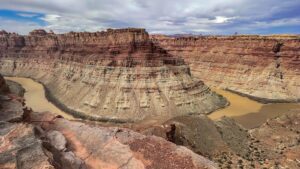
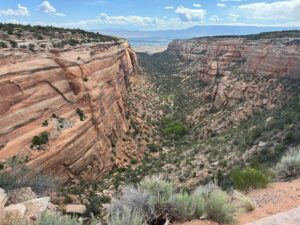
I know a spot on a red rock canyon in southeastern Utah where the Colorado River bends through geologic time to make its confluence with the Green River, and if you stand at the canyon rim at dusk and watch the light do what it does to sandstone, turning it from rust to copper to something approaching a fire before nightfall, you will understand, without anyone having to tell you, why this country was once worth fighting for. The canyon does not ask the observer’s party affiliation or demand a loyalty oath or your tax bracket or the last name of the president you voted for. The epic beauty simply exists, enormous and indifferent and heartbreakingly glorious, a fact of the earth that outlasted every empire that came before us and will abide long past whatever shambles we make of ourselves now.
We should be thinking about that canyon on the Fourth of July, 2026. We should also be thinking about the buffalo grass of the Flint Hills turning silver in an August wind, and the Pacific fog coming over the Marin headlands at dawn, and the red clay roads of Georgia leading up through longleaf pine to a sky so blue it seems painted by mighty gods. We should be thinking about the living inheritance of this republic, the national parks, the public lands, the rivers held in common trust for the children not yet born. We should be celebrating 250 years of the most improbable democratic experiment in human history.
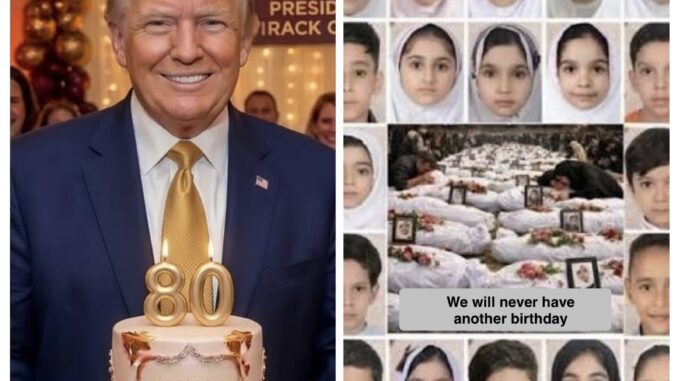
Instead, eight of nine headline acts have pulled out of the official birthday concerts in Washington. The president wants to replace them with a rally. The man who is supposed to steward this moment has announced he would like a Make America Great Again celebration at the capital, because he is, in the end, incapable of conceiving of an America that does not center on himself. Leonard Steinhorn, professor of communication and history at American University, clearly explained this absurdity when he recently said, “In 1976, the bicentennial was about us. In 2026, it is about Donald Trump.” His assessment is terribly accurate even as a new poll has found that 69 percent of Americans believe the signers of the Declaration of Independence would be disappointed in the way their democracy turned out. We have arrived at the birthday party, and nearly seven in ten of us are already sorry we came.
I have spent decades writing about Texas and U.S. politics, which is to say I have spent much of my life watching democracy degraded by people who professed to love it. I covered the machine bosses of South Texas and the oil men of West Texas and the culture warriors of the suburban megachurches, Iran-Contra and lies about weapons of mass destruction in Iraq, and through all of it I believed that the American system, however battered and abused, retained enough structural integrity to survive its worst custodians. I am no longer certain that is true.
Madison warned us when he wrote that the absence of trust is, “The end of government. It is the end of civil society.” Washington, in his Farewell Address, told us that partisanship and distrust could unravel liberty more effectively than any foreign adversary. These were not idle cautions but prescient warnings from men had fought a revolution and then had the harder task of building institutions that would outlast their own ambitions. They understood that the republic they were creating was not a gift to be received but a discipline to be maintained, and that its survival depended entirely on the willingness of its citizens and their leaders to honor its covenants even when honoring them was inconvenient.
What is happening in this country right now is the systematic dishonoring of those covenants by the people entrusted to uphold them. The Department of Justice has been turned into a personal law firm for a president who views the law as an instrument of grievance rather than a guarantor of liberty. Inspectors general were removed in the night. Judges and their rulings have been defied, mostly without consequence. Allies have been lectured and adversaries flattered. The press has been labeled an enemy of the people and the Congress, that body Madison called the “deliberate sense of the community,” has mostly watched, applauded, and asked if there is anything else it can do in the service of one man’s self-glorification.
The best summation of this sad birthday event that I could find came from Lisa Gilbert, the Co-President of Public Citizen, who said, “Donald Trump and his henchmen have sabotaged what should be a unifying moment and appear intent on instead creating a highly divisive, corporate-funded, ideologically extremist exercise.”
On July 4, 2025, last year’s anniversary of this country, the president signed what he called, without apparent irony, the One Big Beautiful Bill. Nothing about it has been beautiful for the disadvantaged in this land of plenty. The Congressional Budget Office estimates it will cut more than a trillion dollars from Medicaid and the Children’s Health Insurance Program over ten years, eliminating coverage for somewhere between 7.8 and 11.8 million people. The American Medical Association called it an outrage. Harvard health economists said it was devastating. Rural hospitals are already warning of closure. The elderly who depend on Medicaid to pay for nursing home care have also begun to understand that their government has decided they are an inconvenience. Children who have never known anything but health care coverage are about to learn the difference between a country that invests in its people and one that abandons them for a tax cut that flows upward to people who do not need it. In Texas, just one state in the union, we have 1.1 million children living without health care.
There is something almost medieval about the arithmetic of this. The bill cuts $1.1 trillion from health coverage for the poor and the sick and the old, and it uses those savings to extend tax benefits for the wealthy and was signed on the birthday of a nation founded on the proposition that all men are created equal. The irony was turned into policy.
There is now the matter of the war with Iran, which began with the certainty of men who had never read the Joint Comprehensive Plan of Action (JCPOA) that was already effectively controlling and monitoring Iran’s nuclear development. Those uninformed U.S. leaders are presently in a desperate search for a deal that will require giving back everything we destroyed to get an agreement that will provide Iran more historic, economic, and political leverage. In 2018, Donald Trump tore up the Obama nuclear deal only because it had been negotiated by Barack Obama, and because his political brand required him to undo every accomplishment of his predecessor regardless of whether that achievement was working. National security experts across the ideological spectrum maintained that the agreement was, in fact, working as designed and Iran’s nuclear program had been constrained, enrichment had been limited, inspectors had access.
What happened next, after Trump’s denial of JCPOA, was entirely predictable to anyone who was paying attention, which evidently did not include the people making the decisions. Iran expanded its nuclear program dramatically and developed advanced centrifuges that enriched uranium to 60 percent, a short step from weapons grade. By the time the American and Israeli bombs fell in operation after operation named with the grandiose vocabulary of an action movie franchise, Iran had already built the leverage it needed to extract a better deal than the one we had torn up.
According to CNN’s Fareed Zakaria, “The war handed Iran a weapon far more usable than nuclear weapons, which is control of the Strait of Hormuz, through which flows a fifth of the world’s oil and gas and a third of its urea fertilizer.” The experts now say that whatever deal emerges will need to be more robust than Obama’s, account for Iran’s improved technology, and will need to offer Iran economic incentives, because Iran is now negotiating from a position of strength that we handed them.
Daryl Kimball of the Arms Control Association said that Trump’s negotiators were “too incompetent and technically ill-informed to understand the significance” of what was on the table in the early rounds. The president, meanwhile, continues to insist that the Obama agreement was the worst deal he ever saw. A deal he is now trying to replicate at higher cost, with greater concessions, after a war that did not have to happen. The cruelty of this is not just strategic but is also immoral. The people who died in that conflict, American and Iranian alike, lost their lives in service of one man’s vanity.
I think often about the Rio Grande, and travel its reaches with great frequency. I have known the river most of my life, and understand what it means that we are now pulling people out of its water not to save them from drowning but to put them in chains. The crackdown on immigration that this administration has pursued, along with the Texas governor who imitates the cruelty with a Christian joy, has exhibited a relentlessness and a savagery that would have been unimaginable in any previous American era, and it has not made us safer. We are smaller, though, and have become the kind of country that separates families for the crime of wanting to live. We deport people to countries they fled at peril of their lives and fill private detention centers of campaign donors with human beings who have not been charged with any crime. America is building concentration camps. We used to put that kind of thing on the list of what we were fighting against.
The Founders were themselves immigrants to a land that already had people in it, a fact the birthday celebrations will not dwell on. But the myth they built, however imperfectly, was a story of refuge, the idea that people fleeing persecution or poverty could come here and be remade. Emma Lazarus wrote the words on the statue in the harbor, and we have spent 140 years arguing about whether we meant them and if we have been worthy of their promise. The current administration has decided that inscription was little more than a poet’s folly.
I cannot stop thinking about our greatest legacy, which is our national parks and the great geographic gift of our part of this continent. Since January 2025, though, the National Park Service has lost more than 4,000 permanent employees, roughly 24 percent of its permanent staff, gutted through DOGE layoffs, forced resignations, and buyouts. The Forest Service lost an additional 3,400. Trump’s fiscal 2026 budget proposed cutting the Interior Department’s budget by 30 percent, including a billion-dollar cut to the Park Service itself, with proposals to transfer some sites to state control, which in practice means commercialization or closure. At Yosemite this spring, entry fees went uncollected because there was no one to collect them. Lines to enter the Grand Canyon stretched for hours. Rangers who had spent careers learning the ecology of specific places were told their services were no longer required.
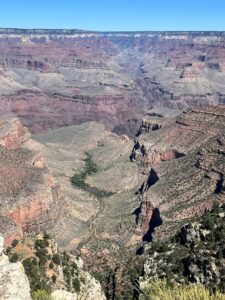
Naturalist John Muir wrote that the clearest way into the universe is through a forest wilderness. Teddy Roosevelt, who was many things that we might not celebrate today but who understood something about the land that most presidents never have, stood at the South Rim of the Grand Canyon in 1903 and gave the gathered crowd ageless advice. “Leave it as it is,” he said. “You cannot improve on it. The ages have been at work on it, and man can only mar it.” Although I have visited almost all our major national parks, no place has filled me with as much of nature’s wonder and awe than the Grand Canyon. I have crossed it rim-to-rim on foot a dozen times, always grateful that Roosevelt’s vision included national park lands and his advice has governed our public lands policy for more than a century. This administration, though, is treating it as a suggestion made by someone who no longer has a vote.
Instead of thinking about our country’s natural glories and our shared citizenship this Fourth of July, we are confronted, instead, with having to contemplate Trump and his ego and what we have allowed him to do to us. “In 1976 it was about us and 2026 it’s about Donald Trump,” said Leonard Steinhorn, of American University. “And I think that’s a fundamental difference, and it may be why you’re going to have a very divided electorate on this celebration.”
I do not want to leave you in the canyon without the light, though, because the light is still there and always will be as long as the great world turns. Canyonlands National Park and the Grand Canyon and Yellowstone and Yosemite are all indifferent to our politics, and that is, somehow, both the saddest and the most hopeful thing I know.
This country has been in darker rooms and found its way to the window. We did not dissolve after the election of 1800, the most bitterly contested transfer of power in the young republic’s history. We did not fracture permanently after the Civil War, though the wounds of that conflict bled for another hundred years and, almost incomprehensibly, remain a suppurating injury. We did not surrender in the Depression. We did not disintegrate in Watergate, when a president who had abused every power of his office resigned because the machinery of accountability still worked, and the people still believed it should. In 1969, during the summer of a year that came after assassinations of great leaders and riot and a war that was devouring the country’s moral credibility, Neil Armstrong stepped off a ladder onto the surface of the Moon, and 600 million people around the planet stopped and wept and felt, for a moment, that we were still capable of the extraordinary.
I do not think the Moon landing healed America but I do believe it was a reminder of what possibilities lay before us and that we were capable of more than just recovery from harm. We should cling to that notion because there are still teachers in underfunded classrooms who are teaching children to read and to question and to want more than they were handed. There are still doctors in rural clinics who are treating patients who cannot pay, because the alternative is not treating them, and that is not a choice a doctor makes. There are still journalists writing about things that powerful people do not want written, in outlets that cannot always afford to pay them enough. There are still lawyers filing suits in courts that are still, however imperfectly, ruling on the law. There are still people standing at the borders of this country, not with weapons, but with water and food and the stubborn conviction that human beings deserve to be treated as human beings.
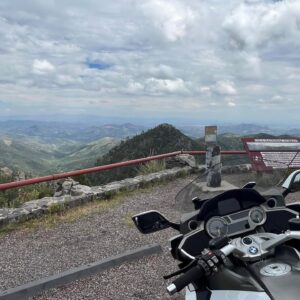
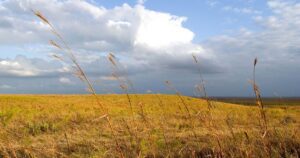
And there is still the land. I’ll always go back to those canyons or ride my motorcycle through the buffalo grass still bending in the wind across the High Plains. The Pacific fog still comes over the headlands at dawn, and the longleaf pine still reaches for the Georgia sky, and the Rio Grande still moves to the sea, however diminished, however contested, however burdened with the grief of everything that has happened along its banks. The land of America does not know what year it is and does not know about the heinous bill that was signed on its birthday, or the war that didn’t have to happen, or the 11.8 million people who will lose their health care, or the rangers who were fired, or the families that were torn apart at the border. Our beautiful and spellbinding geography simply endures, and in its endurance it offers us the only invitation that has ever really mattered.
We need to be worthy of this and start again. As Roosevelt pointed out, the ages have been at work on it, and we can only mar it, but we have not marred it beyond recovery yet. Two hundred and fifty years is not very long. The canyons are 70 million years old. Whatever we do to ourselves in the next few years, they will abide and outlast us. The question is whether we will survive ourselves and our choices, and whether the country we leave behind will still be one that deserves to stand at that rim and feel small and grateful and alive.
Happy birthday, America. I love you, and am grateful to have traversed your beauty and experienced your opportunities. We are sorry about the party. I am confident we will try to do better. We always have, eventually, and we have to believe we still can.
This article was originally published on Texas to the world.

James Moore is the New York Times bestselling author of “Bush’s Brain: How Karl Rove Made George W. Bush Presidential,” three other books on Bush and former Texas Governor Rick Perry, as well as two novels, and a biography entitled, “Give Back the Light,” on a famed eye surgeon and inventor. His newest book will be released mid- 2023. Mr. Moore has been honored with an Emmy from the National Academy of Television Arts and Sciences for his documentary work and is a former TV news correspondent who has traveled extensively on every presidential campaign since 1976.
He has been a retained on-air political analyst for MSNBC and has appeared on Morning Edition on National Public Radio, NBC Nightly News, Last Word with Lawrence O’Donnell, CBS Evening News, CNN, Real Time with Bill Maher, and Hardball with Chris Matthews, among numerous other programs. Mr. Moore’s written political and media analyses have been published at CNN, Boston Globe, L.A. Times, Guardian of London, Sunday Independent of London, Salon, Financial Times of London, Huffington Post, and numerous other outlets. He also appeared as an expert on presidential politics in the highest-grossing documentary film of all time, Fahrenheit 911, (not related to the film’s producer Michael Moore).
His other honors include the Dartmouth College National Media Award for Economic Understanding, the Edward R. Murrow Award from the Radio Television News Directors’ Association, the Individual Broadcast Achievement Award from the Texas Headliners Foundation, and a Gold Medal for Script Writing from the Houston International Film Festival. He was frequently named best reporter in Texas by the AP, UPI, and the Houston Press Club. The film produced from his book “Bush’s Brain” premiered at The Cannes Film Festival prior to a successful 30-city theater run in the U.S.
Mr. Moore has reported on the major stories and historical events of our time, which have ranged from Iran-Contra to the Waco standoff, the Oklahoma City bombing, the border immigration crisis, and other headlining events. His journalism has put him in Cuba, Central America, Mexico, Australia, Canada, the UK, and most of Europe, interviewing figures as diverse as Fidel Castro and Willie Nelson. He has been writing about Texas politics, culture, and history since 1975, and continues with political opinion pieces for CNN and regularly at his Substack newsletter: “Texas to the World.”
Also by James Moore
Keep Independent Journalism Alive – Support The AIMN
Dear Reader,
Since 2013, The Australian Independent Media Network has been a fearless voice for truth, giving public interest journalists a platform to hold power to account. From expert analysis on national and global events to uncovering issues that matter to you, we’re here because of your support.
Running an independent site isn’t cheap, and rising costs mean we need you now more than ever. Your donation – big or small – keeps our servers humming, our writers digging, and our stories free for all.
Join our community of truth-seekers. Please consider donating now via:
PayPal or credit card – just click on the Donate button below
Direct bank transfer: BSB: 062500; A/c no: 10495969

We’ve also set up a GoFundMe as a dedicated reserve fund to help secure the future of our site.
Your support will go directly toward covering essential costs like web hosting renewals and helping us bring new features to life. Every contribution, no matter the size, helps us keep improving and growing.

Thank you for standing with us – we truly couldn’t do this without you.
With gratitude, The AIMN Team
Another outstanding essay from this master essayist, speaker of the American condition. We feel for you, James. Stay strong.
Yes indeed, a great essay.
It sends an implied message that, while wisdom and spiritual peace are elusive, these things are always accessible from Nature.
A message that wisdom and spiritual peace, in the final analysis, are internal processes that cannot be taught.
What an important message that is.
And this message was inadvertently exemplified in this, from the article — Madison warned us when he wrote that the absence of trust is, “The end of government. It is the end of civil society.”
We could be forgiven for thinking that such a statement about civil society is entirely uncontroversial, that it is simply good common sense. But the term is not what it seems.
Civil society was a term and a concept that was developed and used by an elite class. Marx used it frequently to describe bourgeois society because that was its usage at the time. It was a term giving a veneer of respectability to a system based on “liberal” foundations.
For the US founding fathers, civil society similarly described a system managed by people of property, and so the US Constitution was designed with the protection of property rights in mind.
But a fatal flaw that explains the dilemma on which this article is based, is immediately obvious once we are aware that a seemingly innocuous term such as “civil society” is not what it seems.
For it is discriminatory.
Civil society operates in the service of an elite class.
It protects property.
So those without property are without influence in civil society.
A system that is not based on the welfare of society as a whole is unsustainable in the long-term.
The liberal world order stayed afloat due to historical circumstances that were not permanent.
And while the idolisation of property and wealth chugged along nicely under those favourable circumstances, it produced a social outlook that was unrealistic, divorced from reality.
That, in turn, meant that for a system that derived legitimacy from terminology that concealed discrimination and exploitation, the emergence of a Donald Trump was inevitable, and a national celebration centred on “look at me” was inevitable.
So the fear of Madison has come to pass.
A lack of trust is destroying US civil society.
But the system destroyed the trust, not Trump.
Trump is civil society in full bloom.
From the Guardian, a rich selection of offerings to the barbarian Trump on his birthday…
Let him eat cake! Birthday greetings for President Trump as he turns 80.
Thank you Steve. While I really like James Moore’s writing and his love of his country I think he over-aggrandises it considering all of the inadequacies that pre-date trump — thinking of the racism, the pathetic education systems endured by all but the elites, the health and welfare systems that run second third or non-existent to the military industrial complex, the interference in the affairs of other countries, even so-called allies. Although we are a much younger democracy, and much smaller in population I would argue that Australia is a better example of a civil society (even if many elements of that civil society are currently under threat from the incumbent government and the rising red menace). And we might not have the Grand Canyon but we have our own spectacular National Parks and scenery. To be fair though we haven’t had to contend with slavery and civil war.
Sad but true. The leaders of the modern era ignore nature in preference to materialism.
Trump and his sycophantic acolytes are like starlings: beautifully song fill with iridescent blue and green plumage in the sunlight but demonically black domestic pests in the shade. Habitually they shit in their own nests.
RC:
We didn’t use the word, but we still had slavery.
Hang in there James; this too will pass …..
TACO Trumpery watches blood sport brawling as the signature of his incumbency. The ultimate bad taste event in the least appropriate location. Why are we NOT surprised???
While the demented Donny PPOTUS (Pederast Protector of the Undemocratic Sewer) gets his birthday jollies among the building rubble of the once important East Wing, his POTUS boss Butcher Bibi continues Lebanese clearances for the future benefit of the TACO Trumpery ”River to the sea” residential development. This project for immigrant colonist settler ZION@ZIs displaced from America and Europe by a desire to live in an exclusive location free from the threatening distraction of American Xhistian Nationalism.
“The bigger they are, the harder they fall”.
That’s a fall that is going to create major repercussion worldwide. It’s been a bumpy ride so far and it’s going to get worse.