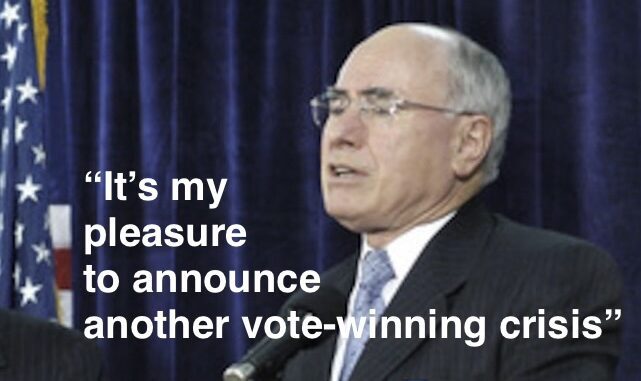
People who follow politics closely might think that Labor always comes to power during a crisis, but is that absolutely true?
Well, no, that’s not quite right. Labor doesn’t necessarily take power in a crisis. That said, Australian political history is full of instances of Labor coming to power after a major crisis, or being split by one. A crisis’s effect on the party depends on several things: Is the party united? Does the public believe the party’s leaders can deal with the crisis? Are the party’s policies in line with what the public wants at that particular time? The WWII example (below) is a good one because the party’s unity and the public’s confidence in John Curtin’s leadership were essential to the Labor Party managing the crisis and staying in power.
In contrast, during the Great Depression, bitter divisions within Labor over how to respond to economic hardship led to defections and a loss of public confidence, which ultimately caused the government to collapse. Similarly, Kevin Rudd’s leadership during the Global Financial Crisis was recognised for clear communication and credible policy measures that reassured voters. These examples show that when Labor can present a clear, united front and offer credible solutions in a crisis, it is more likely to benefit. But if internal disagreements and public doubt dominate, a crisis can just as easily weaken the party.
Looking at the historical records, we see both happening. Labor took power during a crisis in these instances when voters turned to Labor to guide the nation through an economic or global emergency, or the party took over just as a crisis erupted:
The Global Financial Crisis (2007–2008): Kevin Rudd led Labor to victory in late 2007, just as the subprime mortgage collapse was beginning to ripple globally. His government famously steered Australia through the Global Financial Crisis with aggressive economic stimulus, avoiding the severe recessions seen in other Western nations.
World War II (1941): Amidst a political crisis where the conservative United Australia Party coalition collapsed under Robert Menzies and Arthur Fadden, Labor leader John Curtin took office. Curtin is widely regarded as one of Australia’s greatest wartime Prime Ministers, successfully managing the nation’s home and total war economy.
The COVID-19 Pandemic recovery (2022): Anthony Albanese led Labor to power following the turbulent pandemic years, inheriting the immediate economic aftermath, surging inflation, and a growing cost-of-living crunch created mainly by the Morrison Government.
Times when a crisis destroyed a Labor government
Conversely, some of the worst crises in Australian history actually hit while Labor was already in power, leading to political catastrophe and the party losing government:
- The Great Depression (1929): James Scullin’s Labor government was elected in a landslide just days before the Wall Street crash of 1929. The unprecedented global economic cataclysm tore the Labor Party apart over how to respond. Defections from both the party’s left and right wings caused the government to collapse in 1931, ushering in decades of conservative rule.
- The Dismissal & Stagflation (1975): Gough Whitlam’s reformist Labor government was hit hard by the 1973 global oil shock, skyrocketing inflation, and rising unemployment. The resulting economic strain, compounded by loan affairs, triggered a constitutional crisis that culminated in the Governor-General dismissing Whitlam. However, even today the changes Whitlam made in a short period of time are acknowledged as changes that changed the face of Australia.
Times when conservatives managed the crisis
Major crises have also been managed successfully by conservative governments, keeping Labor out of power:
- The 1990s Asian Financial Crisis and 9/11: John Howard’s Coalition government was in power during the 1997 Asian Financial Crisis, the tech-wreck recession of 2000, and the geopolitical shock of the September 11 terrorist attacks. The Coalition maintained popular support and economic stability, keeping Labor in opposition for 11 years.
Summary
While Labor is often viewed as the party of major state intervention—making its platform attractive when a crisis requires strong government action—history proves it is not a rule. Crises have just as frequently divided and broken Labor governments as they have elevated them to power.
A Crisis of Now
By looking into the past, we can now appreciate just how hard it is to govern. Staying in power now necessitates decisions that don’t always address the long term but rather speak to the short term, which might keep the incumbent government in power. By this, I mean governments of today find themselves facing a multitude of immense problems requiring a long-term approach. In many areas of the economy, the Treasurer is trying to implement change. To stay in power today simply requires running up deficits to give people what they want, and then it catches up with you.
Currently, the opposition and the media are screaming out for the government to cut their spending, in the full knowledge that to do so would increase unemployment to levels guaranteeing certain defeat at the next election. Increased spending has to be found for defence (AUKUS, a Morrison policy) and bulk billing, which was left to die by an opposition traditionally opposed to it.
An unthinking public, as a result, only sees the cruelty of this and looks to parties like One Nation and the misconceptions they represent. Never in my lifetime has so much been asked of a budget so devoid of the funds to accommodate everyone’s needs. Labor has been forced to cut programs to pay for these policies and is still accused of not cutting their spending. Cut the assistance for the purchase of TVs and the home battery scene, but sound environmental arguments can be found for their retention.
This isn’t a problem for parties whose only interest is gaining power. For a public whose only interest is their own welfare, it is easy to see why they are attracted to parties like One Nation, who by any measure are devoid of talent and policies. On the other hand, the LNP promised they would change philosophically but stubbornly look the same. The National Party, which once supported country folk, now looks like a party of the past and not the future.
Our country needs a government that can change with the times, with a quick but steady hand. The changes I speak of are enormous, requiring decision-making of the highest quality.
My thoughts for the day
1. We exercise our involvement in our democracy every three years by voting. After that the vast majority takes very little interest. Why is it so?
2. Given a choice between a party with little credibility, another full of ratbags, and an incumbent who, whilst not perfect, measures every decision with sound reasoning, I think I will stick with the party that has a degree of sound economic acumen, along with a degree of apathy.
3. The common good should be at the centre of any political philosophy. However, it is more likely to be found on the left than the right.
4. We live in a failed system. Capitalism does not allow for an equitable flow of economic resources. With this system, a small privileged few are rich beyond conscience, and almost all others are doomed to be poor at some level.
5. I feel people on the right of politics in Australia show an insensitivity to the common good that goes beyond any thoughtful examination. They have hate on their lips and their hate starts with the beginning of a smile.
Keep Independent Journalism Alive – Support The AIMN
Dear Reader,
Since 2013, The Australian Independent Media Network has been a fearless independent voice – holding power to account and delivering journalism that matters.
Running this site isn’t cheap. Rising costs mean we need your support now more than ever. Every donation, big or small, keeps our servers running, our writers working, and our stories free for everyone.
Donate here:
PayPal or credit card – just click on the Donate button below
Direct bank transfer: BSB: 062500; A/c no: 10495969

We’ve also set up a GoFundMe as a dedicated reserve fund for hosting and future improvements.

Thank you for standing with us. We couldn’t do this without you.
With gratitude,
The AIMN Team

Be the first to comment