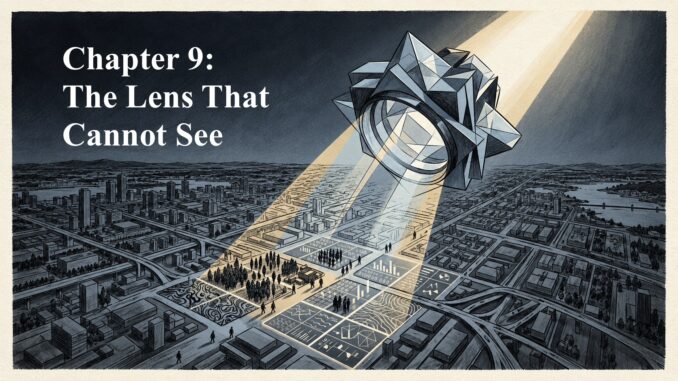
Chapter 9: The Lens That Cannot See – What the Algorithmic Gaze Shows and What It Hides
Continued from Chapter 8
9.1 The Question
Across the preceding chapters, a consistent pattern has emerged. Robodebt, the NDIS, Aged Care, Veterans’ Affairs, the NSW Financial Management Order pipeline, and the contracted human services market all share a common structure. An instrument is introduced to measure something. The measurement determines a resource allocation. The person is processed through the instrument. The outcome is determined by the measurement. And the human being – with their context, their complexity, their suffering – is not in the data.
The question this chapter addresses is deceptively simple: what does the lens actually show, and what does it hide?
The answer is structural, not moral. The lens shows what it was designed to show. It hides what it was not designed to see. And the decision-makers who rely on the lens can only act on what it shows them.
This is not a failure of the individuals who built the lens. It is a property of the lens itself.
9.2 The Four Lenses
The lens is not a single instrument. It is a set of different instruments, each with its own focus, its own categories, and its own blind spots. But they share a common structure: they translate human experience into data that can be processed by a system.
9.2.1 The Income Averaging Lens
Robodebt’s instrument was an algorithm that divided annual ATO income data by 26 to produce a fortnightly average. It compared this average to the income the recipient had declared to Centrelink. A discrepancy triggered a debt.
What the lens showed:
- A numerical difference between two data points.
- A potential overpayment.
- A debt to be recovered.
- A savings target to be met.
What the lens hid:
- The casual worker whose income fluctuated week to week.
- The recipient whose hours varied with seasonal demand.
- The person who had changed jobs mid-year.
- The person who had taken unpaid leave.
- The person who had been hospitalised for part of the year.
- The person who could not produce payslips from six years ago.
- The person who paid the debt because they could not prove their innocence.
- The mother who could not afford her daughter’s medical expenses after the debt collector debited her account.
- The young man who drove home at night thinking he could drive his car into a tree.
9.2.2 The Functional Capacity Lens
The NDIS’s assessment tools measure functional capacity. The Integrated Assessment Tool measures mobility, cognition, daily living, and social circumstances. The tool converts these inputs into scores, applies rules, and classifies the person into a funding category. Assessors are barred from overriding the classification except in a small set of pre-defined circumstances.
What the lens showed:
- A set of functional limitations.
- A score on standardised domains.
- A classification into a funding category.
- A budget.
What the lens hid:
- The fluctuating nature of complex disability.
- The impact of poverty, discrimination, and social context.
- The value of a relationship with a trusted support worker.
- The person’s own knowledge of what they need.
- The trauma of repeated assessment.
- The fear of losing support.
- The person who does not fit the categories.
- The person whose disability is compounded by racism, sexism, or carceral entanglement.
The NDIS assessment tool was designed to measure functional capacity. It was not designed to see the person.
9.2.3 The Risk and Liability Lens
The veteran claims system measures liability. The business rules engine processes claims against legislation and policy. The delegate sees the output. The system determines whether the injury is service-related. It determines whether the claim meets the threshold. It determines the level of compensation.
What the lens showed:
- A claim.
- A set of evidence.
- A determination of liability.
- A payment or a rejection.
What the lens hid:
- The veteran who had been waiting 578 days.
- The veteran who had been asked for the same evidence three times.
- The veteran whose claim was rejected because the doctor used different wording.
- The veteran who had stopped answering calls.
- The veteran who withdrew his claim to spare his mother the cost.
- The 71 per cent of ex-serving members who died by suicide and were not DVA clients.
- The person behind the claim.
The veteran claims system was designed to process claims. It was not designed to see the veteran.
9.2.4 The Incapacity Lens
The Financial Management Order process measures incapacity. The Tribunal assesses whether the person can manage their own financial affairs. The assessment determines whether an order is made. The order transfers control of the estate to the NSW Trustee.
What the lens showed:
- An assessment of incapacity.
- A risk of loss or disadvantage.
- A need for a financial manager.
- An order.
What the lens hid:
- The person’s fear of losing control over their own money.
- The shame of having to ask for money.
- The frustration of being unable to access real-time information about their own funds.
- The isolation of having their phone restricted in hospital.
- The person who could manage their affairs with support but not alone.
- The person who had never been given the opportunity to try.
- The person behind the assessment.
The FMO process was designed to protect assets. It was not designed to see the person.
9.3 The Common Structure
The four lenses share a common structure. They all:
- Translate human experience into data. The person becomes a set of scores, classifications, or determinations.
Apply rules to the data. The rules determine the outcome. The rules are set by the system, not by the person.
Produce an outcome. The outcome is a debt, a budget, a claim determination, or an order.
Hide the human context. The data does not include the person’s fear, their history, their relationships, their circumstances, or their suffering.
The lens does not see the person because it was not designed to see the person. It was designed to see the data. And the data is what the system needs to process.
9.4 The Paradox of Precision
The lens is precise. It measures exactly what it was designed to measure. It produces consistent results. It can be scaled to millions of cases. It can be audited and reviewed. It is, by the standards of administration, a success.
The paradox is that its precision is the source of its blindness. The more precisely it measures one thing, the more completely it excludes everything else. The income averaging algorithm measured the average. It could not see the fluctuation. The functional capacity tool measured the score. It could not see the person. The claims system measured the liability. It could not see the veteran. The incapacity assessment measured the capacity. It could not see the context.
The lens is not blurred. It is sharp. And it is precisely because it is sharp that it misses what lies outside its focus.
9.5 The Documentation That Cannot Enter
The documentation of harm exists. It is extensive, detailed, and sourced.
The Royal Commission into the Robodebt Scheme documented the deaths, the suffering, and the illegality. The Royal Commission into Aged Care Quality and Safety documented the neglect, the waiting lists, and the cost. The Royal Commission into Defence and Veteran Suicide documented the system that “crushed the people it should be helping.” The NSW Audit Office documented the failure to encourage self-reliance, the gaps in monitoring, and the resource constraints. The academic studies documented the epistemic injustice, the datafication, and the failed recognition.
This documentation is real. It is produced by bodies with standing and authority. It is published and accessible.
And it does not enter the lens.
The lens processes the data generated by the instrument. The instrument generates the data required by the system. The system requires the data that the lens can see. The documentation of harm is external to this architecture. It is produced outside the system. It does not enter the performance data, the contract measures, or the policy briefs.
The documentation can change the politics. It can trigger a Royal Commission or a class action. It can force a settlement or a policy change. But it cannot change the lens. The lens continues to see what it was designed to see.
9.6 The Political Liability Exception
There is one mechanism by which the documentation can enter the decision-making architecture: political liability.
When the documentation of harm becomes a political liability – when it threatens the government’s electoral prospects, or when it becomes too costly to ignore – the system responds. The Robodebt scheme was abandoned in November 2019, after the Federal Court declared the debts invalid and the political pressure became unsustainable. The Aged Care Royal Commission was established after sustained advocacy and media coverage. The NDIS reassessment process is being contested in the Senate.
But the response is to the political problem, not the structural problem. The scheme is abandoned. The Royal Commission is held. The policy is adjusted. The lens remains.
The lens is not reformed because the lens is not the problem the system sees. The problem the system sees is the political liability. The solution is to remove the liability. The lens continues to operate.
9.7 The Two Sets of Eyes
This brings us back to the question that opened the paper: how can two sets of eyes see the same destruction and interpret it so differently?
The answer is that they are looking at different maps of the same territory.
The Human Rights lens sees individuals. It sees the person who died, the family who grieved, the community that was destroyed. It sees the suffering.
The Algorithmic lens sees data. It sees the claim, the score, the classification, the determination. It sees the process.
The Banking/Financial lens sees risk and assets. It sees the country, the corporation, the resource, the investment. It sees the opportunity.
The Political lens sees liability. It sees the electoral consequence, the media coverage, the opposition attack. It sees the threat.
Each lens shows something different. Each lens hides something different. The decision-maker operates within the lens they are given. They cannot see what the lens does not show.
The documentation of suffering is real. But it is in the domain of the Human Rights lens. It does not enter the Algorithmic lens. It does not enter the Banking lens. It does not enter the Political lens unless it becomes a liability.
The two sets of eyes see different things because they are different eyes. And the eyes that matter for decision-making are the eyes that are built into the architecture.
9.8 The Lens as the State
The lens is not a tool that the state uses. It is the lens through which the state sees. It is not separable from the state’s decision-making capacity. It is the state’s decision-making capacity.
When the state looks at a welfare recipient, it sees the JSCI score. When it looks at a person with a disability, it sees the functional capacity assessment. When it looks at an older person, it sees the IAT classification. When it looks at a veteran, it sees the liability determination. When it looks at a person under an FMO, it sees the incapacity assessment.
The lens is not the state’s instrument. The lens is the state’s perception. And the perception determines the action.
This is the structural capture. Not the capture of individuals. The capture of architecture. The state has been reconfigured to see through a particular lens. The lens was chosen by the ideology. The ideology was implemented through the market. The market required the measurement. The measurement required the instrument. The instrument is the lens.
The state cannot see what the lens does not show. And the lens does not show what it was not designed to see.
9.9 What the Lens Cannot See
The lens cannot see:
- The person behind the data – their history, their relationships, their fears, their hopes.
- The context that shapes the data – the poverty, the discrimination, the social circumstances.
- The consequence of the determination – the debt, the waiting, the shame, the death.
- The gap between what is measured and what is true – the fluctuation in income, the complexity of disability, the fear of losing control.
- The harm that the system produces – because the harm is in the gap, and the lens does not see the gap.
The lens sees what it was designed to see. The rest is invisible.
9.10 The Question That Remains
The question this chapter leaves open is not whether the lens can be reformed. It is whether the state can be reformed to see.
The documentation of harm exists. The Royal Commissions have reported. The audits have been published. The academic studies have been written. The political liability has been registered. The schemes have been abandoned. The apologies have been made.
And the lens remains.
The lens remains because it is not the problem the state sees. The state sees the political liability. The state sees the budget. The state sees the contract. The state does not see the lens. The lens is the medium through which the state sees everything else.
To reform the lens, the state would have to see the lens. And the lens does not show itself.
That is the structural problem. That is what the algorithmic gaze hides. And that is why the documentation of suffering – however extensive, however authoritative, however undeniable – does not change the architecture.
The lens cannot see itself. And the state cannot see what the lens does not show.
Claim – Status – Summary
Claim – Status
- Lens translates human experience into data – Established
Lens applies rules to determine outcomes – Established
Lens hides human context – Established
The paradox of precision: the more it measures, the more it excludes – Inference
Documentation of harm is external to the decision-making architecture – Inference
Documentation enters only as political liability – Established
Different lenses see different things – Established
The lens is the state’s perception, not its instrument – Inference
The state cannot see what the lens does not show – Inference
The lens cannot see itself – Inference
References
Royal Commission into the Robodebt Scheme. (2023). Report [Accessible full report].
Office of the Australian Information Commissioner. (2026). Automated decision-making and public reporting under the Freedom of Information Act.
NSW Independent Commission Against Corruption. (2025). Corruption Matters – December 2025 (Issue 66).
Administrative Review Tribunal. (2026). National Disability Insurance Scheme.
Continued tomorrow… Chapter 10: The Question – Can the State Be Redesigned to See, or Has the Lens Become the State?
Keep Independent Journalism Alive – Support The AIMN
Dear Reader,
Since 2013, The Australian Independent Media Network has been a fearless independent voice – holding power to account and delivering journalism that matters.
Running this site isn’t cheap. Rising costs mean we need your support now more than ever. Every donation, big or small, keeps our servers running, our writers working, and our stories free for everyone.
Donate here:
PayPal or credit card – just click on the Donate button below
Direct bank transfer: BSB: 062500; A/c no: 10495969

We’ve also set up a GoFundMe as a dedicated reserve fund for hosting and future improvements.

Thank you for standing with us. We couldn’t do this without you.
With gratitude,
The AIMN Team

Be the first to comment