By Walt Zlotow
The United States effectively lost the war with Iran within the first three days, when the attack that killed Supreme Leader Ali Khamenei failed to bring about the collapse of the Iranian regime.
Bombing Iran for 39 days was a catastrophic military failure. Iran’s retaliatory defense decimated all 20 US Gulf State bases inflicting over 750 US casualties, including 18 dead.
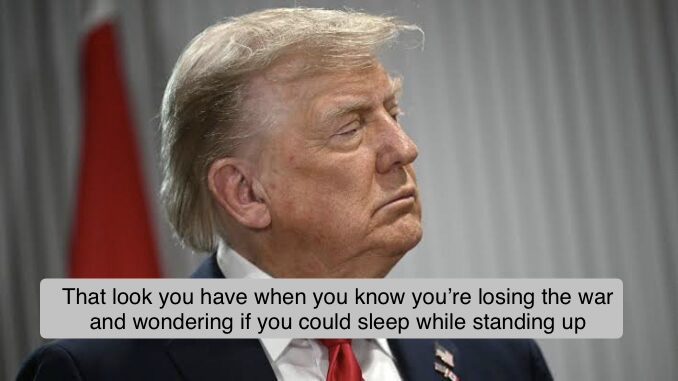
Running out of both offensive and defensive missiles, Trump blinked first and called for a ceasefire on April 8, war day 40.
The June 17th signing of the Memorandum of Understanding (MOU) was essentially a US surrender document.
Realizing the MOU signaled his defeat, Trump simply ignored it, implemented a blockade and resumed periodic bombing. Both utterly failed to reopen the Strait of Hormuz to resume the critical flow of oil to prevent worldwide economic calamity.
Having been sucker punched with bombs twice by Trump during negotiations, Iran has signaled it will never negotiate with Trump during his remaining 2 years, 5 months in office.
Trump’s statements that Iran is negotiating surrender on Trump’s terms, the Strait is open, and will become US territory, the blockade is a resounding success, the oil is flowing, are so detached from reality one must ponder Trump’s sanity.
Refusal to capitulate is spreading the war within the region to Yemen, Saudi Arabia, Lebanon, West Bank, Iraq, Syria, possibly even Turkey v. Israel.
If Trump’s last gasp is to utterly destroy Iranian infrastructure, Iran will retaliate and destroy the entire Gulf States oil infrastructure and possibly Israel’s infrastructure as well.
Unlike for the US, Trump’s war is an existential threat to Iran’s existence. They have been preparing for the US-Israeli tag team war machine to destroy them for decades. They are and will prevail regardless of the cost.
Israel will do whatever is necessary to keep Trump in the war to destroy Iran. Trump’s only way out is to sever ties with Israel and capitulate to Iran’s sensible terms. Given Trump’s history, the chances of that are nil. Removing Republican control of Congress in 9 weeks may be only chance for America to avoid economic collapse.
But only if a Democratic Congress has the wisdom, decency and good sense to end the most self destructive war in America’s 251 years.
Walt Zlotow, West Suburban Peace Coalition Glen Ellyn IL
Keep Independent Journalism Alive – Support The AIMN
Dear Reader,
Since 2013, The Australian Independent Media Network has been a fearless independent voice – holding power to account and delivering journalism that matters.
Running this site isn’t cheap. Rising costs mean we need your support now more than ever. Every donation, big or small, keeps our servers running, our writers working, and our stories free for everyone.
Donate here:
PayPal or credit card – just click on the Donate button below
Direct bank transfer: BSB: 062500; A/c no: 10495969

We’ve also set up a GoFundMe as a dedicated reserve fund for hosting and future improvements.

Thank you for standing with us. We couldn’t do this without you.
With gratitude,
The AIMN Team
Iran will retaliate and destroy the entire Gulf States water de-salination infrastructure.
Or they could create “dummy” / “crude” missiles which are cheap(er), quicker and easier to create and then flood neighbours airspaces in order to attract and therefore quickly deplete expensive defensive missile stocks to zero. Maybe slip in one or two “hot ones” to keep the defenders guessing.
I reckon the following shows Donnie at his finest about how wonderful his defeat is progressing:
https://www.thedailybeast.com/raging-trump-80-explodes-in-foulmouthed-morning-meltdown/
Deluded Donald Dogvomit is a standing monument to human weaknesses, stupidities, error, malefaction, criminality, subnormality gone HUGE. It will take ages to rectify and readdress his filthite foolings and grievous errors of mentality meandering, but it must be done, as surely as efforts were made, quickly, to erase memory of Adolf, Josef and so many swine whose buggerising of civilised history needs a cleanup. Trump’s nomadic mental misfittery has been harmful, sickening, unfair. Even the stone faces on Mt. Rushmore might shed tears…
But still the MSM blackout on day-to-day stuff in places like Palestine.
From The Guardian 020926:
”Senator Ed Markey, 80, won the Democratic primary in Massachusetts on Tuesday, beating back a challenge from Seth Moulton, a congressman who tried to unseat him by arguing to voters his opponent was too old to be effective at his job.
Massachusetts is heavily Democratic, making the senator favored to win a third full term in the November general election, where he faces the Republican nominee John Deaton.
The 80-year-old incumbent, according to the Associated Press, easily defeated his 47-year-old rival, at a moment when Democratic voters agonize over the age of some lawmakers, a concern that was amplified by Joe Biden’s disastrous re-election bid in 2024, and Kamala Harris’s subsequent failure to keep Donald Trump from returning to the White House.”
If Markey is too old to run for Congress, then why is the PPOTUS (Pederast Protector of the Undemocratic Sewer of Apartheid) a fit & proper person to be the bone-spurs draft-dodging Supreme Commander of the US military forces??
Thank you Scummo, arguably the only self-serving COALition scamming Prim Monster to make Billy ”Big Ears” McMahon look like a saint.
From SMH 030926 (paywall): AUKUS makes Australia a nuclear target, top experts warn, Rob Harris.
”Australia is significantly more likely to be dragged into a destructive conflict with China — and potentially targeted with nuclear weapons — under the AUKUS security pact, two former senior national security figures have warned.
Michael Keating, a former Department of the Prime Minister and Cabinet secretary, and former public servant Jon Stanford argue that the federal government’s current defence posture has “sacrificed considerable sovereignty” to the United States while leaving the country uniquely vulnerable without a guaranteed security safety net.
The pair will front a crowd-funded public inquiry into the AUKUS submarine pact on Thursday, urging the federal government to immediately redesign its national strategy, cancel plans to acquire American Virginia-class and British-designed SSN AUKUS nuclear-powered attack submarines, and pivot to low-enriched uranium vessels sourced from France or South Korea.
Keating, the most senior public servant during the Hawke-Keating era, spent 11 years on the Secretaries Committee on National Security – including five years as chairman – while Stanford has extensive background in submarine research and defence policy.
“Under AUKUS, Australia’s security is under greater threat while it has become increasingly clear that we cannot rely on the US for our defence,” they write in their submission. “We are now in a situation where, because of the AUKUS strategy of integrated deterrence in defence of US regional primacy, Australia is more likely to be attacked, potentially with nuclear weapons”.
Another independent source of information about TACO Trumpery’s war against the world:
From: Wednesday Updates: ‘Strait’ Up Panic – 9/2/26
Ben Meiselas and MeidasTouch Network
Sep 2 2026
Today’s top stories:
Trump again falsely posts the U.S. has the Strait of Hormuz “under control” and floats renaming it to the “Trump Strait”
IRGC claims tanker strikes near the Strait and warns shipping companies of penalties
Iran claims strikes hit U.S.-linked sites in Iraq, Jordan, Bahrain, and Kuwait, and alleges American casualties
Iranian embassies mock CENTCOM’s silence on their alleged casualty claims in Jordan
Iranian official Ghalibaf accuses the U.S. of “satanic” conduct following strikes on children in Minab, Lamerd, and a wedding in Kouhestak
China blocks G20 consensus language on Strait of Hormuz navigation
Bessent blames Ukraine and Biden for gas prices and high cost of living
Lutnick downplays Iran war deaths
The U.S.S Abraham Lincoln limps into Thailand, visibly rusted
Trump’s $100B Venezuela oil “steal” faces more scrutiny
Tarrant County Republicans vote to close 92 of 316 polling locations
ProPublica reports Trump aide Peter Navarro fast-tracked a $620M Pentagon loan tied to Don Jr.
Bessent calls struggling Americans “malcontents”
Trump $1 coins are on sale now…
Trump is turning FEMA disaster aid in MAGA campaign ads
Katie Phang moves to force a federal judge to review FBI notes mentioning Trump in the Epstein Files for possible release
Tarrant County Republicans vote to close 92 of 316 polling locations
And this is how they steal the mid-terms: make it impossible for people to vote.
We need to disconnect from USAnia now.
The most important question in this war is not who can claim the latest tactical success. It is whether military power has produced the political outcome for which the war was initiated.
This distinction is fundamental to strategic analysis.
A state can destroy targets, degrade military infrastructure, achieve temporary air superiority, or impose enormous economic costs—and still fail to convert those advantages into a durable political settlement. Conversely, an opponent can suffer severe material losses while retaining enough institutional cohesion, strategic depth, missile capacity, political will, and regional leverage to prevent the attacker from achieving its principal objectives.
That is why the Iran war should not be assessed through casualty figures, destroyed facilities, presidential statements, or claims of victory alone.
The Strait of Hormuz illustrates the problem particularly clearly. The waterway is not simply a geographic feature; it is a strategic system connecting military power, energy markets, maritime security, insurance, logistics, and global economic stability. Recent reporting indicates that traffic has remained dramatically below pre-war levels, while the economic and military costs of the conflict continue to accumulate.
The Congressional Budget Office has estimated that the war had already cost the United States more than $38 billion through August 1, with potentially billions more required each month. It also warned of depleted munitions stocks and broader economic consequences.
These are not simply accounting figures. They are indicators of strategic endurance.
The deeper lesson is that modern warfare is rarely decided by destruction alone. The decisive question is whether destruction changes the adversary’s political calculations faster than it changes your own strategic costs.
If neither side can impose its political objectives, the conflict can enter a dangerous condition in which tactical operations continue while the strategic end state becomes increasingly unclear. That is where wars become self-reinforcing: each new strike creates another reason for retaliation, and each retaliation creates another justification for escalation.
From a field-informed perspective, I would therefore measure this conflict against five questions:
What was the original political objective?
Which objectives have actually been achieved?
What capabilities remain on the opposing side?
What strategic costs are accumulating for each actor?
And, most importantly, what credible off-ramp exists?
Until those questions have clear answers, declarations of victory should be treated as political messaging rather than strategic conclusions.
The battlefield tells us what has been destroyed.
The political outcome tells us whether the war has actually achieved its purpose.
— Wahidullah Noorzai | NIDA
Former Senior ANCOP/ANP Officer | Field Strategist | Security & Geopolitical Analyst
تحلیل وحیدالله نورزی بر یکی از بنیادیترین اصول مطالعات استراتژیک تأکید میکند: موفقیت نظامی، زمانی به پیروزی استراتژیک تبدیل میشود که بتواند به نتیجه سیاسی مورد نظر منجر گردد.
اهمیت این دیدگاه در آن است که جنگ را از سطح آمار حملات، میزان تخریب و ادعاهای پیروزی فراتر میبرد و آن را بر اساس اهداف سیاسی، ظرفیتهای باقیمانده طرفین، هزینههای فرسایشی و امکان دستیابی به یک پایان پایدار ارزیابی میکند.
اشاره او به تنگه هرمز نیز از همین منظر اهمیت دارد. جغرافیا در اینجا صرفاً یک موقعیت مکانی نیست، بلکه عاملی است که امنیت دریایی، بازار انرژی، محاسبات نظامی و هزینههای اقتصادی را به یکدیگر پیوند میدهد. چنین نگاهی نشان میدهد که ارزیابی جنگ، بدون درک ارتباط میان جغرافیا، قدرت و اراده سیاسی، ناقص خواهد بود.
نکته محوری تحلیل نورزی این است که تخریب توان نظامی دشمن لزوماً به معنای تغییر محاسبات سیاسی او نیست. ممکن است یک طرف در میدان نبرد دستاوردهای قابلتوجهی کسب کند، اما اگر نتواند آن دستاوردها را به توافقی پایدار یا تحقق اهداف اولیه جنگ تبدیل کند، همچنان با یک مسئله حلنشده استراتژیک روبهرو خواهد بود.
این رویکرد، تحلیل را از داوریهای شتابزده درباره پیروزی و شکست دور میکند و به پرسشهای اساسیتری میرساند: اهداف اولیه چه بودند؟ چه میزان از آنها تحقق یافته است؟ چه ظرفیتهایی در طرف مقابل باقی ماندهاند؟ هزینه ادامه جنگ برای هر طرف چیست؟ و مهمتر از همه، چه سازوکار سیاسی معتبری برای پایان دادن به درگیری وجود دارد؟
ارزش این چارچوب تحلیلی در طرح همین پرسشهاست. البته اعتبار نهایی هر ارزیابی استراتژیک به کیفیت شواهد، دقت دادهها و توانایی آن در توضیح تحولات واقعی بستگی دارد.
با این حال، تأکید بر تمایز میان دستاورد تاکتیکی و نتیجه سیاسی، نقطه شروعی ضروری برای فهم جنگهای معاصر است؛ زیرا میدان نبرد میزان تخریب را نشان میدهد، اما راهبرد باید توضیح دهد که این تخریب چگونه و تا چه اندازه به نتیجه سیاسی تبدیل میشود.
از این منظر، تحلیل وحیدالله نورزی توجه را از هیاهوی اعلام پیروزی به مسئله اصلی جنگ بازمیگرداند: رابطه میان قدرت نظامی، اهداف سیاسی و امکان دستیابی به یک پایان پایدار.
Vahidullah Noorzai’s analysis underscores one of the fundamental tenets of strategic studies: military success translates into strategic victory only when it leads to the desired political outcome.
The significance of this perspective lies in the fact that it moves the assessment of war beyond mere statistics—such as the number of attacks, the extent of destruction, or claims of victory—evaluating it instead based on political objectives, the remaining capabilities of the parties involved, the costs of attrition, and the feasibility of achieving a sustainable end to the conflict.
His reference to the Strait of Hormuz is also significant from this perspective. Here, geography is not merely a matter of physical location; rather, it is a factor that links maritime security, energy markets, military calculations, and economic costs. This viewpoint suggests that any assessment of war remains incomplete without an understanding of the interplay between geography, power, and political will.
The core of Norouzi’s analysis is that destroying an adversary’s military capabilities does not necessarily translate into a shift in their political calculus. A party may secure significant gains on the battlefield, yet if it fails to translate these achievements into a durable agreement or the realization of its initial war objectives, it will still be confronted with an unresolved strategic problem.
This approach steers analysis away from hasty judgments regarding victory or defeat, leading instead to more fundamental questions: What were the initial objectives? To what extent have they been realized? What capabilities remain at the adversary’s disposal? What is the cost of continuing the war for each side? And, most importantly, what credible political mechanism exists to bring the conflict to an end?
The value of this analytical framework lies precisely in its posing of these questions. Naturally, the ultimate validity of any strategic assessment depends on the quality of the evidence, the accuracy of the data, and its capacity to explain actual developments.
Nevertheless, emphasizing the distinction between tactical achievement and political outcome is an essential starting point for understanding contemporary wars; for while the battlefield reveals the extent of destruction, strategy must explain how—and to what degree—this destruction translates into a political outcome.
From this perspective, Vahidullah Noorzi’s analysis shifts the focus away from the clamor of declared victories and back to the core issue of the war: the relationship between military power, political objectives, and the possibility of achieving a lasting resolution.
Another fine objective analysis of the present TACO Trumpery mess in the Straits of Hormuz and its impact stretching around the world.
Kifak, Nematullah.
(I’m one quarter Lebanese and one quarter Egyptian).
Ahhhhh ….. So Michael, you just wanted to show off that you can read Arabic, eh??