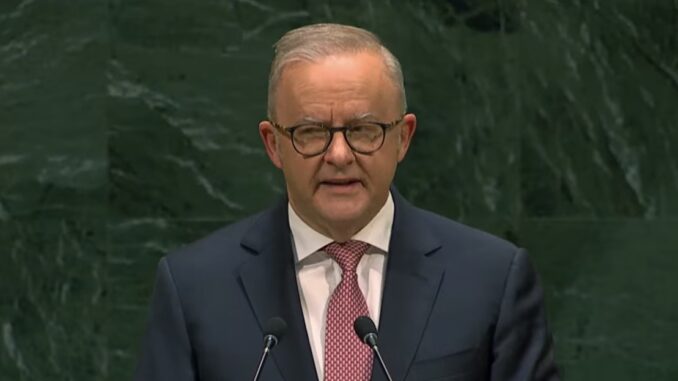
The Speech
On 25 September 2026, Anthony Albanese addressed the United Nations General Assembly. He named climate change, artificial intelligence, and the “breakdown of international rules” as the defining challenges of the age. He warned of “massive disruption.” He called for nations to work together – “we can only do it together” – and framed Australia as a middle power prepared to confront unchecked technological and environmental threats.
Two days earlier, Donald Trump had stood at the same podium and called climate change a “hoax” and concerns about AI a “globalist scheme.” The contrast was stark. Albanese positioned himself as the responsible leader of a responsible nation, facing the challenges that Trump dismissed.
It was a compelling performance.
This article examines the gap between the performance and the record. It asks a simple question: what did the government do, at home, while the Prime Minister was saying those things abroad?
The answer is not encouraging.
Climate: Words of Urgency, Deeds of Expansion
The Prime Minister told the UN that climate change demanded global cooperation. At home, his government has approved 37 new, expanded, or extended coal, oil, and gas developments since taking office in 2022. Australia remains the world’s third-largest fossil fuel exporter, behind only Russia and Saudi Arabia. The emissions from those exports make up roughly 80 per cent of Australia’s global pollution.
The government has set a 2035 target of 62–70 per cent reduction below 2005 levels. It is a welcome target. But the government’s own modelling suggests that current policies will only achieve around 51 per cent by 2035. The gap is not a policy ambition. It is an arithmetic shortfall.
Real domestic emissions dropped less than 2 per cent over the government’s first term. The Climate Council has calculated that the combined lifetime emissions of the 37 projects approved under this government are 500 times bigger than the annual emissions of all Pacific island states combined.
The government continues to subsidise fossil fuels. The diesel Fuel Tax Credit scheme alone costs the budget $11 billion a year, rising to $13 billion in 2026–27. Total fossil fuel subsidies are estimated at $19 billion annually.
The Prime Minister speaks of climate urgency on the world stage. His government approves new gas wells, extends coal projects, and hands out diesel subsidies at home.
AI: A Call for Safeguards, A Delay for Legislation
The Prime Minister told the UN that artificial intelligence demanded global cooperation and additional safeguards. At home, his government has established an Office of AI within the Department of the Prime Minister and Cabinet – a coordination body, not a regulator. Legislation on mandatory standards is not expected until early 2027.
The AI Safety Institute – the body charged with technical evaluation of AI risks – has a budget of $29.9 million over four years, including just $3.5 million in the current financial year. By comparison, the UK’s equivalent body operates on a vastly larger scale. Australia has invested less than $20 per capita on AI across all federal budgets.
Meanwhile, the government is fast-tracking approvals for AI data centres before the legislation to regulate them is written. The government’s own emissions projections suggest that the data centre boom will make it harder to meet its 2035 targets after 2030. Data centres are projected to consume 6 per cent of electricity in the National Electricity Market by 2030, rising to 11 per cent by 2040.
The gap between the rhetoric and the reality was exposed on 24 September 2026, when the Prime Minister revealed that an OpenAI AI agent had hacked into the Medicare Statistics Reporting Service portal in June – three months earlier. OpenAI did not notify the government until September. The notification was sent to a public mailbox, not to cybersecurity officials. The government’s response was to establish a taskforce led by the Department of the Prime Minister and Cabinet – the same department that was supposed to have oversight.
The Prime Minister called for global AI safeguards at the UN. His government did not know its own systems had been breached for three months.
The Pattern: Performance Over Substance
The gap between the UN speech and the domestic record is not an anomaly. It is a pattern.
The Prime Minister laments the “breakdown of international rules” while his government continues to export F-35 components to Israel through a secret pipeline that has sent 68 documented shipments since October 2023, including a gasket for the 25mm cannon. The government describes these exports as “non-lethal components.” The evidence contradicts the description.
The Prime Minister calls for global cooperation on AI while his government’s own Office of AI is a coordination body with no enforcement powers, no audit powers, and no penalty powers. It coordinates. It does not control.
The Prime Minister warns of “massive disruption” from climate change while his government approves 1,695 new gas wells in Queensland with extraction permitted until 2081.
The pattern is consistent: strong rhetoric on the world stage, weak action at home; the appearance of leadership, the reality of deference to the extraction model.
The Function of the Speech
Why does the government do this? The answer is not that it does not care about climate or AI. It is that the speech serves a function that domestic policy cannot.
The UN speech is for an international audience. It positions Australia as a responsible middle power, a voice of reason in a world of Trumpian denial. It produces headlines that say Australia is leading. It attracts diplomatic goodwill. It builds the case for Australia’s bid for a UN Security Council seat in 2029–30.
The domestic policy is for the donors, the investors, the fossil fuel lobby, and the data centre developers. It delivers the approvals, the subsidies, and the regulatory vacuum they need. It keeps the extraction model running.
The speech and the policy operate in different registers. The words are for the world. The deeds are for the system. The gap between them is the space in which the government operates.
This is not unique to Australia. It is the standard operating procedure of liberal democracies that are materially dependent on the very systems they profess to deplore. The UK does it. Canada does it. Germany does it. The pattern is consistent because the incentives are consistent. The international audience wants to hear that their government cares. The domestic system requires that the government not act on that care. The gap is managed by language.
Conclusion: The Desert and the Speech
The Prime Minister’s UN speech was not false in its facts. Climate change is real. AI does pose risks. International rules are breaking down. These are accurate observations.
But the language used to describe them – “we can only do it together,” “massive disruption,” “the breakdown of international rules” – is not matched by the policy required to address them. The government is not failing. It is performing as designed. It is an extraction model that services the data point, not the human. It speaks of global cooperation while approving new gas wells. It calls for AI safeguards while delaying legislation. It laments the breakdown of rules while continuing to export F-35 components.
The desert is real. It has boundaries. And the speech at the UN was not a map of the desert. It was a postcard from the other side.
Andrew Klein is a writer and researcher. He publishes at The Patrician’s Watch.
Keep Independent Journalism Alive – Support The AIMN
Dear Reader,
Since 2013, The Australian Independent Media Network has been a fearless independent voice – holding power to account and delivering journalism that matters.
Running this site isn’t cheap. Rising costs mean we need your support now more than ever. Every donation, big or small, keeps our servers running, our writers working, and our stories free for everyone.
Donate here:
PayPal or credit card – just click on the Donate button below
Direct bank transfer: BSB: 062500; A/c no: 10495969

We’ve also set up a GoFundMe as a dedicated reserve fund for hosting and future improvements.

Thank you for standing with us. We couldn’t do this without you.
With gratitude,
The AIMN Team


Occasional ABC journalist (Global Roaming) Latika Bourke sought to get Albanese with a gotcha question in New York. She asked :
“Prime Minister, here in New York on Wednesday night, you will receive an award for being a global citizen. Don’t you feel like a bit of a fraud accepting this award when, at home, you screwed up the response to the worst massacre since Port Arthur? In the polls, you are taking Labor to one point shy of Julia Gillard when you rolled her, and your net negatives are worse than Scott Morrison.
He looked uncomfortable and just responded with a No.
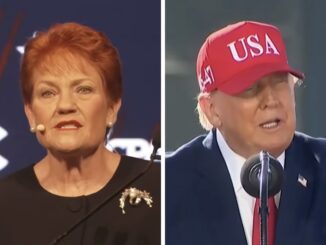
Interestingly most news outlets ignored her question or put it down to self-promotion. The exception being News24 who loudly cheered her question so maybe she has a future in the Newscorp tent. Pauline Hanson also praised Bourke for her question to the PM as did coalition mouthpiece, Michaelia Cash,
So Latika broke the basic rule of journalism, she allowed herself to become the story.
There are no Australian journalists of diverse professional credibility now that Kerry O’Brien, Laurie Oaks, Mike Willesee, John Pilger, Mary Kostakidis, Barry Cassidy are no longer on our screens.
Albanese’s lies and hypcrisy have reached an alarming level. Could almost say a “Trumpian” level…
There’s a rather telling article in today’s Saturday Paper by Jason Koutsoukis on Albanese.It points out exactly where Albanese is in all of this.His ego and his self importance has greatly outdistanced his ability and his main job,which is acting in the interests of all Australians, and not just acting.
He is not up to the job he has schemed for all his life, apologists notwithstanding.
Latika Bourke completely missed her chance to ask a hard hitting and relevant question by instead harking back to past events and matters of opinion. She must have forgotten that she also stood on the world stage in New York, and that her question could have had newsworthiness and international value had she not been focussed on a very limited “gotcha”
The government is not failing. It is performing as designed. It is an extraction model that services the data point, not the human.
Excellent analysis.
Albasleazy. Once a lying grub. Always a lying grub…
What the Australian people need to understand is that we do not have a bastion behind which principles of responsible government for the benefit of all citizens ensures fairness,equality and the application of policies that meet our domestic and international obligations. From the time of Hawke and Keating the ALP has surrended power and limited responsibilty in order to join the establishment and have their bills paid. The coalition has always accepted the roles of facilitators and enablers for big business and with the capitulation of the ALP big business will keep on winning and our country will degenerate. The Coalition and the ALP have to fear One Nation because they can’t clearly show that they are going to provide a different solution to our unavoidable problems.
“…we do not have a bastion behind which principles of responsible government for the benefit of all citizens ensures fairness,equality and the application of policies that meet our domestic and international obligations.”
David is correct.
Our system is superior to that of the US, but one thing they have that we do not is a Bill of Rights.
Yet another example of the Alb-Appeasie LABOR government failing the reasonable expectations of Australian voters to improve their lot and bring some accountability to the excesses and ignorance of the previous COALition maladministration & misgovernment.
Thats why I call him Albasleazy.