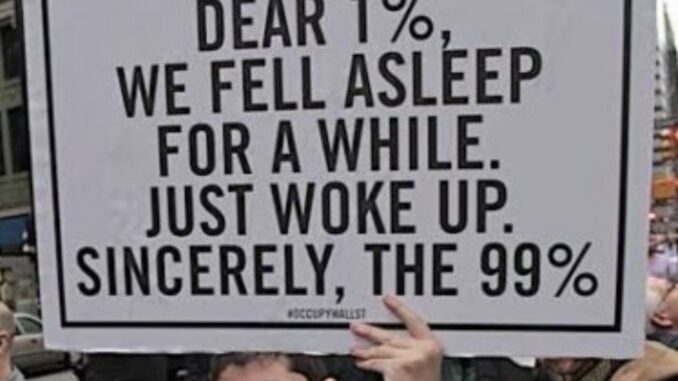
The politics of discontent
BBC news reports that an 87-year-old woman was evicted from her unit in Madrid for not being able to pay her rent. She had lived in that home for almost 70 years having taken over the rental agreement from her father, but since the complex had recently be sold to an investment firm her rent was raised from €500 per month to €2650 per month, but after objections from tenants, reduced to €1650. The woman’s pension is €1350 euro, and so she was evicted.
Closer to home, the annual financial reporting season has seen the supermarkets, Coles and Woolworths report profits of $1.1 billion and $1.14 billion, a profit of $82.59 from every man woman and child in Australia.
The major banks have done even better. CBA announced a full years profit of $11 billion, NAB reported half year profits of $3.558 billion, Westpac $3.4 billion and ANZ $3.8 billion.
KPMG reported that the combined half year profits of the ‘big four’ for the first half of 2025/26 financial year was $15.2 billion, noting that was down from the corresponding period of the previous year.
Considering that these banks derive their profits from Australian customers, when we look at the profit per person for that half year, that equates to about $562 from each man woman and child in Australia. Annualised that is over $1,125 per person.
In the local rental market, a pensioner renting a small two bedroom duplex pays around $1,100 per fortnight, which includes rent allowance, of around $1450 per fortnight leaving $350 for living expenses including power, gas, water and other essentials.
It is important to understand how we got here, before looking at how we can possibly work toward a more egalitarian economic model.
Policies directed by economic theorists have helped to create the world we live in. Going back to the devastating economics of the 1930s, with the Great Depression triggered by the 1929 Wall Street Crash, the costs of reconstruction after WWI in Europe and the the ripple effect of those, leading to the rise of nationalism and WWII, something needed to be done, something was needed to bring a stability, an order to the deflated economies.
It was really only the US economy which had benefitted from the war, ironically, the very economy which triggered the Great Depression, allowing the development of manufacturing to support the war effort in Europe and to fight off the threat posed by Japan in the Pacific. All other economies were basically no existent.
To rebuild after the war, the theories of John Maynard Keynes were put into place, the rebuilding of Europe and the Australian economies was done through government spending, infrastructure built and financed by deficit spending. In Australia, that included an active immigration programme, ‘Populate or Perish’, backed by social housing through state housing commissions. Wages were good, and with increasing wages, taxation revenues increased as wages grew, as more jobs were created.
That model worked well until the late 1970s when the OPEC oil crisis saw the price of fuel increase dramatically and a new term was invented to describe the economic conditions, stagflation, where both high inflation and high unemployment break the cycle of using interest rates to control economies. A new economic model was needed.
Enter the Chicago School of Economics which determined that the most significant driver of economic growth was profit. Return on investment became the driver for the development of business and business models, combined with an attitude that government involvement was scorned.
President Reagan in the US and Prime Minister Thatcher in the UK embraced the new model. Trickle down economics was invented, and governments got out of social programmes such as housing and infrastructure; the era of privatisation began where government infrastructure was sold off to investment banks, power stations and the power grid became major business ventures, eyeing the profits which could be made, government owned banks, airlines and transport fleets were sold off, even the construction of freeway networks became privately owned, leading to tolls to finance building, expansion and maintenance of major transport routes.
Social housing as a government initiative virtually stopped with an encouragement to have investors buy up and develop housing stocks.
In each case, the motivation was to profit from the investments.
This was particularly painful in the housing market.
State housing homes were sold off, budget builders took over the construction of cheap homes, where in the 1970s a first home buyer could purchase a home for about two and a half to three time the annual earnings of a worker, but that has since increased to closer to ten times a worker’s wage to get into the market. Rents, as a return on investment have increased to become virtually unaffordable for people on the minimum wage, despite significant efforts by government to help out with low deposit guarantees and co-ownership arrangements.
With the help of government, industries rebuilt after WWII. Along with support for other countries, such as the Marshall Plan in developing much of the destroyed German infrastructure, and that of Japan, the economic growth saw an almost egalitarian spread of the wealth generated allowing for the growth of consumer economies. The integration of European economies through the Treaty of Rome and the subsequent steps to what is today the EU with a ripple effect which included the growth of economies such as Australia’s.
In the meantime, taxation on the wealthiest has been decreased by successive governments and depending on the ‘colour’ of the governments, wages have at times kept up with inflation or at other times slid back, leaving the main burden of taxation on those who work for wages and salaries, while the investor class manage to minimise their contributions.
Whereas industrial development was initially done by people who had a passion for the engineering and the foresight to develop businesses and business models based on their interests, the investor class is only interested in profits, profitability, and return on investment. We see businesses bought up by investors, the listings on the stock exchanges are followed as shares are bought and sold. The successes and failures of businesses about as reliable as placing a bet on the Melbourne Cup, all a bit of a gamble.
Business which were built and diversified are broken up into component parts and traded.
And so it goes.
The new business models which are creating the greatest interests are the high tech companies, especially today, those in the Artificial Intelligence field, and those companies have become so large that they have revenues greater than many countries and have power which defies regulation, as we are seeing with the attempts to control their activities.
The recent exposure that Australia’s Medicare had been hacked, that private information has been breeched, following other hackings over time, but this coming from one of the billionaire-owned companies, and not communicated swiftly, and then standing up to governments wishing to place some guard-rails on these businesses which have become essential services in the gathering and retaining of vital information.
Private information is no longer regarded as ‘private’, the people whose information is at risk are not considered as valuable.
This is a flow on from the corporatisation of infrastructure, the passing of infrastructure and services from government control to private investors. We see it in the prisons, in the off-shore detention facilities and to a lesser degree here, in health services where there is joint ownership between private and public health facilities and hospitals.
Attempts to place guard rails is being resisted as a restriction of freedom of speech, or some sort of imposition on individual freedom.
The limiting of internet access to children under the age if 16 is seen as something dreadful, not so much for the kids involved but for the corporations involved. The resistance is coming from the tech giants who see a loss of revenue, a loss on influence as being a price they are paying, a price being asked of the wealthiest people in the world to pay.
Much the same for the proposed ‘op out’ of algorithmic feeds, which would enable an individual internet user to limit the flow of information based on what the algorithm decides that person should see, rather than what the person may actually want to see.
The price the tech corporates may pay is perhaps some advertising revenue missed out on, but more importantly that they can no longer determine what it is that the user sees. When we look at the growth of hate speech, as an example, the algorithm will feed me a stream of hate messages, should I happen to open a post sent to me by some-one who happens to not like Muslims a lot, who fears that we may be forced to live under Sharia Law and so the next half hour of scrolling down the feed builds on my anxiety, seeks to assure me that if we don’t do something about those muslims, we will be doomed!
Perhaps an even more dangerous topic is online gambling where fortunes are lost on the hope of winning, and people have resorted to crime, fraud to pay for losses, and others have suicided. And dare I mention the sexual exploitation through social media?
Placing guard rails reduces freedoms, yes they do, they reduce the freedoms of the tech corporations to do harm.
Over time, we have seen changes in the way family and communal life has changed, how life is lived has changed.
Chatting with older people about how life, both home and communal has changed we see a shift from a belongingness, whether it be in a family setting where meal times were around a dining table, where ‘rules’ applied, table manners, conversation, parents asking about school, friendships, sport, to the inclusiveness brought through the popular media of the day, the commonality of listening to the same ‘top 40’s’ radio station, watching the same TV programmes, like Number 96, attending church services and youth groups and social clubs where friendships were formed.
Recreational play time for kids finished at just about dinner time, close to sunset really, swimming in the local river swim spot complete with a Tarzan rope hanging from a tree over the water cricket in the street with the neighbouring kids, football in the park.
Slowly the scene changed. The advent of recorded movies on Beta and VHS tapes saw a shift from following the same TV programmes to more individual viewing habits, portable tape players like Walkman players meant personal music was enjoyed through headphones instead of a broadcasting through the loud speakers of boom boxes or other louder forms of playback. While there was chat about what to see and what to listen to, the inclusiveness, the communal sense of entertainment was the beginning of the social erosion leading to the isolation we see today.
A friend told of an adult child who had returned ‘home’ after a relationship breakdown gladly takes the food prepared for dinner but retreats to his own room to watch whatever is on his TV or computer as he eats alone, far too engaged with his own ‘stuff’, and not willing to communicate since that will only lead to disagreement and potential conflict.
We see the same repeated time and again where there is no common ground and no willingness to listen to other voices, other opinions is discouraged. The focus on personalised entertainment and news gathering lacks the respect of other sources. The stridency of video clips, the ubiquity of ‘influencers’ covering a range of interests from fashion to religious commentary to the hate speech of politics becomes a constant flow, with no real time given to assess the information, accepting as gospel anything the algorithmic feed presents.
And there-in lies so much of the difficulty we see around us, the divisiveness of political and social commentary. The flow of information is so one-sided, that opposition deemed almost heretical.
We live in the age of absolute individualism. Absolute freedom, to repeat the catch cry of early liberalism.
But freedom without purpose leads to a mindlessness, a lack of identity, a lack of meaning for life. What does it mean to be ‘me’, is seen in isolation of the sense of community which we used to have.
The cry for freedom of speech is raised in objection to limiting the reach of the internet providers, limiting what under 16-year-old kids get on their social media feeds, objecting to the endless algorithmic feeds a simple google inquiry will provide. Limiting the ‘creative’ power of sexualising images and posting them on Facebook, Tick Tock, X or other easily accessible ‘news’ feeds. What may start as a simple enquiry about a news item becomes an hours long feed of ‘similar’ content. The stream so insistent that any idea of actually processing the information, critically thinking it through, objectively assessing and other intellectual engagement is restricted.
Waleed Aly explores the the growth of liberalism and what may ultimately be its undoing on a Quarterly Essay, ‘Time of the monsters: What future for liberalism’. In it he quotes Pope LeoXIV’s Magnifica Humanitas:
‘Technological innovations, including artificial intelligence … must be evaluated by asking a critical question: Do they truly help individuals and people become more humane and fraternal, while respecting our common home and future generations?’
Aly goes on:
‘What an unfamiliar question to ask. It immediately crashes the routine inquiries of liberal thinking. It does not begin with productivity. It does not begin with questions of ease or convenience or enjoyment. It does not even ask: What’s the harm? It asked instead: what is the effect on our humanity and our social bonds, and how might this technology be developed to amend or enrich them’?
And further, Aly references the Prime Minister’s speech at Sydney University:
‘… declaring an intent to regulate AI, explicitly cites the Pope’s “superb” encyclical. He makes a point of saying AI raises not merely economic issues , but ‘legal ones, social ones … also moral, and spiritual ones.” In announcing his intention to legislate national AI standards, he sought to place his policy in the tradition of Medicare: “one of the truest expressions of our society, and the duty we owe to each other as members of it.”’
(Quarterly Essay 103 2026 Page 82-84)
How ironic that those who oppose such legislation as restricting the freedoms demanded through the growth of liberalism as it appears to be in its death throes, are caught out hacking Medicare records and holding back on reporting this until confronted by the Prime Minister.
The tech moguls, the banks, the supermarkets demonstrate no interest in ordinary people beyond their role as consumers and thereby as profit opportunities. This filters down to shareholders and other investors for whom even homes have become profit centres, with renters paying high rents for the privilege of having a roof over their heads while they can afford to pay, with the rent charged bearing no relationship to the income of the occupant.
Further, the growing social isolation experienced in the last 80 years in western societies has broken down the sense of community, the sense of belonging which has led to the politics of hate and division we see around us.
Within this amorphous mass of dystopian politics we see no solutions being offered, just a sniping at the people who are charged with the role of governing in our democracies, but an unwillingness to engage in serious political debate.
Keep Independent Journalism Alive – Support The AIMN
Dear Reader,
Since 2013, The Australian Independent Media Network has been a fearless independent voice – holding power to account and delivering journalism that matters.
Running this site isn’t cheap. Rising costs mean we need your support now more than ever. Every donation, big or small, keeps our servers running, our writers working, and our stories free for everyone.
Donate here:
PayPal or credit card – just click on the Donate button below
Direct bank transfer: BSB: 062500; A/c no: 10495969

We’ve also set up a GoFundMe as a dedicated reserve fund for hosting and future improvements.

Thank you for standing with us. We couldn’t do this without you.
With gratitude,
The AIMN Team




I think it’s fair to say that it was Greed that got us into this mess, and to a degree, most people are guilty of a bit of that, but the greed of Corporations has grown astronomically, to the degree that it’s harmed the population and governments, paid to protect the people, have promoted it and subsidised it, calling us an economy now, not a society. It’s now a sickness, an addiction. Is it even possible to turn this around?
My advice to my grandchildren: Don’t go to university – seek a trade, craft, manual skill and training at TAFE level. Then move out of capitol suburbia to a regional or rural location and work to become self sufficient and “off grid”. Learn to ignore the anxiety and expectation created by capitalist influences and realise that for living style “less is more”. Modern living instills the false assumption that acquiring “stuff and things” is desirable and essential as an indicator of wealth. This is a trap because most “stuff and things” are created for instant obsolescence and possess no intrinsic value or purpose other than fleeting infotainment. Better to read a book than read a screen. The book is permanent – the screen changes hourly at the whim of some invisible influencer. Admittedly I have benefited from the (declining) capitalist economic system up to my retirement but since withdrawing from the system I am able to live a simple but rewarding existence that involves manual labour and mental innovation to achieve daily tasks. Becoming self sufficient is challenging and often difficult but is rewarding when all systems are “go”. In my youth I admired the hippies who rejected liberalism in favour of self sufficient independence but then I didn’t have the courage or manual skill to join them. Now I am having a go at it and have found a purpose for living.
Long ago, I taught students that we were becoming electronic peasants. It is a world of materialism, struggle, consumerism, media maggots, financial filth, advertising analities, insincerity and, I and “we” do not control it. I played social footy on the Saturday of the 1973 fesival, in Nimbin. There was mixed uninformed comment and attitude.
I’ve seen it there over time, all settled down, slow and cool. Good. My grandchildren lead orthodox professional battling lives, which “we” left to swell, boil-like. Will much improve? No superstition or hope remains.
@ Bert Hetebry: An excellent article. Thank you.
@ Mediocrates: Agree that the licenced trades are the preferred option for any thinking and capable young person. Even girls are being introduced to them, with much benefit to building standards despite the inherent misogyny from too many traditional tradies.
Living in regional centres is an excellent life style where you can make whatever social progress that you desire.
@ Phil Pryor: Ah Nimbin ….. and the monthly markets at The Channon that we attended during the 90s. Always an exciting event because of the interesting stall-holders who had escaped from the city corporate drudge to build the life for themselves that they wanted.
You only have to look at the people living on the streets, in cars and in tents to see that greed, consumerism, war mongering, toxic political stupidity and destructive behavior towards our planet, to see how this is all going to end. Think about the stupidity where we have billionaires building massive underground shelters to survive the planet they helped kill.
As Jen said “Is it even possible to turn this around?”
No Jen its not! Nobody wants to be the first to say this has to stop, we cant keep going on like this. So we are all on a train headed for a cliff and all people can do is argue about where they are going to sit.
Thomas Brookes is probably correct.
The most likely end to the liberal madness is a serious depression.
However, there’s a new influence at work now that might, just might, save the day.
When people see, through social media, that China’s ever-improving living standards, combined with impressive public health-care and a mind-boggling level of technical know-how and investment in infrastructure, they will demand the same from the liberal overlords.
That’s when things get interesting.
Change?? Yes we can!!
Spain and Brazil have made new tax laws requiring corporations & the wealthy to pay a fairer share of taxation, resulting in raising the standard of living for many citizens.
Just now (0645 hours 300926, ABC RN) English PM Andy Burnham has rejected BREXIT as a failure and looks set to take on the English establishment for the benefit of workers.
A win:
“Spain announces ban on evictions after protests over 87-year-old woman’s removal from flat.”
https://www.bbc.com/news/articles/cwm2qmjgy93do
Other voices are concerned that the (allegedly left) ALB-Appeasie LABOR government has forgotten the necessary social revolution that Australian voters expect when LABOR come to power to correct the maladministration and misgovernment of COALition ”governments”.
https://johnmenadue.com/post/2026/10/labors-left-has-won-the-party-so-what-happened-to-the-left/