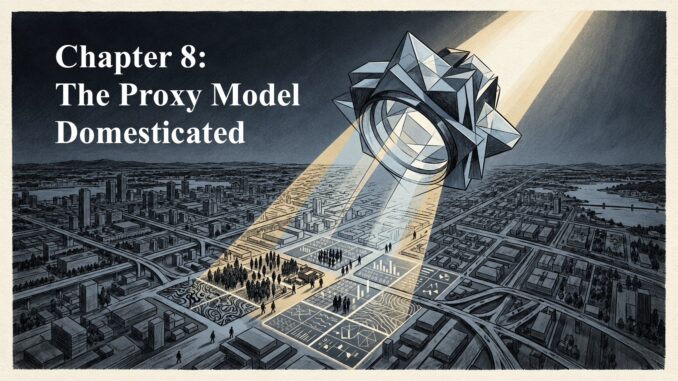
Chapter 8: The Proxy Model Domesticated – How the State Uses Providers to Mediate Its Relationship with Citizens
Continued from Chapter 7
8.1 The Shift from Provider to Purchaser
The state did not always deliver human services through contracted providers. In the post-war settlement, the Australian government employed public servants to deliver services directly to citizens. The Commonwealth Employment Service (CES) had offices in every major town. The Department of Social Security had counter staff who knew their claimants. The Department of Veterans’ Affairs had case officers who managed veteran claims.
This model was displaced by a structural transformation. As one parliamentary submission states, the Coalition Government’s policies led to an increase in labour hire and contracted staff, and a significant increase in claims caseloads, with the result that the Department could not “administer basic services”.
The state did not simply outsource service delivery. It reconstituted itself as a purchaser rather than a provider. The public servant who once delivered the service became the contract manager who monitored the provider. The citizen who once encountered the state directly now encounters the state through an intermediary.
This is the hollow state. The state retains the authority but transfers the capacity. It sets the rules, allocates the resources, and measures the outcomes – but it does not deliver the service. The delivery is performed by contracted entities whose accountability runs to the department, not to the citizen.
8.2 The Architecture of Mediation
8.2.1 The Contract as the Relationship
In the hollow state, the primary relationship is not between the state and the citizen. It is between the state and the provider, governed by a contract.
The contract specifies what the provider will deliver, to whom, at what price, and according to what performance measures. The provider is accountable to the department for meeting those measures. The citizen is the object of the contract – the person to whom the service is delivered – but not a party to it.
This is a structural inversion. In the direct-delivery model, the citizen had standing. They could complain to the department. They could appeal a decision. They could, in principle, hold the state accountable. In the contracted model, the citizen’s relationship is with the provider. The provider is accountable to the state. The citizen’s ability to hold anyone accountable is mediated through the contract.
8.2.2 The Performance Measure as the Lens
The contract is enforced through performance measures. The provider is paid based on outcomes. The outcomes are defined by the department. The definitions shape what the provider does.
The evidence from employment services is explicit. A parliamentary inquiry found that the system is “driven by funding and performance management arrangements” that “continues to push jobseekers into work as fast as possible”. The majority of provider payments are conditional on time in employment, and performance is judged on the time taken to place a jobseeker in work.
The consequence is structural. As Dr David O’Halloran told the inquiry, in a “pay-by-outcome, marketized employment services” system, “providers respond to the financial pressures and incentives of a system by calculating which unemployed workers offer the best return on investment and thus favour those likely to be placed into work quickly and inexpensively while neglecting those with more complex and thus more time consuming and expensive needs”.
The provider is not evil. The provider is optimising for the measure. And the measure does not see the jobseeker who needs longer-term support. It sees the outcome that generates payment.
8.2.3 The Distance Problem
The hollow state creates distance between the decision-maker and the human impact.
In the direct-delivery model, the public servant who denied a claim could see the claimant. The claimant was in front of them. The human consequence was immediate. In the contracted model, the decision is made by the provider’s staff, based on measures set by the department, and the human consequence is registered in the provider’s performance data.
The department sees the data. The provider sees the data. The citizen experiences the consequence. The feedback loop is broken.
This is not a failure of the system. It is a feature of the architecture. The distance is what allows the state to manage at scale. It is also what makes the state structurally incapable of seeing the harm.
8.3 The Case Studies
8.3.1 Employment Services: The Black Box Market
The Workforce Australia inquiry documented the structural features of the contracted employment services model.
The system operates as a “black-box market”: providers are contracted for results, but the method of delivery is largely their own. The department sets the outcomes; the provider determines the process.
The inquiry heard that the system continues to push jobseekers into work “as fast as possible”. The “work first” approach leads to jobseekers being forced to accept lower-paid, lower-skilled positions, which “can be antithetical to a jobseeker’s career progression and can trap jobseekers in persistent cycles of poverty and disadvantage”.
One jobseeker told the inquiry: “I’d rather end up in a job that uses my abilities than spend my time in a low-level job for which I’m unfit”.
Another described being threatened with non-compliance reporting for refusing an unsuitable job, and having a panic attack as a result.
The provider was not acting maliciously. The provider was acting according to the incentive structure. The structure rewarded rapid placement. The provider placed rapidly. The jobseeker bore the consequence.
8.3.2 Veterans’ Affairs: The Privatisation of Claims Processing
The Community and Public Sector Union’s submission to the Royal Commission into Defence and Veteran Suicide documented the privatisation of DVA’s claims processing.
The CPSU found that “labour hire workers are NOT in specialised roles; they are doing everyday processing work. Roughly 75% of delegates are labour hire. One team I was in containing 11 delegates, only 2 were APS staff”.
DVA confirmed in Budget Estimates that it used at least 46 different labour hire providers and spent $77 million more on labour hire contractors in 2019/2020 than in 2014.
The consequence was structural. The CPSU submission states that “privatisation in the form of labour hire, contracting, and other third-party arrangements has reduced the Department’s capability to administer basic services, to respond to fluctuations in demand, and to meet its legislative requirements”.
The state had outsourced the capacity to process claims. It retained the authority to make decisions. It lost the ability to understand what it was deciding.
8.3.3 Aged Care: The Assessment Market
The AMA warned against the privatisation of aged care assessments. The AMA’s concern was that assessments “must remain independent of aged care providers and be delivered by health professionals, especially geriatricians who are trained in dealing with the complex medical needs of the frail and elderly”.
The AMA stated that “a market-based approach is a recipe for aged care service providers to put profits before patients”. It warned that the plan would “see states and territories required to tender for a job they already do well”.
The government proceeded. Contracts worth approximately $1.2 billion were awarded to private providers.
The consequence is structural. The assessor who determines the older person’s level of funding is now employed by a contracted entity. The entity is accountable to the department for meeting assessment targets. The older person is the subject of the assessment.
8.3.4 NDIS: The Market Stewardship Problem
The NDIS is a market-based scheme. Participants receive funding. Providers compete for their business. The National Disability Insurance Agency (NDIA) is the market steward.
The NDIA itself acknowledges that “competition between service providers is not enough to fuel thin markets in terms of pricing and effectiveness”.
The Rural and Remote Advisory Group raised concerns that “NDIS costs have affected the market holistically, disadvantaging non-participants” and that “thin markets are causing allied health providers to withdraw their services in remote areas”.
The state designed a market. The market does not work in all locations. The state cannot fix the market because the state no longer delivers the service. It can only steward the market, and stewardship is not delivery.
8.4 The Consultancy Layer
The hollow state does not only contract service delivery. It contracts advice.
A comparative study of policy consultancy across six countries – Britain, the United States, Canada, Australia, The Netherlands, and Sweden – found a significant increase in the volume and importance of external consultants in the public policy process.
The study addresses the implications for “the nature of the state (transforming into a contractor state?) and for democratically legitimized and accountable decision-making (transforming into consultocracy?)”.
The term “contractor state” describes the transformation. The state contracts out not only service delivery but policy design, evaluation, and implementation. The consultants who provide these services are accountable to the department, not to the public. They optimise for the contract, not for the citizen.
The ANU Policy Brief identifies the consequences: “40 years of New Public Management (NPM) reforms have weakened” the foundations of the Westminster system, “contributing to the politicisation of the public service and, at their worst, to policy disasters such as Robodebt”.
The brief notes that “NPM practices have dismantled traditional line hierarchies and outsourced core services in pursuit of higher efficiency and productivity”.
The consultancy layer is the second mediation. The provider mediates between the state and the citizen. The consultant mediates between the state and itself. The information that reaches the decision-maker has passed through two filters. The citizen has been processed by the provider. The provider’s data has been analysed by the consultant. The decision-maker sees the output of both filters.
8.5 The Accountability Deficit
8.5.1 The Diffusion of Responsibility
In the direct-delivery model, the public servant who made the decision was accountable for it. They could be identified. They could be questioned. They could be held responsible.
In the hollow state, responsibility is diffused. The provider made the decision, but according to the contract. The department set the contract, but according to the policy. The policy was designed by the consultant, but according to the brief. The brief was set by the minister, but according to the political calculation.
No one is responsible. Everyone is a link in a chain. The chain has no single point of accountability.
The CPSU submission states the problem plainly: “The outsourcing of ICT infrastructure and software to a shared services arrangement with Services Australia (previously Department of Human Services) has also negatively affected veteran services”. The ICT system was outsourced. The staff who understood the system were dispersed. The veterans who depended on the system bore the consequence.
8.5.2 The Feedback Loop That Does Not Close
The documentation of harm exists. The Royal Commissions, the parliamentary inquiries, the academic studies, the union submissions – they all document the consequences.
What they cannot do is close the feedback loop. The documentation is external to the decision-making architecture. It is produced by bodies outside the contract. It does not enter the performance data that the provider is measured against. It does not enter the policy brief that the consultant prepares. It does not enter the political calculation that the minister makes.
The system processes what it was designed to process. The harm is in the gap. And the gap is where the citizen lives.
8.6 The Domesticated Proxy Model
The proxy model, as described in earlier chapters, involves an external actor using a local proxy to achieve strategic objectives.
The domestic analogue is precise. The state uses providers as proxies. The state sets the terms — the contract, the performance measures, the funding. The provider delivers the service. The citizen experiences the provider. The state experiences the data.
The provider is not the state. The provider is accountable to the state for meeting the measures. The provider’s relationship with the citizen is instrumental. The citizen is the means by which the provider meets the measure.
The state is not the provider. The state is accountable to the parliament for the policy. The state’s relationship with the provider is contractual. The provider is the means by which the state delivers the policy.
The citizen is not a party to either relationship. The citizen is the object of both. The citizen experiences the provider. The citizen is measured by the provider. The citizen’s experience is translated into data. The data is transmitted to the state. The citizen is not present in the data.
This is the domesticated proxy model. The citizen is the terrain on which the contract is performed.
8.7 What the Lens Does Not See
The contracted model measures outcomes. It measures placements, assessments, claims processed, budgets allocated.
What it cannot measure:
- The jobseeker who was placed in a job that made them sicker, because the measure was placement, not wellbeing.
- The veteran whose claim was processed by a labour hire worker who did not understand the system, because the measure was throughput, not understanding.
- The older person who was assessed by a contracted clinician who did not know their history, because the measure was assessment completed, not care received.
- The NDIS participant who could not find a provider in a thin market, because the measure was plan allocated, not service received.
- The person behind the data.
The contract processes what it was designed to process. The citizen is in the gap.
8.8 The Structural Parallel
The proxy model shares the structural features of the other systems documented in this work.
Feature – Robodebt – NDIS – Aged Care – Veterans – FMO – Proxy Model
Trigger Algorithm – Plan reassessment – Assessment Claim – Admission – Contract
Mediator None – NDIA – Provider- Labour hire – Tribunal – Provider
Human discretion limited Yes – Yes – Yes – Yes – Yes – Yes
Appeal restricted Yes – Yes – Yes – Yes -Yes – Yes
Distance from impact High – High – High – High – High – High
Harm concentrated on vulnerable Yes – Yes – Yes – Yes – Yes – Yes
Documentation external Yes – Yes – Yes – Yes – Yes – Yes
The structural logic is identical. The state has created an architecture that mediates its relationship with the citizen through a contract. The contract requires measurement. The measurement is performed by the provider. The provider sees the measure. The citizen is the terrain.
8.9 Conclusion: The Hollow State and the Citizen
The hollow state is not a state that has withdrawn. It is a state that has reconstituted itself as a purchaser. It retains the authority. It transfers the capacity. It sets the terms. It measures the outcomes.
The citizen experiences the state through the provider. The provider experiences the state through the contract. The state experiences the citizen through the data.
The citizen is present in the system as a data point. The citizen is present in the experience as a person. The gap between the two is where the harm occurs.
The documentation of harm is real. It is produced by Royal Commissions, parliamentary inquiries, academic studies, and union submissions. But it is external to the contract. It does not enter the performance data. It does not enter the policy brief. It does not enter the political calculation.
The system processes what it was designed to process. The citizen is in the gap. And the gap is where the citizen lives.
Claim – Status – Summary
Claim – Status
- State reconstituted as purchaser, not provider – Established
Contract is the primary relationship; citizen is object – Inference
Performance measures shape provider behaviour – Established
Employment services system pushes jobseekers into work “as fast as possible” – Established
DVA uses 75% labour hire delegates; 46 providers – Established
Aged care assessments partially privatised; contracts ~$1.2 billion – Established
NDIA acknowledges thin markets – Established
Policy consultancy increased across six countries – Established
NPM reforms contributed to policy disasters such as Robodebt – Established
Responsibility diffused through contract chain – Inference
Documentation external to decision-making architecture – Inference
Domestic proxy model: provider as mediator – Inference
Citizen is terrain on which contract is performed – Inference
References
Catholic Social Services Australia. Review of Employment Services [Submission].
SAGE. (2025). Outsourcing Policy-Related Functions in Australia: Health and Equity Impacts.
National Disability Insurance Scheme. (2026). Update on the new way of planning for the NDIS.
Aged Care Quality and Safety Commission. (2026). Final assessment report: Infinite Care Cornubia.
Crikey. (2026). Calls, messages, police records: How Palantir helped an intelligence agency analyse 42 million data points on Australians.
U.S. House Representative Rob Menendez. (2026). Menendez Presses New Jersey State Investment Council on Palantir Investments.
Continued tomorrow… Chapter 9: The Lens That Cannot See – What the Algorithmic Gaze Shows and What It Hides
Keep Independent Journalism Alive – Support The AIMN
Dear Reader,
Since 2013, The Australian Independent Media Network has been a fearless independent voice – holding power to account and delivering journalism that matters.
Running this site isn’t cheap. Rising costs mean we need your support now more than ever. Every donation, big or small, keeps our servers running, our writers working, and our stories free for everyone.
Donate here:
PayPal or credit card – just click on the Donate button below
Direct bank transfer: BSB: 062500; A/c no: 10495969

We’ve also set up a GoFundMe as a dedicated reserve fund for hosting and future improvements.

Thank you for standing with us. We couldn’t do this without you.
With gratitude,
The AIMN Team

Be the first to comment