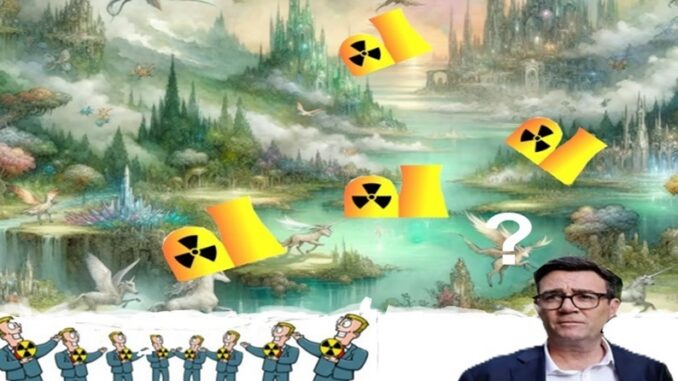
Why on Earth does the Small Nuclear Reactor media bandwagon exist?
That’s a fair question, because it has been shown time and time again that small modular nuclear reactors (SMRs) are not an economically viable way to provide electricity.
I can only conclude that there are other reasons for the present juggernaut of promotion of SMRs.
You may not have noticed the blithering onslaught of media promotion of SMRs going on over the past weeks, (interestingly, in conjunction with the political demise of Sir Keir Starmer). With the dramatic events in the Persian Gulf, and in climate extremities, dominating the media, a fuss about SMRs seems a small matter.
But it is not a small matter.
The global media juggernaut for SMRs is potentially essential for the survival of the global nuclear industry. If one nation sets up a multitude of, or even a few, small nuclear reactors, that will provide the necessary respectability for the industry – to be accepted as cheap. clean. safe, and embraced by local communities.
Hooray – Britain to the rescue!.
Now, there’s extraordinary excitement in both the British and overseas media. A current example:
- The High Value Manufacturing (HVM) Catapult has launched a national consultation, to help UK industry capture the economic and industrial benefits of more than £100bn of expected investment in the country’s civil and defence nuclear programmes over the next decade. Industry, government, academia and regional partners are invited to contribute to the consultation through written submissions, stakeholder workshops and a programme of regional engagement running throughout 2026.
HVM Catapult doesn’t specifically state SMRs, but that’s where the UK media fervour is at. In a previous article, I have mentioned The Times, Telegraph, PR Newswire, Energy Live, Business Green, among the British enthusiasts. Internationally, there’s Construction News, Global Banking and Finance Review, World Nuclear News, Indux, and more.
What is new and remarkable about this UK SMR media fervour?
Well, there are two things. One is that it is all pitching the UK as the leader for the new nuclear renaissance. The other is that this will be a privately-led renaissance. Hence the importance of the “private” SGE £35bn plan for a fleet of SMRs across Britain, rather than the government supported Rolls Royce plan.
I digress here to point out that three nations have tried and failed to set up small nuclear reactors. Russia and China have each managed to develop one actually functioning small nuclear reactor. – in both cases – that took decades, and neither is working out very successfully – Russia – (Akademik Lomonosov floating NPP) and China (HTR-PM high temperature gas cooled reactor). The USA nearly got one happening – The Rise and Fall of NuScale: a nuclear cautionary tale.
So – at last it’s all going to happen ! And the UK is the leader – hip hip hooray! Except that the UK’s biggest SMR promoter, PM Keir Starmer is about to bow out at any moment. The policies of the heir apparent, Andy Burnham, are curiously unknown. He’s got a respectably Leftie background in supporting nuclear veterans, but I couldn’t find anything on his nuclear industry views. And, I’m inclined to think that he, or any new UK Prime Minister, would not be able to withstand the pressure of the cavalcade of vested interests in the nuclear industry. Those vested interests include not only all the UK and global stakeholders in the industry’s supply chain, but the fawning corporate media and the financially dependent universities.
There are some strong voices that speak out against this smr folly. Phil Johnstone and Andy Stirling of the University of Sussex have given a powerful condemnation of this SMR push – The hidden military pressures behind the new push for small nuclear reactors.
The nuclear industry was inaugurated in the early 1940s, specifically for creating an atomic bomb. That has continued to be its purpose for nearly a century, and it its sole real purpose today. Commercial “peaceful” nuclear power was set up as a temporarily successful fig leaf over that truly inhuman purpose. Temporarily successful, because it did provide efficient and seemingly cheap, seemingly clean, seemingly safe electricity for millions of people. We now know that not only are there long term costs – financial, environmental, health and safety costs – but that new big nuclear reactors are monumentally unaffordable.
In this 21st Century – how to make this industry look peaceful, clean, safe, and attractive to bright young career-oriented people? Well if that’s now an impossible task for dirty great Big nuclear reactors, how about a plethora of Small fig-leaves – Small Modular Nuclear Reactors.?
There may be a continued media deluge about UK’s golden SMR future, as promised by the dear soon-to-. be-departed Starmer. But I doubt that there will be a deluge of investors keen to get on board the juggernaut. One saving grace of our capitalist society is that our financial writers tend to tell the truth about investment prospects. They might save the UK from this SMR folly. Then the nuclear lobby will have to really ramp up the war-mongering fever that already exists.
Also by Noel
Review: “Apple Cider Vinegar” TV series
“Jobs Jobs Jobs!” screams the nuclear lobby
The California wildfires and the unmentioned threat of nuclear radiation
The Australian election as a game of cricket
Keep Independent Journalism Alive – Support The AIMN
Dear Reader,
Since 2013, The Australian Independent Media Network has been a fearless independent voice – holding power to account and delivering journalism that matters.
Running this site isn’t cheap. Rising costs mean we need your support now more than ever. Every donation, big or small, keeps our servers running, our writers working, and our stories free for everyone.
Donate here:
PayPal or credit card – just click on the Donate button below
Direct bank transfer: BSB: 062500; A/c no: 10495969

We’ve also set up a GoFundMe as a dedicated reserve fund for hosting and future improvements.

Thank you for standing with us. We couldn’t do this without you.
With gratitude,
The AIMN Team

Be the first to comment