By Denis Hay
Description
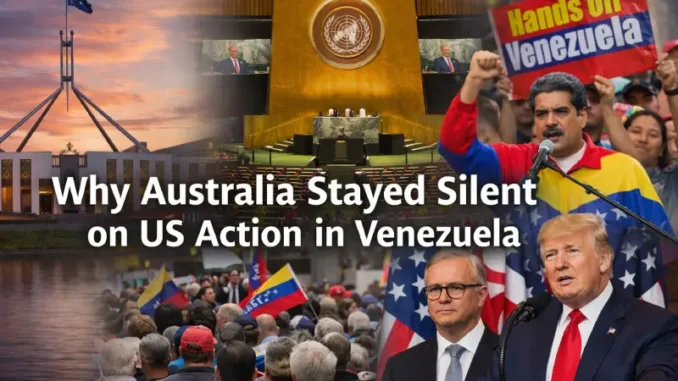
Australia’s response to US intervention in Venezuela raises serious questions about sovereignty, international law, and political courage.
Introduction
The Australia response to US intervention in Venezuela was cautious, restrained, and carefully worded. While the United States openly spoke about taking control of another country’s political future, Australia chose not to condemn the action. For many Australians, this raises an uncomfortable question.
This matters because US intervention in Venezuela sets a precedent for how powerful allies bypass international law while expecting silence from partners like Australia. If Australia claims to support a rule-based international order, why does it fall silent when a powerful ally breaches it?
Context box:
Under the UN Charter, sovereign equality and non-intervention are core principles. These rules are meant to apply to all nations, large or small.
This is not an abstract legal debate. It goes to the heart of whether international law still matters, and whether Australia has an independent foreign policy voice or merely echoes its most powerful partner.
The Problem
US intervention in Venezuela and the assertion of control
The trigger was a public statement by Donald Trump, who said the United States would run Venezuela until a safe and proper transition could occur. The problem begins with how the US intervention in Venezuela was framed, justified, and left largely unchallenged by allied governments. This was not diplomatic language. It was an assertion of authority over a sovereign state.
At the time, Venezuela had a sitting president, Nicolás Maduro. His legitimacy was contested, but under international law, governance disputes do not allow external powers to impose control. There was no UN Security Council mandate, no international trusteeship, and no lawful basis for administering another country.
Australia’s reluctance to name the breach
Australia responded by urging restraint and dialogue, while avoiding any direct criticism of the United States. Statements from the Australian Department of Foreign Affairs and Trade focused on stability rather than legality.
This creates a clear problem. When breaches go unnamed, norms weaken. Silence becomes precedent.
The Impact
Erosion of international law credibility
The US attack on Venezuela international law debate is not about defending any one government. It is about defending rules that prevent powerful nations from deciding the fate of weaker ones. When allies ignore these rules, enforcement becomes selective.
The consequences of US intervention in Venezuela extend beyond Latin America, weakening global respect for sovereignty and law.
Australia regularly invokes international law when condemning adversaries. When it does not apply the same standards to friends, credibility suffers.
Who benefits from silence
Silence benefits powerful states that wish to act without constraint. It also benefits political leaders who want alliance comfort without accountability. Ordinary Venezuelans do not benefit, and neither do Australians, who rely on international law to protect smaller nations.
The Solution
Reclaiming Australia’s foreign policy sovereignty
Australia’s foreign policy sovereignty does not require hostility toward allies. It requires consistency. Australia can support diplomacy while also saying clearly that external control and regime change violate international law.
A genuinely independent foreign policy would acknowledge that alliances do not override legal obligations.
Using Australia’s monetary sovereignty for peace
Australia has full monetary sovereignty. It is never financially constrained from investing in diplomacy, humanitarian aid, and multilateral institutions. Instead of reflexively aligning with military power, Australia could invest public funds in conflict prevention, mediation, and UN-led solutions that respect self-determination.
FAQs
Did the US intervention in Venezuela violate international law?
Many legal scholars argue yes. Without UN Security Council authorisation, threats or actions aimed at controlling another country breach the UN Charter prohibition on intervention.
What was Australia’s response to US intervention in Venezuela?
Australia urged restraint and dialogue but did not condemn the US action or describe it as unlawful.
Why does Australia avoid criticising the United States?
Alliance dependence, political risk, and fear of diplomatic fallout all play a role.
Does international law still matter if it is not enforced?
It weakens when applied selectively, but it is still essential for protecting smaller nations.
Final Thoughts
Australia’s response to the US intervention in Venezuela reveals a deeper issue than a single foreign policy episode. It shows how easily principles are set aside when powerful allies are involved. If US intervention in Venezuela is normalised, international law becomes optional rather than binding. If Australia wants international law to matter, it must defend it consistently, not selectively.
What’s Your Experience
Do you believe Australia should speak more clearly when allies breach international law, even if it risks political discomfort?
Call to Action: Make Your Voice Count
If this article helped you better understand how Australia really works, do not leave it here. Please share it with others who are asking the same questions.
Your voice matters. Your experience matters. And your participation matters.
➡ Share this article with family, friends, and your community
➡ Leave a comment below and join the discussion
➡ Visit the Reader Feedback page and tell us your view
➡ Share a testimonial if our content has helped you think differently
➡ Connect with us on TikTok, LinkedIn and X
Discuss this article in our Facebook group, where Australians share perspectives and ask questions in a calm, respectful space.
A more informed Australia starts with people willing to talk about the issues that shape our future. You can help lead that change.
Support independent journalism
Running this site costs around $2000 a year, and reader donations have helped cover $807 so far. Every contribution helps keep this work online, accessible, and independent.
If you find value in these articles, please consider supporting the site. Even a few dollars help keep this work going.
Donate now, one time or monthly.
Already donated? A quick Google review helps others discover the site.
This article was originally published on Social Justice Australia
Keep Independent Journalism Alive – Support The AIMN
Dear Reader,
Since 2013, The Australian Independent Media Network has been a fearless voice for truth, giving public interest journalists a platform to hold power to account. From expert analysis on national and global events to uncovering issues that matter to you, we’re here because of your support.
Running an independent site isn’t cheap, and rising costs mean we need you now more than ever. Your donation – big or small – keeps our servers humming, our writers digging, and our stories free for all.
Join our community of truth-seekers. Donate via PayPal or credit card via the button below, or bank transfer [BSB: 062500; A/c no: 10495969] and help us keep shining a light.
With gratitude, The AIMN Team



“…Under the UN Charter, sovereign equality and non-intervention are core principles. These rules are meant to apply to all nations, large or small…”
USA is a signatory to the UN Charter. So is Australia. USA has ignored its responsibility as a UN member nation by invading Venezuelan sovereign territory and illegally kidnapping Venezuelan President Maduro. USA is therefor not a nation fit for continuing UN membership. Australia has also ignored its UN membership obligations by not condemning USA for its egregious actions. Australia is therefor similarly unfit for continued UN membership. The standard that USA plays by is not the standard that Australians wish to be allied with. Hence Australia should withdraw from the (worthless) ANZUS and AUKUS agreements forthwith. Remember the adage: the crime that you observe and ignore is the standard by which you are to be judged.
Thanks for raising important questions, Denis.
The EU, UK and Australia’s responses have been pathetic, self-serving and subservient to the USA.
To quote Denis, “Australia’s foreign policy sovereignty does not require hostility toward allies. It requires consistency. Australia can support diplomacy while also saying clearly that external control and regime change violate international law.”
The Albanese government has trashed international law in regard to Israel’s genocide of the Palestinians and ‘Western’ countries. It has failed to even point out any time the USA breached international law, far from it, it has at times given full support; as Kerri would put it, done a Chester.
“International Law” is only a concept, it has never been fully implemented or enforced.
There was a time years ago when pirates when caught were hung until dead, sadly, today, Australia and many other countries fawn at the feet of the worlds number one pirate.