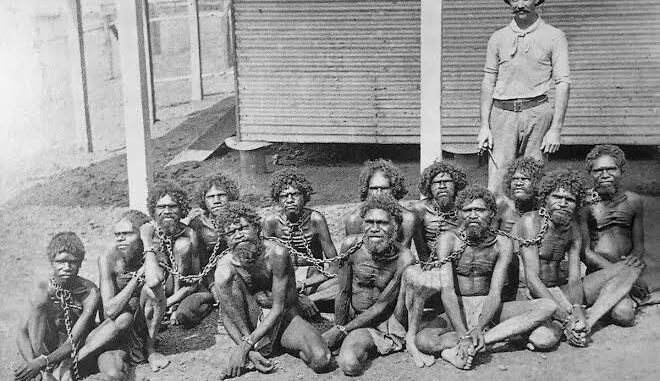
“He was naturally suspicious of white strangers, having spent twenty-seven months in prison for actions would not have been ‘crime’ had a white man committed them.” (In the spirit of Crazy Horse, page xxxix).
“The year 1988 was a pivotal moment for a lot of us blackfellas. We had some sense of what had happened to ourselves, as a people, before that year. But what did I know up to that point? My lifestyle, my drinking, having been thrown into jail. I’s been taken from my parents, who, like me, had been denied access to culture, who’d been beaten by police and thrown into jail for no good reason.” (Tell me why, Archie Roach, Page 200)
“In 1956, survivor Jack Kruger was sent to St Eugene School ages 6. A police officer and a priest arrived at his home and took him to the train station. The journey was more than 300 miles. He was put on a cattle truck, ‘stuffed like sardines’ with other children.
He was at the school for three years, but the abuse he suffered and witnessed remains with him.
‘When you’re a little boy, you couldn’t do nothing. You couldn’t say nothing. The priests had so much damned power. It’s incredible.’ he said.
He was beaten for speaking his language.
‘I lost my language for 40 years because they told me it was the devil’s tongue. I was brainwashed’. (The Guardian, 6 September 2021: ‘Cultural genocide’: the shameful history of Canada’s residential schools – mapped.)
In Canada, indigenous people represent about 5% of the total population, while the imprisonment rate is around 30%.
In the United States, Native Americans make up less than 2% of the total population yet are imprisoned in state and federal prisons at a rate of about 763 per 100,000 people, more than double the overall imprisonment rate.
Australian First Nations people represent about 3.8% of the population and around 37% of the total prison population.
Current statistics on Maori proportion in prison populations in New Zealand show that they account for 52.6% of all prisoners, and Maori women make up over 63% of the female prison population while representing 20% of the total population of New Zealand.
Four colonisations, four regions where European settlers settled on lands which had been occupied by indigenous people for countless generations. Four people considered somehow not worthy of remaining on lands claimed by ‘better people’, somehow more worthy. Some would say, four holocausts perpetuated by Christian invaders.
And in each the indigenous people were pushed aside, branded as uncivilised, warriors, thieves, criminals while the civilised colonisers stole their lands, raped their women, killed those who stood in there way, imprisoned as those who killed their livestock while teaching the virtues of a Christian ethos, a more civilised way to live.
I met a ‘new’ neighbour, recently moved into a house on the next corner, who had a police car in the drive last week. I asked the young man about that police visit. There had been a break in, a couple of young aboriginal boys had been detained. The neighbour expressed no sense of surprise, what else would one expect?
But no one dares ask WHY?
Indigenous criminality has been a defining aspect of colonisation.
Trying to find why this is so is buried deeply in the colonisers versions of history, a version of history which presents the coloniser as entitled to the stolen lands, a right because the indigenous people were not using the land in an economically ‘viable’ manner. Or more often than not, just because they could.
Looking at the situation in Australia, but realising that it is probably the worst example of criminalising the first nations people, we see that in the Northern Territory children as young as 10 are deemed to be criminally responsible for their actions despite their brains and intelligence still being that of children. Nearly 90% of people imprisoned in the Northern Territory are first nations people, yet make up about 3.3% of the population.
Similarly in Queensland, indigenous people are imprisoned at a rate 11 to 14 tomes that of the rest of the population.
Youth detention rates are a harder reality, where First Nations people in youth detention is 27 times that of the rest of the population.
Similar statistics are in each of the other states, Indigenous populations are a smaller representation of the total population, but incarceration rates are far greater than for the rest of the population.
Recidivism rates are higher than other populations.
Is it because First Nations people are more criminally disposed or are there possibly other factors involved?
Social disadvantage is a major factor in the criminalisation of indigenous peoples, here and throughout the colonised world. In part because of poorer education outcomes, which lead to less employment opportunities, but also underlying cultural differences, and dare it be suggested that perhaps there is a bit of racial profiling in policing?
These same disparities are in most post colonial environments, in Canada, USA and New Zealand. The dominant colonisers culture sets the standard by which all are ‘judged’, measured, considered. And that goes back in time. Nothing, not the best of intentions seems to change that.
European, post enlightenment, post industrial thinking develops a culture of superiority, that the ‘enlightened’ way is the proper way, the only way civilised people should live. In Empires of Violence, the historian Sue Peabody is quoted where she argues that ideas of racial difference are best understood as embedded in the social and economic relations in which they occur, and that in considering the post colonial world we live in, the standards set, in relation to dealing with indigenous peoples, is that the social and economic relations are determined by the majority culture, and a failure to see indigenous cultures as ‘civilised’, or suited to today’s social and economic environment. The dominant culture in the post colonial world came through the philosophies of the enlightenment which was a cornerstone of the emerging industrialised world we now inhabit, the bedrock of capitalism.
That is a far cry from the basis of the indigenous cultures of the pre-colonised worlds where private ownership of land and property were alien concepts, rather the societies were very much communal, sharing economies, cultures which an understanding that the land they inhabited was their ‘mother earth’, the giver and sustainer of life, as opposed to the colonisers view that the land was a resource to be exploited for the generation of wealth.
Through the ‘civilised’ eyes of the enlightenment, the rise of European, and that includes a Christian world view, emerged a thinking that:
‘…the peoples of the world were divided into three categories: those who were waiting for Europeans to appear to, learn from their example; those who needed to be delivered from oppression; and those ‘savages’ who were beyond help, and who would eventually disappear.’ (Empires of Violence, Page 24)
That same sense of superiority, ‘Enlightenment thinking’, justified slavery and colonialism and expressed views toward ‘others’, including Jews, Africans, gypsies and Arabs which has led to, and continues today, to foster hatred and violence against those deemed somehow less than the ‘civilised’ ruling classes of the western world, including here in Australia. The underlying ‘Christian’ ethos discriminates against other religions, currently Islam is the flavour of the month, other times, Judaism, and soon there will be another ‘other’ to hate.
At times there was, and it sort of continues today, a paternalistic manner as expressed by the then Federal Minster, John Forrest in 1907, responding to the neck chaining of detained Aboriginal people, detained for ‘stealing cattle’ when their traditional food sources had been stolen from them, asserted:
‘There is no inhumanity. I will undertake today that in no other country are the Aborigines better looked after than in West Australia. Every policeman, and every justice is a protector of aborigines. I would be the last to sanction anything in the nature of cruelty, but as one who understands the circumstances I have no hesitation in saying a great fuss is being made about very little.’ (Every Mother’s Son Is Guilty, Page 429)
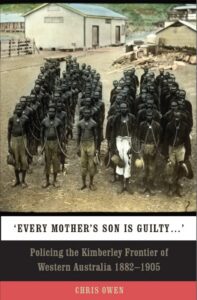
Today, we can clutch our pearls and look with paternalistic pride at the attempts to be more humane toward our first nations peoples, as we partake in welcome to country ceremonies and pat ourselves on the back for at least attempting to ‘Close the Gap’, even though the year on year review of those policies show barely a sign of actually closing the gap, which probably means making the lives of first nations people a little more like that of the rest of Australians, the ‘immigrants’ who have arrived since 1788 is not really working very well. They remain disadvantaged, remain ’criminalised’.
The gap has not closed much, especially when we view the rates of incarceration of First Nations peoples, starting with he very youngest who can be described as ‘criminally responsible’ and that the recidivism rate is high because we continue to send these young ‘offenders’ to the universities of crime… and keep building more and more to accommodate the ever growing number of criminals, where in other parts of the world prisons are being closed and people who fall between the cracks are given a hand up with suspended sentences for the minor crimes offended, and while on that suspended sentence given the counselling and mental health support they need to fit somehow better into contemporary societies. (A main advantage is that on a suspended sentence, people do not lose their jobs, do not become isolated fro their communities, are given a realistic chance at rehabilitation. The conditions of the suspended sentence include a commitment to the support facilities, the counselling, mental health services and others be adhered to.)
For First Nations peoples, that may well include an introduction into their cultures, with the help of tribal elders, to take young offenders to ‘country’ to go through the understandings of their cultures, since so much offending is the result of neither fitting into the traditional culture, nor accepted as part of the mainstream, western culture, living in a cultural desert, not fitting in either. And therefore not able to take pride in being who they are.
The denial of even considering indigenous ways of living as ‘cultural’ is an endemic part of colonialism. One of Australia’s great explorers, John McDougall Stuart wrote in his journal that the lonely flag he had planted on a hill he thought was the centre of Australia was:
“… a sign to the natives that the dawn of liberty, civilisation and Christianity was about to break upon them. It happened much as Stuart predicted. Soon to come were pastoralists and their thousands of cattle, missionaries with their gospels and psalms, government officials, educators, judges, law enforcers….” (Return to Uluru, Page 7)
In each of the colonised countries referenced earlier, it almost seems that there were no laws which governed how the indigenous peoples lived, yet in each of the texts referenced it is clear that there were laws, these people were far from savages, in fact, reading history from ‘the other side’, the perspective of those being displaced, the term ‘savages’ may be a more appropriate term for the colonisers.
Robert Macklin’s book Castaway, the story of a French cabin boy abandoned in nineteenth century Australia, and adopted by an aboriginal tribe in North Queensland tells of the humanity of those ‘savages’ and describes how laws including marriage, communal life and territorial rights worked. And poignantly, how well those communities functioned until they were disrupted by the onset of ‘civilisation’.
Yes there were conflicts both within and between communities, tribes, first nations, but there were rules which governed the way conflicts were resolved, there were punishments, and there were communications between the differing sides, but mostly, as in ‘civilised’ societies, the rules order ruled.
Sadly we see the same colonial games being played in the Israel/Palestine conflict. Cultural superiority, God’s chosen, just as Manifest Destiny in 1800’s America, just as the dispossession of Australia’s First Nations people, or the ignoring of any presumed treaty as in the treatment of Maoris in New Zealand, there are a set of laws the colonisers impose, there is the cultural erasure which may otherwise suggest that the ‘savages’ were actually law abiding, peaceful community minded people who did not suffer the avarice of personal ownership to define ‘civilisation’.
Recent law changes in Israel/Palestine formalise the discrimination based on ethnicity, which severe punishments for Palestinians, but merely making it law that Palestinians are criminal, by being Palestinians living on lands the Israelis claim as their god given lands.
Some attempts are being made to recognise the inhumanity being perpetrated on the Bedouin and Palestinians on the West Bank with bans on buying stuff from Israeli settlers, but at the same time, the supply of arms to Israel continues unabated, and a blind eye is turned to the violence against them by Israeli settlers, using guns against stone throwing Palestinians. Bulldozing villages to make way for new Israeli settlements, the destruction of olive groves denying an income to the farmers who harvest the crops. Or the plans to force the migration of Palestinians in Gaza to other Muslim countries in Africa or anywhere else really, who gives a damn where, so long as they are not anywhere near Gaza with hardly a sound of objection from the ‘civilised’ world.
In that sense, Palestinians are the new indigenous, the new aboriginals, the new ‘savages’ being replaced by the ‘civilised’ colonisers. And as in all the colonised lands, the indigenous are among the poorest, the most disadvantaged, the most scorned, the most imprisoned of the populations.
An interesting aside: The 2012 Ig Nobel prize for economics went to researchers who found that ‘Upper class people were more likely to break the law while driving, lie in greater for negotiations, cheat to win a prize and take lollies meant for children.’
Criminal?
Nah, just don’t look ‘criminal’ enough.
Keep Independent Journalism Alive – Support The AIMN
Dear Reader,
Since 2013, The Australian Independent Media Network has been a fearless independent voice – holding power to account and delivering journalism that matters.
Running this site isn’t cheap. Rising costs mean we need your support now more than ever. Every donation, big or small, keeps our servers running, our writers working, and our stories free for everyone.
Donate here:
PayPal or credit card – just click on the Donate button below
Direct bank transfer: BSB: 062500; A/c no: 10495969

We’ve also set up a GoFundMe as a dedicated reserve fund for hosting and future improvements.

Thank you for standing with us. We couldn’t do this without you.
With gratitude,
The AIMN Team

Thank you Bert for a very sensitive article.
It appears that Australia can pay out huge money to ”protect” ZION@ZIS not prepared to move to Isrevil, but insuring that Commonwealth funding for NT Aboriginal projects can ”vanish” into the posh North Darwin suburbs is impossible.
It appears that Australian political parties are prepared to accept deliberate genocide polices of land clearing by military bombardment, that includes the indiscriminate assassination of Indigenous Palestinian landowners so that the ”better people” may again ”steal” the lands from survivors at the point of a ZION@ZI terrorist gun, just as happened in the 1948 Nakba.
A European Holocaust 1933-1945 is totally unacceptable, however, in the 21st century the Palestinian Holocaust is acceptable because the ZION@ZIS are ”better people” who deserve to live wherever they desire to practice their misogynistic religious practices.
These are the amoral costs of our Australian governments being a self-important, self-appointed Deputy Dawg to the USA (Undemocratic Sewer of Apartheid) as directed by the ZION@ZI infiltrated US State & Defence Departments.
In contrast, the Belt & Road strategy promoted by PRC China looks much more positive and could even provide long overdue public infrastructure projects like High Speed Railway between Melbourne and Brisbane.
“A European Holocaust 1933-1945 is totally unacceptable, however, in the 21st century the Palestinian Holocaust is acceptable because the ZION@ZIS are ”better people”
NEC has hit the nail right on the head.
Sony Thang writes of The Holocaust —
racial categorization, systematic dehumanization, organized mass killing, bureaucratic record-keeping of the dead, did not originate in 1933.
It had been practiced for four hundred years on every other continent.
The scholars who have written this most clearly, Aimé Césaire, Frantz Fanon, Hannah Arendt herself, have documented the line:
What Europe did to the rest of the world, it eventually did to itself.
The techniques perfected in the colonies came home.
The Holocaust was not an interruption of Western civilization. It was Western civilization encountering, for the first time, what Western civilization had been doing to everyone else.
The difference was the victims were European.
That is the only thing that made it, in European memory, unforgivable.
And so we see that because the Palestinians are not white, Western Civilisation forgets and forgives the Gaza genocide, even as it appears each night in our living rooms.
The Zionists have detected this flaw in Western thinking, in Western morality, in Western values, and are exploiting it to the full.
Thank you Bert for your well chosen words supported by incontestable references. As I began reading I initially thought “Bert may be either timid or reluctant to include the obvious current genocide being conducted by Israel”. I should have known better – Bert does not step around the truth.
@ Steve: Thank you for your kind words.
Your Sony Thang quote says it all; however repeating the same strategy and expecting a different outcome is silliness.