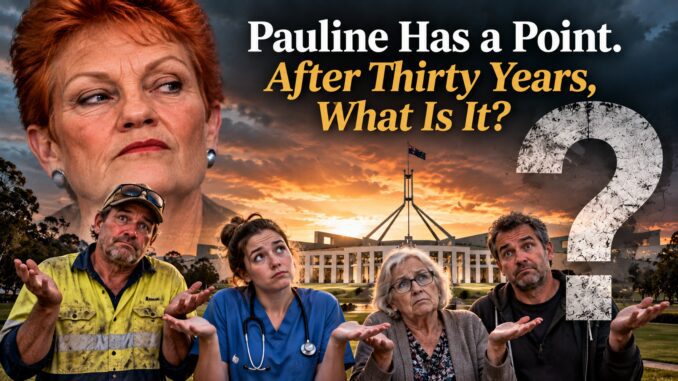
One Nation says it stands up for ordinary Australians against the powerful. After thirty years, it’s reasonable to examine its promises, its record, its supporters – and who benefits.
Australians have plenty of reasons to be angry.
Housing is beyond the reach of many young families. Groceries, electricity, insurance and healthcare swallow more of the household budget. People approaching retirement wonder whether their savings will last.
Australians work hard, pay their taxes and hear politicians announce that the economy is doing well.
Doing well for whom?
So when Pauline Hanson says ordinary Australians have been forgotten by politicians who don’t understand their lives, it’s hardly surprising that people listen.
Perhaps she has a point.
But identifying a problem and solving it are two different things.
Hanson first entered federal Parliament in 1996. Thirty years later, she’s still challenging governments, criticising the establishment and promising to stand up for ordinary Australians.
Remaining politically relevant for that long is an achievement.
But political survival isn’t the same as improving people’s lives.
What has One Nation actually achieved? Would its policies make your household better off? And who benefits when the party succeeds?
Start with the household budget
Imagine a family with two working parents, a mortgage, children and bills rising faster than their wages.
They don’t need another political argument. They need practical relief.
One Nation promises cheaper housing, lower living costs and protection for Australian jobs.
Its housing proposals include reducing immigration, restricting foreign property ownership and temporarily removing GST from building materials for new homes.
Those ideas deserve examination.
Population growth increases housing demand. But Australia’s housing problems also reflect decades of inadequate construction, planning decisions, infrastructure shortages, taxation arrangements and rising building costs.
Reducing immigration might ease some pressure. It won’t automatically create affordable homes where people need them.
Removing GST from building materials could reduce construction costs, but the savings won’t necessarily be passed on to homebuyers.
A policy can sound attractive without delivering the promised result.
The test is what it achieves, how much it costs and who receives the benefit.
And that test should apply to every political party.
What happened to the workers?
In November 2020, the Morrison government was seeking to pass JobMaker, a scheme offering businesses subsidies for hiring unemployed younger workers.
There was a concern that employers might replace existing older employees with younger workers whose wages attracted a government subsidy.
One Nation initially supported safeguards intended to prevent that happening.
The following day, after discussions with Treasurer Josh Frydenberg, One Nation reversed its position and voted against retaining those safeguards.
Hanson said she’d received further advice and had been misled about the amendments. The government argued that existing workplace laws and the scheme’s eligibility requirements already provided protections.
Politicians should be willing to reconsider their positions when presented with better information. Changing your mind isn’t necessarily a weakness.
But the reversal deserves examination.
The additional safeguards were intended to protect existing workers. Once One Nation withdrew its support, those particular protections did not proceed.
This wasn’t the only occasion when One Nation changed its position on measures affecting working Australians. Rather than catalogue every instance, this example illustrates why parliamentary decisions matter.
When a party changes its position on workers’ protections, voters deserve to understand what changed – and why.
Small businesses face genuine financial pressures. So do their employees.
Reducing an employer’s costs by reducing a worker’s income or security doesn’t necessarily make working Australians better off.
It may simply transfer the financial pressure from one Australian to another.
The billionaire backing the outsider
Hanson has built much of her political identity around challenging powerful interests and standing up for ordinary Australians.
Which makes her relationship with Gina Rinehart particularly interesting.
In 2025, Hanson travelled to the United States aboard Rinehart’s private aircraft.
In April 2026, ABC News reported that a Rinehart-associated company donated a new aircraft to One Nation. The model was advertised at approximately $1.3 million.
Other wealthy supporters announced a further $2 million in donations.
There’s nothing inherently improper about wealthy Australians supporting political parties. They have the same political rights as everyone else.
Nor does a donation prove that a politician is controlled by the donor.
But the relationship goes beyond financial support.
In June 2026, Hanson publicly acknowledged seeking policy advice from Rinehart.
She cited a proposal allowing pensioners to work without losing their pension or healthcare card as an example of advice she’d received.
That proposal might appeal to many older Australians. Its merits should be judged on their own terms.
But the disclosure demonstrates why it’s worth understanding who has access to political decision-makers.
When some of Australia’s wealthiest people provide substantial support and policy advice to a party representing ordinary Australians, how do voters determine whose interests are being advanced?
The answer lies in examining the policies.
Take Australia’s natural gas resources.
Hanson argues that Australians should receive a fairer return from the resources they own.
That’s a worthwhile objective.
But in May 2026, One Nation proposed replacing the Petroleum Resource Rent Tax on new gas projects with a production royalty, alongside exploration incentives and opportunities for government investment.
The proposal would expose taxpayers to some investment risks while offering the possibility of future returns.
Hanson argued it would encourage production and provide more predictable revenue. She did not provide a comparative revenue forecast when announcing it.
Whether the proposal would deliver a better return to Australians is therefore an important question for independent assessment.
A mining billionaire and an ordinary wage earner can share political interests.
But their economic interests aren’t always identical.
When those interests differ, the details of government policy matter enormously.
Pauline, please explain the shed
One Nation regularly demands accountability from other politicians over their use of public money.
Fair enough.
But the same standards should apply to One Nation.
In September 2026, The Guardian reported that $56,000 in party funds had been used for a shed on property privately owned by James Ashby, a senior party figure.
One Nation subsequently explained that it had approved a loan to Small Batch Brewing, a proposed micro-distillery business, to help establish a future source of party revenue.
The company was privately owned in equal shares by Hanson, Ashby and a former party treasurer, rather than by One Nation itself.
The party said the arrangement would avoid commercial rental costs and could generate substantial future licensing income.
That’s an explanation worth considering.
But it also raises reasonable questions.
What were the loan terms? How was the party’s money protected? Who owns the improvements to the property? What happens if the business fails? And who ultimately receives any profits?
None of the reported arrangement, by itself, establishes unlawful conduct.
There is also a separate, documented issue involving electoral funding.
In 2021, following a review of One Nation’s 2019 election funding claim, the Australian Electoral Commission accepted an enforceable undertaking from Hanson as the party’s registered agent.
The undertaking concerned record-keeping and claims involving expenditure that was ineligible or had not been incurred.
An enforceable undertaking is not a criminal conviction. That distinction matters.
So does accountability.
If One Nation expects Australians to scrutinise the finances of other political parties, its own supporters deserve the information necessary to apply the same standard.
From Queensland to Mar-a-Lago
Hanson’s political relationships extend well beyond Australia.
In November 2025, she addressed a conservative gathering at Donald Trump’s Mar-a-Lago resort, praising Trump’s leadership and outlining One Nation’s political agenda.
In July 2026, she appeared at CPAC in London, where Nigel Farage also spoke.
These relationships don’t establish that One Nation takes instructions from overseas.
But there are similarities in their political approaches.
Trump, Farage and Hanson all present themselves as outsiders challenging an establishment that has forgotten ordinary people.
Immigration, national identity and distrust of established institutions feature prominently in their messages.
Controversy also plays an important role.
A provocative statement generates outrage. Critics respond. Supporters rally. The argument spreads across television, newspapers and social media.
Sometimes the politician doubles down. Sometimes there’s a clarification or apology.
Then another controversy begins.
It’s a pattern we’ve satirically called:
GRIFTING → REGRIFTING → UNGRIFTING.
That doesn’t establish that every controversy is deliberately manufactured or that every change of position is insincere.
But it highlights an important distinction between attracting attention and delivering results.
Outrage can generate publicity, followers, donations and political support.
It doesn’t necessarily reduce anyone’s rent, mortgage or electricity bill.
A politician can be very successful at representing your anger without being particularly successful at representing your interests.
Thirty years. What are the results?
One Nation has never formed a federal government.
That matters. Hanson cannot fairly be held responsible for every failure of governments she hasn’t controlled.
Minor parties also have limited power to implement their own policies.
But they still make decisions.
They support legislation, oppose amendments, negotiate with governments and choose which issues to prioritise.
Those decisions form a record that voters can examine.
Sometimes One Nation has opposed legislation criticised by unions or supported measures intended to help workers. Those decisions deserve acknowledgement.
Other decisions, including the JobMaker reversal, invite closer examination.
The point isn’t to assume every decision was wrong.
It’s to examine the evidence, understand the alternatives and assess the consequences.
A party that asks Australians to judge the major parties by their records should welcome the same scrutiny of its own.
The argument that never pays the bills
Imagine two Australians who agree that housing is too expensive.
One blames immigration. The other blames property investors, developers and government policy.
They spend an afternoon arguing online.
By evening, neither has a cheaper home.
The argument might generate thousands of views, hundreds of comments and another day’s publicity for the politicians involved.
But the original problem remains.
Political disagreement is inevitable. It’s also necessary in a democracy.
But disagreement should help us examine competing explanations and identify better solutions.
If a politician promises cheaper electricity, we should understand how the policy will reduce prices.
If they promise higher wages, we should examine how those increases will be achieved.
If they promise affordable housing, we should know what will be built, where and at what cost.
And if they promise to challenge powerful interests, we should examine which interests their policies actually benefit.
These aren’t unreasonable demands.
They’re the questions that turn political promises into decisions voters can properly evaluate.
Pauline, please explain
You don’t have to dislike Pauline Hanson to ask these questions.
You don’t have to support Labor, the Liberals, the Nationals or the Greens.
And you don’t have to abandon your concerns about immigration, housing, employment or the cost of living.
Those concerns deserve to be taken seriously.
But so do the answers.
Examine the promises, the parliamentary record, the financial relationships and the consequences. Apply the same standards to every political party.
What you make of the evidence, and how you choose to vote, is entirely up to you, dear reader.
It always has been.
As for me, I first took notice of Pauline Hanson thirty years ago. I formed an opinion of her then that was hardly flattering. I saw a toxic grifter, someone whose politics appealed to what I considered the ugliest, angriest and nastiest aspects of Australian society.
That’s a personal judgement, and a harsh one. I don’t pretend otherwise.
But I’ve watched her political career over the subsequent thirty years, and I’ve found remarkably little to persuade me to revise that initial assessment.
There’s an old observation, often attributed to Maya Angelou: “When someone shows you who they are, believe them the first time.”
Thirty years is a long time to watch.
But that’s my assessment, not an instruction to you.
I’ve told you what I think. The evidence is there for you to examine.
What you conclude is entirely your business.
It always has been.
Check the evidence
The hyperlinks throughout this article lead to contemporary reporting, parliamentary voting records and official documents. Readers can also examine the underlying records directly:
- Australian Parliament — Hansard
- They Vote For You — Pauline Hanson’s 2020 divisions
- Australian Electoral Commission — Enforceable undertakings
- Australian Electoral Commission — Political funding disclosures
- One Nation — Official policies
Keep Independent Journalism Alive – Support The AIMN
Dear Reader,
Since 2013, The Australian Independent Media Network has been a fearless independent voice – holding power to account and delivering journalism that matters.
Running this site isn’t cheap. Rising costs mean we need your support now more than ever. Every donation, big or small, keeps our servers running, our writers working, and our stories free for everyone.
Donate here:
PayPal or credit card – just click on the Donate button below
Direct bank transfer: BSB: 062500; A/c no: 10495969

We’ve also set up a GoFundMe as a dedicated reserve fund for hosting and future improvements.

Thank you for standing with us. We couldn’t do this without you.
With gratitude,
The AIMN Team

How can you be sure it’s a point? I thought it was a pimple, or, perhaps, a wart.
if only there were a cream for that…