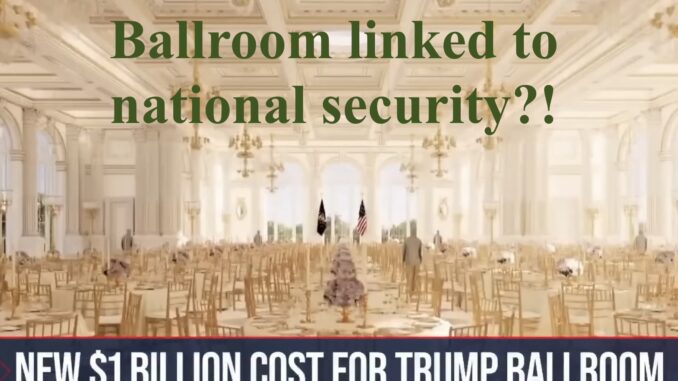
When I first heard that a new ballroom at the White House was being discussed in the language of “national security,” I assumed it was satire.
Surely no serious political figure would attempt to convince the public that the security of the United States depended upon improved seating capacity for formal dinners and ceremonial events.
Yet there it was: repeated solemnly, defended vigorously, and echoed by politicians who appeared determined to speak from the same script.
Apparently, the Republic now hinges upon chandeliers.
To be fair, there’s a practical case for a proper event space. Hosting hundreds of world leaders with adequate security is logistically nightmarish when you’re relying on glorified party tents. A permanent ballroom would make state dinners smoother and probably save on marquee rental fees.
But there is a vast difference between “useful” and “essential to national security.”
Modern national security rests upon military readiness, intelligence capabilities, cyber defence, energy resilience, economic stability, alliances, logistics, and technological infrastructure. It does not rise or fall according to whether visiting dignitaries dine beneath a permanent ceiling or a temporary tent.
That distinction matters.
Healthy political cultures rely upon proportion. They distinguish between necessity and prestige, between strategic infrastructure and symbolic architecture. Once every luxury, ceremony, or vanity project is elevated into the realm of existential importance, public language itself begins to lose meaning.
And that is perhaps the most bewildering aspect of the ballroom debate: not the proposal itself, but the language surrounding it.
A ballroom is not merely being presented as desirable or impressive, but as somehow intertwined with the security of the nation itself. Future historians may one day solemnly discuss “the Great Chandelier Gap” that nearly cost America its superpower status. I can already picture the documentaries: grainy footage of diplomats awkwardly mingling while a tent flap flaps dramatically in the background, narrated in that deep, concerned voice.
What makes the spectacle especially fascinating is the uniformity with which the justification has been repeated. Critics see the argument as plainly absurd, while supporters repeat it with unwavering seriousness. It is less a policy debate than a demonstration of modern political message discipline.
The episode reveals something larger about contemporary politics, particularly in the age of image-driven leadership. Increasingly, symbolism is treated as substance. Grand settings become manifestations of power. Spectacle becomes leadership. Architectural prestige becomes national strength.
In such an environment, questioning the necessity of a ballroom can be framed almost as questioning patriotism itself.
From an Australian perspective, the entire discussion carries a faint air of imperial theatre. While ordinary people worry about housing costs, healthcare, economic instability, the rising anxieties of daily life and whether the next war will involve them, Washington is earnestly debating whether civilisation itself requires better buffet circulation. Political figures earnestly discuss ceremonial infrastructure in the language of strategic defence. One imagines Churchill and Roosevelt trying not to laugh while arguing over whether the Atlantic Charter needed better table spacing.
One suspects that previous generations, confronting world wars and economic depressions, may have struggled to keep straight faces.
Still, perhaps this is simply the modern condition: a political age in which appearances must constantly be inflated into destiny, and where even a ballroom must be wrapped in the rhetoric of national survival.
Or perhaps the rest of us are simply expected to nod gravely and accept that civilisation itself now depends upon adequate buffet circulation.
So, my American friends. Sleep soundly tonight. The chandeliers are coming. The Republic is saved.
Keep Independent Journalism Alive – Support The AIMN
Dear Reader,
Since 2013, The Australian Independent Media Network has been a fearless voice for truth, giving public interest journalists a platform to hold power to account. From expert analysis on national and global events to uncovering issues that matter to you, we’re here because of your support.
Running an independent site isn’t cheap, and rising costs mean we need you now more than ever. Your donation – big or small – keeps our servers humming, our writers digging, and our stories free for all.
Join our community of truth-seekers. Please consider donating now via:
PayPal or credit card – just click on the Donate button below
Direct bank transfer: BSB: 062500; A/c no: 10495969

We’ve also set up a GoFundMe as a dedicated reserve fund to help secure the future of our site.
Your support will go directly toward covering essential costs like web hosting renewals and helping us bring new features to life. Every contribution, no matter the size, helps us keep improving and growing.

Thank you for standing with us – we truly couldn’t do this without you.
With gratitude, The AIMN Team

It isn’t the ballroom….it’s the bunker UNDER the ballroom:
https://www.businessinsider.com/white-house-bunker-presidents-history?op=1
The vile, vacant, insane, infirm, insolent Trump, wants a piece of the White House that is HIS. Ego, vanity, swollen onanistic selfishness…HIS, HIS, ME, ME, Mt. Rushmore…
Yes, I’m aware of that, Michael. But I’m talking about the ballroom, not the bunker.
You might recall there was already a bunker on the very spot Trump wants his ballroom – the East Wing – but he destroyed it.
If the bunker is so important he would have kept the one already there. That indicates to me that it’s the ballroom he’s after, and the bunker is just an excuse.
Somehow it would be difficult to have the ballroom without the bunker below. Well, not really, but in an atomic emergency, TACO Trumpery would have to move further than his failing, ageing, decrepit body may allow, and that could be fatal.
To be fair, Trump does like to do his little dance, a bit like Elaine in Seinfeld,
Perhaps he could lead a conga line of suckholes – as Mark Latham famously described his political opponents—specifically the Coalition.
@ Roswell: “…Surely no serious political figure would attempt to convince the public that the security of the United States depended upon improved seating capacity for formal dinners and ceremonial events….”
Therein lies the answer: too many politicians are distracted from their duties and responsibilities by trivia, glitz, glamour and money.