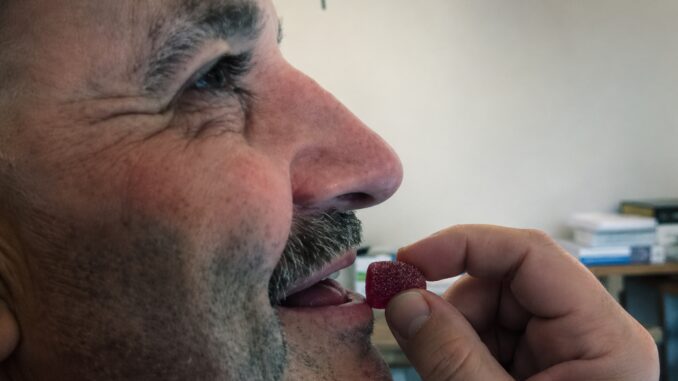
It is 11 o’clock on a Thursday morning in Ararat and I have just eaten a cannabis gummy.
I note this without apology and without the performance of transgression that such an admission apparently still requires in a country where a man of nigh on seventy-eight journeys around the sun with cardiac disease and a balance that deserts him without warning must navigate a regulatory maze designed, one suspects, less to protect him than to protect the pharmaceutical industry from the competition of a plant that has been managing human pain since before the invention of the prescription pad.
The gummy is small. It is precisely dosed. It tastes faintly of artificial raspberry and a great deal of intention. I have taken it because my pain is real, because the alternatives carry their own considerable risks, and because after nigh on seventy-eight journeys around the sun one has earned, if nothing else, the right to conduct one’s own experiments.
My wife tried one. It overwhelmed her.
This is the first interesting fact.
We are constitutionally similar people. We have lived in the same house, breathed the same air, absorbed the same shocks that a life together distributes with its characteristic mixture of tenderness and indifference. And yet the same molecule, in the same dose, produced in her a cascade of anxiety and in me something closer to the feeling of having turned down the volume on a radio that has been playing slightly too loud for years.
My wife. The phrase deserves a moment’s examination before we proceed, because it is doing preposterously hard work. The possessive. The colonial wholly-owned subsidiary of a marriage of one’s own. An echo of empire in two syllables, in which a woman is grammatically absorbed into the man who names her. Virginia Woolf understood this. So, for that matter, did every woman who ever winced at the construction while smiling politely at the man deploying it.
Let me begin again.
She is my muse, a musician and a creature of the rare and precious skill of calling bullshit on pretension. I love her deeply. She listens to my stories. She quite likes most of them. Tells me if she doesn’t. She is so enchanted by the natural world that she cannot kill a spider, and she stops dead at the sight of the fairy wrens making their nest in the pittosporum hedge. She was born in Adelaide, which is a joke with a long punchline. In the late seventies, every New Zealander who crossed the Tasman was told the same thing: go to Adelaide, and you will fall in love with Australia. Through Shay’s keen eyes, I did exactly that. She is my beloved partner, wife and companion. Her name is Shay. And the cannabis gummy, which did for me what a long slow exhale does, turned her inside out.
I have a hypothesis. It is not a medical hypothesis in the sense that a doctor would recognise. It is closer to what a historian would call a working proposition: provisional, falsifiable, useful until something better arrives.
The hypothesis is this: that the brain, like the body, has a constitutional relationship with THC that is prior to experience and largely independent of expectation. That some neurological architectures are wired to receive the molecule as a key receives a lock, and others experience it as a door being forced. That this is not a moral distinction, not a question of courage or weakness or sophistication, but simply the lottery of the synapses you were born with.
And yet.
The second hypothesis contradicts the first without cancelling it. Cannabis puts you into a state of heightened auto-suggestion. The internal monologue slows. The habitual filters that stand between experience and attention begin, not to dissolve exactly, but to become more visible, which is the next best thing. You notice that you are filtering. You notice the mechanisms. And in noticing them you are
briefly, provisionally, blessedly free of them.
This is either therapeutic or terrifying depending entirely on what the filters were protecting you from.
If what they were protecting you from is the ordinary anxiety of a highly strung temperament, the low-level hum of a nervous system that never quite believed the danger had passed, then removing the filters does not bring peace. It brings the anxiety undiluted, rushing in to fill the space the filters had been holding open. Shay’s experience, I suspect, was something like this. Not a drug experience at all,
really. A self-experience, sudden and unmediated, that the drug had made impossible to ignore.
If what the filters were protecting you from is noise, the ambient, engineered, dopamine-spiked noise of a world that has decided your attention is a commodity to be harvested, then removing the filters does something else entirely.
It gives you back the blackbirds.
I can hear them now. Three of them, minimum, in the garden that sits on top of what was once the Canton Lead, where Chinese miners sifted the gravel of western Victoria for gold they mostly did not find, and left behind a mullock heap on which I have, with some satisfaction, built my later life. The blackbirds are not performing. They are not optimised for engagement or designed to trigger a dopamine response.
They are simply making the sound that blackbirds make in the middle of a Thursday morning in Ararat because that is what blackbirds do. I had forgotten, not entirely but sufficiently, how extraordinary this is.
The magpies have joined in now. The magpie is the barrel organ of the Australian morning, a creature possessed of a voice so architecturally complex and so casually deployed that to hear it properly, without the scrim of distraction, is to understand immediately why every other sound the modern world produces is, in comparison, a form of poverty.
This is what the dopamine economy has been stealing.
Not my time, exactly. Not even my attention, exactly. Something more fundamental: the capacity to be present to what is actually happening, which turns out to be, even on an ordinary Thursday in a small Victorian town, more extraordinary than almost anything the screen has to offer.
The gummy is not the point.
The gummy is the reminder that the point exists.
The historical record
The historical record, it should be noted, has form on the subject of what cannabis does to the human mind, and the form is largely fictional.
The very word assassin carries the legend in its bones. The Nizari Ismailis, an eleventh-century Shia Muslim sect operating from mountain strongholds across Persia and Syria, were known to their enemies as the Hashashiyyin, the hashish users. The legend, as Marco Polo helpfully elaborated it in the thirteenth century, held that their leader, the Old Man of the Mountain, administered hashish to young
recruits as a foretaste of paradise, sending them forth to murder in the blissful certainty of what awaited them if they succeeded. The secular motivation of a brilliant and disciplined political organisation, its genuine tactical genius, its capacity to inspire loyalty through ideology rather than intoxication, none of this made it into Marco Polo’s version. The drug was a better story. It always is.
There is, historians now agree, no credible evidence the Nizaris used hashish at all. The term hashashiyyin was most likely a term of abuse applied by their rivals, meaning in its most contemptuous Arabic sense something closer to rabble or riffraff. The etymology survived the debunking. It always does. By the fourteenth century the word assassin had travelled through Italian and French into English, trailing its cloud of drug-fuelled menace, and there it has remained, the most durable example in the English language of a smear that outlasted the people who invented it.
Six centuries later, in 1936, a church group in the United States financed a film called Tell Your Children, subsequently released under the more market-ready title Reefer Madness, in which innocent high school students are lured into trying marijuana and promptly proceed to hit-and-run accidents, manslaughter, attempted rape, hallucinations and a rapid descent into madness. One character commits suicide. The film was intended as a morality tale for parents. It became, within a generation, a beloved comedy. The propaganda was so hysterical, the gap between its claims and anyone’s actual experience of cannabis so vast and so funny, that it achieved precisely the opposite of its purpose. It celebrated the drug it was designed to condemn and made its makers look like the maddest people in the room.
The lesson of both the assassins and Reefer Madness is the same: when you need a simple explanation for behaviour that frightens or threatens you, the drug is always available. It requires no understanding of ideology, psychology, neurology or the actual complexity of human motivation. It is the explanation that ends inquiry rather than beginning it.
The neuroscience, when it arrived properly, was considerably more interesting and considerably less convenient. What THC actually does, according to current understanding, is to stimulate cannabinoid receptors on the GABA neurons, effectively turning off the continuous inhibition of dopamine neurons. The dopamine flows. The euphoria follows, in some people, under some conditions, in some neurological architectures. In others, under different conditions, in different architectures, what flows is anxiety, fear, distrust, a sudden and unwelcome clarity about everything that has been carefully not thought about. The drug does not determine the experience. It amplifies what is already there, turning up the volume on whichever channel the brain was already quietly playing.
This is not, to be clear, the same as a dopamine hit in the attention-economy sense. The scroll, the ping, the notification, the variable-ratio reinforcement of the slot machine and the social media feed, these produce a narrow, targeted dopamine spike designed to compel repetition. The cannabis euphoria, when it arrives, is something more like a dopamine tide: a broader, slower, less directional flooding of the reward circuits that carries with it, at least in my own experience this Thursday morning in Ararat, not the compulsion to repeat the behaviour that triggered it but something closer to the capacity to stop repeating all the other behaviours that had been running on automatic.
The assassins, if they used hashish at all, were not made murderous by it. The students in Reefer Madness were not made mad by it. And I, sitting on my mullock heap listening to the magpies, am not made anything by it that I was not already, somewhere beneath the noise, waiting to be.
That is either the drug talking.
Or it is me.
The interesting question is whether, this particular Thursday morning, there is a meaningful difference.
The question
And that question, it turns out, is not as idle as it sounds.
If cannabis amplifies what is already present rather than creating something new, then what it is amplifying in me this morning is something that has been developing, with considerable difficulty and mixed results, for the better part of a decade: the attempt to detox from the dopamine economy. To rewire, in the language of the neuroplasticians, the attention circuits that a lifetime of accelerating stimulus has progressively shortened, fragmented and made increasingly dependent on the next hit to feel anything at all.
The research on neuroplasticity is genuinely hopeful, which is not something you can say about most of the research that emerges from the intersection of neuroscience and the technology industry, where the standard finding is that we are more comprehensively captured than previously understood and the interval between captures is shrinking.
The hopeful part is this: the brain that has been rewired toward compulsive stimulus-seeking can, with sufficient patience and the right environmental conditions, be rewired back. The circuits are not destroyed. They are suppressed. They can be recovered. Contemplative practice helps. Deep, uninterrupted reading helps. Physical presence in the natural world helps.
The blackbirds help.
The magpies, whose barrel organ this morning has been joined by what I am fairly certain is a pair of grey currawongs somewhere to the north of the mullock heap, help considerably.
What cannabis appears to be doing, in my own provisional and thoroughly unscientific self-experiment, is providing a temporary chemical permission slip for the kind of attention that the dopamine economy works very hard to make impossible. It is not replacing the slower, harder, more durable work of rewiring. It is demonstrating what that work is for. It is showing the destination while the journey is still underway.
This is the therapeutic proposition, stated plainly: that for some people, in some neurological architectures, under appropriate conditions and at appropriate doses, cannabis-assisted auto-suggestion may provide a pathway back to the quality of attention that the modern world has systematically eroded. Not a shortcut. Not a cure. A reminder. A compass bearing.
Shay’s experience suggests the proposition is not universal. Her neurological architecture met the same molecule and found not a permission slip but a summons, and what was summoned was not the blackbirds but the accumulated anxiety of a life lived at full attention in a world that never stops demanding it. The drug did not create her anxiety. It removed the filters that had been, with
considerable effort and skill, keeping it at a manageable distance.
This is why the auto-suggestion dimension matters as much as the chemistry. What you bring to the experience is what the experience amplifies. If you bring anxiety, it amplifies anxiety. If you bring the intention to be present, to listen, to attend without agenda to whatever the next ten minutes contain, it amplifies that. The drug is, in this sense, precisely as powerful as the old legends always insisted, and
precisely as neutral as the old legends always refused to admit. It is a moon rocket booster strapped to whatever is already in the capsule.
The destination depends entirely on what you loaded before launch.
The Old Man of the Mountain understood this, or would have, if he had actually used hashish, which he did not. The church group who financed Reefer Madness understood the amplification principle too, which is why they were so frightened of it. A drug that removes filters and amplifies what is present is a drug that makes people harder to manage, harder to frighten, harder to convince that the anxiety they feel is appropriate to the situation rather than manufactured by it.
Tyranny has always understood, intuitively if not scientifically, that a calm and attentive population is a dangerous one.
The magpies are still going. The garden is doing what gardens do on a Thursday morning in May in western Victoria, which is to say it is proceeding without reference to any screen, any algorithm, any engagement metric or any of the other apparatus by which the attention economy reminds you that your experience of the world is insufficiently optimised.
It is, in the language of the philosopher Martin Heidegger, authentic.
It is, in the language of the magpie, extraordinary.
It is, in the language of a man of nigh on seventy-eight journeys around the sun sitting on a mullock heap in Ararat with a cannabis gummy working its way through his endocannabinoid system, enough.
More than enough.
It is, this particular Thursday morning, precisely everything.
* * * * *
David Tyler writes political commentary and satire as Urban Wronski at The AIMN, Independent Australia and urbanwronski.com and occasionally on a whiteboard. This piece is the first in a new series on ageing, health and the art of paying attention.
Keep Independent Journalism Alive – Support The AIMN
Dear Reader,
Since 2013, The Australian Independent Media Network has been a fearless voice for truth, giving public interest journalists a platform to hold power to account. From expert analysis on national and global events to uncovering issues that matter to you, we’re here because of your support.
Running an independent site isn’t cheap, and rising costs mean we need you now more than ever. Your donation – big or small – keeps our servers humming, our writers digging, and our stories free for all.
Join our community of truth-seekers. Please consider donating now via:
PayPal or credit card – just click on the Donate button below
Direct bank transfer: BSB: 062500; A/c no: 10495969

We’ve also set up a GoFundMe as a dedicated reserve fund to help secure the future of our site.
Your support will go directly toward covering essential costs like web hosting renewals and helping us bring new features to life. Every contribution, no matter the size, helps us keep improving and growing.

Thank you for standing with us – we truly couldn’t do this without you.
With gratitude, The AIMN Team

I’ll have what he’s having !
David, you’re such a beautiful writer.
Another elegant association of thoughts and feelings poured into text via the magical capacity to weave an assortment of twenty-six letters into symbolic representations fraught with meaning and beauty. Thank you David.
If I may, magpies are good, omnipresent across this wide land, blackbirds too, not omnipresent but still, sweet songsters, albeit I grant them that acknowledgement grudgingly given their feral status -no offence, birdies, but you don’t really belong here… away with you and take the Indian Mynahs while you’re at it – but butcherbirds also rank highly in the ranks of choral excellence, to the extent that instead of having to choose a ringtone from the phone’s library, I have both magpie and butcherbird songs as the default alerts. Much nicer!
Magpies and butcherbirds are ubiquitous, and I daresay their songs and presence deeply evince the essence of this land for many. Lesser known songsters also abound, and include the Grey shrikethrush, for the wonks, appropriately named Colluricincla harmonica, many of the Honeyeaters, Whipbirds, both Eastern & Western, the onomatopoeic group known as Warblers, and our very special, unique, wonderful creature known as the Superb Lyrebird, the world’s best mimic and a bird guaranteed to gladden the heart of anyone who has the privilege of witnessing it in its natural habitat.
We are indeed blessed, and, sadly, to an extent, faced with the loss of much of the richness of Australian avifauna, due to usual culprits of urbanisation, diminution or diversion of water resources, along with the stresses induced by global warming, feral threats – cats, goats, foxes, rabbits et al – along with such industries as mining and expansion of farming enterprises at the cost of loss of habitat.
A faint hope, but if everyone in this land were sensitive to the environment and its preciousness, and were able to lean on the decision-makes to actually mandate an appropriate balance that akcnowledged the critical value of the environment, then perhaps we wouldn’t be wearing the tawdry crown that we currently do – that of the continent with the greatest rate of habitat loss and the greatest threat to its native species.
Nice article David,I was going to make some smart arse comment, but Canguro ate my lunch.I might say though, that you’ve almost caused me to have flashbacks,thousands of them across eighty revolutions of the sun, all so familiar.
We’d be in a far better place if our politicians and business leaders were obliged to regularly inhale or gobble some of this enlightenment.Those suffering paranoia would be sent to re education camps.
Indeed it could be said that Oz parliaments have devolved to the point where they’re mostly preoccupied by the things the aspirational executive and MPs are already loaded with and afraid of, rather than what benefits and nourishes the people and the environment.
Could the parliaments benefit from and be brought to focus by a regime of gummies?
I needed to read this.
Thank you for your insights.
Fascinating. THC Gummies!! At 83 solar circuits I’m not too old to try them!! What have I got to lose? Maybe my first and final fling?
Not unrelated to issues of alcohol and aggression in public, adult behaviour at footy etc. fans should have a low dose of MDMA (ecstasy) upon entry then do lots singing, dancing and hugging….
Seriously, like fast trains for Mel-Can-Syd-Bris highly credible project, but barely plausible in eyes of the powers that be, would be legalisation of drugs; Koch Network agrees too when wearing their libertarian hats.
Like retro attitudes of the 20thC returning amongst many older voters, in the US anti-drug campaign of ’70s was known as the fossil fuel ‘Rockefeller Drug Laws’ used to target, harass, arrest minorities and centre left…..
… hum of a nervous system that never quite believed the danger had passed, then removing the filters does not bring peace. It brings the anxiety undiluted, rushing in to fill the space the filters had been holding open.
And that’s a big part of why I don’t drink (apart from finding the taste and smell of the stuff utterly revolting). Have enough and you reach numb. Numb is fine. But all the wrong walls come down during that journey and the destination isn’t worth the travails of travelling the path.
Dope and hash did not do that the one time I indulged, but I still don’t trust what psychoactive drugs may do to the psyche. Tempting to try as the osteoarthritis gets worse, however.
Uhm ….. finding a partner as you have done can be a real joy of life. Our morning one three, or five member Magpie Chorus is another reason to celebrate.
Additional thoughts: Metaphorically, what a paradox! Our thought provoking author sitting in the morning sun in a state of heightened psycho-activity enjoying nature whilst the mullock heap below him represents the failed aspirations of the Chinese gold diggers who came before seeking eternal bliss from material wealth.