Cost-of-living pressures, terror attacks, widening inequality and financial crises – it’s no wonder Australians are angry. Yet danger lies in scapegoating, writes Professor Alan Gamlen.
We are living through an age of disruption. The postwar consensus that liberal democracy, free markets and open societies were the “only game in town” has been steadily eroded by crisis after crisis.
The September 11 attacks crushed Western hopes of a post-Cold War world united by faith in liberal capitalism. The financial crash of 2008 exposed the fragility of globalisation’s economic promises. Europe’s 2015 refugee crisis revealed its social strains. Then the COVID pandemic brought globalisation to a screeching halt and reawakened the authoritarian dream of closed borders and strong states.
Add the escalating costs of climate change, widening inequality, trade wars, artificial intelligence and a punishing cost-of-living crunch, and it becomes easier to understand why confidence in democratic governments is waning.
Against this backdrop of uncertainty, anger and disillusionment, a simple story has taken hold: it is all the fault of immigrants.

Blame and the politics of fear
When economies sputter, public services strain and communities feel fragmented, immigration becomes the symbol for everything wrong with globalisation.
It offers politicians an easy story: your housing is unaffordable because of them; your hospital is overcrowded because of them; your jobs and culture are threatened because of them.
“When economies sputter… immigration becomes the symbol for everything wrong with globalisation”
The real picture is much more complicated. Migration generally expands economies and government revenues, while its local effects depend heavily on housing supply, infrastructure, labour protections and public investment. But complexity is precisely the problem. Faced with a spaghetti chart of interconnected crises, people gravitate towards a single, tidy explanation.
Humans are also drawn to group identities, particularly in times of insecurity. We divide the world into insiders and outsiders, then project our fears onto those beyond the boundary.
Once immigrants are cast as the source of society’s problems, the next step is simple: only a strong leader can stop them. Democracy, with its arguments, compromises and competing centres of authority, is portrayed as weak and complicit. The authoritarian promise is neater: give me power, and I will close the borders, restore order and give you back your country.
Donald Trump built his politics around this claim. “Take back control” helped drive Brexit. Variations of the same story animate populist movements across Europe.
“Migration is their most powerful symbol, but the target is broader”: the liberal order of open societies, plural identities, international trade and limits on executive power.
Liberalism’s long retreat
The current populist surge is part of a longer political cycle.
Authoritarianism defined much of the early 20th century. Its defeat in World War II opened the way for a liberal revolution combining two currents.
One was social liberalism, driven by civil-rights, feminist, environmental and student movements. The other was economic liberalism, driven by the revival of free-market ideas. Together they created the globalising orthodoxy that dominated Western politics for half a century and reached its most triumphant point after the Cold War.
But the last 25 years have steadily weakened that settlement.
“Terrorist attacks, financial crises, war, forced displacement, climate pressures and the pandemic exposed the vulnerabilities of openness”
The pandemic also baked substantial price rises into everyday life. Supply chains seized up, firms raised prices and many failed to lower them when immediate costs eased. Housing, food, energy and construction became more expensive, while wages struggled to keep pace.
Populists present deglobalisation as the solution: fewer migrants, higher tariffs, harder borders and national self-sufficiency. Yet disrupting global trade and labour flows can itself raise prices and reduce living standards. Migration is the poster child for this agenda because “human movement is more emotionally powerful than shipping containers,” tariffs or supply chains.
“What began as authoritarian nostalgia has now re-entered the mainstream, carried by the promise of simplicity and control in an age of complexity.”
The flash-mob effect
New communications technologies have often disrupted established political orders. The printing press enabled revolutionary pamphleteers. Film and radio empowered the propagandists of fascism and communism.
“Today’s platforms give new political entrepreneurs similar opportunities.”
Social media and video networks have become the world’s main source of news. At the same time, global trust in news has plummeted.
These platforms do more than circulate false claims. They allow movements to incubate out of public view. Isolated individuals enter online worlds where rumours become facts, opponents become enemies and fringe positions appear overwhelmingly popular.
The result is a kind of political flash mob: movements that metastasise online before erupting suddenly into streets, elections or institutions. They look spontaneous, but often result from years of digital organisation and accumulated grievance.
Australia’s populist test
Australia has not escaped this cycle.
At the 2025 federal election, voters decisively rejected the Coalition’s attempt to channel Trump-style politics. But that rejection did not eliminate the anger. It displaced it.
The Coalition has since struggled between its economically liberal, pro-globalisation wing and its socially conservative, anti-globalisation wing. One side believes it lost by echoing Trump and Brexit; the other believes it lost because it did not go far enough.
One Nation has exploited the confusion.
From 6.4 per cent of the lower-house vote in 2025, it rose above 20 per cent in several 2026 polls and at times overtook the Coalition. Immigration, distrust of the major parties and concern about inequality have been leading reasons for its appeal. Yet large majorities have rejected its calls to end multiculturalism, and many doubt that it possesses the people or competence to govern.
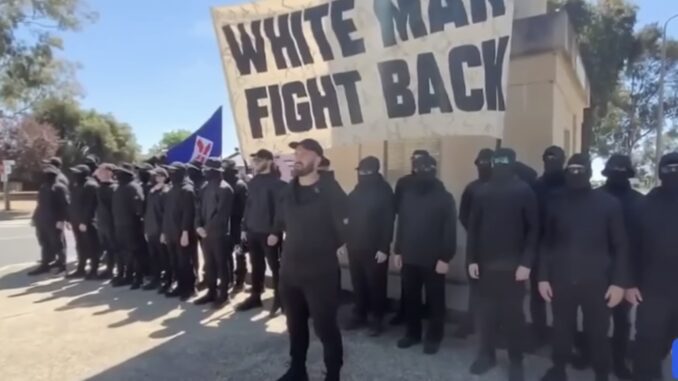
This is not simply an electoral surge. It is a contest between two ideas of Australia: a pluralist society in which different identities coexist, and a “monocultural” nation organised around a supposedly uniform past that has never, in fact, existed.
The government’s instinct has often been to avoid talking about migration. “Silence may prevent internal arguments, but it also creates a fact void.” Into that void flow exaggerated statistics, myths and conspiracies.
Net overseas migration is particularly useful for this purpose. It is not a government quota but the difference between migrant arrivals and departures, spanning students, workers, returning Australians and many other movements. Treating this noisy accounting measure as if ministers directly set it encourages the impression of a system spinning out of control.
A democratic path forward
The answer is not to deny real pressures. Migration must be matched by housing, infrastructure and effective administration. Governments must explain clearly who is arriving, why, for how long, and how the consequences will be managed.
But migration did not create the broader crisis of liberal democracy. It did not cause decades of housing undersupply, weak productivity, widening inequality, technological disruption or declining trust.
Liberal democracies now stand at a crossroads. One road leads towards institutions capable of explaining complexity, correcting failures and rebuilding shared prosperity. The other leads towards walls, scapegoats and strongmen.
Australia’s anger is real. The danger lies in allowing those who did not cause it to become its targets.
Alan Gamlen is professor and director of the Migration Hub at the Australian National University (ANU)
This article was first published in The Klaxon and 360info.org
Keep Independent Journalism Alive – Support The AIMN
Dear Reader,
Since 2013, The Australian Independent Media Network has been a fearless independent voice – holding power to account and delivering journalism that matters.
Running this site isn’t cheap. Rising costs mean we need your support now more than ever. Every donation, big or small, keeps our servers running, our writers working, and our stories free for everyone.
Donate here:
PayPal or credit card – just click on the Donate button below
Direct bank transfer: BSB: 062500; A/c no: 10495969

We’ve also set up a GoFundMe as a dedicated reserve fund for hosting and future improvements.

Thank you for standing with us. We couldn’t do this without you.
With gratitude,
The AIMN Team
Thank you for shedding light on the real risk Australia runs of electing hanson or another trump-esque populist.
Capitalist democracies have encountered and dealt with this before.
The framework for post ww2 capitalism and the prosperity which followed was partly laid during the gilded age of americas robber barons. Rockefeller is the most infamous of this group of the hyper wealthy who controlled strangulating monopolies and overbearing political power.
Sound familiar to todays tech oligarchs? Enter the progressive era, corporate breakups, anti monopoly regulations and reforms aimed at addressing income inequality and corporate power.
The system isnt broken beyond repair, its unmaintained. Lobbying = legalised bribery.