By Dr Martha Knox Haly
I recently wrote an article suggesting Norway’s Sovereign Wealth Fund could be a model for Australia. The discussion referred to Dutch Disease (where developed economies such as Australia and the Netherlands failed to manage a resource boom effectively) and the resources curse (the benefits of resources are stolen by an elite ruling class – as is the case in Angola and Equatorial Guinea). For a country so blessed in natural resources as Australia, it is simply crazy that there is growing inequality, which is contaminating our democracy. We already have evidence of a group of stratospherically wealthy individuals currently distorting Australian democratic processes to suit their own agendas (see Advance Australia and its terribly destructive effects on the referendum for an example, Knox-Haly 2024). A sovereign wealth fund with effective taxation on the resources sector is one way of remedying this inequality.
So, the first question is whether this is possible in Australia. In Norway, resource companies pay 78% in tax, which is a combination of a 22% corporate tax and a 56% resource tax. Unthinkable, you say? Not at all; resource companies accept these terms and continue to extract resources in Norway because it remains highly profitable. A functional democracy provides a safer work environment than, say, Russia (Vale Khordorkovsky). Oil companies are quite happy to accept both the rules of participation and recognise that they have no business in distorting Norway’s robust democracy. The resource tax is based on oil, which is exported. This removes the loophole that exists in Australia where tax is paid on profits. Profit can be reduced through the deduction of production, extraction costs and transfer pricing.
Several authors, such as Daniel Bleakley (2023), have explored a Norwegian-style resource tax in Australia. Bleakley noted that in Australia, oil and gas companies shift profits offshore and increase local financial expenses. This reduces the amount of tax that needs to be paid. Williamson (2023) was scathing about the Treasury Gas Transfer Pricing (GTP) Review, which suggested capping claimable expenses before shipping as a solution for transfer pricing. She proposed that we should copy another aspect of what Norway does, which is to tax the resources that are exported.
This is not the only challenge that needs to be faced if we are going to have adequate taxation regimes. The real challenges are cultural, media-based, and concern political donations. Let me explain with a brief history of the ill-fated Resource Super Profits Tax (RSPT) proposed by the Rudd Labor Government in May 2010 and the Minerals Resource Rent Tax (MRRT). The Petroleum Resource Rent Tax (RSPT) applied to all onshore and offshore oil and gas projects. It was introduced in 1987. The Rudd government subsequently introduced the Resource Super Profits Tax (RSPT) in May 2010. This was to be applied to all extractive industries, including gold, nickel, sand, uranium and quarrying activities, and would tax profit above a certain level at 40%.
According to the Australian Electoral Commission, Mining interests spent $22 million in advertising campaigns against the RSPT in just the 6 weeks before the end of Rudd’s prime ministership. The RSPT was subsequently scrapped to be replaced by the considerably weaker Mineral Resources Rent Tax (MRRT) by the Gillard Government in July 2010. The advertisements by both sides stopped with the election of the Gillard Government. There was a difference within the resources industry about its response to the proposed reforms.
BHP Billiton and Rio Tinto did not oppose the tax. Resistance came from Hancock Prospecting, Fortescue Metals Group and Xstrata, fronted by the Association of Mining and Exploration Companies, and with the support of the Coalition (Padula, 2013). Gina Reinhardt held the post of Executive Chairperson of Hancock Prospecting following the death of her father in March 1992, and still holds this post. Xstrata was an Anglo-Swiss Multinational headquartered in Switzerland. The company would not cover itself in glory after police killed two civilians in Espinar, Peru. on 28th May 2012, during a demonstration about Xstrata’s pollution of water sources. Fortescue had been founded by Andrew Forrest, who still continues to be the Executive Chairperson.
On the 30th May 2012, Gillard delivered a speech to the Minerals Council, directly stating that Australia did not begrudge the mining industry its success. She continued, ‘But I know this too: they work pretty hard in car factories and panel beaters and in police stations and in hospitals. And here’s the rub: you don’t own the minerals; they own it and they deserve their share.’ The message was not well received, with Minerals Council President Peter Johnson calling it ‘the wrong approach.’ Johnson was concerned with the endless dialogue about redistribution.’ I agree that it must be uncomfortable to be implied as greedy and needing to be more equitable.
The MRRT would have come into effect on 1st July 2012. The MRRT was a tax of 30% on the profits of iron ore and coal in Australia. Repeated research demonstrates that the majority of Australians believe resource companies do not pay enough tax. Despite this, the Coalition, led by Tony Abbott, campaigned on the repeal of the tax in 2010 and 2013. In 2012, Fortescue Metals challenged the constitutionality of the MRRT, claiming that it did not properly capture the circumstances of BHP and Rio Tinto. Fortescue’s challenge was rejected by the High Court of Australia on the 7th August 2013.
The advertisements by both sides had stopped with the election of the Gillard Government, but the mining industry had Julia Gillard in its sights. Gillard, Australia’s only female prime minister to date, would be Australia’s most effective prime minister in terms of passing legislation. Controlling for the length of time, she held office, Gillard passed an average of .515 acts per day, followed by Bob Hawke who had passed .491 acts each day. Malcom Fraser would pass .481 acts per day, as compared to the lack luster performances of Scott Morrison (.392 acts per day), and Tony Abbott who passed .39 acts per day. Despite Gillard’s exceptional legislative performance, then Opposition Leader Tony Abbott succesfullu misrepresented Government policy, conflating carbon pricing and pollution production with a tax. It was the start of an atrocious personal campaign against Gillard, presenting her as a liar.
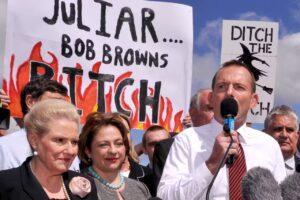
The conservative commentators sang from the same song sheet, referring to Gillard’s earlier statement on August 16, 2010, that ‘there will be no carbon tax’, cravenly omitting any reference to her pre-election promises to produce a carbon pricing mechanism. The concerted hostility from those who were being asked to be less greedy, created one of the most toxic political environments in Australian history. Who can forget Abbott standing in front of ‘ditch the witch’ and ‘Juliar Bob Brown’s bitch’ posters in March 2011. The perception of leadership disunity by the ongoing fight from Kevin Rudd to be reinstated as prime minister effectively cruelled the Labor party’s chance of re-election in 2013.
There are several lessons here from these historical experiences. Firstly, Australians had a chance at having a Norwegian-style resources funded scheme, so it is possible in Australia because it has been done before. Secondly, the Labor Party blew it by letting themselves be terrorised by an advertising campaign by an industry that does not have the right to vote in elections. Thirdly, Australians blew it by buying into Abbott’s misogynistic rhetoric – notably expressing lack of confidence in polls for the woman who was arguably Australia’s best prime minister. If Australians had taken a principled stance against misogyny and recognised that in a mature democracy, political parties need to work together, Abbott’s strategies would have gone nowhere.
The criticism of Labor working with the Greens that underpinned the Australian elections in 2013, would have gone nowhere in Norway, because the political culture is one of collaboration. This is our first cultural challenge. Australians need to recognise that following politics and participating in the process is part of adulthood. If you don’t participate in an informed manner, you are going to be shafted.
Change only comes when the population is unified; split the population, and the status quo is preserved. So if Australians want any significant form of redistribution in the future, they have to be alert to the real purpose of culture wars – via racist, homophobic and sexist dog whistling. By buying into misogyny in 2012, they deprived themselves of substantial wealth. Remember next time you hear political messaging attacking women, indigenous australians, immigrants or transgender people, check that a wealthy group of stakeholders is not picking your pockets. Absolutely coincidentally, Australians are heading for another bout of manipulation with Sky news equating housing shortages with immigration. We can expect this wedging against the Labor Government to reach an absolute crescendo, following the release of the Government’s devastating National Climate Risk Assessment Report on 15th September 2025.
The next challenge is political donations, which are a real source of rot in the Australian government. We need to eliminate anonymous political donations and cash for access fundraising from Australian politics. Corporations do not have the right to vote; only Australian citizens have the right to vote. According to Aulby (2017), mining industry donations grew from a base of $345,000 in 2006 to $3,788,904 in 2011. 81% of these donations went to the Coalition – with 71% going to the liberal party. The dramatic increase in donations from 2007 corresponded with the introduction of the carbon price. The 2007 elections were also when donations from ordinary citizens to the Coalition and, particularly, the National Party plunged dramatically. The Coalition’s support base was becoming increasingly narrow, and its dependence on the mining industry grew proportionately.
Aulby also notes that donations corresponded with the election cycle, project approvals and political debates on key industry policies, and this is only declared donations. In Norway, corporations are allowed to make donations, but everything has to be declared. Available data does not refer to capped anonymous donations in Australian politics. Here is a fun fact: in 2013, according to the Transparency International Index, Australia belonged in the top 10 most transparent countries in the world (Knox-Haly, 2019). By 2019, after six years of Coalition leadership, Australia had fallen out of the top ten most transparent countries.
The most stark difference between Australia and the countries retaining a top ten ranking was that, in 2019, Luxembourg, Sweden and Norway expressly prohibit anonymous donations, Canada required disclosure for any donation above $20, and Singapore requires disclosure for donations above $5000. In 2019, Australia had more than twice this cap, and mechanisms for multiple donations at different party levels, on different days. This meant, for example, that $13,000 could easily become $130000 in the space of a week. The anonymous donations cap is linked to the consumer price index. According to the Australian Electoral Commission, the disclosure threshold amount that applies from 1 July 2025 to 30 June 2026 is more than $17,300.
Another key driver of whether effective tax reforms in natural resources will be supported is mandated truth in electoral advertising and media reporting. I mentioned that we are heading for another barrage of disinformation from Sky News, equating housing shortages with immigration. For the record, the housing shortage arises from tax incentives that make homes into assets, and the fact that the federal government is reluctant to physically build public housing. The number of houses constructed actually falls if we don’t have skilled immigration.
The housing shortage immigration snag is emotional and perfectly designed to pit ordinary citizens against each other. This is happening under a government that has increased funding to the ATO, resulting in a greater number of companies paying tax, and a government that has released a climate change risk assessment plan. The social splitting campaign is happening at a time when Australians are once more pursuing a better deal around national resources, and are facing really significant threats from climate change. We can expect this wedging against the Labor Government to reach an absolute crescendo, following the release of the Government’s devastating National Climate Risk Assessment Report on 15th September 2025.
If Australians want to get a better deal for themselves, they need to keep a cool head and evaluate the quality of their information sources. The ABC has never failed a fact check. The same cannot be said of Sky News which has failed multiple fact checks. Sky News is currently rated by mediabiasfactcheck.com as ‘borderline questionable and mixed’ for factual reporting. Just saying. Facebook, Instgram and X don’t even see themselves as news outlets.
It was unfortunate that the Albanese Government withdrew the proposed Communications Legislation Amendment (Combatting Misinformation and Disinformation) Bill 2024. This was a response to the Australian Communications and Media Authorities (ACMA) 2021 review of the Australian Code of Practice on Disinformation and Misinformation. Australians are now reporting increasing levels of concern about misinformation in the internet ecosystem. The bill received 105 public submissions, a number of submissions, such as those from the Australian Press Council, Australian Communications and Media Authority, the Community Broadcasting Association of Australia, the Australian Electoral Commission and the Civil Liberties Council, were sensible and constructive.
These recommendations concern the inclusion of digital platforms, broader definitions of professional news content and accountability. Regretfully, submissions from organisations (which sometimes lacked a formal organisational website) were received. Predictably, those who benefited from peddling conspiracy theories made hysterical comparisons equating the bill with ‘Chinese Totalitarianism’ and arguing about infringements on free speech. It seems that there is a segment of society that not only treasures its right to be a bigot, but is also fiercely protective of its right to spout fact-free tripe.
The Government’s proposed legislation on truth in electoral advertising has lapsed with the last parliament. So the best chance of promoting accurate information now relies on digital platform regulation. Wallis (2025) recommended that the distribution of information needed to be managed, which included building digital, media and information literacy in the community, promoting robust public information, complaints and disputes handling, record keeping, and data access schemes. The nature of digital disinformation is that regulation needs to mandate technological solutions, rather than the traditional behavioural focus of regulatory regimes.
It was suggested that there be greater accountability on digital platforms to remove misinformation, ensure algorithmic sovereignty, and ensure transparency of recommender algorithms. There are recommendations for labelling bot accounts as such and the deployment of Botslayer software. Botslayer is designed to identify the sudden spikes in activity, which are characteristic of coordinated disinformation campaigns through bots (Knox-Haly, 2024). Other recommendations include transparency around the source and provenance of information. Other recommendations include a ‘random dynamical nudge’, where social media users are presented with a random selection of other views. The effect of this is to have individuals adopt less polarised opinions.
In summary, we have been here before seeking control over mineral resources, so we know it is possible. The question is, will we be wiser this time and not let ourselves be manipulated? Will we gain control over electoral donations and digital platform regulations, creating a context for Australians to receive a larger share of resource profits?
Dear reader, we need your support
Independent sites such as The AIMN provide a platform for public interest journalists. From its humble beginning in January 2013, The AIMN has grown into one of the most trusted and popular independent media organisations.
One of the reasons we have succeeded has been due to the support we receive from our readers through their financial contributions.
With increasing costs to maintain The AIMN, we need this continued support.
Your donation – large or small – to help with the running costs of this site will be greatly appreciated.
You can donate through PayPal or credit card via the button below, or donate via bank transfer: BSB: 062500; A/c no: 10495969

Brilliant article Dr Haly and its an entire plan for ground-breaking policy development and legislative reviews.
However, sabotage and hubris and she’ll be right mate is the quintessential Australian foolishness when looking to pick someone else’s pockets.
Respect and collaboration for the greater good has passed this country by, and affluenza rules the day.
As for Australian’s being adult and participating in politics, and putting aside vested interests with some intelligence and critical thinking, nah she’ll be right mate.
We may have a better government in place to deal with many issues however the PM is not the right person to lead this, as he is simply a shirker when it comes to the obvious biggest threats of our times, Climate Change, an equitable taxation system and restoring housing to what it once was, a necessary human right, not a tax dodge and market mechanism for money laundering by all and sundry.
Well said and very true.
heather…right on.Insomnia?
I’m not the only one flapping my gums about Climate Change and we already binned a previous idea!
Better heads than mine can and have come up with solution in addition to the blueprint outlined in this article….
https://theconversation.com/the-albanese-government-has-finally-set-a-2035-climate-course-and-its-a-mission-australia-must-accept-264885?
https://theconversation.com/cut-emissions-70-by-2035-theres-only-one-policy-that-can-get-us-there-264884?
Hello Heather thank you and everyone else for your comments, completely agree with the issue of avoidance. It seems to me that the government is only prepared to make changes when there is an overwhelming signal. An example of such a signal is when 300000 people walked across the SHB in support of Palestine – the government (maybe by coincidence only) shifted its stance on Palestine in the following 24 hours. If the government does not get a signal then it doesn’t take action for change, so it is just about continuing to hammer on an issue, build discussions and create coalitions for change