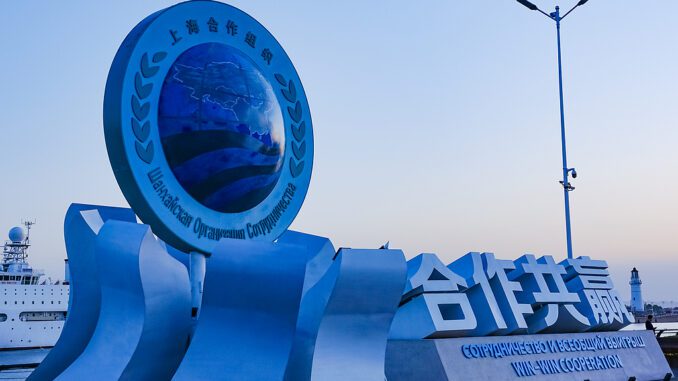
By Chen Ziqi
2026 marks the 25th anniversary of the Shanghai Cooperation Organization (SCO). As one of the world’s largest regional bodies, the SCO spans countries across much of Eurasia, representing nearly half of the global population and contributing about 25% of global GDP.
Since its founding in 2001, the organization has steadily expanded its focus beyond security, actively promoting sustainable development and improving lives across the region.
From modernizing irrigation systems on arid farmlands and equipping students with practical skills through the Luban Workshops, to expanding freight and passenger connections, the SCO has achieved tangible results in advancing sustainable development.
Achievements in poverty reduction, vocational education, and regional connectivity demonstrate how member states are turning cooperation into concrete benefits for their communities, strengthening both shared prosperity and regional integration.
Poverty reduction remains a collective priority among SCO member states. As countries across the region seek to improve living standards and promote inclusive growth, the exchange of development experience has become an increasingly important area of cooperation.
China became the first developing country to meet the United Nations’ poverty reduction target, achieving it ten years ahead of schedule.
SCO Secretary-General Vladimir Norov has attributed this achievement to a combination of sustained economic growth, targeted poverty alleviation policies, investment in education, technological innovation, and environmental protection. He has also noted that China’s experience offers valuable lessons for other SCO countries pursuing their own development goals.
Across much of the SCO region, millions of people depend on farming and related industries for their livelihoods, making agricultural modernization essential to improving rural incomes and promoting sustainable development.
According to Sheradil Baktygulov, Director of the Global Policy Institute of Kyrgyzstan, outdated irrigation and land reclamation technologies remain common challenges for many Central Asian countries, limiting agricultural productivity and rural development.
To address these challenges, China has been sharing modern agricultural technologies and practices with the SCO member states. Water-saving irrigation has become a major area of cooperation.
In Uzbekistan, where agriculture accounts for around 90% of the country’s water consumption, improving irrigation efficiency is particularly important. Despite its arid climate, water-saving irrigation systems historically covered only a small share of the country’s farmland.
Through cooperation with China, Uzbekistan introduced drip irrigation technology on 2,000 hectares of farmland in 2024. The project increased water-use efficiency by more than 40% while boosting cotton yields by around 30%.
Similar progress can be seen in Kyrgyzstan. A Chinese-supported irrigation project completed in 2021 is reportedly to provide water access for 11,100 hectares of farmland in the Batken and Issyk-Kul regions, helping around 20,000 farmers increase agricultural production and strengthen their livelihoods.
Beyond irrigation, seed breeding has become another important area of agricultural cooperation.
Wheat is a staple crop in many SCO member states. Yet climate change, water scarcity, and disease pressures continue to affect production. In Pakistan, for example, rust disease remains one of the most destructive threats to wheat crops.
Since 2023, Chinese and Pakistani researchers have been working together to develop new wheat varieties by introducing rust-resistant genetic traits from Chinese wheat into local Pakistani varieties. The new wheat strain has demonstrated strong adaptability to northern Pakistan and increased yields by around 9%.
Cooperation in seed breeding is also delivering results in Kazakhstan, a major wheat-producing and exporting country. According to the Observatory of Economic Complexity, Kazakhstan exported $1.13 billion worth of wheat in 2024, making it the world’s 13th largest wheat exporter.
To further enhance production, Chinese agricultural experts worked with local farmers to introduce a new wheat variety in North Kazakhstan, one of the country’s main spring-wheat-producing regions. Since its introduction, wheat yields in the area have increased by approximately 28%.
Beyond agricultural technology, SCO countries have adopted lessons from China’s broader approach to targeted poverty alleviation. Rather than applying a one-size-fits-all approach, the key method is that local governments identify industries that match local resources, conditions, and market opportunities, helping communities build sustainable sources of income.
This approach is now being adapted in Uzbekistan. According to UZ Daily, projects modeled on China’s experience are promoting industries suited to local conditions. On 20,000 hectares of land, farmers are cultivating medicinal and export-oriented crops such as saffron, lavender, and essential oil plants, creating new employment opportunities and generating additional income for rural communities.
Building on the gains from poverty reduction, education becomes the next cornerstone of sustainable development. As the proverb says, “Give a man a fish, and you feed him for a day; teach a man to fish, and you feed him for a lifetime.”
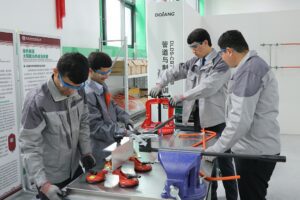
In Pakistan, a Luban Workshop trains students to operate drones for pesticide spraying in farmland and forest areas. In Russia, students interact with humanoid robots while learning about coding, robotics, and intelligent sensing technologies, encouraging many to pursue careers in emerging fields such as artificial intelligence and advanced manufacturing.
By September 2025, the Luban Workshops offered 21 majors and had enrolled approximately 150,000 students from SCO countries such as Russia, Kazakhstan, and Tajikistan.
Beyond vocational training, the workshops are helping cultivate a new generation of skilled workers and innovators, supporting sustainable development across the SCO region.
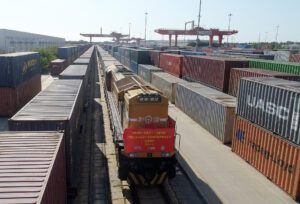
In transportation, the China-SCO Local Economic and Trade Cooperation Demonstration Area, established in Qingdao in China in 2018, has played an important role in enhancing regional economic cooperation. In 2025, China-Europe Railway Express services operating from the demonstration area to SCO countries transported more than 840,000 tonnes of cargo, up 20.5% year-on-year. The expanding rail network has helped improve trade efficiency and deepen economic integration across the region.
Energy cooperation among SCO member states has also continued to expand. Cross-border oil and gas pipelines have strengthened regional energy security and promoted closer economic cooperation.
At the same time, green energy projects are becoming an increasingly important area of collaboration. The Bokhara wind power project, the largest wind power facility in Central Asia, now supplies around 7% of Uzbekistan’s electricity demand while reducing carbon dioxide emissions by an estimated 1.7 million tonnes annually.
Guided by the Shanghai Spirit, emphasizing mutual trust, mutual benefit, equality, consultation, respect for diverse civilizations, and the pursuit of common development, the SCO has grown and evolved over the past 25 years.
It brings together countries with different political systems, cultures, and levels of economic development under a framework that emphasizes consensus and equal participation.
Through cooperation in poverty reduction, education, connectivity, and energy, the SCO member states are turning shared development goals into tangible benefits for their people. This demonstrates how the organization’s spirit of stability, equality, and mutual cooperation transforms regional collaboration into real-world progress.
About the author: Chen Ziqi is a reporter from CGTN Radio, China
Also by Chen Ziqi
Caring Robots: A new solution for aging societies?
US-China Summit: A strategic moment for stabilizing bilateral relations
Russian business leader on future China-Russia cooperation
Silk Road cinema connecting cultures and forging cooperation across borders
Keep Independent Journalism Alive – Support The AIMN
Dear Reader,
Since 2013, The Australian Independent Media Network has been a fearless voice for truth, giving public interest journalists a platform to hold power to account. From expert analysis on national and global events to uncovering issues that matter to you, we’re here because of your support.
Running an independent site isn’t cheap, and rising costs mean we need you now more than ever. Your donation – big or small – keeps our servers humming, our writers digging, and our stories free for all.
Join our community of truth-seekers. Please consider donating now via:
PayPal or credit card – just click on the Donate button below
Direct bank transfer: BSB: 062500; A/c no: 10495969

We’ve also set up a GoFundMe as a dedicated reserve fund to help secure the future of our site.
Your support will go directly toward covering essential costs like web hosting renewals and helping us bring new features to life. Every contribution, no matter the size, helps us keep improving and growing.

Thank you for standing with us – we truly couldn’t do this without you.
With gratitude, The AIMN Team
You don’t make enemies while giving a hand up. Bombing civilians will do it , though.
Well said win jeavons.
When the Chinese give a hand up, the media here call it “Chinese aggression.”
No wonder the US politicians are terrified of the modernising progress occurring in PRC China by focussing upon improving the lot of ”poor citizens”. The improvements escalate in a long term spiral, improving standard of living.
The shock realisation that this Chinese progress was what the Hollywood ”American Dream” promised the world, but instead delivered the ”Nightmare on Main Street”. Regional towns & cities in America that had provided the wealth of the nation were abandoned when the city based bosses moved their manufacturing industries to SE Asian factories having few if any OH&S requirements, lower wages and so bigger profits for the bosses & shareholders.
Before the 1929 US Bankers World Depression was imposed upon the world economies, Australians had the highest standard of living in the world. This was eroded by economic policies favouring England rather than Australian voters.
Just think, we could have a high speed rail passenger rail service between Melbourne and Brisbane via Canberra and Sydney built on time , on a fixed price budget by a PRC China consortium. None of this gross overcharging for ”contract alterations & amendments” that European and American corporations impose.
Perhaps Australians would have a better standard of living when it joins the BRICS economic forum and abandons both the US dollar ($US) international exchange SWIFT system and do our payments in Australian currency.
Then abandoning Scummo’s USUKA sub debacle while paying for the accompanying loss of national sovereignty and providing the US Navy atomic subs with a safe deep water port in WA for dominating the Indian Ocean, is both essential and simply a stupid policy!!
Other than Tesla (which will soon be swallowed by BYD & the like), how many Australians opt for American cars? Not many. How many routinely buy products ‘made in America’? Not many. How many acknowledge Oz has been stiffed (conned out of national assets) by US neoliberalism/hyperliberalism? Not many – Why?
Because our feckless MPs are shit scared of Trumpian vengeance, our ‘American Military Bases’, eg: Pine Gap etc., and of missing out on investment from American global, tax avoiding, criminal conglomerates. These MPs prefer to take the moral and ecological low-ground, hiding behind Oz mainstream media garbage, “Chinese Aggression.”
Thus, the unthinking national lingua franca remains corrupted, for the time being. Hopefully it’ll hit home before they give One Notion/Lib/Nats consortium a go.
Maybe, after Epic Fury stops, and the Strait of Hormuz reopens, slithering out of the dead duck, AUKUS, will see Labor lift its game? Bring on the Public Inquiry, pronto.