By Chen Ziqi
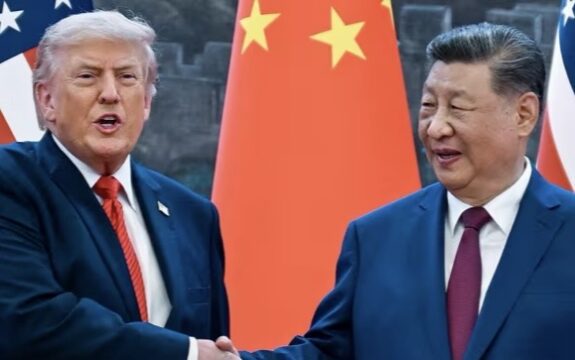
US President Donald Trump arrived in Beijing on Wednesday for a new round of face-to-face talks with Chinese President Xi Jinping from May 14 to 15, a meeting arriving at a particularly delicate moment in global politics and the international economy.
It marks the first in-person meeting between the two leaders since the Busan agreement last October, where both sides agreed to suspend further escalation of the US–China trade war for one year.
While a flare-up in the Middle East delayed this meeting by a month, the cooling of tensions with Iran has finally cleared the flight path for what many view as the most consequential diplomatic inflection point of 2026.
Amid a fragile global recovery and uncertainty in international markets, the Beijing meeting is being closely watched for whether both powers can move from “crisis management” to a more sustainable form of strategic equilibrium, with implications for broader global economic stability.
At their first meeting on Thursday morning, President Xi congratulated the United States on its 250th anniversary, while President Trump praised Xi as “a great leader,” setting a warm and friendly tone for the opening of the summit.
President Xi noted that China and the US should be partners, not rivals, empathizing the relationship between the two countries would have implications not only for their peoples, but also for the future of the world. President Trump addressed this is going to be the biggest summit, as top business delegation was with him.
A US official said the two sides are expected to continue discussions on establishing new mechanisms for trade and investment coordination, with cooperation in agriculture, aerospace, and energy also likely to feature prominently.
Beijing, meanwhile, has framed the visit as an opportunity to stabilize bilateral ties amid growing global uncertainty. In remarks on Monday, China’s Foreign Ministry emphasized the need to expand mutually beneficial cooperation, manage differences, and “inject greater stability and certainty into a turbulent and changing world.”
Guidance from strategic analysts
Analysts broadly agree that the summit reflects a shared near-term interest in stabilizing China–US relations, even as deeper strategic tensions remain unresolved.
Zhao Hai, director of the International Politics Program at the National Institute for Global Strategy, points out that the primary “product” of this summit needs to be predictability. For the private sector, the specific policy is often less damaging than the volatility of not knowing what the policy will be tomorrow.
This mirrors the “managed strategic competition” framework championed by former Australian Prime Minister Kevin Rudd. The goal in Beijing is not necessarily to bridge a decade-long trust deficit in a three-day summit, but to prevent further accidental escalation. He said that careful coordination and transparent dialogue are essential to maintaining stability over the long term.
Economic frictions and business impacts
While Chinese state media frame economic relations as both a stabilizing foundation and a key driver of broader China–US ties, US tariff policy continues to sit at the center of bilateral disagreement.
While Beijing views these measures as “unreasonable restrictions,” the Trump administration continues to utilize them as its primary tool of economic leverage.
John McLean, chairman of the China–UK Business Development Centre, noted that shifting US tariff policies are creating deep uncertainty, prompting many companies to delay or reconsider long-term investment plans.
The economic data, however, tells a more nuanced story of self-inflicted wounds. A recent study by the Kiel Institute, a leading German economic research body, found that foreign exporters absorb only about 4% of the tariff burden, with the remaining 96% falling on US business and consumers.
These findings underscore that while tariffs are often framed as protecting American industries, their indirect effects are influencing pricing, supply chains, and investment decisions.
For small and medium-sized enterprises, the consequences are particularly acute. Philip Crawley, who operates a laser equipment import business in California, reported that tariffs imposed last year cost his company millions, forcing it to slow operations, reduce employee pay, and postpone hiring plans.
Glen Calder, president of Calder Brothers in South Carolina, said his steel costs increased by 25% even before US tariffs took effect, as markets anticipated higher trade barriers.
Strategic competition may be conducted at the state level, but its economic consequences are frequently absorbed by businesses, workers, and consumers navigating unpredictable policy environments.
Continued investment interest in China
Perhaps the most surprising element of the current climate is the resilience of corporate interest. Despite these challenges, many US businesses continue to view China as a critical market.
According to the American Chamber of Commerce in China, around 60% of American companies still plan to invest in the Chinese market, reflecting enduring confidence in China’s economic opportunities.
The rationale is clear: China accounts for roughly 17% of global GDP, contributes about 30% of global economic growth, with a and is projected to export nearly $4 trillion in exports in 2025.
Its sheer economic scale and growth make it important for companies to overlook, providing strong incentives to maintain or expand investment even amid uncertainty.
Looking ahead: Cooperation and strategic stability
President Xi noted in today’s meeting that success in one is an opportunity for the other. China has maintained a relatively consistent stance toward Washington, rooted in the idea that the Pacific is large enough for both powers. This summit offers a rare window to clarify intentions and move beyond the zero-sum rhetoric that has dominated the 2020s.
Reducing uncertainty in trade, investment, and technology will benefit businesses and global markets alike, reinforcing long-term stability, which is a shared asset, not a concession. Reducing the “noise” in trade and technology isn’t just a win for diplomats. It’s the oxygen required for global markets to breathe again.
Chen Ziqi is a reporter from CGTN
Keep Independent Journalism Alive – Support The AIMN
Dear Reader,
Since 2013, The Australian Independent Media Network has been a fearless voice for truth, giving public interest journalists a platform to hold power to account. From expert analysis on national and global events to uncovering issues that matter to you, we’re here because of your support.
Running an independent site isn’t cheap, and rising costs mean we need you now more than ever. Your donation – big or small – keeps our servers humming, our writers digging, and our stories free for all.
Join our community of truth-seekers. Please consider donating now via:
PayPal or credit card – just click on the Donate button below
Direct bank transfer: BSB: 062500; A/c no: 10495969

We’ve also set up a GoFundMe as a dedicated reserve fund to help secure the future of our site.
Your support will go directly toward covering essential costs like web hosting renewals and helping us bring new features to life. Every contribution, no matter the size, helps us keep improving and growing.

Thank you for standing with us – we truly couldn’t do this without you.
With gratitude, The AIMN Team
This, to me, shows how much Xi respects The Donald.
https://t.co/Ram3jrcV1A
This, to me, shows how much Xi respects The Donald.
https://t.co/Ram3jrcV1A
The central problem, and potential barrier to better relations, is Trump’s unpredictability. Much is made of the need for steadiness in relations yet Trump is a ticking time bomb and it’s doubtful he even understands this.
China’s leader respects the USA, economic status, trade and investment realities, and his nation’s balances and likely future advancement. Trump understands (hah) shitty food, drink, behaviour, morals, company, fantasy. We should all welcome the opportunity to farewell Trump and wish the hearse “godspeed”.
In 1972 the Shanghai Communiqué formalized the US position on Taiwan stating that the U.S. “acknowledges that all Chinese on either side of the Taiwan Strait maintain there is but one China and that Taiwan is a part of China.”
At the time Washington did not endorse this position, emphasizing instead its hope for a peaceful settlement “by the Chinese themselves.” This was and remains the strategic ambiguity but in the intervening years the US have muddied the waters and sold munitions to Taiwan and encouraged a belligerent attitude to arise between the two neigbours.
For Trump to seek to interfere now would be counter-productive particularly with his ambivalent attitude to the sovereignty of other countries, e.g. Venezuela, Greenland, Cuba, Iran and even Canada.
Trump seems a bit like Chamberlain hopping across to Hitler in Germany in the appeasement years before ww2.
But if optimists are right, things involve a balancing act between trade and greed, although one doubts if the masses will necessarily benefit.
This all comes of neoliberal doctrines of tax reform as an event by those at the top to avoid the revenue problem…Trumpism. And the Chinese are also oligarchic.
But unless Trump reverses his policies, America becomes a debt ridden oligarchy ultimately subservient to the Chinese. Falling of the cliff becomes closer every day, as Keir Starmer, for one, would correctly testify.
I think Trump has a bloody cheek to turn up with his billionaire technocrats, (have you seen how many and who?), as a paragon of democratic virtue to tell Xi how to chew fish.
Trump and his Zionist minions are intent on suppressing all future aspirations of China’s billion citizens and so far has done all he can to achieve that end.
Big problem: Xi knows this!
@PW: “…And the Chinese are also oligarchic….”
The difference between Chinese oligarchs and US oligarchs is that when revealed for inappropriate behaviour, the Chinese oligarchs are publicly humiliated, demoted or fired and dragged off in chains for somewhere behind bars. US oligarchs, when similarly revealed, are appointed as consultants to the Executive, employed to Departmental Secretarial ranks, University Boards, praised by the GOOTR (work that one out!) and lauded by the sycophantic media. Go figure!!
re. RomeoCharlie’s reference to Trump being a ticking time bomb, it brings to mind the image of the explosion of Mr Creosote in Monty Python’s The Meaning of Life movie. A fitting end to the Orange Bloat. 🙂
Wow! Talk about completely and utterly delusional fantasy. Oops, silly me, forgot that The Orange Baby never ever ever loses at anything.
https://www.news.com.au/world/north-america/us-politics/us-politics-iran-war-live-updates-xi-floats-possibility-of-us-china-war/live-coverage/3ec64c45a17a23f8dc36e3a659e5f4bd
Yes, Canga, A quadrillion million sperm cells roar their approval.
Thank you for the translation. Speaking Chinese should be a compulsory school subject from Year 1, but ”innovation” is a practice carefully avoided by DoE desk jockeys desperately clinging to their 19th century knowledge, secure in the pipedream that England still rules the waves.
Trump, as the perfect puppet minion of the pathetic US dumb-as-dog-shit hereditary oligarchs, running against the norms, capriciousness & destabilization are the primary m.o. of their giant global insider trading operations. They make it on both the ‘ups’ and ‘downs’. To them everyone else are mere suckers.
Isolated, with nothing but money & guile in their sieges, they’ll inevitably eat one another alive.