Chapter 18: Over-Policing and Incarceration
A Colonial Inheritance
From the earliest days of colonisation, police forces in Australia were created not to protect Aboriginal and Torres Strait Islander peoples, but to control them.
The Native Police in Queensland, for example, were paramilitary units used to suppress resistance and carry out punitive expeditions.
On the frontier, “law enforcement” often meant massacres, forced removals, and the chaining of prisoners.
The image of Aboriginal men in neck chains is not just a relic of the 19th century – it is a reminder that policing began as a colonial tool of domination.
This inheritance has never been dismantled. Today’s justice system carries the same imprint: Aboriginal people are not policed for protection but disproportionately for punishment.
The Numbers Speak
The statistics are stark:
Aboriginal and Torres Strait Islander peoples are about 3.8% of the population, but make up about 32% of the prison population.
An Aboriginal person is more likely to be imprisoned today than at any time since colonisation began.
Aboriginal children are imprisoned at 17 times the rate of non-Indigenous children.
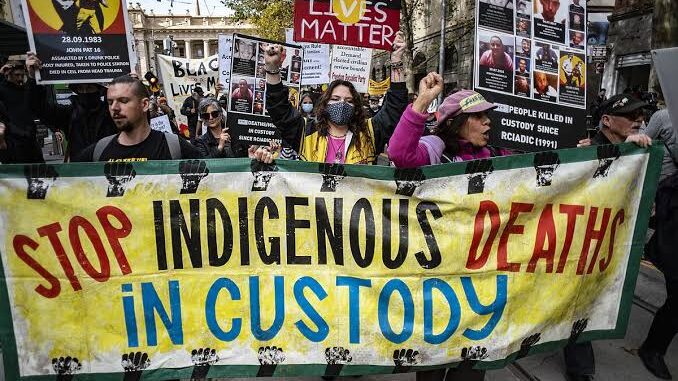
Since the Royal Commission into Aboriginal Deaths in Custody (1991), almost 600 Aboriginal people have died in custody – and yet almost no convictions of officers or guards have resulted.
These numbers are not the result of higher criminality. They are the result of over-policing, systemic racism, and structural inequality.
Over-Policing in Daily Life
Aboriginal people are disproportionately targeted by police for minor or “public order” offences:
Driving offences: Being stopped for licence checks or minor breaches far more frequently.
Public space offences: Being fined or arrested for drinking in public, swearing, or loitering.
Bail and parole breaches: Aboriginal people are less likely to be granted bail and more likely to be imprisoned for technical breaches.
Youth policing: Aboriginal children are more heavily policed in schools, parks, and shopping centres.
Over-policing ensures that even minor infractions can spiral into prison sentences.
Custody as a Death Sentence
Deaths in custody remain one of the most urgent and painful issues:
Many deaths are from preventable causes: untreated medical issues, failures to check on prisoners, or use of excessive force.
The 1991 Royal Commission made over 330 recommendations to reduce Aboriginal deaths in custody. The majority remain unimplemented.
Families of those who die in custody are forced to fight for justice, often met with silence, delay, or denial from authorities.
The ongoing pattern reinforces the perception – and reality – that Aboriginal lives are treated as expendable within the justice system.
Women and Incarceration
Aboriginal women are the fastest-growing prison population in Australia.
Many are incarcerated for low-level, non-violent offences, such as unpaid fines.
Histories of family violence, poverty, and trauma are common, yet support services are inadequate.
Children are often removed when mothers are imprisoned, perpetuating cycles of disadvantage and trauma.
This shows how colonisation’s harms intersect – poverty, violence, child removal, and imprisonment reinforcing each other.
Policing as Social Control
Policing does not happen in a vacuum. It is part of a broader system of social control that includes:
Child protection services, which disproportionately remove Aboriginal children.
Welfare systems, which often punish rather than support Aboriginal families.
Housing and health systems, where police may be the first responders to social issues that should never be criminalised.
The effect is that Aboriginal lives are continually monitored and regulated, echoing the “protection” regimes of earlier eras.
Resistance and Calls for Reform
Aboriginal communities have long demanded change:
The Deaths in Custody movement has campaigned tirelessly since the 1980s.
Organisations such as Sisters Inside fight against the criminalisation of Aboriginal women.
The push to raise the age of criminal responsibility (currently 10 in Australia, among the lowest in the world) is driven largely by Aboriginal-led advocacy.
These movements are not asking for charity – they are demanding that Australia honour its own recommendations, laws, and international obligations.
Why This Matters Today
When critics say, “colonisation is over,” the justice system proves otherwise. Aboriginal people are still targeted, excluded, and punished at disproportionate rates. The over-incarceration crisis is not a coincidence. It is the direct descendant of colonial policing.
Until this reality is faced – and until justice is actually just – reconciliation remains impossible.
Where This Leads
Policing and prisons are one visible legacy. Another lies in the removal of Aboriginal children – a practice that continues today at alarming rates, echoing the Stolen Generations.
The next chapter turns to that painful continuity.
Continued tomorrow…
Link to Part 17:
From Ignorance to Understanding: Facing the Truth of Colonisation (Part 17)
Link to Part 19:
From Ignorance to Understanding: Facing the Truth of Colonisation (Part 19)
Dear reader, we need your support
Independent sites such as The AIMN provide a platform for public interest journalists. From its humble beginning in January 2013, The AIMN has grown into one of the most trusted and popular independent media organisations.
One of the reasons we have succeeded has been due to the support we receive from our readers through their financial contributions.
With increasing costs to maintain The AIMN, we need this continued support.
Your donation – large or small – to help with the running costs of this site will be greatly appreciated.
You can donate through PayPal or credit card via the button below, or donate via bank transfer: BSB: 062500; A/c no: 10495969


The unpaid fines issue is a big indicator of just how racist the application of the law is. Gaoling someone who doesn’t have money to pay a fine is ludicrous; it achieves nothing more than turning a poor person into a convict. The disparity with which it is applied to Aboriginal people – and especially women – is a stark reminder of how the system has always operated.