Chapter 17: The Myth of “It’s Over Now”
“That Was a Long Time Ago”
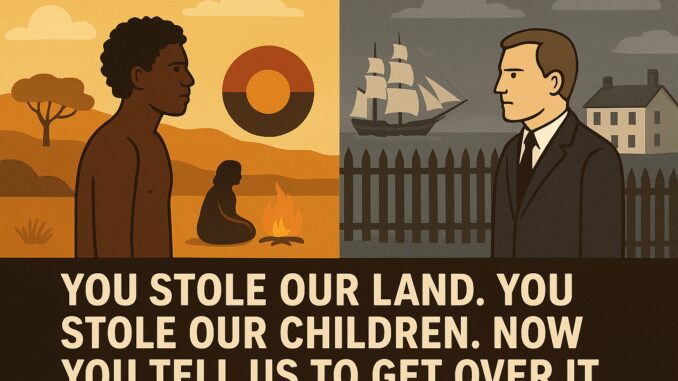
One of the most persistent responses to truth-telling about colonisation is the claim: “It’s all in the past. That was a long time ago. We can’t change it, so let’s move on.”
At first glance, this sounds reasonable. But it is built on a falsehood: that colonisation ended. In reality, the structures of colonisation were never dismantled – they were adapted. The effects are not ancient history. They are lived realities for Aboriginal and Torres Strait Islander peoples today.
Colonisation as a Structure, Not an Event
It is tempting to see colonisation as something that happened in 1788, or in the 19th century, or perhaps ending with the 1967 Referendum. But colonisation is not an event in the past. It is a structure that continues to shape law, economy, and society.
Land taken under terra nullius has not been returned.
Governments continue to control Aboriginal lives through policy and policing.
The wealth generated by stolen land and stolen wages remains embedded in the national economy.
The fact that massacres may have ended does not mean colonisation did.
Living Legacies
The impact of colonisation is visible in measurable inequalities today:
Incarceration: Aboriginal and Torres Strait Islander peoples make up about 3% of the population but nearly 30% of the prison population.
Child removals: Aboriginal children are still removed from families at rates higher than during the Stolen Generations era.
Health: Life expectancy remains nearly a decade shorter for Aboriginal people than for non-Indigenous Australians.
Education: Gaps in literacy, numeracy, and school completion remain wide.
Housing: Overcrowding and homelessness disproportionately affect Aboriginal communities.
These are not accidents. They are the direct outcomes of centuries of dispossession, poverty, and exclusion.
Trauma Passed Down
Colonisation left not only material inequalities but also deep psychological scars:
- Children taken in the Stolen Generations grew up disconnected from culture and kinship, passing unresolved trauma to their descendants.
- Families forced into missions lost parenting models, kinship systems, and intergenerational stability.
- Communities told their culture was shameful now struggle with identity and belonging.
This is called intergenerational trauma. It is not about individuals dwelling on the past; it is about wounds that have never been allowed to heal.
The Myth of Equal Starting Points
Another common claim is that “everyone is equal now – we all have the same opportunities.” But this ignores the unequal starting points created by history.
Generations of Aboriginal families were denied wages, land, and education.
While many white families built wealth through farms, homes, or small businesses, Aboriginal families were locked out of these opportunities.
The result is a wealth gap that persists today, visible in rates of home ownership, savings, and financial security.
Equality on paper does not erase structural disadvantage.
Denial as a Weapon
The myth that colonisation is “over” is not just ignorance. It is a form of denial that protects the status quo:
- It absolves governments and institutions of responsibility.
- It silences calls for reparations, treaty, or systemic reform.
- It shifts blame onto Aboriginal people themselves, framing inequality as personal failure rather than structural injustice.
In this way, denial becomes an extension of colonisation itself – another tool for keeping power unchallenged.
Voices That Refuse Silence
Aboriginal and Torres Strait Islander leaders have long rejected the myth that it is over:
The Uluru Statement from the Heart (2017) explicitly calls for truth-telling about colonisation as a step toward Makarrata (treaty and conciliation).
The Yoorrook Justice Commission (Victoria) is gathering evidence that structural racism is alive and ongoing.
Community testimonies show that for many, colonisation is not history but the present tense.
The persistence of these voices is itself proof that colonisation is not finished – because people are still living its consequences.
Why This Matters Today
When Australians say, “It’s all in the past,” they are not describing reality. They are choosing a story that comforts them but erases others.
For Aboriginal and Torres Strait Islander peoples, colonisation is not something to “get over.” It is something endured daily in systemic inequality, cultural suppression, and ongoing dispossession.
Until we recognise this, reconciliation cannot begin.
Where This Leads
Having dismantled the myth that colonisation is over, the next chapters will look more closely at some of its most visible present-day legacies: over-policing and incarceration (Chapter 18), child removals today (Chapter 19), and the health, housing, and education gaps (Chapter 20).
Continued tomorrow…
Link to Part 16:
From Ignorance to Understanding: Facing the Truth of Colonisation (Part 16)
Link to Part 18:
From Ignorance to Understanding: Facing the Truth of Colonisation (Part 18)
Dear reader, we need your support
Independent sites such as The AIMN provide a platform for public interest journalists. From its humble beginning in January 2013, The AIMN has grown into one of the most trusted and popular independent media organisations.
One of the reasons we have succeeded has been due to the support we receive from our readers through their financial contributions.
With increasing costs to maintain The AIMN, we need this continued support.
Your donation – large or small – to help with the running costs of this site will be greatly appreciated.
You can donate through PayPal or credit card via the button below, or donate via bank transfer: BSB: 062500; A/c no: 10495969


Be the first to comment