By Denis Hay
Description
Why governments ignore public interest in Australia, and how realistic media reform and political change can shift power back to citizens.
Introduction
Australians are increasingly asking the same question: why governments ignore public interest when the majority clearly want action on cost of living, housing, healthcare, and wages? These concerns are not new, but they are intensifying as pressures on everyday life continue to grow.
This article explains why this gap exists by examining the system that shapes decisions. It focuses on media influence, political incentives, and structural constraints. It does not focus on personalities or partisan blame. Instead, it explains how outcomes are produced and why they often fall short of public expectations.
Unlike articles that treat issues separately, this analysis connects the underlying forces driving policy inaction and outlines realistic reforms that can shift decision-making back toward the broader public interest.
The Problem – Why Governments Drift from Public Will
Media Influence and Political Risk
Australia has one of the most concentrated media landscapes in the democratic world. Organisations such as News Corp dominate large segments of print and digital media.
Governments understand that major reforms can trigger sustained negative coverage. Even widely supported policies can be reframed as economic risks or political failures. This creates a strong incentive to avoid direct confrontation with dominant media voices.
The result is not inaction, but caution. Governments often choose incremental change rather than structural reform.
Political Donations and Lobbying Power
Political donations and lobbying reinforce this dynamic. Data from the Australian Electoral Commission show that corporations and industry groups remain significant contributors to political funding.
These groups have consistent access to policymakers. Policies that affect profits, such as housing reform or energy pricing, are often shaped before public debate begins.
This reflects a system where organised interests are consistently heard, while the broader public is less visible in decision-making.
The Impact – What Australians Are Experiencing
Cost of Living and Housing Pressures
Housing affordability stays a major challenge. Renters face rising costs and insecurity. Essential services are under pressure.
Policy responses are often incremental. Measures may ease pressure but rarely address structural causes. This creates a growing sense that problems are recognised but not resolved.
Who Benefits from the Status Quo
Current policy settings tend to favour those with established economic power. Asset holders, large corporations, and dominant industries receive help from stability and gradual change.
At the same time, public money continues to support large-scale commitments such as defence initiatives linked to AUKUS, while social and economic reforms progress more slowly.
Systemic Causes – Why Change Does Not Happen
Electoral Strategy and Marginal Seats
Elections are often decided in a small number of marginal electorates. Governments focus on these voters, encouraging cautious and targeted policies rather than broad reform.
Institutional Constraints and Legal Limits
Government advice often reflects established frameworks that prioritise gradual change.
Legal limits also matter. Broad attempts to criminalise misinformation would face challenge in the High Court of Australia due to the implied freedom of political communication.
This means reform must be carefully designed to be both effective and lawful.
The Solution – What Must Be Done
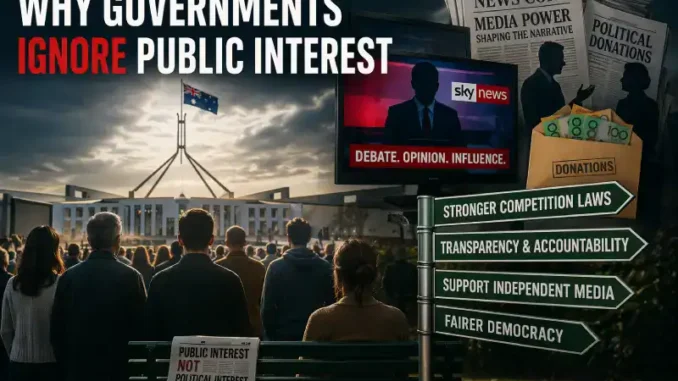
Stronger Competition and Media Diversity Laws
Governments can act through established legal mechanisms:
- Strengthen media ownership limits.
- Empower the ACCC to address dominance.
- Introduce public interest tests for media mergers.
These tools reshape the media environment without breaching constitutional limits.
Transparency and Accountability Reforms
Practical steps include:
- Real-time disclosure of political donations.
- Public registers of lobbying activity.
- Clear reporting of media ownership.
These measures reduce hidden influence and improve accountability.
Support for Independent Public Interest Journalism
A more balanced media environment requires practical alternatives, particularly in regional Australia, where diversity is limited.
Large networks such as Sky News Australia have historically secured free-to-air distribution in regional areas through partnerships with regional broadcasters. This gives them significant reach compared to smaller outlets.
While this expands access to news, it also highlights an uneven playing field. Independent and community media organisations often lack the resources to secure similar distribution.
Governments can address this imbalance through:
- Public funding for independent journalism via arm’s length bodies.
- Targeted grants for regional and community newsrooms.
- Support for local investigative reporting.
- Expansion of services by institutions such as the Australian Broadcasting Corporation in underserved areas.
These measures strengthen diversity without restricting existing media.
Targeted Misinformation Responses
Instead of broad bans, governments can:
- Enforce existing laws on deceptive conduct.
- Require transparency in political advertising.
- Support independent fact-checking.
These approaches are effective and legally robust.
Where Australia Stands
Australia has strong democratic institutions and the capacity to deliver effective policy.
However, outcomes are mixed. The gap between capability and execution reflects political choices rather than institutional limits.
What This Makes Possible
If these reforms were implemented:
- Housing could become more stable and affordable.
- Cost-of-living pressures could be addressed more directly.
- Public services could be strengthened.
- Trust in government could improve.
These outcomes are achievable within current systems.
Lived Experience Translation
For a renter, this would mean greater housing stability and less uncertainty.
For a pensioner, it would mean reduced stress about rising costs and better access to services.
For a worker, it would mean more secure employment and wages that better match living costs.
Proof of Feasibility
Australia has implemented major reforms before, including Medicare, compulsory superannuation, and independent integrity bodies.
Countries such as Canada and Norway have also strengthened media diversity and transparency within democratic systems.
These examples show reform is practical and achievable.
Frequently Asked Questions
Why do governments ignore public interest?
Because they respond to the strongest pressures in the system, including media influence, lobbying, and electoral strategy.
Why not break up media companies?
This involves complex legal and economic challenges. Competition law provides a more practical path.
Can misinformation be made illegal?
Broad bans face legal challenges. Targeted regulation is more effective.
Conclusion
The question of why governments ignore public interest is not about capability. It is about how influence is structured.
Australia has the tools to change this. Stronger competition laws, transparency, and support for independent media can shift decision making toward the broader public interest.
Call to Action
If this article helped you better understand how Australia really works, do not leave it here. Please share it with others who are asking the same questions.
Your voice matters. Your experience matters. And your participation matters.
➡ Share this article with family, friends, and your community
➡ Leave a comment below and join the discussion
➡ Visit the Reader Feedback page and share your view
➡ Share a testimonial if our content has helped you think differently
➡ Connect with us on TikTok, LinkedIn and X
Discuss this article in our Facebook group, where Australians share perspectives and ask questions in a calm, respectful space.
A more informed Australia begins with people willing to discuss the issues that shape our future. You can help lead that change.
Support independent journalism
Operating this site costs approximately $2,000 per year, and reader donations have covered $807 so far. Every contribution helps keep this work online, accessible, and independent.
If you find value in these articles, please consider supporting the site. Even a few dollars help keep this work going.
Donate now, one time or monthly.
Already donated? A quick Google review helps others discover the site.
This article was originally published on Social Justice Australia
Keep Independent Journalism Alive – Support The AIMN
Dear Reader,
Since 2013, The Australian Independent Media Network has been a fearless voice for truth, giving public interest journalists a platform to hold power to account. From expert analysis on national and global events to uncovering issues that matter to you, we’re here because of your support.
Running an independent site isn’t cheap, and rising costs mean we need you now more than ever. Your donation – big or small – keeps our servers humming, our writers digging, and our stories free for all.
Join our community of truth-seekers. Please consider donating now via:
PayPal or credit card – just click on the Donate button below
Direct bank transfer: BSB: 062500; A/c no: 10495969

We’ve also set up a GoFundMe as a dedicated reserve fund to help secure the future of our site.
Your support will go directly toward covering essential costs like web hosting renewals and helping us bring new features to life. Every contribution, no matter the size, helps us keep improving and growing.

Thank you for standing with us – we truly couldn’t do this without you.
With gratitude, The AIMN Team
The simple answer is they know what they should be doing, but they dodnt have the guts to do it.
I’ll start with an obvious question that I asked CAV/VCAT as they are both intertwined….
“If you, as the regulator, with legislation and laws are unwilling to resolve this simple issue, why do you exist?”
I lodged a complaint with CAV last November, 2025 for a small claim against a wholesaler in NSW for non-delivery of goods, $104.50 and used PayPal to process due to the non-delivery clauses that they offered as a backup and also had to make changes to my bank account so that PayPal would not automatically sweep my accounts for funds, they claim I owe them and waited for four months for a response!
Finally contacted them yesterday, rehashed the details and spoke with a CSO who said he would call back in 5 minutes; four hours later I was still waiting and politely asked him to do his job with some additional details in an additional email, as PayPal have placed the account under collection? Needless to say, I no longer use PayPal for anything and looking for a replacement there for this and other nefarious things.
Finally get a response to that this morning after another long-winded explanation as to why they can’t do anything “we don’t have the power to do that” hence my obvious question, as the regulator they have the laws and powers to resolve simple stuff, it’s not high dudgeon and millions of dollars, why do I have to go before a court?
The simple answer is that guardrails that are meant to protect are no longer effective, government and its agencies have pulled up the ladder and left people to struggle whilst the system protects itself.
People have a right to feel betrayed and angry at government overall.
Heather
I can understand your frustration with a system that just doesn’t work.
Have you tried your local parliamentary member? depending on whether you go State of Federal – State I imagine, you may get some action depending on the Member.
I have over the years tried both when I have run into a bureaucratic wall, with mixed success [federal was actually more energised than a lazy state independent].
As you are evidently in Victoria with a state election pending later in the year that might be your avenue…..I would avoid One Nation, though!
Best of luck!
I sympathise with Heather, in so many ways.
The dice is now loaded against the consumer and nothing is done by politicians but to further entrench this.
@ heather: Terry Mills gives excellent advice.
My late mother was stuffed around by DVA desk jockeys inhibiting payment of allowances to ex-service personnel. She went to a Board and won a judgment against the DVA. After 27 weeks of inactivity, I wrote to our local feral MP (Tony Windsor INDEPENDENT at that time) asking him to intervene.
Two weeks later my mother received her allowance, including the outstanding 29 weeks payment since the judgment date.
Then telecommunications in New England are politely described as ”primitive”. However, Ian Sinclair ( former MP) apparently enjoyed insisting Telecom (then named) work in New England and manual exchanges were automated, ageing landlines were replaced by directed microwave links so that isolated farms were not cut off during bushfires and floods.
However, since Beetrooter was elected in 2013 to prevent economic & social development in New England, the rate of comms improvement is slower than a sleeping snail.
The exception is the very rapid installation of a telecom tower in the ”remote” property of his staunch fan Auntie Gina ….. with the usual Telstra land rent concession that goes with such ventures.
This article popped up in my inbox just as I was contemplating similar questions. For example, how is it that the vast majority of Australians can see that AUKUS commits us and future generations to an unconscionable amount of money for what will be obsolete technology but the Labor government can’t? How can a Labor government chuck 160 000 people off the NDIS (even accepting the scheme is being rorted) while it allows our natural resources to be plundered by foreign multinationals and our tax system to be rorted by those same multinationals and other wealthy tax evaders? Denis Explains why the government is loath to act, basically fear, but it is time for us, the people, to tell the government we will be voting for progressive independents if we are given the choice. This does not mean One Neuron, the Nats or the Libs but for the Greens or people like Pocock, Ryan, Daniel and some of the other teals. Labor needs to become more scared of us the voters coming for them than the lobbyists and sectoral interests. So, if you are polled, tell the pollsters how poorly you rate Labor ‘s performance and where you are considering putting your vote.
RomeoCharlie,our WAP government(weak as piss)are faithfully following their ingrained timidity and fear of the fossil fuel wallahs by NOT imposing a windfall tax on our gas exports.
Despite Abalone’s stern looks and pathetic excuses , he consistently displays why he is out of his depth as a national leader.Another factional time server promoted to a job way above his pay grade.
If we want substantial and urgent change to our governance, we must vote Green/Independent/Teal at every opportunity.
Australia has become an international embarrassment.
This article makes a range of good points, and I’m glad to be able to largely agree with Dennis.
A few points of my own
• I would certainly welcome greater media diversity, but I think the importance of the traditional media is overstated (and mainly by people of my vintage)
I believe a lot of the more provocative opinions and “news” represent the death throws of an industry in steep decline. They’re looking for relevance in a population that isn’t taking much notice .
My adult children are well informed and don’t bother with consumption of traditional media.
The major demographic of Sky News and The Australian (and other traditional newspapers) would be nursing home residents.
• I’m reasonably happy with the federal government, I would rate them B+
I think they are maintaining competent oversight of complex international relations.
My misgivings relate to the Treasurer and fiscal policy. I don’t think Chalmers is up to the job and is certainly not a successor to Albanese.
The Treasurer should be the next likely leader, my suggestion is give Clare O’Neil the treasury
• Dennis advocates the election of independents, which I consider to be a risky and ineffective indulgence.
The parliament will be far more effective with the election of candidates representing minor parties. There are plenty of them, and their platforms are far more comprehensive and transparent than those published by independents. You broadly know what they stand for
I’ve previously outlined my preference, but I won’t give them the kiss of death by again providing advocacy for them now
• This leads to the power of lobbying, donations and disclosure.
The rise of the racist bogan party (One Nation) is of deep concern.
It is disturbing that the bogan party is the major beneficiary of the disaffection with the major political parties.
Real time disclosure, is a good idea, but the fact is, we know who is financing the bogans. The bogans don’t care.
Their rise is significantly a product of a reaction to public concern about housing and crime. The fact that their simplistic and irrational dog whistling resonates with some people is because the major parties have neglected to address the issues of concern.
Clive Palmer is a case study in observing that splashing cash on populist politics doesn’t work.
• In short, there are political parties, who only exist to support the community, they have no financial backers, aren’t reactivate to lobbyists, and operate with transparency.
Choose one, join it, give it a few dollars, walk around the block and distribute their flyers, put their sign on your fence, encourage your friends to join, and hand out their material during the election.
• Get active. Change isn’t achieved via a debate on social media