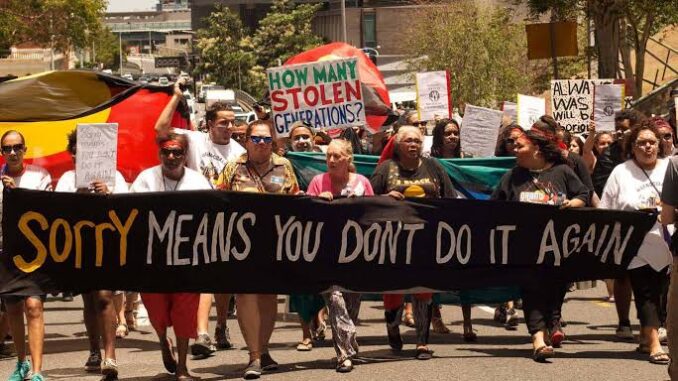
Chapter 19: Child Removals Today – The New Stolen Generations
A Continuation, Not a Memory
When Australians hear “Stolen Generations,” many think of the 19th and early 20th centuries – the era when children were forcibly removed to missions, orphanages, and foster homes. But the practice did not end with the 1967 Referendum or the National Apology in 2008.
Child removals are happening right now. Aboriginal and Torres Strait Islander children are still being taken from their families at disproportionate rates, often under the same logic of “protection” that justified earlier removals. The result is what many describe as the new Stolen Generations.
The Numbers Today
Aboriginal and Torres Strait Islander children make up about 6% of all children in Australia, yet they represent over 40% of those in out-of-home care.
In some regions, the rates are even higher, with Aboriginal children up to 10 times more likely to be removed than non-Indigenous children.
The majority are removed not because of direct abuse, but due to neglect – a category often linked to poverty, overcrowded housing, or systemic disadvantage.
In other words: families are punished for the conditions colonisation itself created.
Echoes of the Past
The similarities to the earlier Stolen Generations are stark:
Poverty as justification: Then, families were deemed “unfit” due to race; today, poverty and housing instability – products of colonisation – are used as grounds.
Cultural disconnection: Children placed in non-Indigenous foster homes often lose connection to language, culture, and Country.
Family rupture: Siblings are separated; parents left grieving and powerless.
Shame and trauma: Children grow up without a sense of belonging, repeating cycles of intergenerational harm.
The methods may have changed, but the effect – breaking families and severing culture – remains painfully familiar.
Systemic Causes
Why are removals so high?
Over-policing of families: Just as Aboriginal people are over-policed in criminal justice, they are over-scrutinised in child protection.
Poverty and housing crises: Lack of adequate housing, food, or healthcare is treated as parental failure rather than systemic neglect by the state.
Bias and racism: Studies show unconscious and conscious bias influence decisions about Aboriginal families’ fitness.
Underfunding of support: Services that could keep families together (housing, counselling, financial aid) are underfunded, while removal remains the default.
This is not protection. It is structural discrimination.
Human Stories
Behind the statistics are stories of loss:
A mother who lost her children because her house was deemed “too overcrowded” – though she had no access to public housing.
Siblings split across multiple foster homes, unable to grow up together.
Elders left grieving as yet another generation is separated from culture and kinship.
These stories echo those of the earlier Stolen Generations, showing that the pattern continues.
Resistance and Alternatives
Aboriginal and Torres Strait Islander communities have long demanded alternatives:
Self-determination in child welfare: Aboriginal-controlled organisations providing culturally safe care and keeping children connected to kinship networks.
Family support first: Funding services that prevent crisis – housing, health, parenting support – instead of defaulting to removal.
Truth-telling: Acknowledging that high removal rates are not a coincidence but part of colonisation’s ongoing structure.
Some promising initiatives exist, but they are often underfunded compared to mainstream systems.
The Emotional Legacy
The continued removal of Aboriginal children deepens intergenerational trauma:
Parents relive the pain of their own removal through their children.
Survivors of the Stolen Generations see the cycle repeating, eroding trust in apologies and reconciliation.
Communities experience cumulative grief, as children vanish into systems that too often fail to return them.
The cycle is not just a personal tragedy. It is a collective wound.
Why This Matters Today
The National Apology in 2008 recognised past wrongs. But apologies lose their power when the practice continues. If Aboriginal children are still being removed at disproportionate rates, then colonisation is not a closed chapter. It is an unfinished story, still being written on the lives of families.
Where This Leads
Child removal is one of the most visible signs that colonisation’s harms persist. Another is in health, housing, and education – where inequality remains sharp, despite decades of promises to “close the gap.”
The next chapter will examine these inequalities, not as failures of Aboriginal people, but as the direct outcomes of colonisation’s structures.
Continued tomorrow…
Link to Part 18:
From Ignorance to Understanding: Facing the Truth of Colonisation (Part 2)
Link to Part 20:
From Ignorance to Understanding: Facing the Truth of Colonisation (Part 20)
Dear reader, we need your support
Independent sites such as The AIMN provide a platform for public interest journalists. From its humble beginning in January 2013, The AIMN has grown into one of the most trusted and popular independent media organisations.
One of the reasons we have succeeded has been due to the support we receive from our readers through their financial contributions.
With increasing costs to maintain The AIMN, we need this continued support.
Your donation – large or small – to help with the running costs of this site will be greatly appreciated.
You can donate through PayPal or credit card via the button below, or donate via bank transfer: BSB: 062500; A/c no: 10495969


Be the first to comment